You Stopped Editing. You Did Not Stop Working On The Edit.
The most useful research finding about interrupted work is the one nobody expects. In The Cost of Interrupted Work: More Speed and Stress, researchers at UC Irvine and Humboldt University found that people complete interrupted tasks in less time than uninterrupted ones, with no measurable drop in quality. They compensate by working faster. The cost is real, but it is not paid in the output — it is paid, in the authors' words, in "more stress, higher frustration, time pressure and effort."
That is precisely why the cost of managing your own video editor never appears in anyone's spreadsheet. It does not make your week visibly slower. It just makes it worse.
Across 10,000+ delivered editing projects sitting behind 200M+ views and over $10M in client revenue, we see the same shape every time a creator moves from self-editing to outsourcing. The editing hours vanish, exactly as promised. Then a second set quietly grows back to replace some of them: writing the brief, uploading footage, answering questions, chasing a file, watching the cut, writing notes, watching it again, re-explaining the note that didn't land, approving, filing, invoicing. Nobody quotes for that time, nobody logs it, and it never appears in the comparison that justified hiring in the first place.
This is a different question from the real hours behind a 10-minute video, which counts hours at your keyboard doing the cut. This one counts the hours you spend managing someone else doing it — and, more usefully, which of them you can delete.
What Four Videos a Month Actually Costs You in Management Time
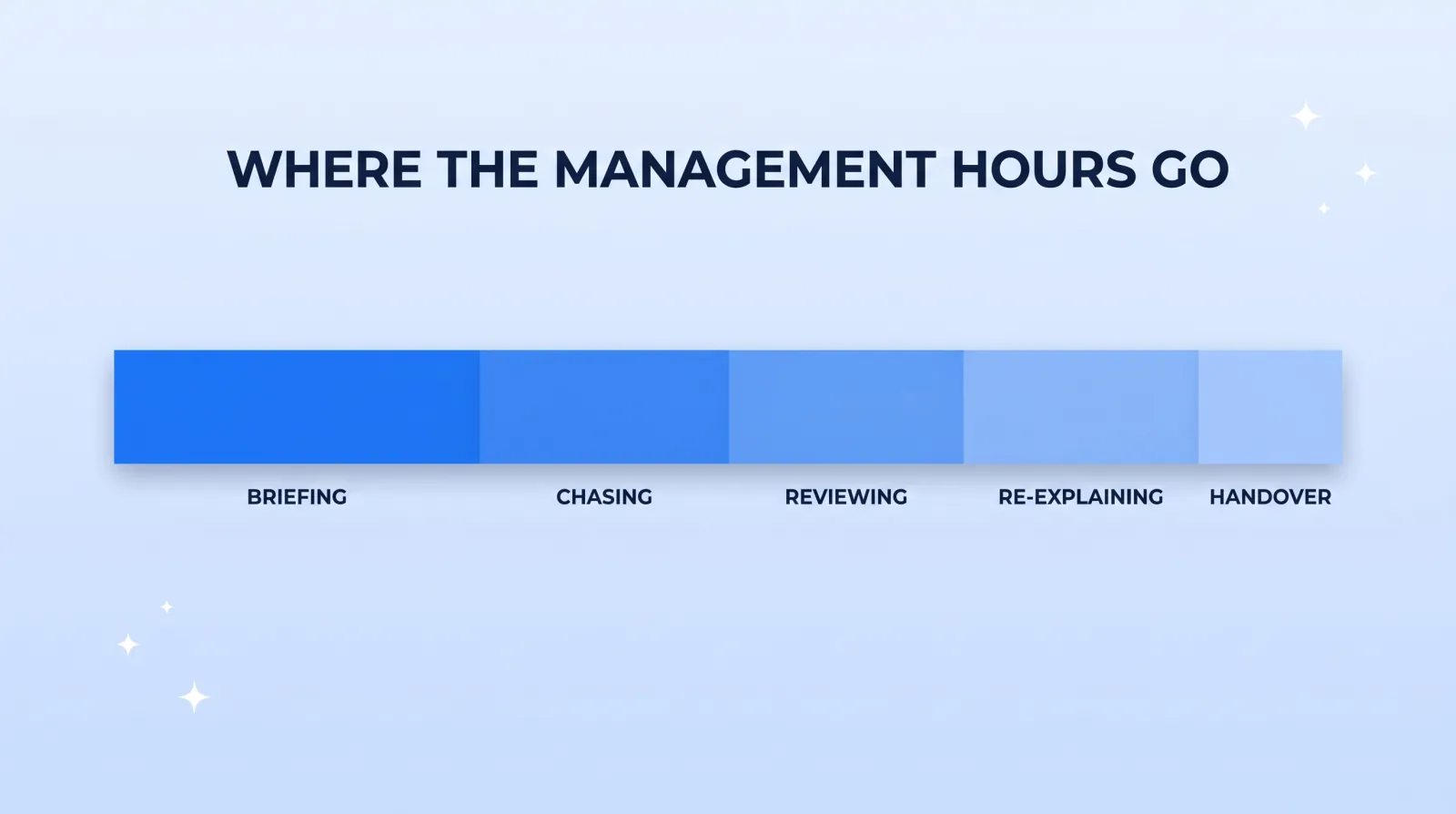
Here is the per-video coordination load we observe on the client side of a long-form engagement, on accounts where the creator personally runs the relationship:
| Activity | What it looks like | Per video |
|---|---|---|
| Brief & handoff | Writing the brief, uploading footage, naming files, linking references | 0:30 – 1:15 |
| Questions & clarifications | Answering "which take?", "is this logo current?", "what's the CTA?" | 0:20 – 0:50 |
| Chasing | Checking whether it started, asking for an ETA, following up on silence | 0:10 – 0:40 |
| Review pass 1 | Watching end to end, writing timestamped notes | 0:30 – 0:50 |
| Review pass 2+ | Re-watching, re-noting, re-explaining a note that came back wrong | 0:25 – 1:00 |
| Handover & admin | Downloading, checking the export, filing, thumbnail sign-off, invoicing | 0:15 – 0:35 |
| Total | 2:10 – 5:10 |
Call the median 3.5 hours per video. At four videos a month that is 14 hours — roughly two working days you never budgeted for, spent on work that produces nothing on its own. Price your hour at $75 and that is $1,050 a month sitting invisibly on top of the editing invoice.
The two rows that surprise people are chasing and review pass 2+. Both are pure waste in the manufacturing sense: neither adds anything to the finished video. Chasing exists because you have no visibility into status. Second and third review passes exist because the first round of notes was ambiguous, or because the brief left a decision open that the editor then had to guess at.
The Three Taxes That Do Not Show Up in the Table
The context-switch tax. A four-minute Slack answer is not four minutes. It arrives mid-task, pulls you into the edit's mental model, and leaves a crater behind it. Ten of those across a week is not 40 minutes; it is most of an afternoon. It is worst for founders and solo operators, who have nobody to absorb the interruption.
The decision-deferral tax. Every question you leave unanswered in the brief comes back to you later — at a worse moment, with less context, and with the edit blocked behind it. Workspace369's client onboarding checklist for agencies makes this point from the service provider's side of the table, and its named failure modes apply exactly in reverse to the buyer: asking for everything at once instead of staging requests by milestone, and keeping client messages outside the record, so decisions live in a chat thread nobody can find two weeks later. That describes most creator–editor relationships precisely.
The re-explanation tax. A note like "make the intro punchier" costs you 30 seconds to write and buys you a revision round that costs an hour. Our guide to giving video revision notes that actually get fixed exists because this single line item is the largest controllable slice of the whole stack.
Cut the Round Trips, Not the Minutes
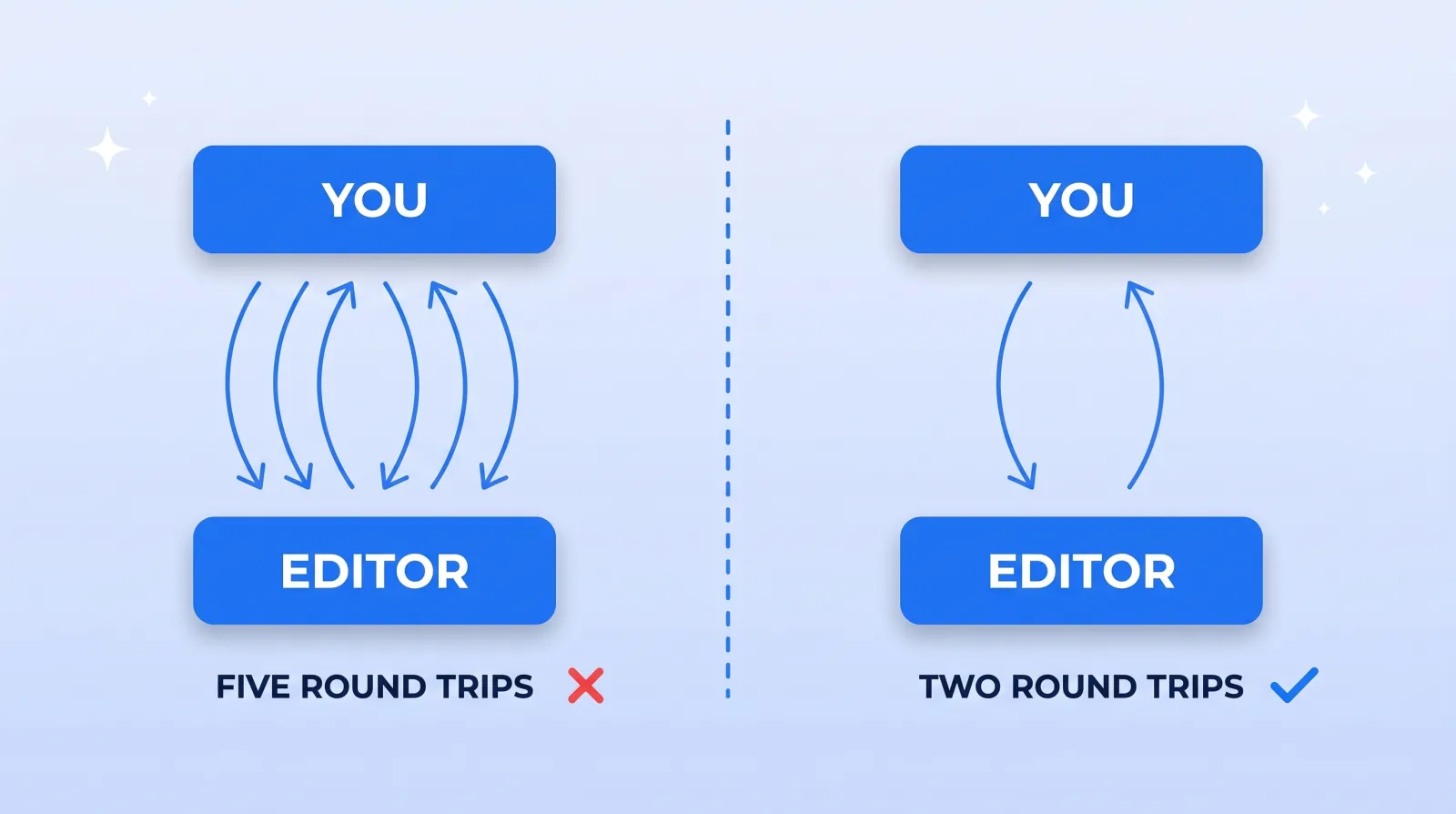
Most people attack management overhead by getting faster at each step — typing the brief quicker, reviewing at 1.5× speed. Wrong variable. The cost is dominated by how many times the video comes back to your desk, because every return trip carries a full re-watch, a fresh set of notes and another context switch.
Five round trips down to two is not a 60% saving on review time. It is that plus three fewer context switches, three fewer re-watches and three fewer days of calendar drift — which is why the same 3.5-hour median collapses to under an hour on mature accounts running identical volume.
This is also the clearest structural argument for a studio over a solo hire. A studio absorbs the coordination internally — someone else chases the editor, someone else runs the internal QC pass, so the first cut you see is the second cut that was made. You are buying the removal of the loop, not just the labour inside it. Other specialist shops sell on the same logic: App369, a Miami development studio, publishes a fixed 8–12 week delivery window with one named senior developer as the client's direct counterpart rather than a rotating queue, because in outsourced technical work a predictable schedule and a single accountable contact are worth more to a buyer than a lower hourly rate. Post-production is no different.
Five Changes That Remove Most of the Overhead
- Write the brief once, as a template, not as a message. Every recurring field — deliverables, aspect ratios, caption style, music direction, brand assets, CTA — lives in a document you copy and edit, not a paragraph you retype. Our editor handoff framework is the version we hand to clients.
- Close the open decisions before the edit starts, not during it. Every "let's see how it looks" is a deferred question that will interrupt you later. Settle the thumbnail direction, the intro length and the music lane at handoff.
- Give notes once, timestamped and batched. One consolidated list beats six messages across two days — six messages guarantee a second revision round, because the editor started work on message two before message five arrived. A review tool that anchors comments to timecode, like Frame.io, removes the translation step entirely.
- Replace chasing with a standing checkpoint. One agreed status update — "first cut by Thursday 5pm, I'll flag on Wednesday if that slips" — deletes the entire chasing row. You are not asking for more communication; you are asking for it on a schedule so you stop generating it yourself.
- Put files and decisions in one place with a fixed structure. Not chat. A folder convention plus a single brief document means nobody re-asks where anything is. Our video file management system covers the folder side.
Run those five for a month and the median drops from 3.5 hours per video to roughly 50 minutes. Nothing about the editor changed.
Measure It Before You Change Anything
For two weeks, keep a note on your phone. Every time you touch the edit without being the person cutting it — a message, an upload, a review, an approval, a chase — log the minutes. Do not reconstruct it later; retrospective estimates run about half.
Three numbers come out of that fortnight: total hours, hours spent on round trips two and beyond, and the count of separate interruptions. The first is what the relationship really costs, the second is how much of it better notes would fix, and the third tells you whether you have an editor problem or a process problem. In our experience it is a process problem about four times out of five.
If the total clears 15 hours a month, you have effectively hired a part-time project manager, and the person doing that job is you. The Bureau of Labor Statistics puts the median wage for project management specialists at $102,320 as of May 2025 — about $49 an hour for the role you just absorbed for free. At that point the honest comparison is no longer editor versus DIY; it is a managed studio against an in-house editor you would have to manage anyway, with the management hours counted on both sides of the ledger. For founders running this personally alongside everything else, that arithmetic is usually decisive — it is why our founder-led brand engagements are built to keep the client out of the loop by default rather than in it.
The Bottom Line
Outsourcing your editing swaps editing hours for coordination hours nobody quoted you for — a median 3.5 per video, or two working days a month at four videos. The fix is not reviewing faster. It is cutting the number of times the video returns to your desk, by front-loading decisions into a reusable brief and batching notes into one timestamped pass. Measure the two weeks first: the number is almost always higher than you think, and almost always fixable without changing editors.