

Editing Relationships Rarely Fail in Week One. They Fail in Week Three.
Wistia's video marketing research keeps landing on the same conclusion: publishing consistency, not individual polish, is what separates channels that compound from channels that stall. That is the real reason people outsource the edit. The part nobody plans for is the handover itself.
Week one almost always goes well. Attention is high, the brief is fresh, the first cut gets read closely by both sides. The trouble arrives around week three, when the novelty has worn off and nothing has been written down — the same note gets given for a third time, the client starts "just fixing the small stuff myself," and by week six somebody quietly concludes the editor was not very good. Usually the editor was fine. The onboarding was never designed.
Across 10,000+ editing projects at Mark Studios — work sitting behind 100M+ views — the accounts still running two years later are overwhelmingly the ones where month one was treated as a build, not a probation period. Our order data shows how fast that judgment gets made: 63% of repeat clients placed their second order within 30 days of the first (outsourcing benchmarks). Thirty days is enough to construct a system that runs without you. It is also exactly enough time to rebuild your own bottleneck in a new place and not notice.
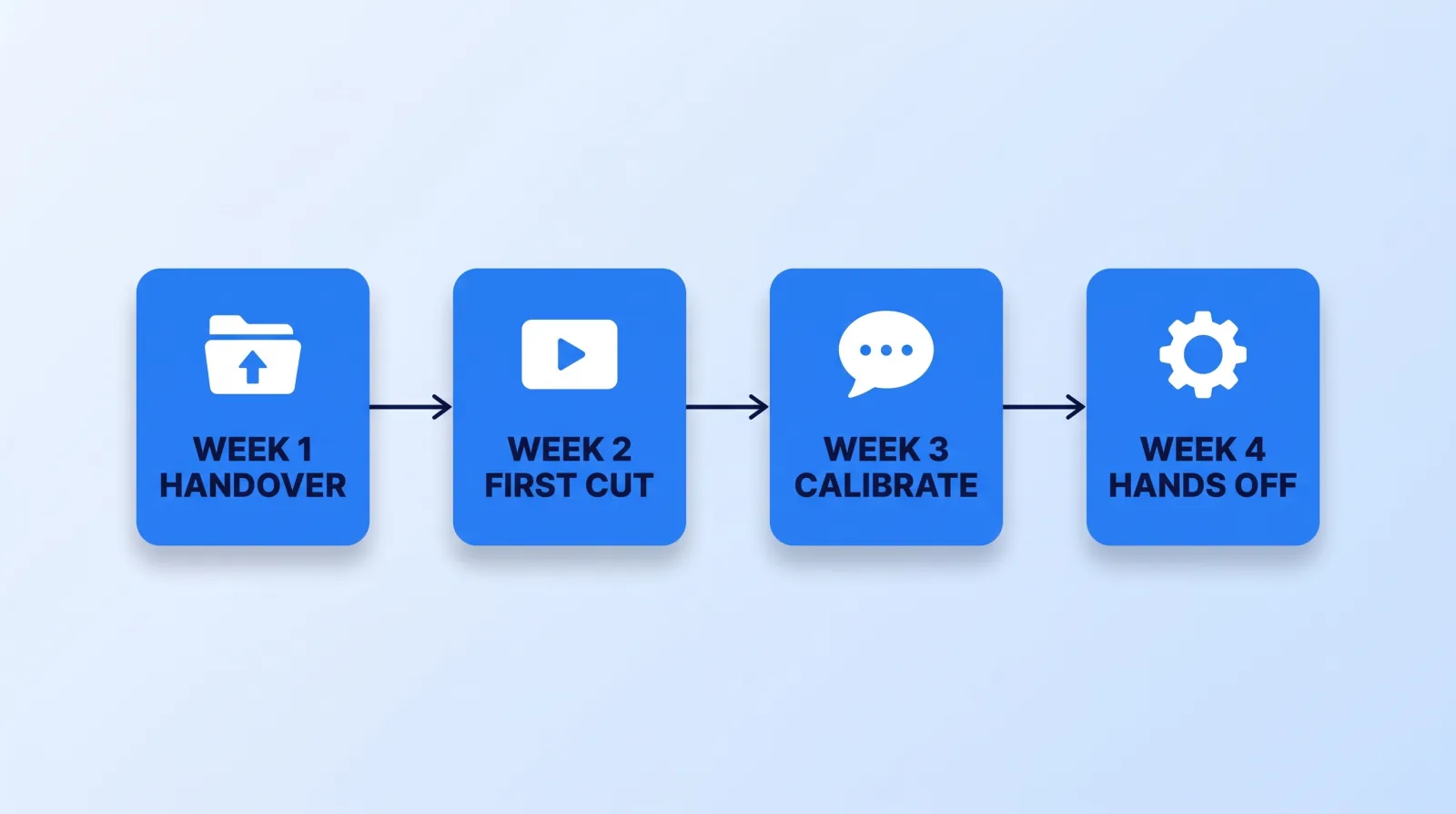
Week 1: Hand Over the System, Not Just the Files
Most first weeks consist of a Drive link and a hopeful message. Then two days evaporate while your editor reverse-engineers your caption font from a screenshot. Logistics surface late: in our study of 704 buyer conversations, questions about sending files rose from 2.9% of first messages to 8.8% of whole conversations.
A day-one packet costs about ninety minutes to assemble once and it removes almost every avoidable question from the next twelve months. Five things belong in it.
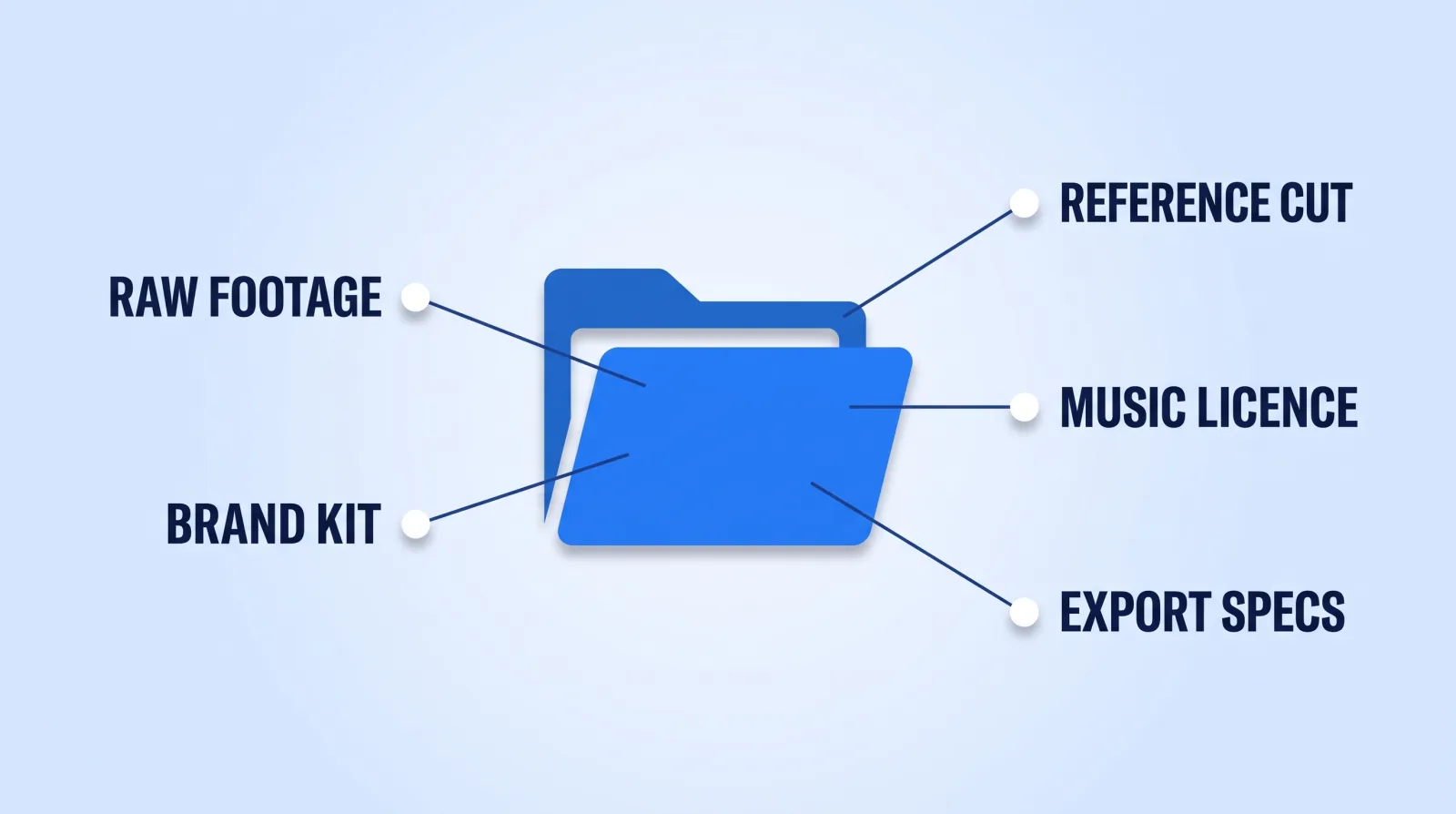
| Asset | What it prevents |
|---|---|
| Raw footage, named consistently | Guessing which file is the A-cam and which is the reshoot |
| Brand kit — logo files, hex codes, caption font | Approximated colours that look wrong at 100% zoom |
| One reference cut, timestamped | "Punchier" meaning two different things to two people |
| Music licence proof | A claim landing on a monetised video three months later |
| Written export specs | A soft upload nobody can explain |
For that last row, use YouTube's recommended upload encoding settings as the baseline and write your chosen resolution, frame rate and bitrate into a document instead of relying on the editor's defaults. For music, per-channel licences from a library like Epidemic Sound are worth the line item precisely because you can produce them on request.
If your brief itself is the weak link, our editor handoff framework is the structure to copy — but write it once as a reusable template, not per video. Doing it fresh every week is how outsourcing quietly becomes a second job. Our own intake runs on the same packet — raw footage, a short brief and one reference video, then a fixed quote — and how working with Mark Studios works lays out each step.
Give access properly in week one, too. Named accounts with scoped roles, never a shared password. YouTube's channel permissions system exists so an editor can upload without holding your login, and we walk through the roles and the offboarding path in YouTube channel access permissions. Setting this up on day one takes ten minutes. Doing it on day ninety, after a departure, is a bad afternoon.
Week 2: The First Cut Is a Calibration Instrument
Treat cut one as a measurement, not a deliverable. You are learning what your editor does when you have not specified something — and that gap, not their craft, is what you will be managing for the next year.
Read the first cut twice. The first pass is the normal one: does it work. The second pass is diagnostic, and it asks four questions.
- Where did they make a judgement call you would not have made? That is an unwritten preference, and it belongs in your style sheet now.
- What did they ask about before starting? Zero questions is a warning sign, not efficiency.
- What did they fix that you did not flag? Cleaning up audio you never mentioned is a good sign about how the next fifty videos will go.
- Where is the pacing yours and where is it theirs? Pacing and editing rhythm is the hardest thing to specify in writing and the most expensive to leave ambiguous.
Then write your notes properly. Round two is where the relationship is actually built, and vague feedback in week two produces a rebuilt timeline in week five. Our guide to revision notes that actually get fixed covers the format; the short version is timecode, observation, desired outcome, in that order, in a timecoded review tool such as Frame.io rather than a scattered comment thread.
Week 3: Convert Corrections Into Standing Rules
This is the week that decides the outcome, and it is the one nobody schedules.
Everything you corrected in weeks one and two is currently living in a chat history. Chat histories are not systems. Take thirty minutes and promote each recurring correction into a one-line standing rule in a single shared document — the style sheet.
STYLE SHEET — Channel X
Captions .......... Inter Bold, 72px, bottom third, 2 lines max
Cold open ......... hard cut on first sentence, no logo sting
B-roll ............ max 4s per clip, none over dialogue peaks
Music ............. bed at -22 LUFS under VO, ducked 6dB
Lower thirds ...... first mention only, never repeated
Sponsor segment ... 0:45 max, always after the first payoff
A rule earns its place after the second time you have given the same note. Once written, the note is retired — you should never give it again, and if you do, that is now a process failure with a name rather than a vague sense that things are not sticking.
Week three is also when you should be honest about volume. One video a week is not a workload that reveals much. If you plan to run a real cadence, get the second and third video into the pipe now, while attention is still high, rather than discovering the capacity ceiling in month four. Recurring-format work — a weekly show, a podcast, a series — is where this compounds hardest, which is why our podcast and show editing engagements are built around a fixed weekly slot rather than ad-hoc requests.
Week 4: Step Out of the Loop On Purpose
The goal of month one is not a good video. It is a video you did not have to be in the room for.
Run this pre-flight gate before you approve anything in week four. If all seven are true, hand the checklist to your editor and stop reviewing rough cuts.
- The style sheet exists and the last two cuts required no rule that is not on it.
- A second editor has been named and has access, so a sick day is not a missed upload.
- Turnaround is written down as a number of business days, and both parties have hit it twice.
- Revision rounds are defined — how many are included and what starts a new one.
- Export specs are in the document, not in someone's memory.
- Assets flow one way, into a single folder structure, with no files arriving by direct message.
- You reviewed the last cut once, not three times.
Point seven is the actual test. Two full review passes in week four means the calibration did not take, and the fix is almost never a better editor — it is a rule you have been giving verbally and never wrote down.
The Day-30 Scorecard
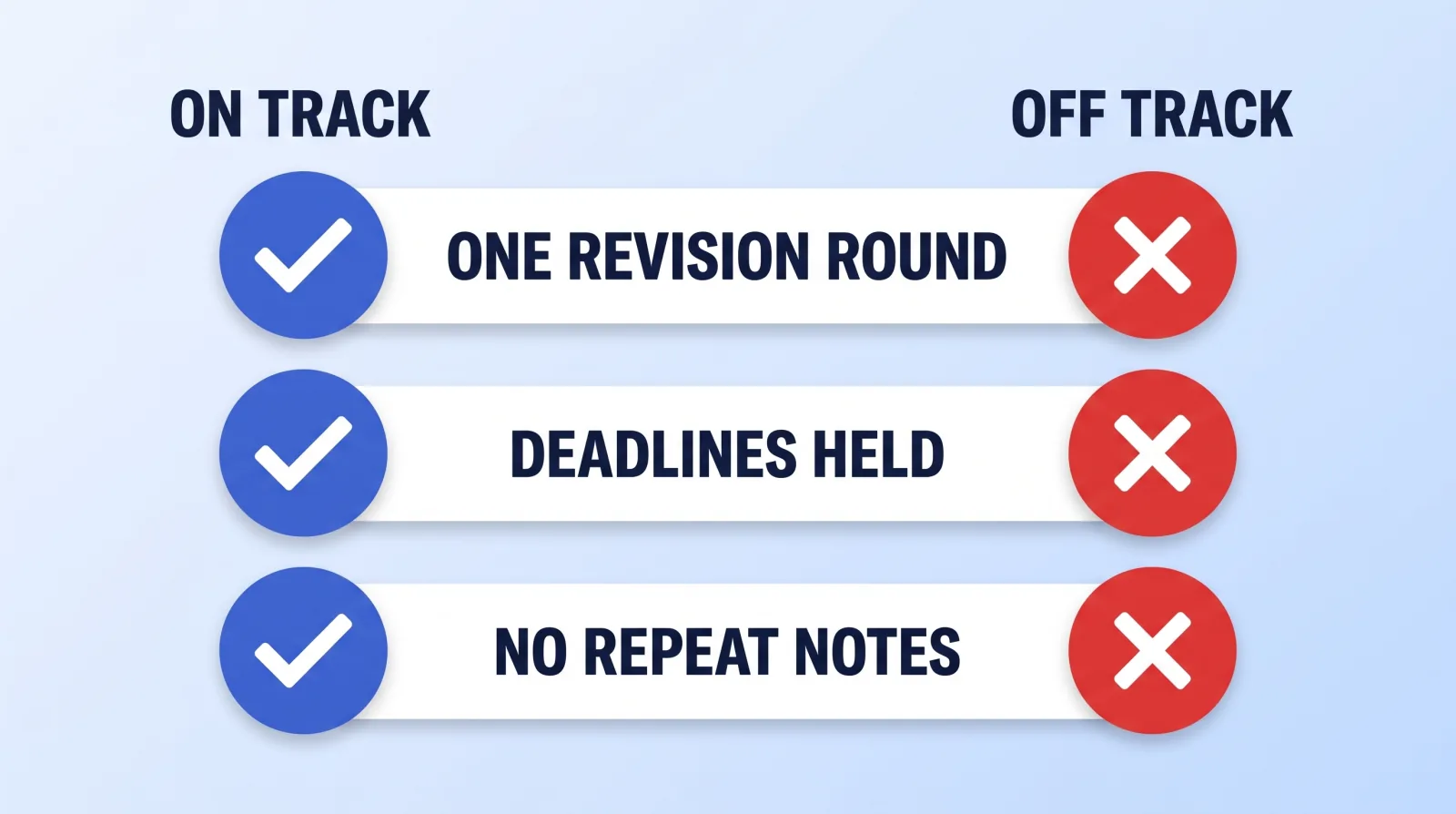
Three signals tell you whether this is working, and none of them is "do I like the video."
| Signal | On track | Off track |
|---|---|---|
| Revision rounds per video | One, occasionally two | Three or more, still trending up |
| Deadline behaviour | Hit, or renegotiated early | Hit after a reminder from you |
| Repeat notes | None from the style sheet | Same note, third time |
| Your time per video | Falling week over week | Flat or rising |
If revision rounds are climbing, the brief is the problem. If deadlines only land after you chase them, capacity is the problem. If your own hours are flat at day thirty, you have not outsourced anything — you have added a handoff to a job you are still doing, which is the exact failure mode that makes an in-house hire look attractive when it usually is not. The fixed-cost maths behind that comparison is on our in-house editor comparison, and the US Bureau of Labor Statistics data for film and video editors is the neutral wage baseline for it.
One caveat on month one that is worth saying plainly: if you skipped the vetting stage, none of this rescues a bad match. Onboarding compounds a good decision, and no style sheet fixes a provider who cannot name the person editing your videos — which is why vetting a video editing service comes first and this comes second.
The Bottom Line
The first thirty days are a build, not a trial. Hand over a packet instead of a folder in week one, treat cut one as a calibration instrument in week two, promote every repeated note into a written rule in week three, and measure your own review time in week four. If your hours are falling and the same note has stopped coming up, the system is working — and that, not the first video, is what you were actually buying.


