

The Demo Reel Is the Least Informative Thing You Will Be Shown
Wyzowl's annual State of Video Marketing survey has put business video adoption around the nine-in-ten mark for several years running, which means almost nobody is deciding whether to make video any more. They are deciding who edits it. And the artefact almost every buyer uses to decide — the demo reel — is the one artefact engineered to tell them nothing.
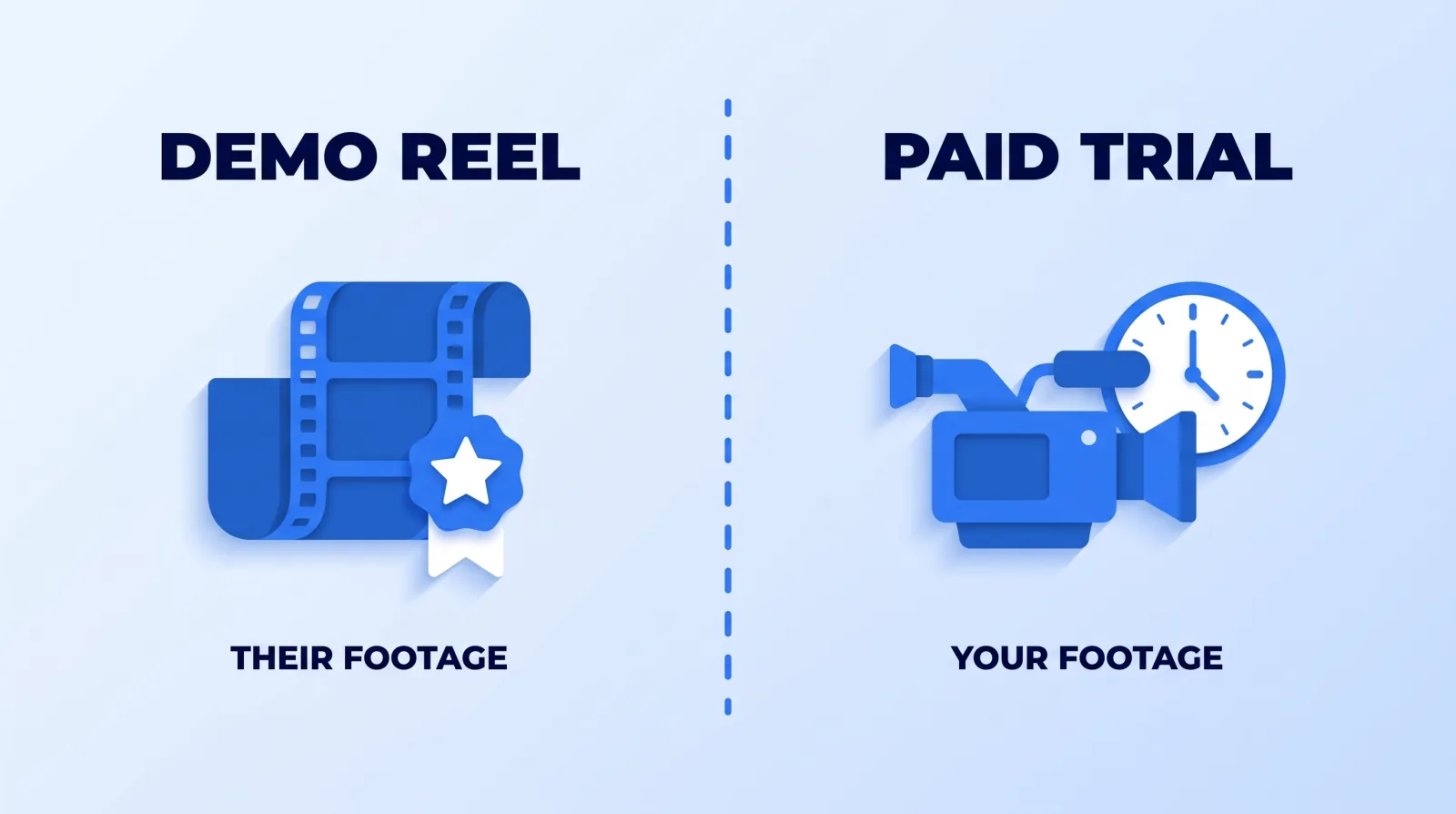
A reel is a sales asset. It is the best three seconds of the best forty projects, cut by the best editor on the roster, on footage that was lit properly, with a deadline that did not exist. Nothing in it is a lie. It is simply not a sample of the thing you are buying, which is typical output on your footage under your deadline, produced by whichever editor happens to be free in March.
Across 10,000+ editing projects at Mark Studios — work behind 100M+ views — the pattern in failed engagements is consistent. Almost none of them failed because the buyer misjudged craft. They failed because the buyer never tested the operating system around the craft: who actually cuts it, what happens on round two, and who picks up the file when that person is unavailable.
The Five-Stage Vetting Funnel
Vetting is a narrowing process, and each stage is designed to be cheap enough that you are willing to run it on more than one candidate.
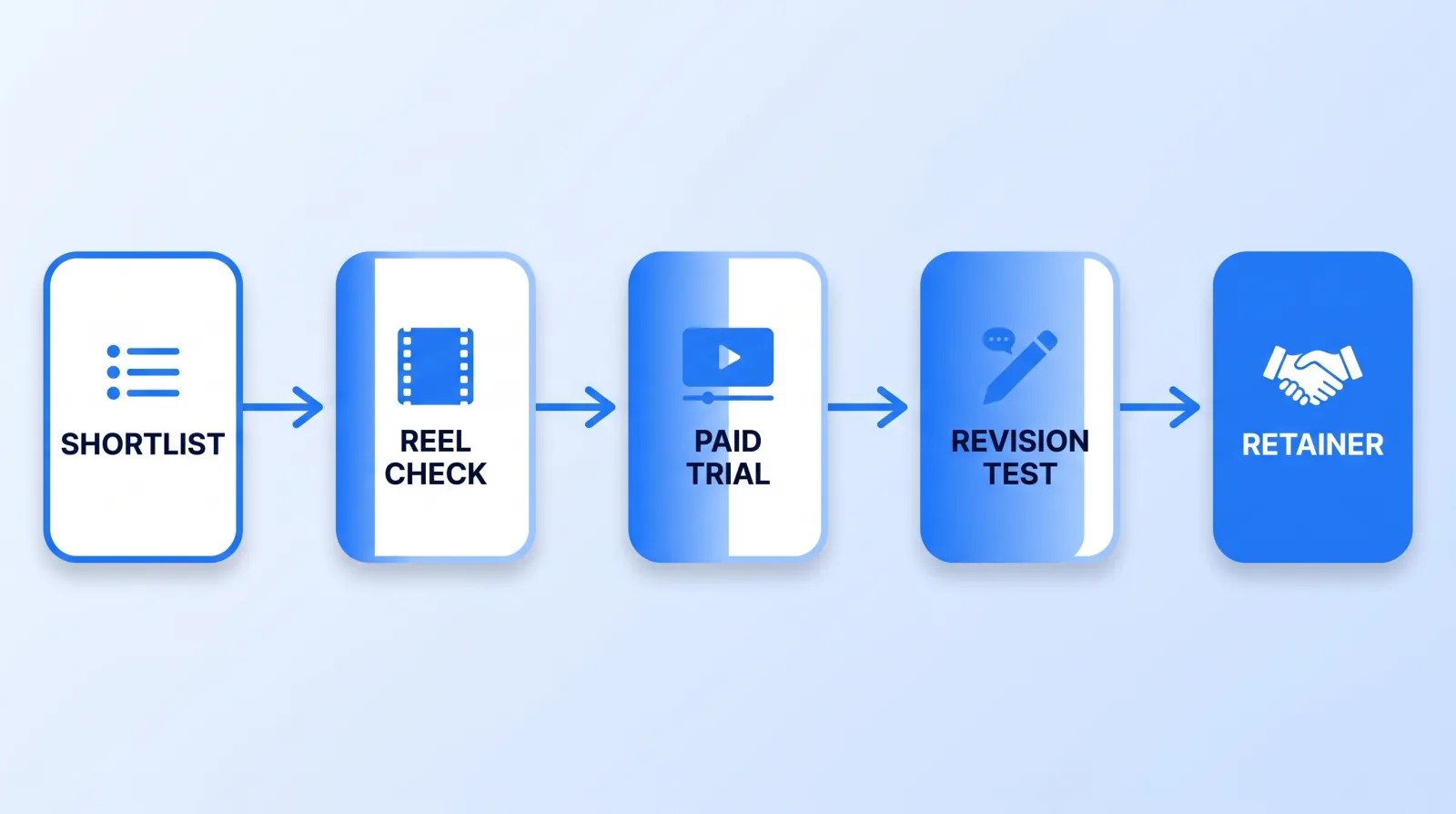
- Shortlist — three candidates, no more. Vetting properly costs real hours, and past three you start comparing on price because everything else has blurred. If you don't have three names yet, our comparison of video editing services for YouTubers sets ten side by side, with public starting prices and stated turnaround.
- Reel check — not "is this good", but the diagnostic questions in the next section. Twenty minutes each.
- Paid trial — one real deliverable, paid at full rate, on your actual footage.
- Revision test — the stage nearly everyone skips, and the one that predicts the next twelve months.
- Retainer — commit, with a defined exit.
Run stages one to four on all three candidates before committing to any of them. The comparison is the whole point; a trial you run on a single provider tells you what that provider does, not whether it is good.
How to Actually Read a Demo Reel
You cannot judge craft you do not have, but you can judge specificity, and specificity is checkable by anyone.
| What to look for | What it tells you |
|---|---|
| Same channel appearing across multiple clips | They keep clients. The single strongest signal on any reel |
| A named editor credited per project | Individuals, not an anonymous pool |
| Work in your format, not just your industry | A podcast studio and a short-form studio are different businesses |
| Unglamorous footage handled well | They can work with what you will actually send |
| A dated portfolio, ideally under 18 months | The roster that made the reel may have left |
The disqualifying tell is a reel of categories — three seconds of gaming, three of fitness, three of real estate, no client named. That is a reel assembled to look broad, and broad usually means a marketplace routing your job to whoever bids lowest, which is the failure mode we unpack on our freelance marketplaces comparison.
The Paid Trial: Design It So It Predicts Something
Free trials are worth exactly what you pay. An unpaid test edit is done at the end of someone's day, usually by their fastest person, and it is not a sample of contract work. Pay full rate for one real deliverable — one you intend to publish — and you get a genuine sample plus a video.
Send exactly what you would send on a normal week, not a curated best case:
- Real footage, including the take with the bad audio. Perfect source hides the skill you are paying for.
- Your actual brief, in the format you will use every week — the structure is in our editor handoff framework.
- Your brand kit — logo, fonts, colour codes. Watch whether they ask for what you forgot.
- A real deadline, matching the tier you intend to buy. Turnaround is a scope question, and what 24-hour, 72-hour, and one-week windows actually buy you is worth reading before you set it.
- One reference video, timestamped on the exact thing you like.
Then measure the things that are invisible in a finished file: how many clarifying questions arrived before work started (zero is a red flag, not efficiency), whether the deadline was hit or renegotiated early, whether captions were hand-checked or auto-generated and left, and whether the audio was actually mixed or just made loud.
The revision round is the real test. A good first cut proves someone can edit. A good second cut proves they can be worked with, and you will spend far more of your life in round two than round one. Send three notes: one objective ("cut 0:42–0:51"), one subjective ("the middle drags"), and one ambiguous ("make the intro punchier"). Watch what happens to the ambiguous one. A professional asks a question or proposes an interpretation. A weak operator guesses, and you burn a third round finding out. If your notes themselves are the variable, our guide to revision notes that actually get fixed removes that ambiguity first.
The Nine Questions That Predict Quality
Ask these before the trial. They take five minutes and they are the highest-yield part of the whole process.
- Who specifically will edit my videos, and can I have their name? Anonymity means a pool, and a pool means style drift.
- What happens when that person is sick or on holiday? The only acceptable answer names a second person.
- How many revision rounds are included, and what starts a new one? Get the boundary in writing.
- What is your average first-response time on a weekday? Compare the answer to what you observe during the trial.
- Do you sign an NDA, and where is my footage stored? Non-negotiable in regulated work — it is the first question every firm asks us on our legal video editing engagements.
- Who owns the project files, and can I have them if we part ways? "We keep the project files" is a lock-in clause wearing a technical costume.
- Do you supply source music licences? Unlicensed music is a monetisation risk that arrives months later; libraries like Epidemic Sound issue per-channel licences you can actually produce on request.
- What are your export specs? They should be able to answer without looking, and it should match YouTube's recommended upload settings.
- What does your review workflow look like? Timecoded review in a tool like Frame.io beats a comment thread; email screenshots signal an outfit that has not scaled.
Question two is the one that most reliably separates outcomes. A single freelancer and a single in-house hire both have a queue depth of one — capable, but with no redundancy, and the in-house version also carries the fixed salary cost we break down on the in-house editor comparison. If you want to benchmark that route honestly, the US Bureau of Labor Statistics' occupational data for film and video editors is the neutral wage baseline, and it is higher than most creators assume once benefits and idle weeks are counted.
Red Flags, and What They Actually Mean
| Red flag | What it usually means |
|---|---|
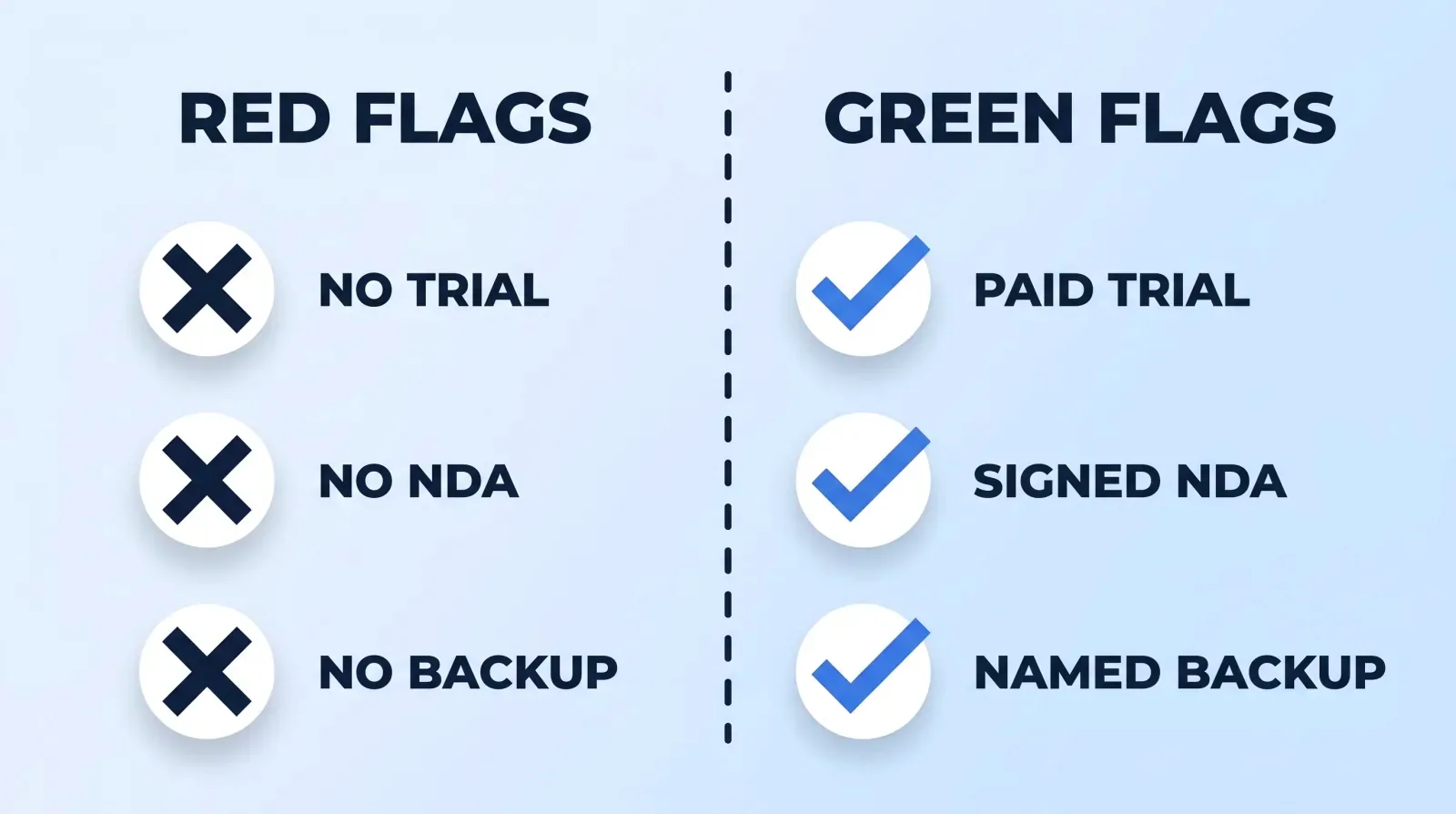
| Refuses a paid trial | Their typical output does not match their reel |
| Quotes instantly without asking about footage volume | The quote will change, or the scope will silently shrink |
| No contract, no NDA | No recourse, and a genuine confidentiality exposure |
| Unlimited revisions, prominently advertised | Either a rushed first cut is priced in, or "unlimited" has undisclosed limits |
| Cannot name a backup editor | Queue depth of one, sold as a team |
| Dramatically cheapest of the three | Someone is absorbing the gap — usually via a rotating junior editor |
The last one deserves care. Cheap is not automatically bad, but a quote well under the others is a claim about efficiency that should be verifiable. Ask where it comes from. Real answers exist — templated graphics, a transcript-first workflow in something like Descript, an established brand kit. "We're just competitive" is not an answer, and the mechanics of a defensible price are laid out in our breakdown of what video editing actually costs.
One closing note on what you are optimising for. Wistia's video marketing research keeps arriving at the same finding: consistency of publishing beats individual polish. The provider who is slightly less brilliant but reliably delivers 48 videos a year will outperform the more talented one who delivers 30. Vet for the second number, not the first.
The Bottom Line
Judge the operating system, not the reel. Pay for one real trial on your own footage, send three notes including a deliberately ambiguous one, and ask who edits it and who covers them when that person is away. The providers that survive those three tests are the ones still delivering in month twelve — and that, not craft, is what you are actually buying.


