

A 24-Hour Turnaround Is a Queue Position, Not an Editing Speed
Ask ten editing services for a 24-hour turnaround and nine will say yes. What almost none of them will say is that the number describes where your file sits in a queue, not how many hours a human spends on your timeline. The two are only loosely related, which is why two studios quoting "24 hours" hand back work a full tier apart in quality.
It gets worse at the end of the chain, where the clock keeps running after the editor is finished. YouTube's own upload documentation is explicit that processing time scales with resolution and length — a 4K master is frequently still being processed long after the export completed and the file was handed over. If your publish time is 9am, "delivered at 8am" is not delivered.
Across 10,000+ editing projects at Mark Studios — work sitting behind 100M+ views — the most common source of a genuinely unhappy client is not craft. It is a turnaround expectation nobody wrote down. In our study of 704 buyer conversations, turnaround was the second most common first question after price, at 7.3% of first messages, yet only 29 first messages named a deadline. Below is what the numbers actually mean when you are buying, and which of them you control.
Where the Calendar Actually Goes
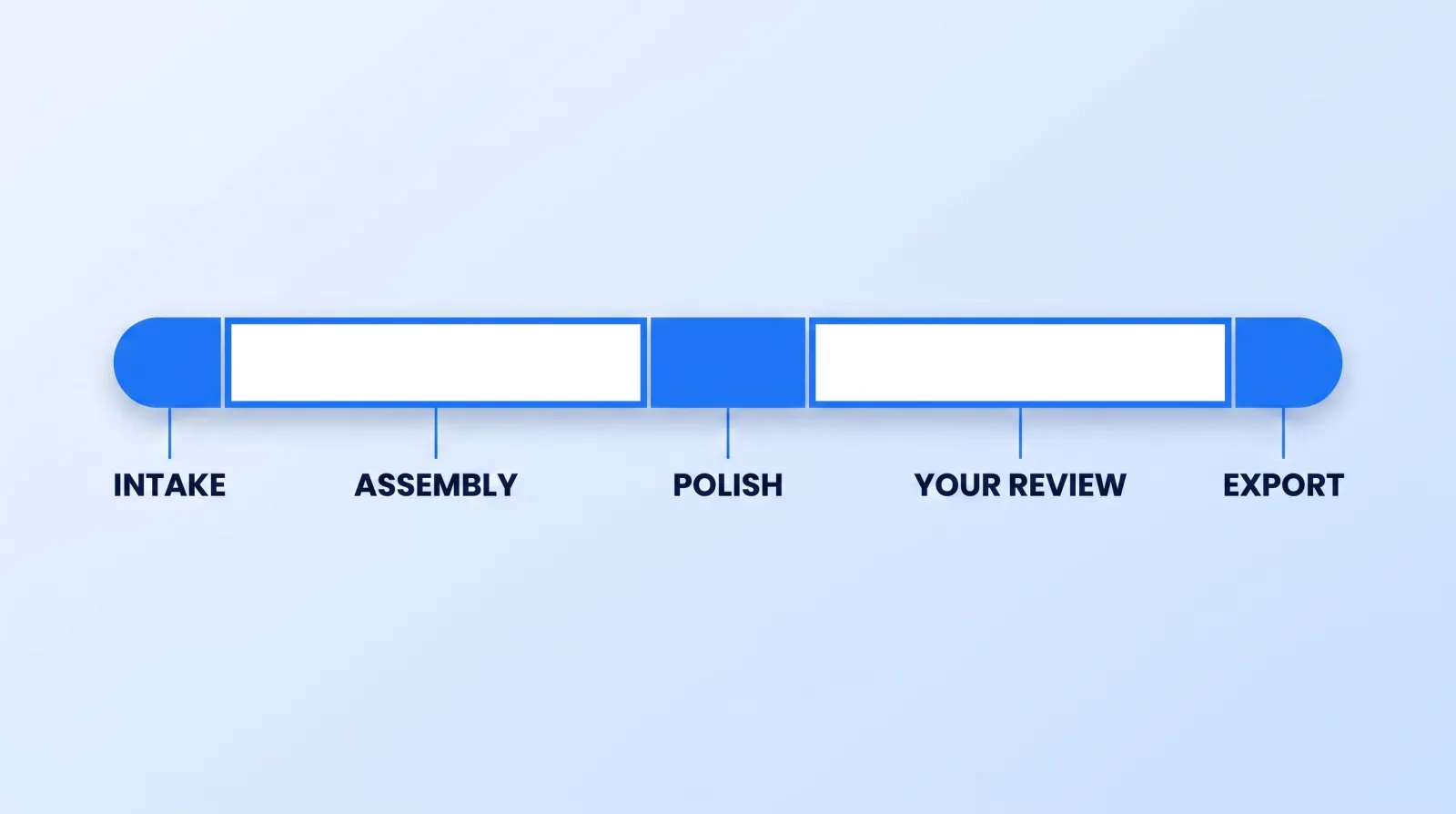
Elapsed turnaround breaks into five blocks, and only two of them belong to the editor.
- Intake — transfer, verifying the brief, confirming deliverables. Minutes if you prepared, half a day if assets arrive in three batches from two clouds.
- Assembly — the actual cut. On a clean single-cam talking-head, an experienced editor gets to a watchable first cut in roughly one to three hours per finished minute, depending on how much footage they have to wade through.
- Polish — captions, grade, sound, graphics. Fast when templates exist, slow the first time.
- Your review — the block clients never count. On our order board it is routinely as long as the assembly that preceded it, because a first cut delivered Friday afternoon gets watched Monday.
- Export and handoff — render, upload, transcode. Small, but not zero, and not skippable.
The practical consequence: on a 72-hour promise, an editor who has your files at 9am Monday realistically has around 30 working hours of their own, not 72. The rest is transfer, waiting, and your calendar. The fastest way to compress turnaround is not a faster editor — it is shrinking the two blocks that are yours.
What Each Turnaround Tier Actually Buys
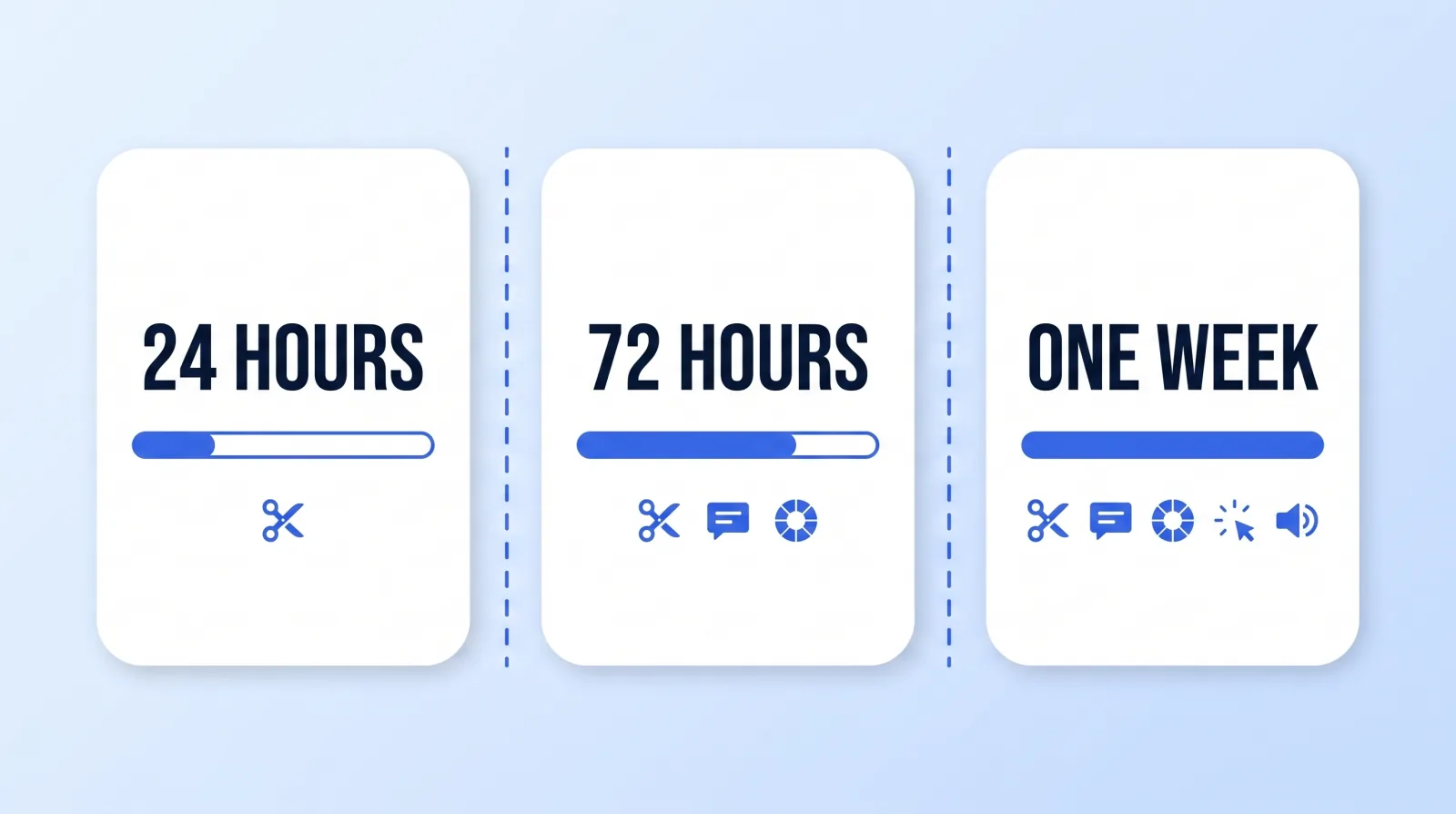
| Tier | Honestly fits | What gets skipped | Realistic for |
|---|---|---|---|
| 24 hours | Cut, trim, basic audio levelling, one export | Bespoke graphics, careful grade, hand-timed captions, any real revision round | Podcast clips, reaction content, news-reactive uploads, short-form batches |
| 72 hours | The cut plus captions, a competent grade, template lower thirds, one revision round | Original motion design, sound design beyond music and levels | The standard long-form upload. This is the tier most channels should be buying |
| One week | Everything above plus bespoke graphics, sound design, multi-cam sync, two full revision rounds | Very little | Launch videos, ads, sponsor integrations, anything where the video is the campaign |
A 24-hour edit is not a worse editor working faster. It is a smaller scope, and the honest studios say so up front. The dishonest version quotes 24 hours at the same price as 72 and quietly ships you the 24-hour scope, which is where "the edit felt thin" complaints come from.
Most clients don't book the fastest tier. In our own order data, the median standalone order was due 6 days after it was placed and 73.1% were due within a week; thumbnails were the quickest, at a median of 3 days. The breakdown by format is in our video editing outsourcing benchmarks.
Rush also has a price, and it is not arbitrary. Moving your file to the front of a queue displaces someone else's work, so a genuine 24-hour rush reliably carries a 25–50% premium — the mechanics are broken down in our guide to what video editing actually costs. A service that offers rush turnaround at no premium is either not busy or not rushing.
The Six Things That Make Your Edit Slower — and the Checklist That Fixes Five of Them
Nearly all avoidable delay traces to the same six causes, and only the first is really the editor's.
- Source-to-delivery ratio. Two hours of footage for an eight-minute cut is a different job from twelve minutes of footage for the same cut. This is the biggest driver of assembly time and the one clients almost never mention when asking for a deadline.
- Multi-cam and external audio. Syncing two cameras and a lav is 20–40 minutes before a single creative decision gets made. Recording a clap or using timecode removes most of it.
- Assets arriving late. Logo, sponsor copy, product shots, the b-roll folder. An edit that stalls waiting on a brand kit is not a slow edit.
- Music not chosen. Swapping the track after the cut is locked means re-timing everything cut to it. Pick from a library like Epidemic Sound before the edit starts, not after the first review.
- Graphics from scratch. Template lower thirds are minutes. An animated sequence built to spec is its own project, and it does not compress into a 24-hour window no matter what you pay.
- Feedback latency and vague notes. A round trip is dead calendar time. Two vague rounds cost more days than one precise round, which is exactly why our post on revision notes that actually get fixed exists.
The pre-flight checklist, run before you send anything, buys back roughly a day on a standard long-form upload:
- Footage uploaded in one transfer, in a labelled folder structure — our file management system is the version we hand editors.
- Deliverable list stated in full: one horizontal master, how many verticals, thumbnail or not.
- Brand kit attached — logo, fonts, colour codes — not "same as last time".
- Music track chosen, or explicit permission for the editor to choose.
- Reference video linked, with a timestamp on the exact thing you like.
- A written brief rather than a voice note. The structure is in our editor handoff framework.
- A named reviewer with a committed review window. One person, one deadline.
Tools compress the mechanical parts of this genuinely well — AutoPod removes most of multi-cam switching, Descript collapses transcript-based rough cuts — but none of them shorten the review block. That one is entirely yours.
Queue Depth Is the Variable Nobody Quotes
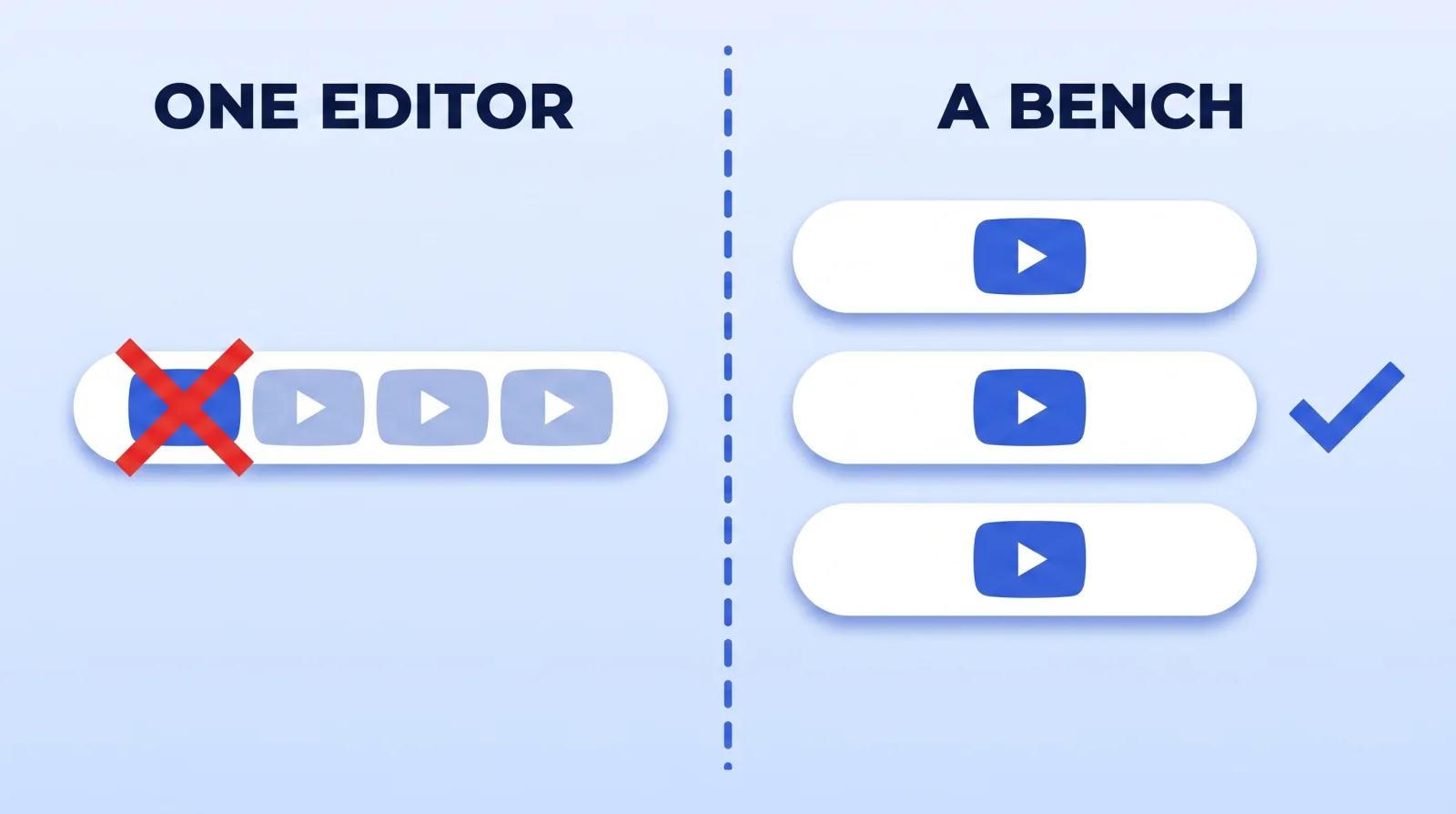
One number predicts whether a quoted turnaround survives a real month: how many videos this provider can have in flight at once.
A single freelancer has a queue depth of one. Their quoted 72 hours is accurate right up until they get sick, take a holiday, or land a better-paying client — at which point your turnaround is not 72 hours plus a bit, it is indefinite, and you find out on the day you needed the file. That risk is structural, not a character flaw, and it is the main thing we unpack in our comparison of marketplace hiring versus a managed team.
An in-house editor has a queue depth of one too, with better communication and worse economics — you pay for the idle weeks as well as the busy ones, which we costed out on the in-house editor comparison page. A studio's advantage is not that any individual editor is faster; it is that a second editor exists, so nothing sits behind one person.
This matters most where the deadline is external rather than self-imposed. Real estate video is the clearest case we work on: a listing video that lands four days after the open house is not a late deliverable, it is a wasted one. The window is short to begin with: the median existing home spent 31 days on the market in August 2026, per the NAR figures in our real estate video statistics. When the deadline is set by someone other than you, buy queue depth, not the lowest quote.
Two cheap habits protect any of the three arrangements: run approvals through a review tool like Frame.io instead of a comment thread so notes carry timecode, and export to YouTube's recommended upload settings the first time so nobody re-renders. Wistia's video marketing research keeps landing on the same conclusion — consistency of publishing outperforms polish — and a turnaround you can actually hit every week is what consistency is made of.
The Bottom Line
Turnaround is not a measure of how fast an editor works. It is a measure of scope, queue depth, and how much of the calendar you personally occupy. Buy 72 hours for standard long-form work, treat 24 as a deliberately reduced scope with a rush premium attached, and reserve a full week for anything with bespoke graphics. Then fix the two blocks that are yours — a complete handoff and a named reviewer with a deadline — and you will get more days back than switching providers would ever give you.


