The Revision Round Is Where the Budget Quietly Dies
Wistia's 2026 State of Video Report — built on a survey of 900+ professionals plus 13 million videos and 79 million hours of viewing data — found that companies are producing more video while nearly half hold their budgets flat, and that outsourcing is rising as in-house teams stretch. Wyzowl's twelve-year survey points the same way. More videos, the same money, more hands on each edit — which puts the whole margin in the one place nobody optimises: the notes you send back.
Here is the pattern across 10,000+ video editing projects at Mark Studios, on work that has driven 100M+ views. The videos that go five rounds are almost never the hard edits. They are ordinary edits that got a vague first note. Round count is set by the quality of the feedback, not the difficulty of the cut — good news, because feedback is the one variable a creator controls completely.
We covered how to brief a video editor before a project starts. This is the loop back, after you have watched V1 and something feels off.
Why Most Revision Notes Fail
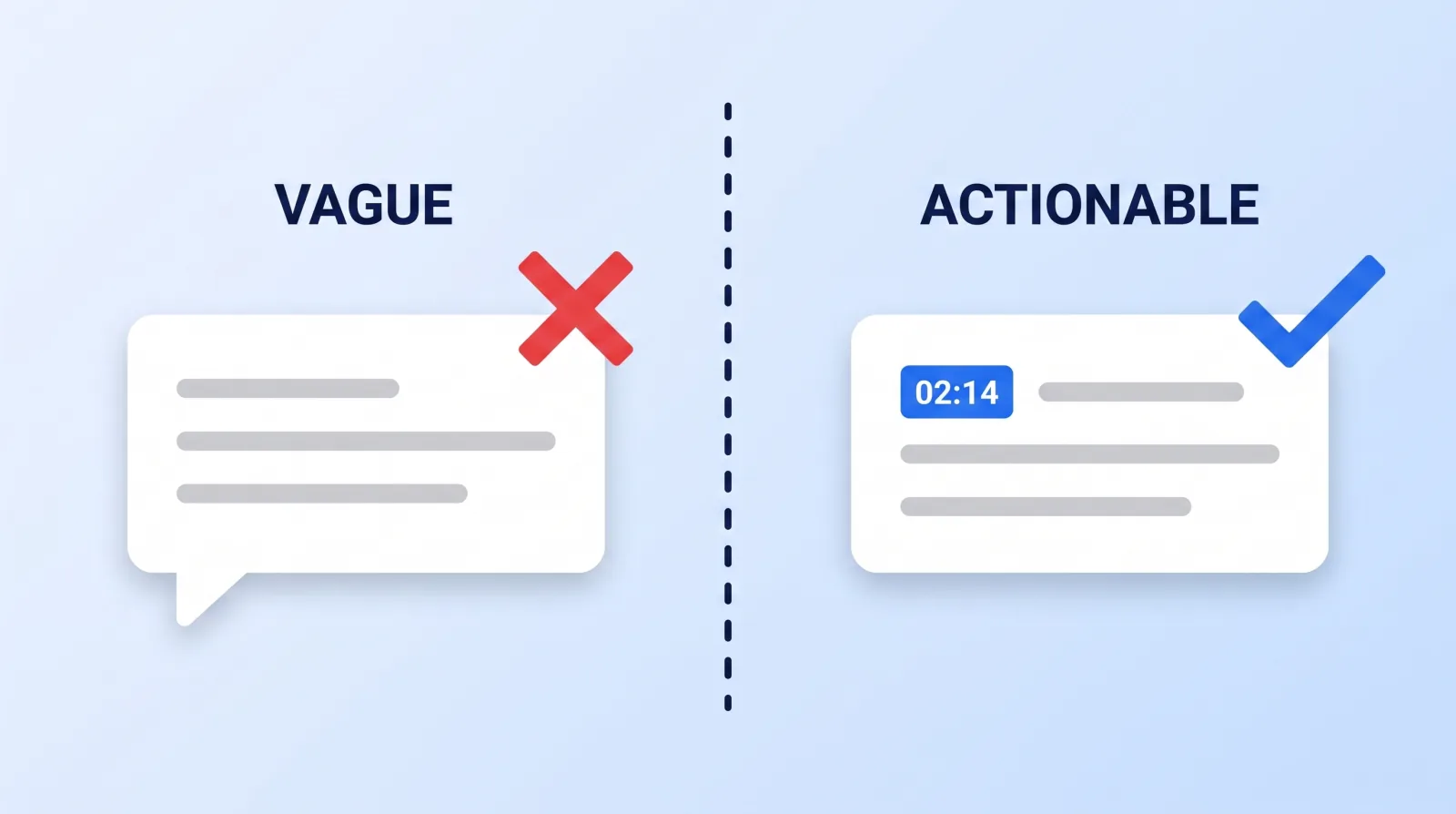
Nearly every unusable note fails in one of three ways.
| The note you sent | What the editor receives | What it costs |
|---|---|---|
| "The intro feels slow." | Something is wrong in the first 90 seconds. | A guess, then a round to correct the guess. |
| "Can you make it punchier?" | An adjective with no unit of measurement. | Editor changes music; you meant the cuts. |
| "Just do whatever you think." | A decision handed over without the context to make it. | Their taste, your name on it. |
The deepest failure is the second one: a diagnosis sent instead of a symptom. Creators feel a dip and jump to a cause — "the music is wrong." Nine times out of ten the music is fine and the dip is a two-second dead beat before the hook lands. You are the best witness to the problem and the worst diagnostician of it.
Say what you felt and where you felt it. Let the person who built the sequence work out why.
The Anatomy of a Note That Gets Fixed
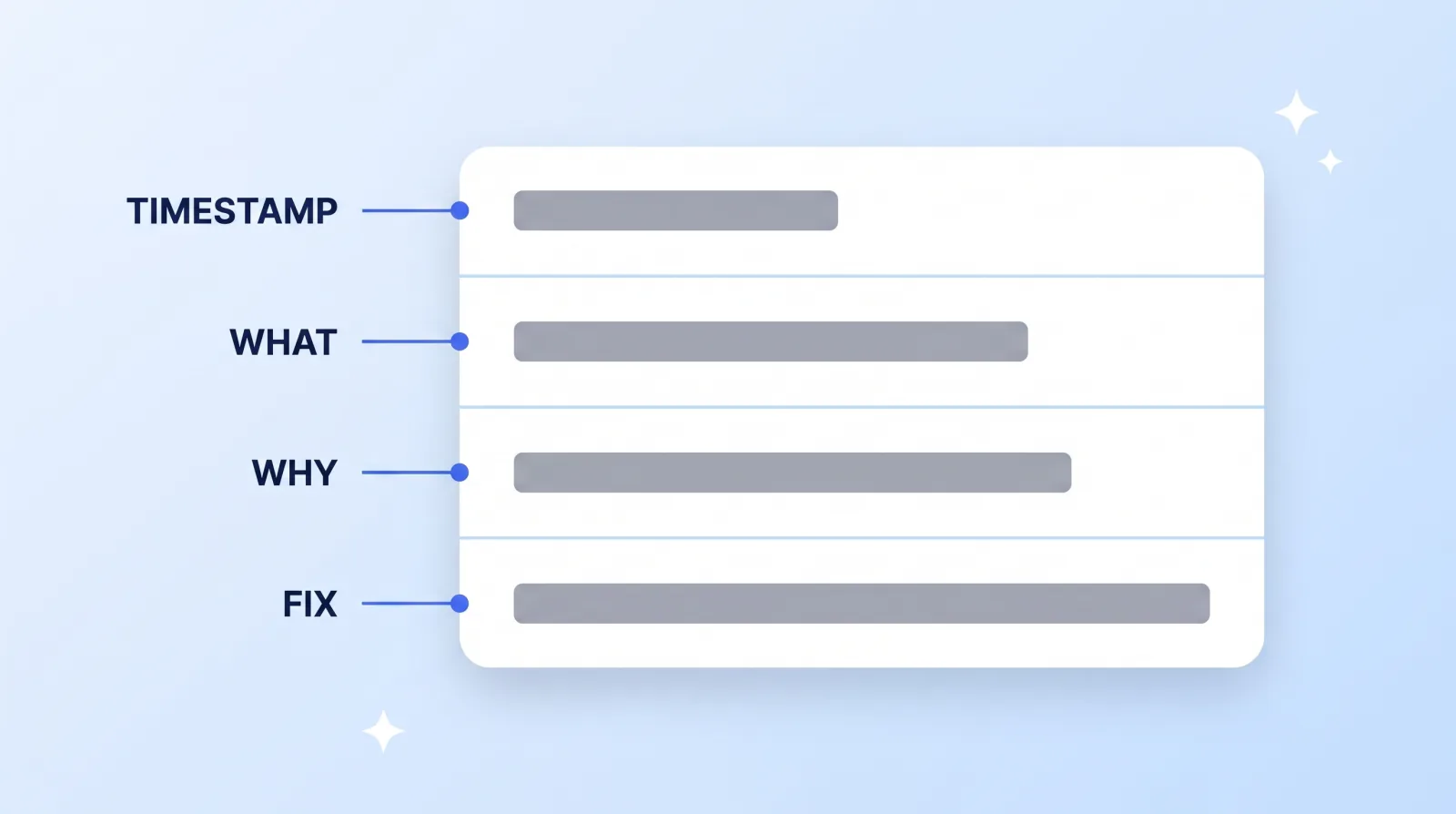
Four parts. The first three are mandatory.
- Timestamp.
01:47, not "around the middle." This single habit removes more round-trips than everything else on this list combined. - What. The observable thing, described neutrally. "Two beats of silence after the question."
- Why. The stake. "It reads like a mistake, and this is the moment people decide to stay."
- Fix (optional). Your suggestion, explicitly flagged as a suggestion.
Written out, a real note looks like this:
01:47 — Two beats of silence after I ask the question.
        Reads like a mistake right where retention is decided.
        Suggestion (open to better): tighten to a hard cut, or
        push the music swell forward to cover it.
That takes eleven seconds to type. It is unambiguous, executable on the first pass, and it leaves the editor room to solve it better than you would have.
Two more rules that matter more than they sound:
- Separate "wrong" from "different." A misspelled lower third is wrong. A grade you would have taken warmer is different. Wrong gets fixed every round; different gets one round and is then settled, or you are paying for taste iterations. Genuine defects — a soft focus pull, a blown highlight — are a third category, because there are limits to what post can salvage.
- Never send a note you have not checked against the current export. Many "you missed my note" arguments turn out to be a client watching a cached V1. Reload before you write.
Round Structure: Two Passes, Not Five
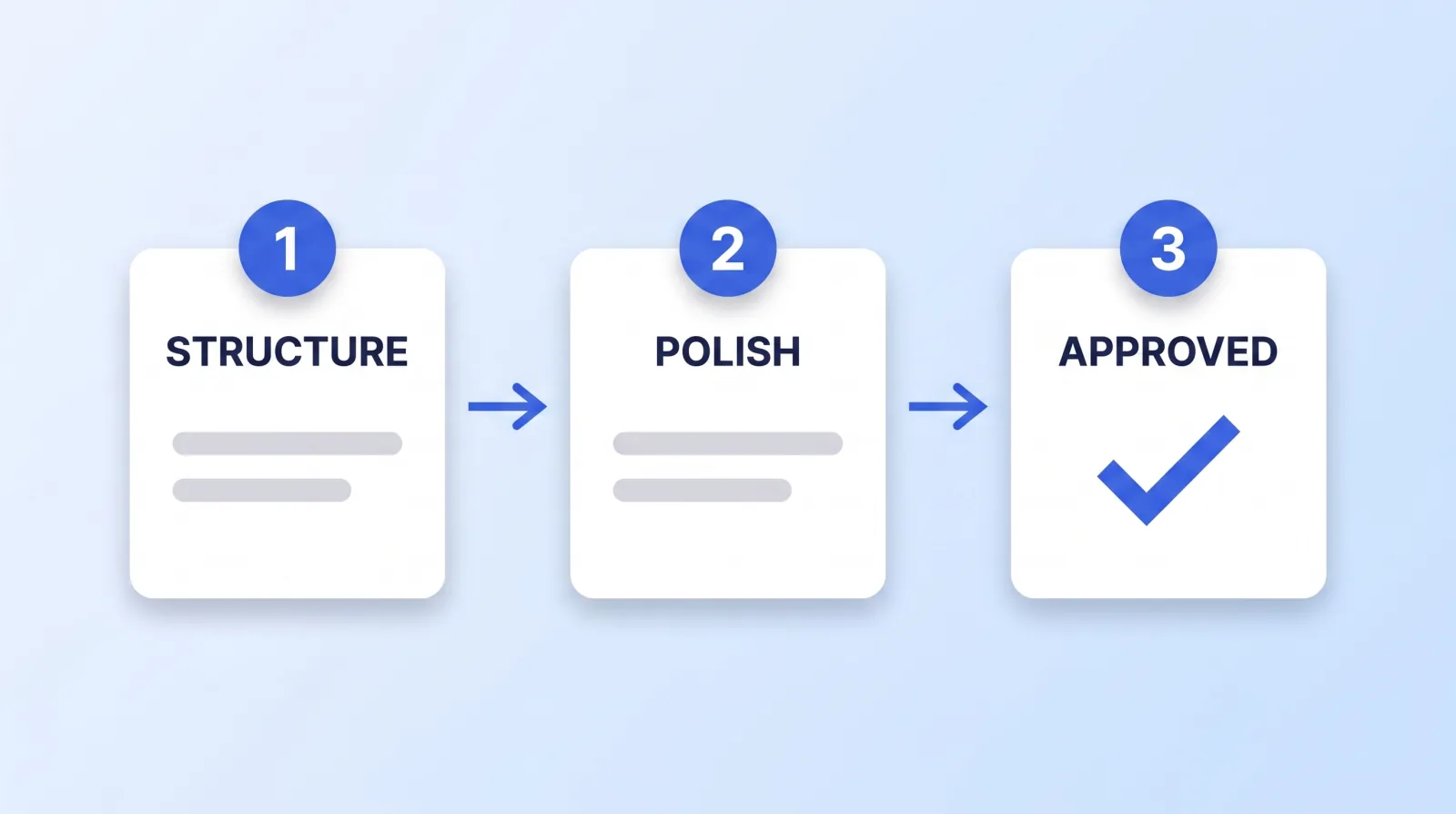
Rounds are ordered passes, and the order exists for a mechanical reason: structural changes destroy polish work. Ask for colour and caption tweaks in round one, then cut 40 seconds in round two, and you paid an editor to grade and caption 40 seconds of video that no longer exists.
| Round | What belongs in it | What must not |
|---|---|---|
| 1 — Structure | Cut order, pacing, sections moved or removed, hook, length | Colour, captions, mix, fonts, graphic polish |
| 2 — Polish | Grade, audio mix, captions and typos, graphics, transitions | "Can we move the section about X" |
| 3 — Approval | Confirming round-2 notes landed | New ideas of any kind |
Two included rounds plus an approval pass is what we run, and it matches the revision allowance most studios put in a contract — a clause worth getting right when you price your video production services. The line that makes it hold: all notes submitted in a single pass count as one round. Without it, a client sends four emails over three days and genuinely believes that was one round, while the editor has done four context switches.
If you routinely need round four, the problem is upstream: the brief was thin, or nobody agreed what the video was for. Neither is fixed by another round.
Where the Notes Should Live
The channel you use changes the notes people write. A tool that makes timestamps free produces timestamped notes; one that does not, does not.
| Channel | Timestamps | Verdict |
|---|---|---|
| Review player with frame-accurate comments (Frame.io, Descript) | Automatic | Default. The timestamp is captured for you, so the laziest possible note is still locatable. |
| Numbered doc with manual timestamps | Manual | Fine, and better than a player for long strategic notes. |
| Chat thread (WhatsApp, Slack, DMs) | None | Notes scatter and nobody can tell what is still open. Use it to say the notes are ready, never to hold them. |
| Voice memo or a live call | None | Good for explaining a feeling. Always followed by a written list — memory is not a deliverable. |
Whatever you pick, one place holds the canonical list. The most common failure when you hire and manage a global editing team is notes arriving through three channels at once: the editor fixes eight of eleven, you see three missed, trust drops, and nobody was actually at fault.
The Pre-Send Gate
Run this before you send any revision list. It takes about four minutes.
- ✅ Watch the whole export without pausing to write. First pass is for reaction, not notes.
- ✅ Watch it again and write. Timestamp every note as you go.
- ✅ Confirm you are on the current version. Reload; check the file or version number.
- ✅ Tag every note wrong or different. If more than a third are "different," you are art-directing, not revising.
- ✅ Delete the diagnoses. Rewrite anything phrased as a cause into what you observed.
- ✅ Check it against the brief. A note that contradicts the brief is a scope change — say so, and expect it to cost time.
- ✅ Send once, as one list, with a deadline. Not four messages across three days.
- ✅ Say what is working. Editors calibrate on what you keep, not only on what you kill.
Step 4 is the one that surprises people. When we started tagging notes at Mark Studios, late-round lists were routinely closer to half preference than defect — a pricing conversation, not an editing problem.
For the approval pass, upload the locked cut as unlisted and watch it in YouTube Studio rather than a review player. Compression, the mobile player and the real thumbnail crop all behave differently there, and it is the last cheap moment to catch something.
The Bottom Line
The number of revision rounds a video takes is mostly a function of how the first note was written, not how hard the edit was. A timestamp, an observation, and a stake — in that order — converts a reaction into a task, and a task gets done on the first pass.
Keep structure in round one and polish in round two, hold every note in one place, and send them as a single list. Do that and two rounds is enough — on work that is better than what five rounds of guessing would have produced.