The Short Answer: How Many Revision Rounds to Expect
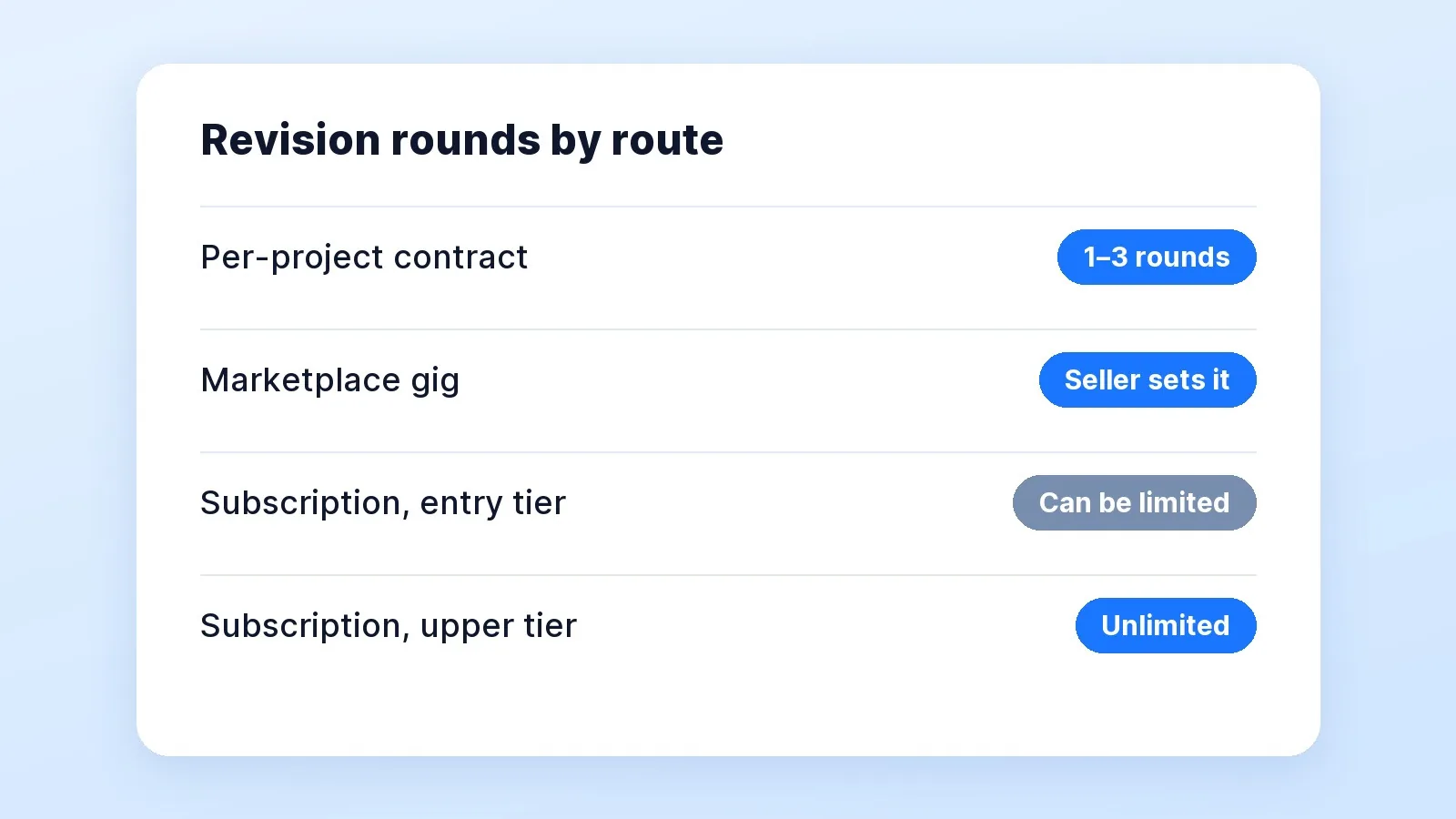
One to three rounds is the normal range in a per-project video editing contract, with anything beyond that billed extra. Marketplace gigs set their own count per package. Monthly editing subscriptions mostly advertise unlimited revisions, but unlimited is often a tier feature, and the cheaper plan at the same company can be the limited one.
Those are market terms. Ours are on our process page: every Mark Studios order includes 3 revision rounds within the agreed scope. Every figure below links to where we read it, checked October 6, 2026.
The number on the pricing page is the least useful part of a revision policy. Three things decide whether you actually get the cut you wanted, and almost no pricing page states them: what counts as one round, how long you have to send notes, and what gets reclassified as a new project instead of a revision.
Revision Policies by Route
| Route | Published revision policy | Source |
|---|---|---|
| Per-project contract | One to three rounds included, extras billed per hour, per round or per revision | OneSuite: "Most freelancers offer 1–2 rounds"; an editor on Creative COW: "Usually I say that it includes 2 rounds"; Minifridge Media: "the standard is three rounds" |
| Marketplace gig | Set per gig and package by the seller | The "Revisions" line in each Fiverr gig's package table |
| Per-video agency | Unlimited revisions on the per-video price | Tasty Edits pricing: $327 for one horizontal video, $278 each in an 8-pack, unlimited revisions, 48-hour turnaround |
| Subscription, entry tier | Can be limited | VidChops Weekly at $495 a month: 3 revisions per video |
| Subscription, upper tier | Unlimited | VidChops Pro at $995 covers 8 videos with unlimited revisions per video; Video Husky Eskimo at $849 lists unlimited revisions with a 20-minute finished cap |
| Unlimited retainer | Unlimited requests and revisions, worked as a queue | beCreatives Scale plan at $999 a month billed quarterly, "one request at a time"; Flocksy entry plan at $1,199 a month billed annually |
Read that table top to bottom and one pattern stands out: the revision count is a pricing lever, not a quality signal. VidChops sells the same service at two levels, and the $500 difference between Weekly and Pro buys unlimited revisions along with twice the monthly credits. Paying for "unlimited" often means paying for the tier that also lifts the volume or length cap you were going to hit anyway.
If you're choosing between these routes rather than within one, our comparisons of Video Husky, VidChops, beCreatives and Tasty Edits set out what each plan covers, and how we compare with a freelance marketplace covers the gig route.
What "Unlimited Revisions" Actually Means
Unlimited almost always carries two unwritten limits.
It's sequential, not parallel. Increditors' review of Video Husky puts it plainly: "The word 'unlimited' refers to the total number of requests you can make over the course of the month, not simultaneous parallel projects." beCreatives says the same about its own plans: unlimited revisions, "one request at a time." Every round you spend on video one is a round the queue isn't spending on video two.
It's "within scope." Unlimited revisions to the edit you commissioned isn't the same as unlimited changes to what the edit is. A colour tweak, a different music bed, a tighter cold open, trimming eleven seconds from the middle: those are revisions. Recutting the same footage to a new script or adding a section that needs new graphics is a new brief. Minifridge Media draws the same line: "Revisions are edits within the approved direction, but a scope change is something structurally different."
The practical test: ask what has been reclassified as a new project recently, and why. A service that answers specifically has a policy. One that says "we just keep going until you're happy" will show you the line under deadline.
What Counts as One Round
This is the clause worth more than the count.
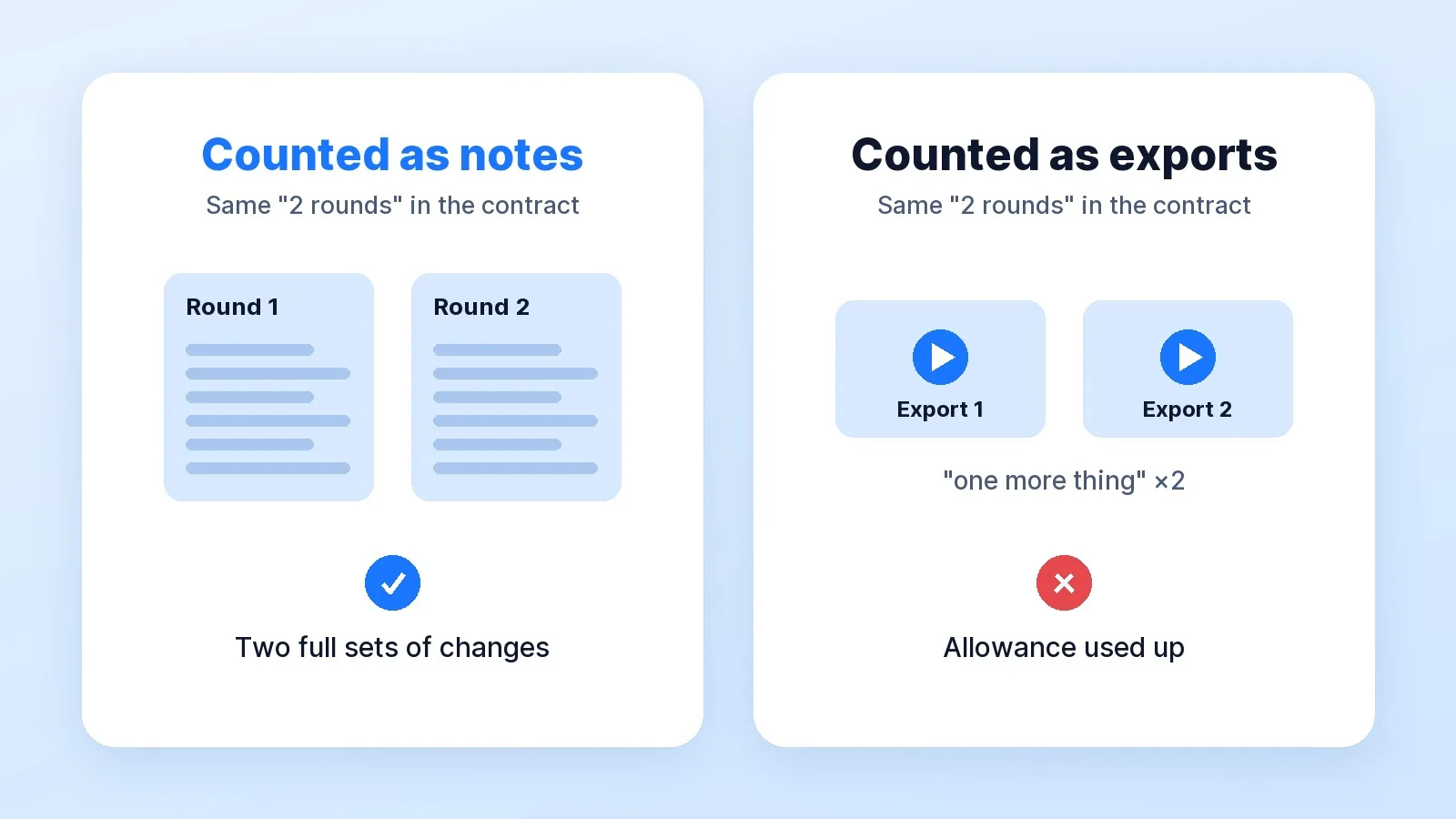
The workable definition is one consolidated list of feedback that produces one new export. One video editor scope-of-work template writes it as "a single, consolidated list of feedback provided by the Client within 48 hours of a milestone delivery."
The difference isn't academic. Under a consolidated definition, two rounds means two lists of notes, which is generous, because one list can hold thirty items. Under a per-export definition, two rounds means two exports, and a client who emails "one more thing" four times has spent the allowance on four near-identical cuts. Same number in the contract, very different purchase.
Two clauses follow from this and belong in any agreement you sign:
- A feedback window. A fixed period after each delivery to send the consolidated list, like the 48 hours in the template above. It keeps the project fresh for the editor and keeps your slot in the queue.
- A named decider. Rounds get burned by contradictory notes, not difficult ones. If marketing, the founder and the subject-matter expert all send notes separately, the editor has no version to cut toward. Our guide to giving revision notes that actually get fixed covers the format. Naming one person to merge the notes is the part that saves rounds, especially on B2B and SaaS video, where a cut can pass marketing, product and legal before anyone calls it done.
What Extra Rounds Cost
Once the included rounds are used, per-project contracts bill extra, and the unit varies. OneSuite tells freelancers to charge "either per hour or per revision." Minifridge Media charges additional rounds "at a flat rate per round." On a subscription, extra rounds have no line-item cost at all. They cost you throughput, which is the same money arriving by a different route.
That trade is the real decision:
- Predictable notes, few reviewers, fixed brief → a per-project contract with a set number of rounds is cheaper, and the overage rarely triggers.
- Many reviewers, evolving brief, steady volume → a subscription tier with unlimited rounds removes an argument you'd otherwise have every month, and you pay for it in queue depth.
Our post on subscription versus per-video pricing works through the volume maths, and what video editing costs in 2026 covers the base rates each route starts from.
Five Questions to Ask Before You Sign
- How many rounds are included, and is that per video or per month? A monthly cap on a multi-video plan is a very different product from a per-video cap.
- What counts as one round: a list of notes, or an export? Ask for the answer in writing. This one sentence is worth more than doubling the count.
- How long do I have to send notes, and what happens if I miss the window?
- What turns a revision into a new project? Ask for two recent examples. The answer tells you whether the policy is real.
- How fast do revisions come back? An unlimited policy with a five-day turnaround on each round is slower than two rounds delivered next day. Our turnaround guide covers what each speed buys.
In our experience across 10,000+ projects, revision cycles run long because the brief moved or nobody merged the notes, far more often than because the first cut was bad. Before you commit to anyone, how to vet a video editing service covers the trial edit and the questions that expose a vague policy.
The Bottom Line
One to three rounds is the per-project norm, marketplace sellers set their own, and unlimited is a subscription feature, sometimes only on the upper tier. Don't compare providers on the revision number. Compare them on what counts as a round, how long you get to send notes, and where they draw the line between a revision and a new brief.
Every Mark Studios order includes 3 revision rounds within the agreed scope, set out in your project Order, and material scope changes are quoted as additional work. That's our done-for-you video editing service.