

The Same Ten-Minute Video Gets Quoted at $45 and at $1,800
Send an identical brief to ten editors and the quotes will span a factor of thirty. That is not a market full of people ripping you off. It is a market where "edit a ten-minute video" is not a specification, so every editor prices a different job in their head. One is quoting a straight assembly from a clean single-cam take. Another is quoting a multi-cam sync, a graded image, burned-in captions, six motion graphics and two revision rounds. Both are answering the question you asked.
The floor underneath all of it is labour. The US Bureau of Labor Statistics puts the median annual wage for film and video editors at $75,420 as of May 2025, before payroll taxes, benefits, hardware and software — which means a US-based editor cannot deliver competent work at $30 a video and stay solvent. Any quote far below the labour floor is buying you either offshore rates, a trainee, an unsupervised AI pass, or a person who has not read the brief.
At Mark Studios we have priced and delivered more than 10,000 editing projects — work sitting behind 100M+ views — and the pattern is dull but consistent: clients who understand how editing is priced pay less and get more, because they stop buying ambiguity. This post is the buyer's side of the ledger. If you are the one setting rates rather than paying them, our guide to pricing your own video services is the mirror image.
The Three Pricing Models, and What Each One Is Really For
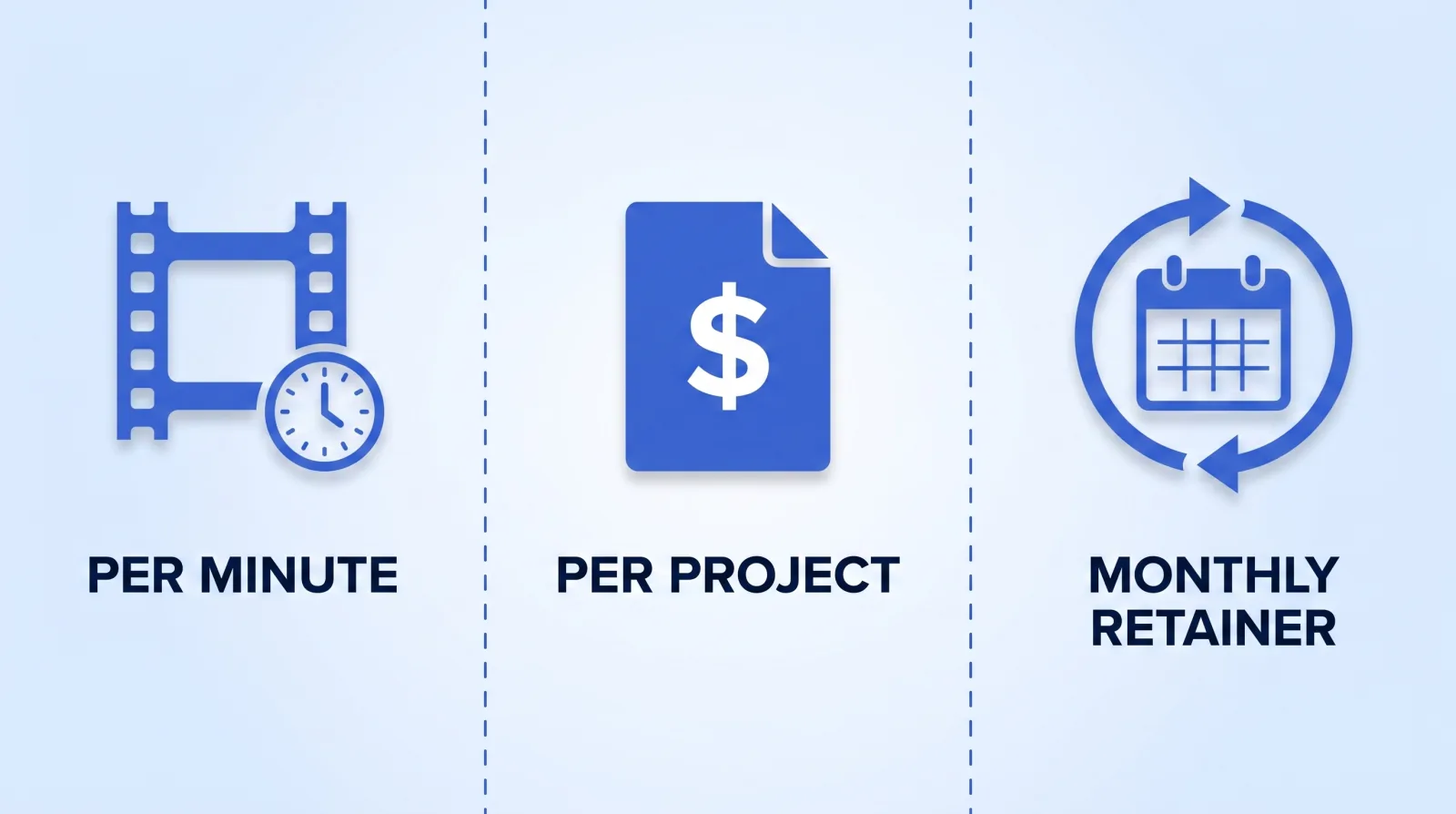
| Model | How it works | Fits | Where it bites you |
|---|---|---|---|
| Per finished minute | A rate ($15–$120+) times the runtime of the delivered cut | Talking-head, podcast, course modules — anything with predictable density | A 20-minute video with three cuts costs the same as one with 400. Editors either pad or lose money |
| Per project | One fixed fee for a defined deliverable set | One-off launches, ads, sizzle reels, anything with graphics | Scope creep. Without a written revision cap, the fee is fixed and the hours are not |
| Monthly retainer | A recurring fee buying a set output (e.g. 4 long-form + 12 shorts) | Publishing on a schedule, 4+ videos a month | You pay in slow months. Only worth it above roughly three videos a month |
Per-minute pricing is the most quoted and the most misleading, because runtime and effort are barely correlated. A 30-minute unedited interview trimmed to 22 minutes is a fraction of the work of a 6-minute ad. Ask any per-minute quote what it assumes about source-to-delivery ratio — if the answer is "however much you send", the rate is either padded or about to be renegotiated.
Retainers are where serious channels end up, and the reason is not the discount. It is that a retained editor stops re-learning your show every month. Our own retainer clients get faster turnarounds in month four than month one on the same fee, purely because the templates, the caption styling and the format are already built.
What Actually Moves the Price
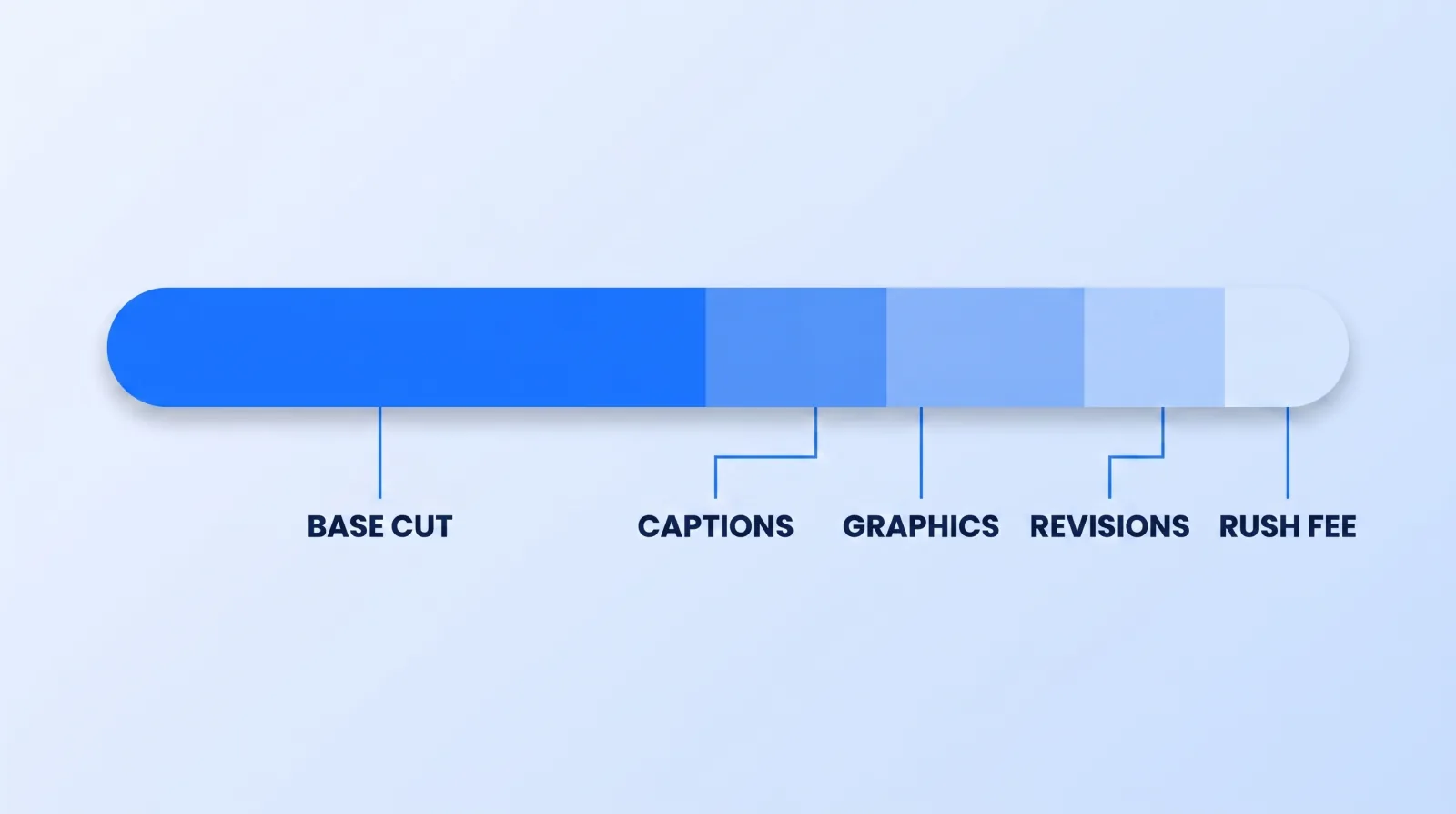
Six variables account for nearly all the spread between quotes. Nothing else moves the number much.
- Source-to-delivery ratio. Two hours of footage for an eight-minute cut is a different job from twelve minutes of footage for an eight-minute cut. This is the single biggest driver and the one clients never mention.
- Deliverable count. One horizontal master versus one master plus eight verticals. Ask for the verticals up front; retrofitting them costs 30–45 minutes each versus 10–15 when planned. That maths is in framing one take for both aspect ratios.
- Motion graphics. Lower thirds from an existing template are nearly free. Bespoke animated sequences are their own line item, often $50–$300 each.
- Captions. Automated captioning through a tool like Submagic is cheap; hand-corrected, properly timed captions are an hour of human work. Which one you need is covered in burned-in vs closed captions.
- Revision rounds. Two included rounds is standard. Unlimited revisions is a pricing structure, not a favour — it is priced into the base fee, and you pay for it whether you use it or not.
- Turnaround. A 24-hour rush displaces other work in the queue and reliably carries a 25–50% premium. Every studio charges it; some just hide it in the base rate.
Music and stock are separate again — a licensed music subscription is usually the client's cost, not the editor's, and it is worth confirming who is paying before invoice day.
The Real Bands in 2026
These are the bands we see across the market, quoted per finished long-form video of roughly 8–12 minutes. They are not a price list; they are what a quote in each band buys.
| Band | Per video | What you actually get |
|---|---|---|
| Under $75 | $25–$75 | Assembly editing. Cuts, basic music, auto-captions. No grade, no sound work, no judgement about structure |
| Working rate | $150–$400 | A competent full edit: pacing, colour, sound levels, templated graphics, captions, two revisions |
| Studio rate | $400–$1,200 | The above plus bespoke graphics, multi-cam, a real audio pass, shorts derived from the master, and someone accountable for the schedule |
| Premium / agency | $1,200–$3,000+ | Creative direction, scripting input, brand systems, dedicated team, contractual turnaround |
For published rates by format, see our breakdowns of YouTube video editing cost, short-form video editing cost, podcast editing cost per episode, YouTube thumbnail cost, YouTube intro and outro cost, video ad editing cost, corporate video editing cost, real estate video editing cost, sports highlight video cost and documentary editing cost.
Most creators over-buy at the bottom and under-buy at the top. If your channel is monetised, the arithmetic in our channel unit economics breakdown usually shows the working rate paying for itself somewhere around 15–25k views per upload. Below that, the $75 band is a rational choice. Above it, you are leaving money on the table to save $200.
Seven Questions to Ask Before You Pay Anyone
Price is the question buyers lead with. In our study of 704 buyer conversations, it was the first question in 22.9% of first messages, three times as often as turnaround, yet only 76 first messages mentioned a budget. A quote can only be as precise as what it was given, which is why the first and third questions below come before any comparison.
- What source-to-delivery ratio does this quote assume? Get a number. "Up to 90 minutes of footage" is a real answer; "whatever you send" is not.
- How many revision rounds are included, and what counts as one? A round is one consolidated set of notes, not one note.
- What is the turnaround, and what does rush cost? If there is no stated rush fee, there is no rush capability.
- Are verticals included or extra? Decide now, not after the master is approved.
- Who pays for music and stock licences? See our music licensing guide for why this one gets expensive quietly.
- What do I get if I leave? Project files, or just exports? Ask before the first invoice, not after the relationship sours.
- Show me an edit you did from footage as messy as mine. Not a showreel. A real before-and-after from a client whose raw material was ordinary.
Two of those seven — the ratio and the revision definition — will resolve most of the gap between two quotes that look wildly different. And the quality of your own brief moves the number too: our editor handoff framework exists partly because vague briefs get priced defensively.
If you're buying for a small business and want names to put these questions to, our list of the best video editing services for small businesses compares the options on published price, turnaround, revisions, commitment and filming.
The Quote Is Not the Cost
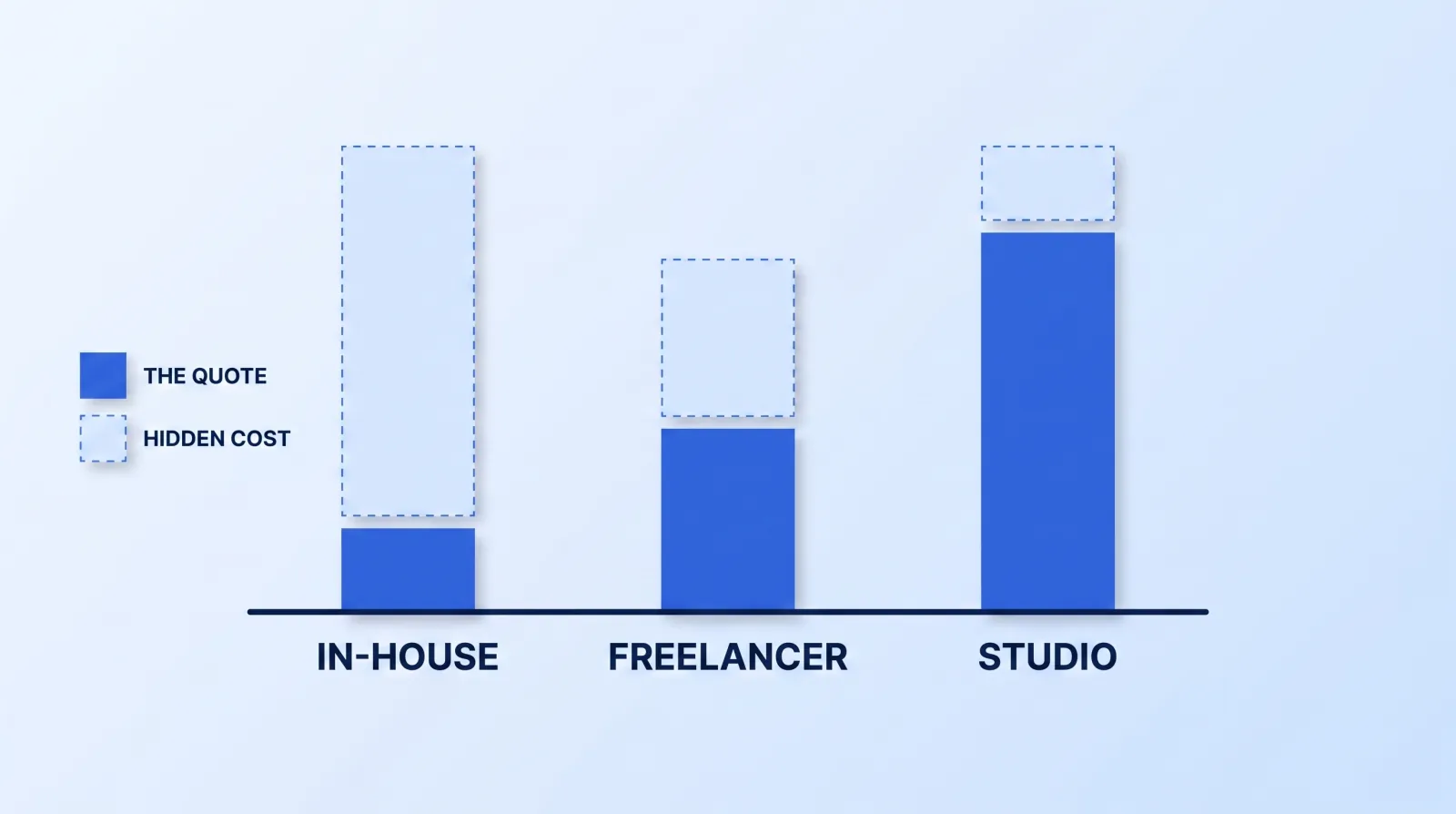
Every option carries cost that never appears on the invoice.
An in-house editor looks like a salary and is actually salary plus payroll taxes, benefits, recruiting, a machine, Resolve Studio or a Creative Cloud seat, storage, and the weeks of downtime when you have nothing for them to cut. It is genuinely the cheapest per-video option — but only above roughly twelve videos a month, and only if you can keep the queue full. We laid the full comparison out on our in-house editor vs studio page.
A freelancer is the cheapest quote and the highest variance. One person means one point of failure: a holiday, a better-paying client, or an illness stops your publishing schedule. Marketplace hiring compounds it — the churn and re-briefing cost is real, which is why we wrote up how marketplaces compare to a managed team.
A studio quotes higher and hides less. You are paying for a bench, a reviewer, and someone whose job is the deadline rather than the timeline. For volume buyers — the e-commerce brands we run ad edits for are the clearest case — the per-video price is higher and the cost per shipped video is lower, because nothing sits in a queue waiting on one person.
Two cheap controls make any of the three safer: run approvals through a proper review tool like Frame.io instead of a comment thread, and write notes the way our post on revision notes that actually get fixed describes. Vague feedback is the most expensive thing in this entire article, and it is free to fix. Deliverable specs matter too — an editor working to YouTube's recommended upload settings from the start does not re-export twice.
The Bottom Line
Video editing has no single price because "a video" is not a unit. Fix the specification — source ratio, deliverable count, revision rounds, turnaround — and the quotes converge to within about 30% of each other, at which point you are comparing craft instead of guesswork. Expect $150–$400 for a competent full edit of a standard long-form upload in 2026, treat anything under $75 as assembly labour, and judge the total by cost per shipped video rather than by the number on the invoice. Wistia's video marketing research is clear that consistency beats polish; the pricing model that keeps you publishing is the correct one.


