

The Three Options Cost About the Same. They Fail Differently.
At the volume most buyers actually publish — four to eight videos a month — an agency, a freelancer and a salaried in-house editor land within roughly 20% of each other per shipped video. The US Bureau of Labor Statistics puts the median annual wage for film and video editors at $75,420 as of May 2025, and that labour floor applies whether the person sits on your payroll, invoices you monthly, or works inside a studio. Nobody routes around it. What you are really choosing is who absorbs the bad week — the week footage lands late, the editor gets flu, the brief changes on a Friday, or three deadlines collide.
That reframing matters because buyers almost always compare these options on headline rate, conclude freelance is cheapest, and then meet the real cost twelve weeks later when their one editor goes quiet before a launch. Across 10,000+ editing projects sitting behind 100M+ views, we have onboarded clients migrating in every direction — freelancer to studio, studio to in-house, and in-house back out again. Those migrations are almost never triggered by price. They are triggered by a failure mode that finally bit.
If you have not settled on a budget yet, start with what video editing actually costs. If you're choosing between studios, the best video editing services for YouTubers compares them side by side. This post assumes you know the number and are deciding who to hand it to.
The Three Models, Side by Side
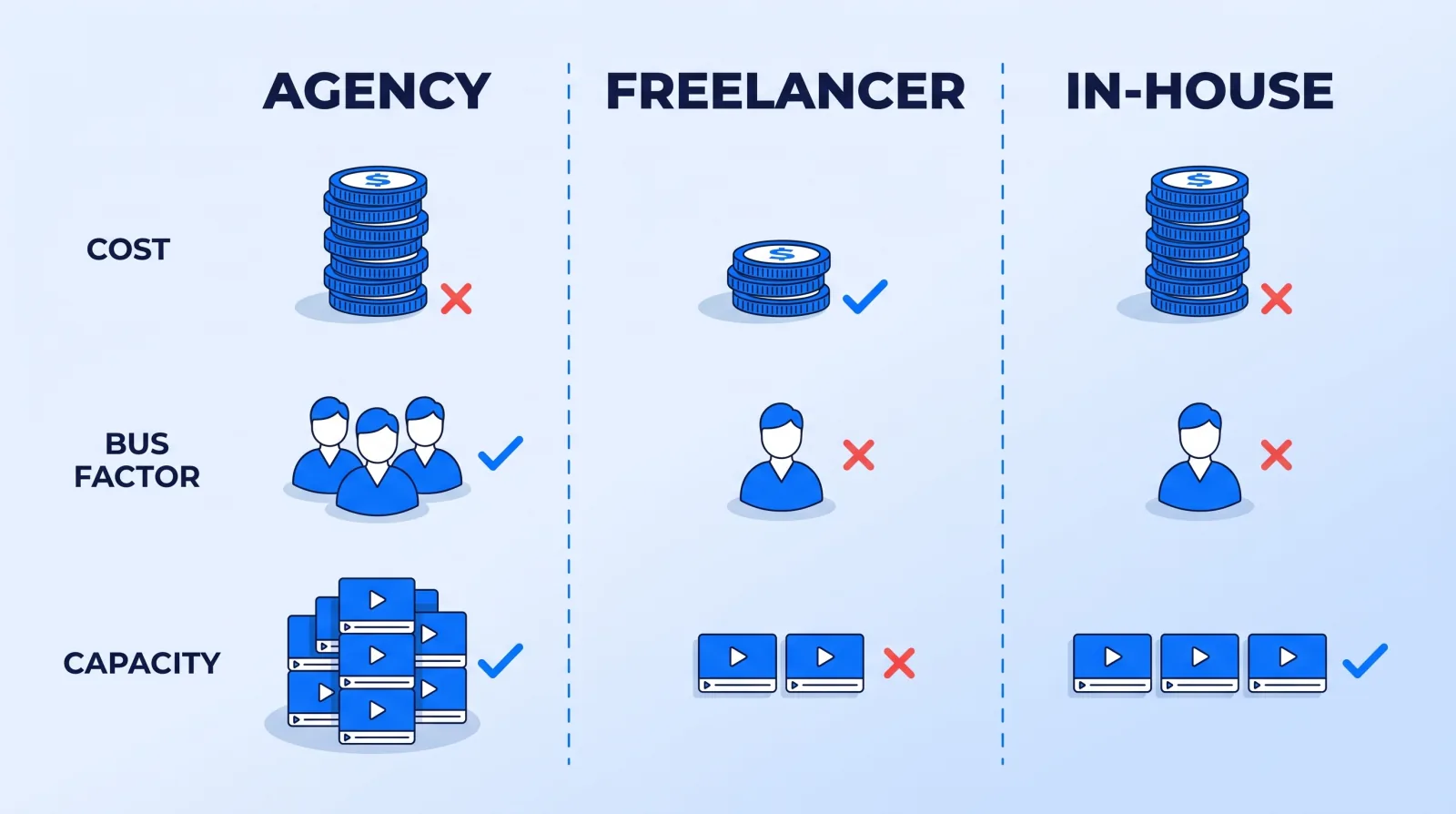
| Freelancer | Studio / agency | In-house editor | |
|---|---|---|---|
| Headline cost | Lowest per video | Middle to high per video | Highest fixed, lowest marginal |
| Bus factor | One | Several | One |
| Ramp to good | 2–4 videos | 1–3 videos (they onboard for a living) | 4–8 videos |
| Peak capacity | ~1 video at a time | Several in parallel | ~1 video at a time |
| Cost in a slow month | Zero | Retainer, or zero on per-project | Full salary |
| Who chases the deadline | You | Their producer | You |
| Institutional memory | Leaves with them | Lives in the studio's docs | Leaves with them |
| Best at | One format, steady low volume | Mixed formats, spikes, hard dates | High volume, tight brand control |
The row that decides most engagements is peak capacity, not cost. A freelancer is a serial processor. If you need a long-form master, eight verticals and a paid-ad cut by Thursday, one person physically cannot parallelise that, so your deadline becomes their queue order. A studio can put three editors on it. Whether you need that capability at all is a question about your calendar, not your budget.
The row that decides most regrets is institutional memory. When a freelancer or a solo in-house editor leaves, your caption styling, export presets, project templates and every unwritten preference walk out with them. That is a real, quantifiable relaunch cost — usually two to four videos of degraded output while the replacement rebuilds what was in someone's head.
What In-House Actually Costs (The Number Almost Nobody Runs)
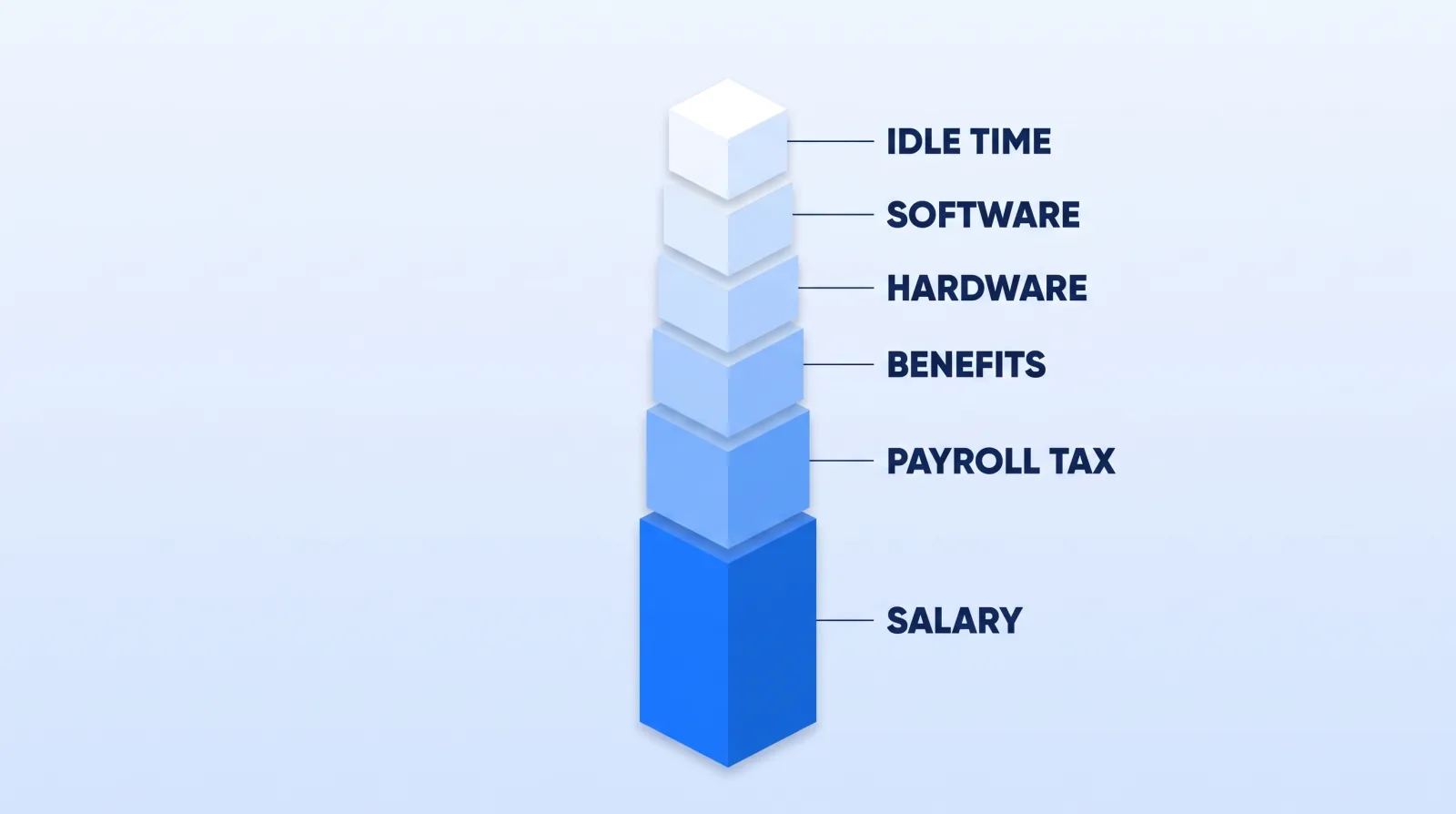
Salary is not the cost. BLS Employer Costs for Employee Compensation data consistently shows benefits running around 30% on top of wages for civilian workers — so a $65,000 editor is a ~$85,000 line item before you have bought them anything to edit on.
| Line item | Annual, realistic |
|---|---|
| Base salary | $60,000 – $80,000 |
| Payroll tax + benefits (~30%) | $18,000 – $24,000 |
| Workstation + storage, amortised | $2,000 – $4,000 |
| Software licences (NLE, plugins, stock, music) | $1,500 – $4,000 |
| Recruiting, amortised over ~2 years | $2,000 – $5,000 |
| Fully loaded | $83,500 – $117,000 |
Divide that by output. At 12 videos a month it is roughly $580–$810 per video — competitive with studio rate, and you get total brand control. At 4 videos a month the same hire is $1,740–$2,440 per video, which is premium-agency money for one person's opinion and no redundancy. The threshold is queue occupancy, not headcount ambition. You are not paying for an editor; you are paying for a full queue, and every idle week is billed to you at full rate. To run that division with your own salary, volume and freelancer rate, use the free video editor hiring cost calculator.
Software is the line people misjudge in both directions. DaVinci Resolve has a genuinely capable free tier, so the NLE itself can be $0 — but a licensed music subscription, stock, plugins and a review platform like Frame.io are recurring costs that a studio absorbs into its rate and an in-house hire adds to yours. We break the full fixed-cost comparison down on our in-house editor comparison page.
Bus Factor Is the Risk You Only Price After It Happens
Both the freelancer and the solo in-house editor have a bus factor of one. This is the single most under-weighted variable in the decision, because it costs nothing until it costs everything.
The mitigations are not symmetrical. An in-house editor at least gives you notice, a handover window and files on company storage. A freelancer who stops replying gives you none of those, and if the project files live on their drive under their licence, recovery can take longer than re-editing from scratch. Four protections are worth building on day one regardless of model:
- Own the storage. Footage and project files live in your cloud, shared to them — never the reverse.
- Own the accounts. Grant channel access through YouTube's permission roles, never a shared password, so access is revocable without a credential reset.
- Own the documentation. A written style sheet is the only version of institutional memory that does not resign.
- Own the licences. Music and stock subscriptions in your name, so nothing is retroactively unlicensed when someone leaves.
Do those four and a freelancer's bus factor of one becomes survivable rather than existential. Skip them and even an agency relationship gets painful to exit.
Turnaround Variance Beats Turnaround Speed
Buyers ask "how fast?" The question that predicts satisfaction is "how consistent?" A freelancer who delivers in 48 hours nine times and eight days on the tenth is worse to plan around than a studio that always takes four days, because your publishing calendar is built on the promise, not the average.
Studios buy down variance with a bench — that is most of what the premium is for. A solo operator cannot, which is why their variance tracks their personal life, and an in-house editor cannot either, which is why your calendar quietly reshapes itself around their holiday. The full breakdown of what each turnaround tier buys is in how long a video edit actually takes.
The Volume Thresholds
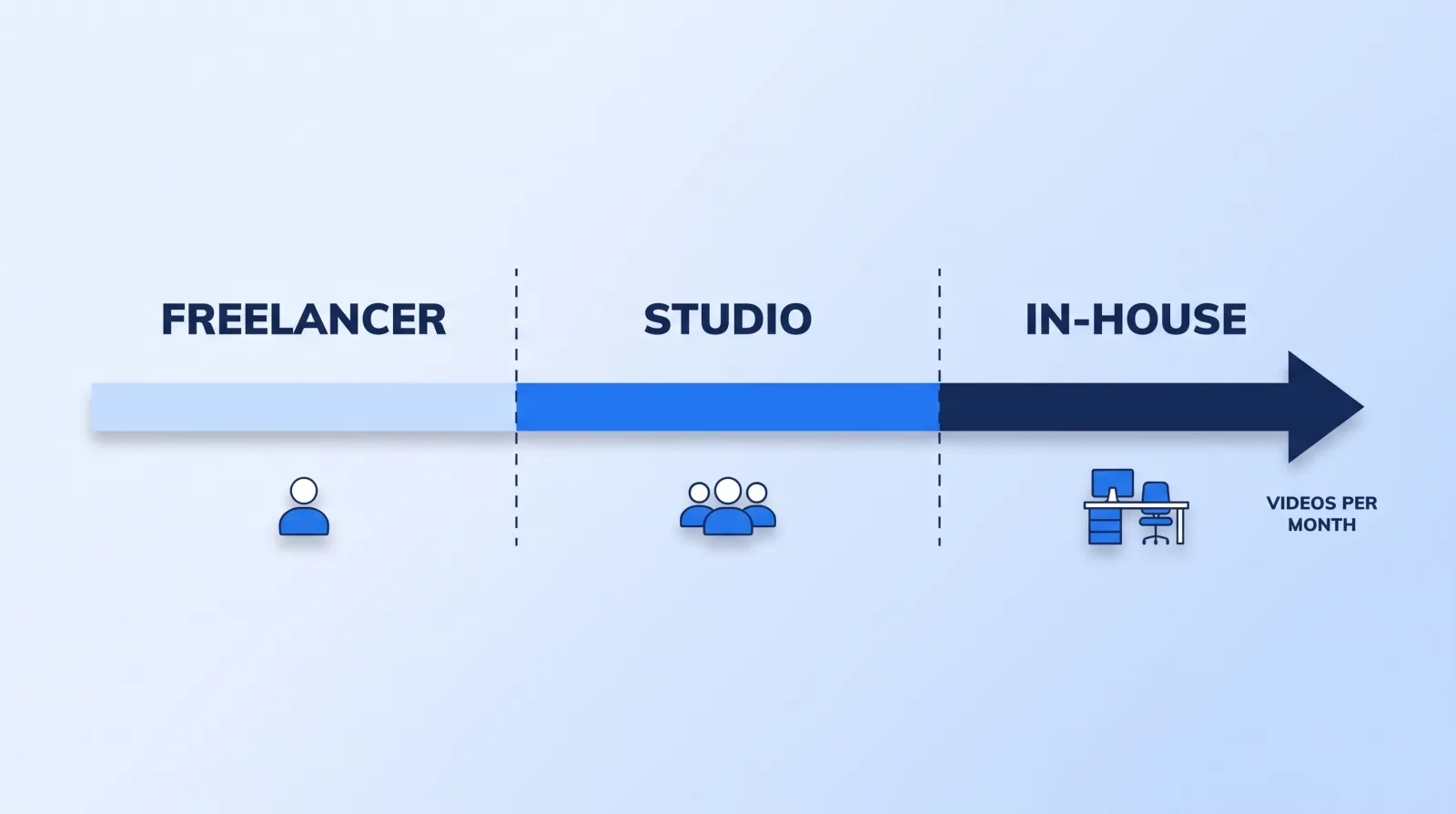
With 91% of businesses now using video in their marketing, most teams are publishing more than they planned to, so run this against next quarter's calendar rather than last quarter's:
- Under 4 videos a month, one format, no hard dates. Freelancer. Anything else is over-buying. Vet properly — the marketplaces are a mixed bag, which is why we maintain a freelance marketplace comparison and step-by-step guides to hiring on Fiverr and on Upwork.
- 4–12 videos a month, or mixed deliverables, or fixed publish dates. Studio. You are buying parallel capacity and someone else chasing the schedule. To see what a set monthly output looks like at that volume, compare Mark Studios' monthly plans.
- 12+ videos a month, sustained for two consecutive quarters, with a queue you can guarantee. In-house starts winning on cost. The clients who make this work are usually SaaS content teams with a contractual content calendar, not creators whose output varies with motivation.
- Spiky volume at any level. Studio, or a small in-house core plus overflow. A salaried hire cannot flex, and a freelancer cannot absorb a spike.
- Any volume, but the brand is the product. In-house or a retained studio. Never a rotating cast of marketplace freelancers.
The most expensive mistake we see is skipping straight to step 3 on projected volume. If the queue does not stay full, you have converted a variable cost into a fixed one and bought a bus factor of one at the same time.
Pick by Failure Mode, Not by Price
Ask which failure you can least afford to survive, and the answer chooses itself. If a missed launch date is unsurvivable, you need a bench, and only a studio has one. If an unpredictable monthly bill is unsurvivable, you need a retainer or a salary, not per-project quotes. If losing your visual identity to a resignation is unsurvivable, you need documentation and shared storage far more than you need any particular model.
And if you cannot answer the question yet, hire the reversible option. A freelancer or a studio can be replaced in a week. An in-house hire cannot, and building your own team is a different project with its own hiring, management and retention overhead — one we mapped out in hiring and managing a global editing team. Whichever way you go, vet the provider properly first; the model matters far less than the operator inside it. If a studio fits, our professional video editing services page shows what Mark Studios edits and how a project runs. And if the option you're weighing is no editor at all, AI video editor vs hiring an editor covers what CapCut and Descript can and can't take off your plate.
The Bottom Line
The three models are close enough on price that price should not decide it. Choose on capacity if your deliverables are mixed, on bus factor if continuity matters more than rate, and on volume if you are seriously considering a salary — in-house only pays below roughly $600 per video once you keep the queue genuinely full. Everything else is a preference, and preferences are cheap to change when you picked the reversible option.


