

YouTube Publishes the Definition of a Show. Most Channels Fail It on the First Line.
Open YouTube's documentation on creating shows from your videos and the platform gives you a spec, not a suggestion. A show is "a collection of high-quality episodes with a clear connection across episodes," where episodes share "the same characters or hosts, tell one long story, or talk about a similar topic" — and carry "the same intro, same style of thumbnails, and same video format."
Read that last clause again. YouTube is not describing a creative preference. It is describing the thing it can recognise, group, and re-surface. And on the audience side it says the same thing from the other direction: YouTube's guidance on new, casual and regular viewers tells creators that the way to convert first-time watchers into loyal ones is "content that's more consistent and similar in topic or format," built as "a series of videos from topics that have already proven popular."
Across 10,000+ projects at Mark Studios — the work behind 100M+ views — the channels that plateau almost never have an idea problem. They have a format problem. Every upload is a fresh negotiation: new structure, new brief, new argument about what the intro should be — the exact problem a well-produced recurring vlog format is built to solve. Nothing compounds, because nothing repeats.
The Four Layers of a Format
A format is not a logo and an intro sting. It is four decisions, stacked, and each one below carries the one above it.
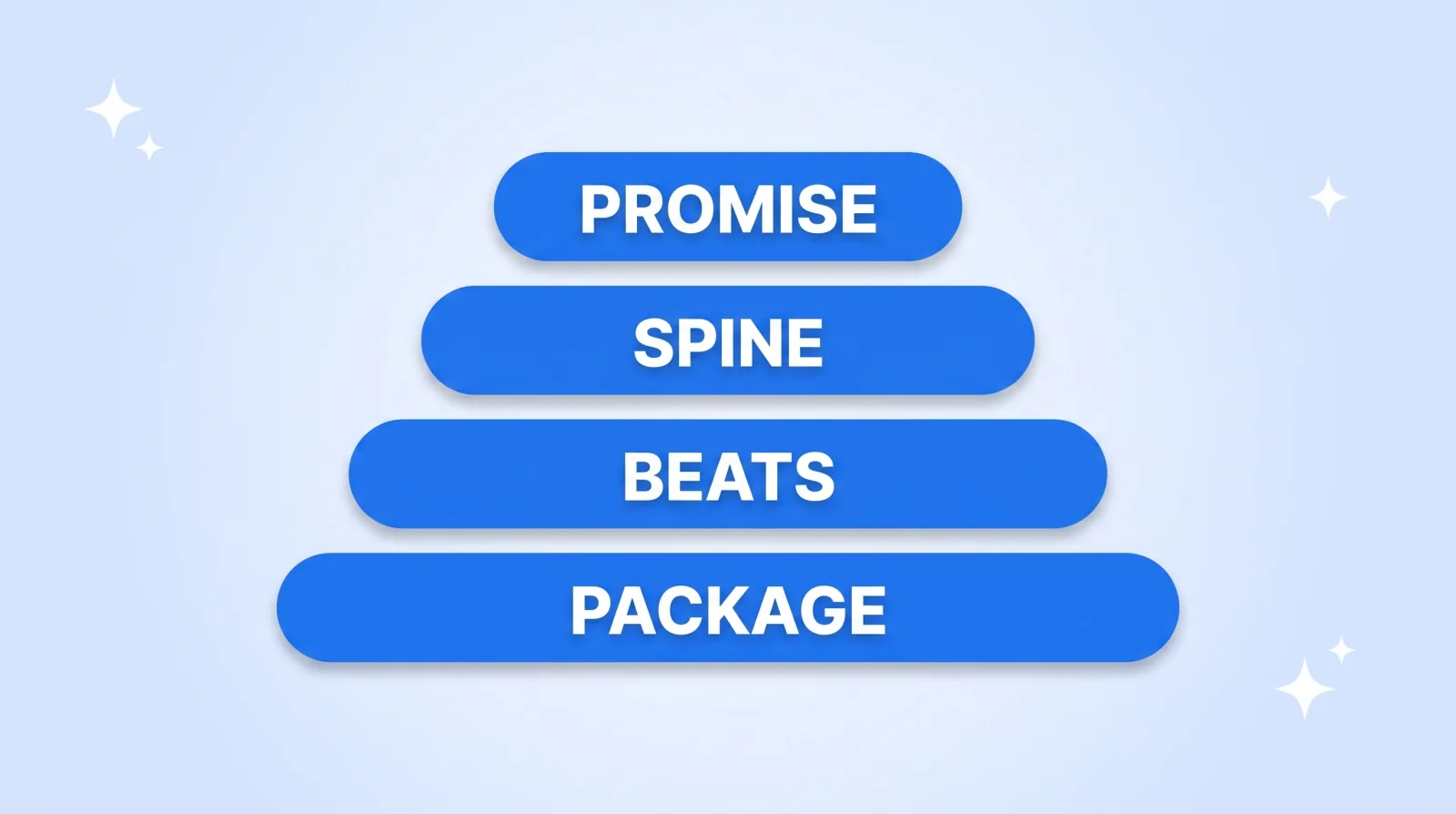
- Promise — one sentence naming who the show is for and what they get every single time. If you cannot say it without the word "and," it is two shows.
- Spine — the fixed order of segments inside an episode, with rough timings. This is the layer that makes an episode feel like an episode rather than an upload.
- Beats — the two or three recurring moments viewers come to expect: the scorecard, the running gag, the same sign-off line in the same shot.
- Package — the title pattern, the thumbnail template, the intro, the music bed, the chapter naming convention.
Most creators build the Package and stop. It is the visible layer, and it is where a visual identity system lives. But a beautiful package with no spine underneath still costs full price to make every week.
What Repeats and What Varies
The failure mode is not "too repetitive." It is repeating the wrong layer. Creators who fear sameness lock the topic and vary the structure — which is exactly backwards, and produces a channel that feels samey and disorganised at once.
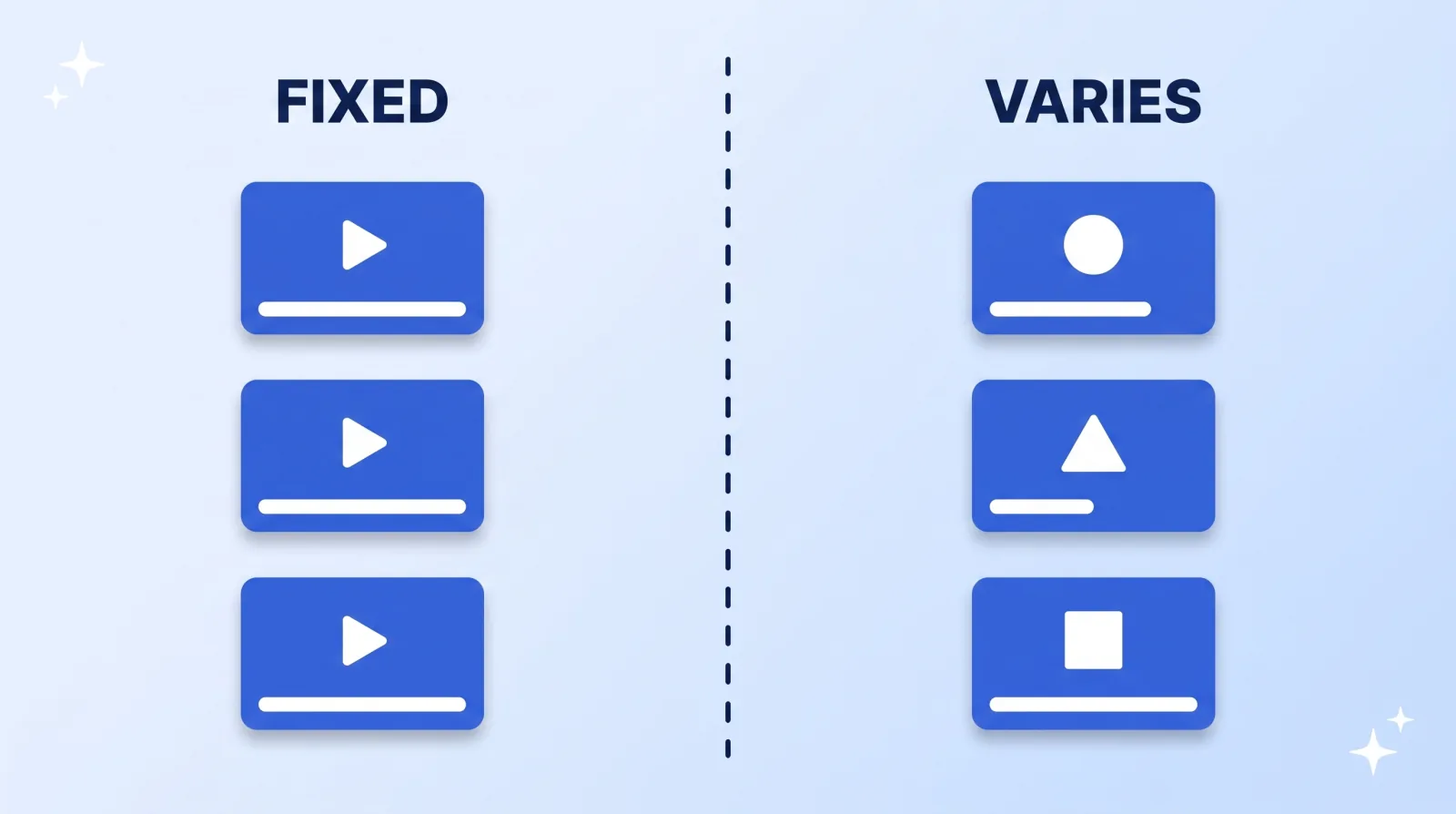
| Layer | Locked for the whole season | Rewritten every episode |
|---|---|---|
| Promise | Who it is for, what they get | Nothing |
| Spine | Segment order and rough timings | Which subject fills each segment |
| Beats | The recurring bits and their graphics | The content inside each beat |
| Package | Title pattern, thumbnail template, intro, music bed | The variable half of the title, the subject on the thumbnail |
Here is what a spine actually looks like written down — this is the shape of document we ask every format client to sign off before episode one:
EPISODE SPINE — "The Teardown" (runs 12–16 min)

0:00   COLD OPEN      The single worst thing we found, no setup
0:20   TITLE CARD     4 seconds, identical animation every episode
0:24   FRAME          Who this show is for, what today's subject is
1:10   SEGMENT 1      The setup — what they were trying to do
4:00   SEGMENT 2      The teardown — exactly three named failures
9:00   THE SCORECARD  Recurring beat: same five criteria, same graphic
11:30  THE FIX        What we would have done instead
14:00  SIGN-OFF       Same line, same shot, every episode
Nothing in that document says what the episode is about. That is the point. The subject is the only variable, and it is the only part you should be spending creative energy on each week.
The Format Dividend Shows Up in the Edit
A format is a production system before it is an audience strategy, and the savings are not subtle.
When a channel has a spine, the editor brief stops being written from scratch. It becomes a diff: here is episode 12, here is what changed from episode 11. Nobody has to ask where the graphics go, because they went in the same place last time. Revision rounds compress hardest of all — "correct" is no longer a matter of taste, it is whatever the previous episode did, which means a note can be settled by pointing at a timestamp instead of arguing.
The same discipline is what makes batching possible. You cannot shoot four episodes in a day if each has a different structure — you can only batch a thing that has a template. Formatless channels produce at 1x forever, which is why the cadence starts to feel like a treadmill.
Wiring the Format Into YouTube's Own Plumbing
Once the format exists on paper, YouTube gives you two mechanisms to declare it, and almost nobody uses either.
Series playlists. A series playlist "allows you to mark your playlist as an official set of videos that should be viewed together," and the payoff is stated plainly: it "allows other videos in the playlist to be featured and recommended when someone is viewing a video in the series." YouTube's series playlist documentation lists the constraints too — you need a verified account, only your own videos qualify, and "a video cannot appear in more than one series playlist." That last rule is why a format has to be a real, bounded thing rather than a loose vibe.
Shows, seasons and episodes. The newer Shows tooling lets you promote an existing playlist into a show with seasons, episode numbers, artwork and descriptions. YouTube distinguishes non-serial shows (watchable in any order, listed newest to oldest) from serial ones (meant to be watched in sequence, listed oldest to newest), and notes that shows "may be eligible to appear in search as well as under 'Recommended shows' and 'Continue watching.'" Getting into a "Continue watching" shelf is a distribution surface you cannot buy and cannot thumbnail your way into.
Both sit in the same family as playlists, end screens and cards, with one difference: a series or a show tells YouTube the videos belong together as a unit, rather than nudging one viewer toward one next video.
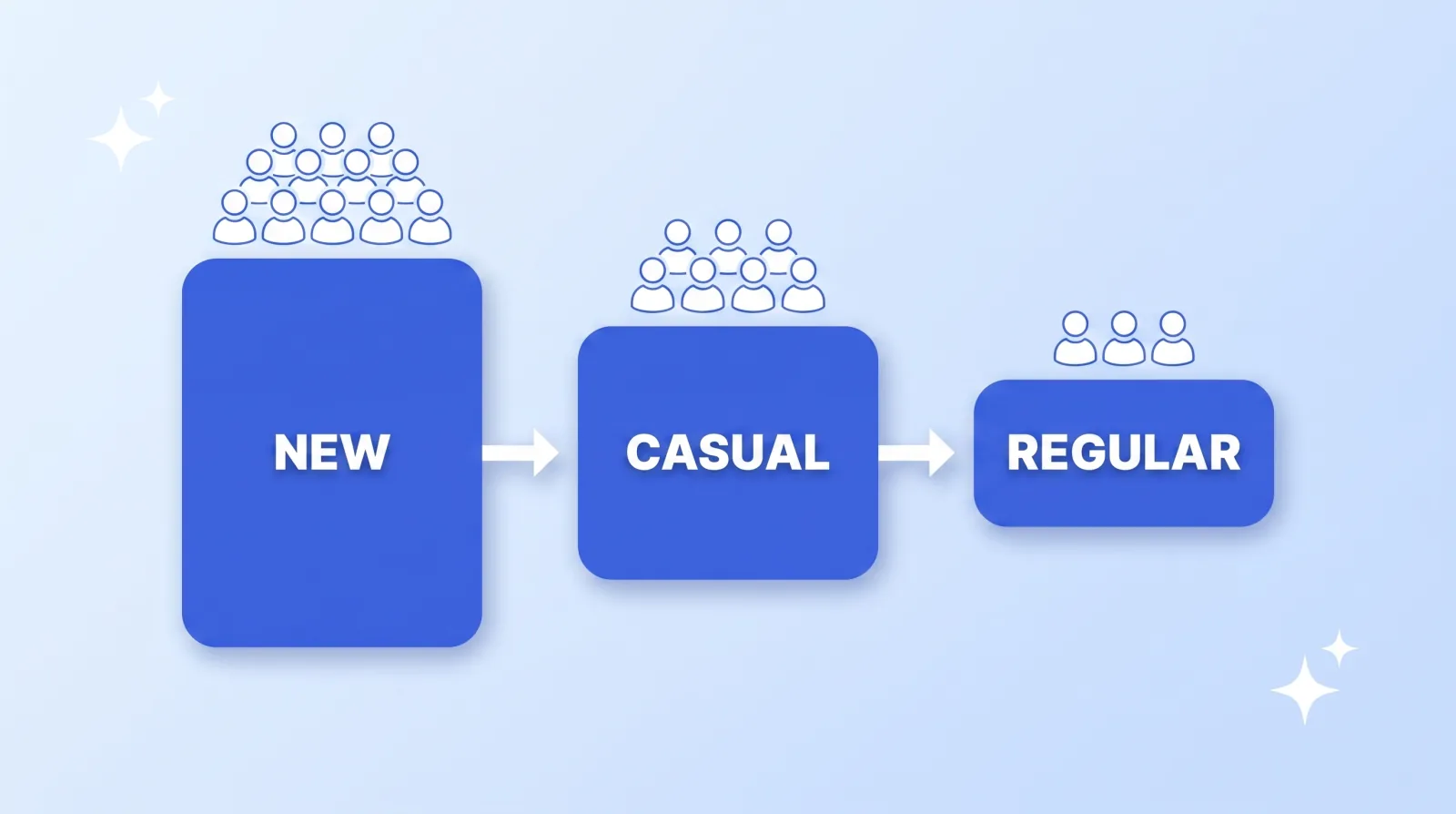
It is worth knowing what you are aiming at. YouTube defines regular viewers as people who "have returned to watch your content for at least six months in the past year." That is a twelve-episode commitment at minimum on a monthly cadence — which is the real reason format beats individual hits. YouTube's own explanation of how recommendations work confirms it "also consider[s] the reputation and the quality of a channel to determine how, when, and to whom the content can be surfaced." Channels are the unit being judged, not videos.
The Format Design Gate
Run this before episode one, not after episode nine:
- ✅ Write the promise in one sentence with no "and" in it
- ✅ Name the show, separately from the channel name — it goes in every title
- ✅ Lock the spine as a timed rundown and get everyone to sign off on it
- ✅ Choose two or three recurring beats you are willing to make 20 times
- ✅ Build the package once — title pattern, thumbnail template, intro, music bed
- ✅ Commit to a season length (8 to 12 episodes) before you judge whether it works
- ✅ Create the series playlist or show and set the season and episode numbers
- ✅ Check Analytics → Audience → returning viewers 90 days in, against the baseline you recorded on day one
Item 6 is the one people skip, and it is the one that decides the outcome. A format judged on three episodes will always look worse than a one-off, because the compounding has not happened yet. Formats are priced like infrastructure: expensive at the start, nearly free by episode ten.
The Bottom Line
YouTube has said what it is looking for in unusually plain language: the same intro, the same thumbnail style, the same video format, and topics consistent enough to turn a first-time viewer into someone who returns across six months. Almost no channel supplies it, because supplying it means designing a container once instead of designing every video.
Lock the promise, the spine and two or three beats. Vary only the subject. Then declare it to the platform with a series playlist or a show, and give it a full season before you decide whether it worked.


