The Person You Are Paying Is Usually a Business of One
Roughly one in three U.S. film and video editors — 14,000 of about 39,400 — is self-employed, according to the Bureau of Labor Statistics employment projections we catalogued in our video editing statistics ledger. The BLS employer survey behind most published "editor salary" figures does not count them at all, because it only measures wage-and-salary jobs (BLS Occupational Outlook Handbook).
That has a practical consequence nobody puts in a pitch deck: when you hire an editor, there is usually no accounts-receivable department, no procurement process, and no arbitration clause. The payment structure is the contract — the only part of the arrangement that is genuinely enforced, by the fact that money either moves or it does not.
Across 10,000+ delivered editing projects sitting behind 200M+ views and more than $10M in client revenue, we have been paid every way there is: platform escrow, wire, half-now-half-on-delivery, monthly retainer, and the occasional buyer who insisted on net-45 for a $300 edit. How someone structures payment tells you more about how they run their shop than their demo reel does. Reels are curated; terms are operational.
This is standard industry practice, not legal or financial advice. For anything with real money attached, have your own advisor read the agreement.
Five Ways the Money Actually Moves
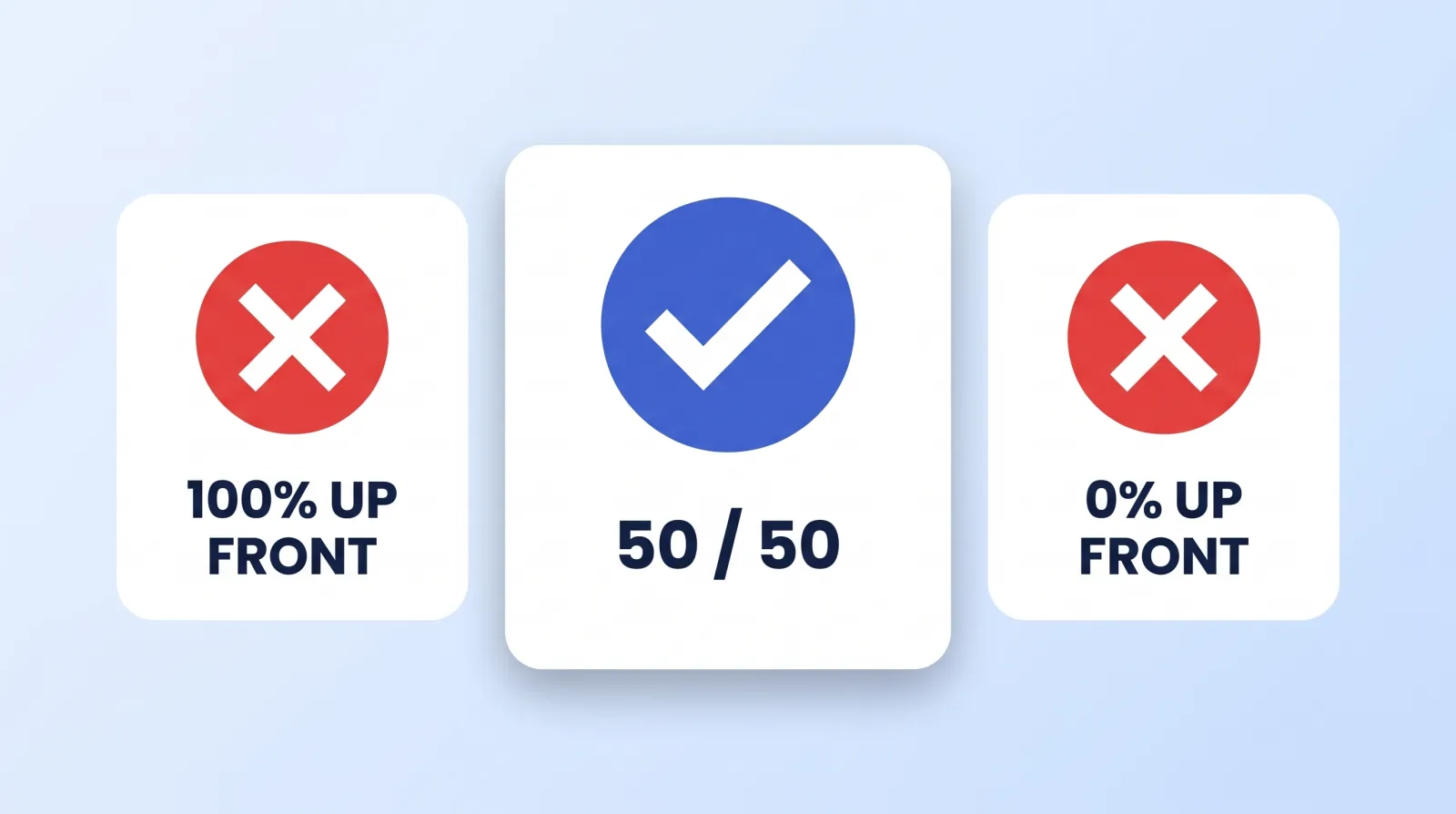
There are five structures in common use; everything else is a variation.
| Structure | How it works | Who it protects | When it is normal |
|---|---|---|---|
| 100% up front | Full payment before work starts | The editor, entirely | Small fixed-price jobs; any first job under ~$150 |
| Deposit + balance | Typically 50% to start, 50% on approval | Both, roughly evenly | The default for project work above ~$300 |
| Milestone | Payment released at named stages | Both, precisely | Multi-video packages, long-form, anything over ~$2,000 |
| Platform escrow | Buyer funds up front, platform releases on acceptance | The transaction itself | Marketplace hiring, first engagements |
| Net terms | Invoice on delivery, paid in 15/30/45 days | The buyer's cash flow | Established retainers; companies with real AP |
The one buyers guess wrong most often is the deposit. It is not a trust test — it is a schedule reservation. An editor holding a week for you is a week they cannot sell to anyone else. That is why every working shop asks for something, and why "pay me when you're happy" is rare.
What the Terms Signal About the Shop
Read the ask, not just the number.
- 100% up front, direct to a personal account, from someone you have never worked with. Not automatically a scam — it is how most sub-$150 work is priced, because collection costs more than the job is worth. But it is the highest-risk position available, so match it to the smallest possible first job.
- A deposit in the 30–50% range with a named balance trigger. The most common shape among established shops. The balance trigger matters more than the percentage: "on approval" is good, "on delivery" is better defined, "when you're satisfied" is a dispute waiting to happen.
- Nothing up front at all. Worth one question. Either the shop is well-capitalised, or it is absorbing scheduling risk it has not priced — and unpriced risk surfaces later as a missed deadline rather than a refund.
- Net-30 offered unprompted on a first engagement. Usually a sign you are dealing with a business that has done corporate work. The SBA's guidance on managing business finances is blunt about why small vendors avoid it: every day of terms is a day they are financing you.
- A number that drops sharply when you push, with no change in scope. Price that moves 40% on a single email was never anchored to the work. Our post on what video editing actually costs lays out the bands that hold.
None of these is a verdict alone. With a paid trial they are most of the picture, which is why we treat commercial terms as a vetting input alongside craft in our guide to vetting a video editing service.
Platform Escrow vs Paying Direct
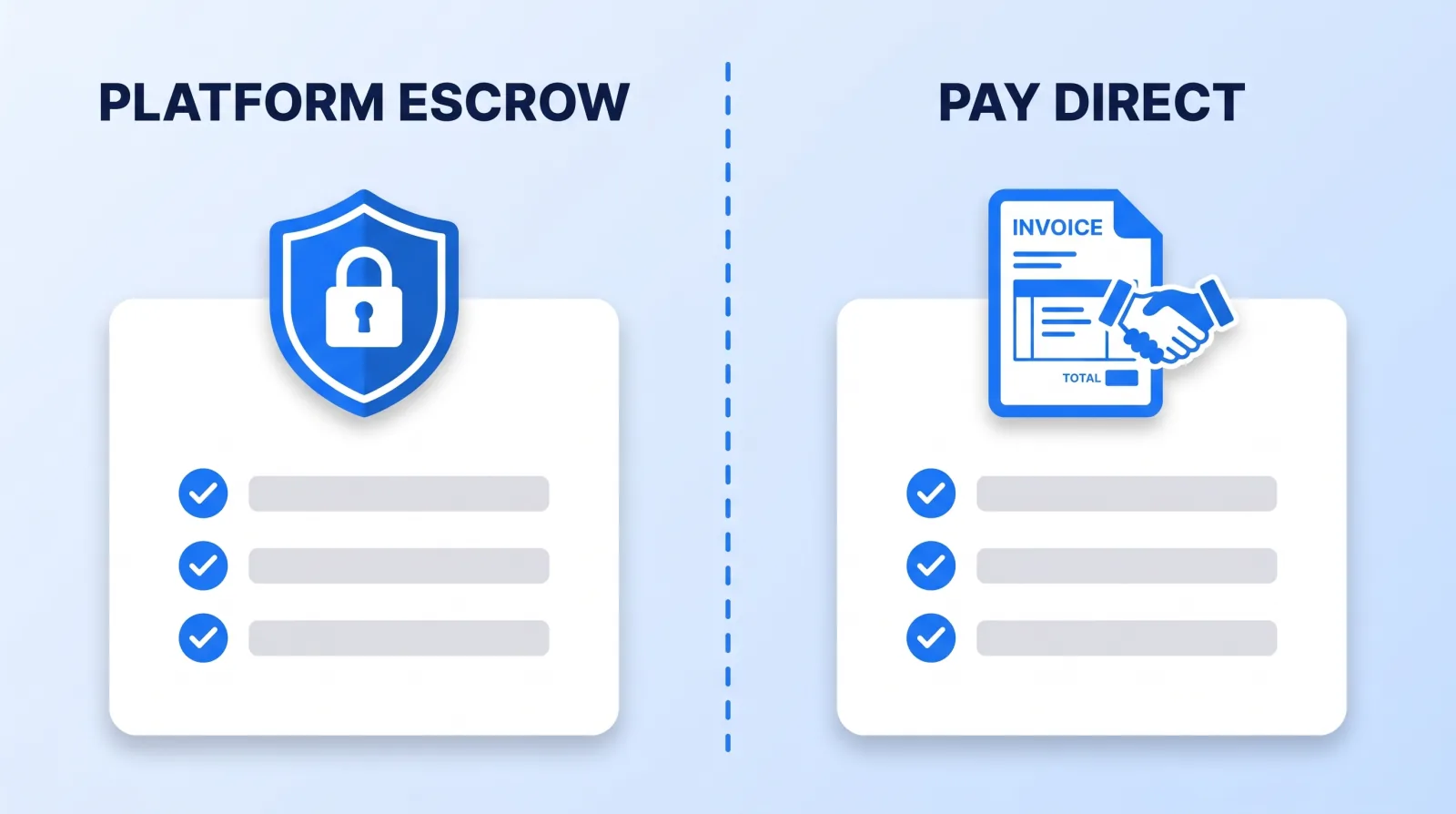
This is a genuine trade, not a right answer.
Escrow on a marketplace means your money is taken up front and held until you accept delivery. You get a dispute process, a paper trail, and a counterparty the platform can actually reach. You pay for it in fees, in a delivery definition set by the platform, and in a relationship that lives inside someone else's messaging system. The structural trade-offs are laid out in our freelance marketplaces comparison.
Paying direct removes the fee and the buffer in the same motion. It is the right call once a working relationship exists, when you need a scope the platform's delivery model does not describe, or when your finance process requires a real invoice. It is the wrong call for a first job with someone you found yesterday.
One control worth more than either: pay by card or through a payment processor rather than by bank transfer or crypto. A card carries a dispute mechanism that a wire does not — the FTC's guidance on disputing credit card charges covers the rights involved. For founders putting this on a company card, it also gives your bookkeeper something to reconcile against.
Nine Things to Settle Before Money Moves
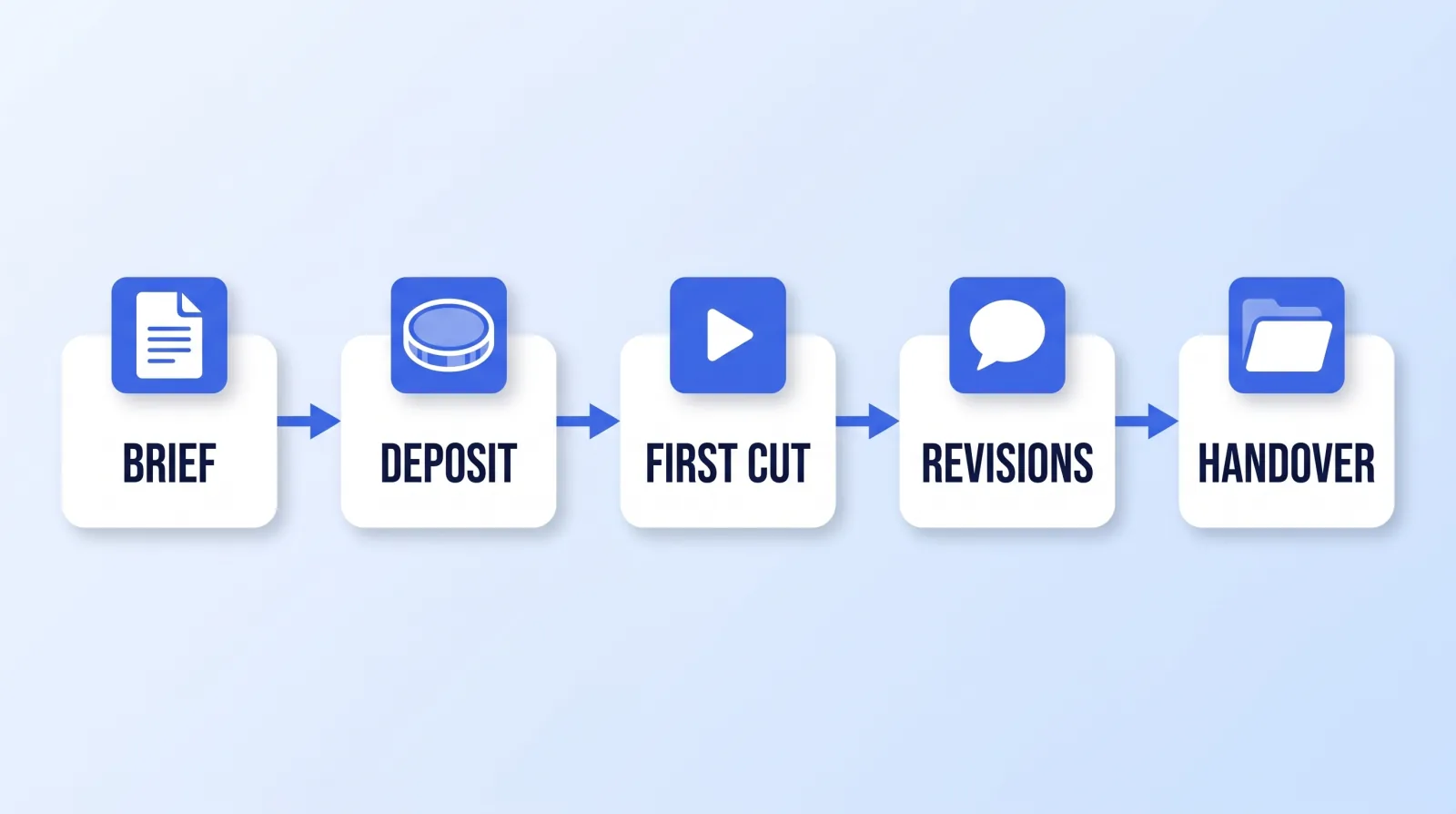
Work through this before the first transfer, not after the first problem.
- The deliverables are itemised. "One edited video" is not a list. Count, format, aspect ratios, caption files, thumbnails.
- The number of included revision rounds is named, and so is the price of an extra one.
- The balance trigger is an event, not a feeling. "On approval of the final cut" beats "on completion."
- A revision round has a definition. One consolidated set of notes, not an open channel — the standard our post on revision notes that actually get fixed describes.
- Rush and scope-change pricing exists in writing before you need it. Every shop has a rush rate; the ones that quote it after the fact are the problem.
- Approval happens somewhere reviewable. A proper tool like Frame.io timestamps who approved what. A group chat does not.
- Copyright transfer on final payment is stated explicitly. Under US Copyright Office Circular 30, contractor work is "made for hire" only in narrow statutory categories and with a signed agreement — an invoice transfers nothing. The full picture is in who owns your project files.
- The project archive is a line item, not a favour you ask for later.
- You know the legal name behind the account you are paying. For a one-person business this is the most useful thing to have and the least awkward to ask for at quoting time.
When Delivery Goes Wrong Mid-Payment
The deposit is paid, the date has passed, and the replies have slowed. Work in this order.
Establish whether it is a delay or a disappearance. They need opposite responses and look identical in week one. A missed date with a message attached is a delay; three days of silence on a same-day-responsive channel is something else — the signals are in our post on what to do when your video editor disappears.
Ask for the work in its current state, not for the money. A project archive of a half-finished edit is worth more than a contested deposit, because it is the thing a second editor can pick up. Request it while goodwill still exists.
Use the mechanism that matches how you paid. Escrow means open a dispute inside the platform's window — finite, and it closes quietly. Card means contact the issuer. Bank transfer means you are negotiating, and your leverage is whatever future work you represent.
Then fix the structure rather than the person. In almost every rescue we have been called into, the failure traced to a payment shape rather than a bad actor: the entire fee paid before a single frame existed, or a balance tied to "first cut" so nothing was owed for the revisions that make a video usable. Wistia's research keeps landing on the same conclusion — consistency beats one-off polish — and a structure that stalls your calendar for three weeks costs far more than the deposit it put at risk.
The Bottom Line
Ask how payment is structured before you ask for a price. A roughly even deposit-and-balance split with the balance tied to a named approval event is what a working engagement looks like; pay by a method that carries a dispute mechanism; and settle deliverables, revision counts, copyright transfer, and the project archive in writing before the first transfer. The terms are the cheapest due diligence you have, and unlike a demo reel they cannot be curated.