The Calendar Is Section Nine, Not Section One
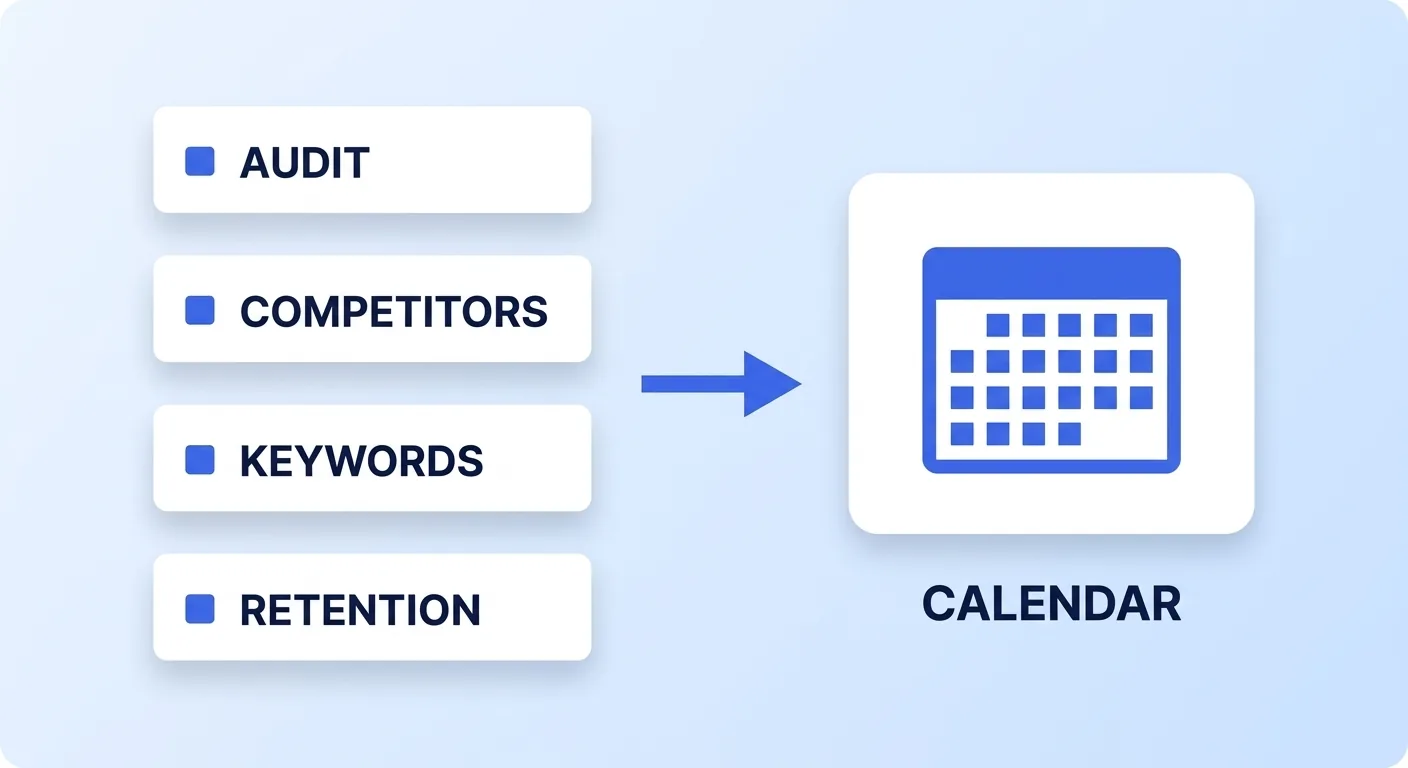
In the blueprint our Strategy Generator produces, the 90-day content calendar is §9 of 12. That ordering is the entire argument. Eight sections of analysis run before a single video gets a date: positioning, a performance audit, a title and thumbnail lab, hook analysis, a competitor teardown, a keyword cluster map, a retention-curve audit, and an outro and CTA review. Only then does anything get scheduled.
Most content calendars fail in the opposite order. Someone opens a spreadsheet, types thirteen weeks across the top, and fills the cells with ideas they already had. That produces a schedule, which is a commitment device — useful, and the subject of our guide to planning and batching a 90-day calendar. It does not produce a plan, because nothing in it is downstream of evidence about your channel.
YouTube Tells You to Build It This Way
This is not an agency opinion. YouTube's own documentation on measuring key moments for audience retention defines "top moments" as the points where almost nobody dropped off, and its stated recommendation is to "consider creating newer content by expanding on the content from the top moments."
That is a content calendar instruction hiding in an analytics help page. Your next videos are supposed to come from the parts of your existing videos that held attention. The same page notes the graph only appears once a video is at least 60 seconds long and has 100 views — a small detail with a real consequence: a brand-new channel does not have this signal yet, so its first calendar is necessarily a hypothesis rather than a derivation.
The same logic runs through the rest of the inputs. The YouTube Analytics intro percentage tells you whether your first 30 seconds matched the promise your packaging made — which is why the metrics worth planning against are a much shorter list than the dashboard offers, and why we keep a fixed shortlist of the KPIs that actually matter. Thumbnail and title guidance treats those two as a pair, and the packaging decision gets its own pre-publish checklist rather than being left to whoever uploads. Backlinko's ranking-factor research is a reasonable outside read on which surfaces those signals feed. And because recommendations are driven by what individual viewers actually watch rather than by a publishing streak, consistency alone is not a strategy — it only compounds when the things you publish consistently are related to each other.
Three Pillars, Not Thirteen Ideas
The calendar section resolves into 13 weeks organised under three content pillars, with every video carrying a hook, a working title, and the data behind it.
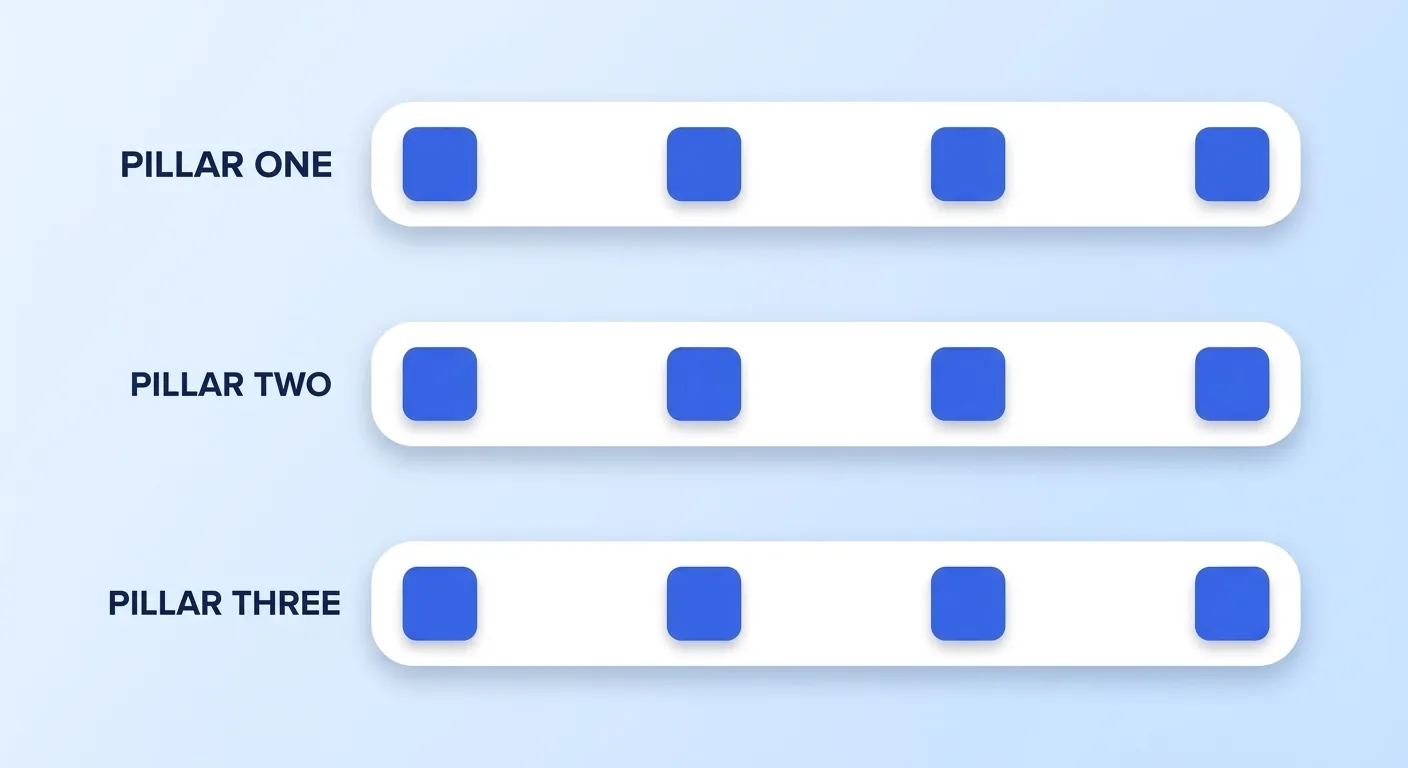
Three is a deliberate constraint. One pillar is a rut. Thirteen unrelated ideas teach the recommendation system nothing about who to show you to, because each upload starts a new audience-building problem. Three lanes are enough to cover a niche while still letting each video reinforce the last, which is also why the blueprint follows the calendar with a series architecture section — three episodic formats designed to build recurring viewership rather than one-off uploads.
The "data behind it" column is the part that most distinguishes a generated calendar from a brainstorm. The keyword cluster map that feeds it runs to 47 clusters mapped to intent, so a given week's video is not there because it sounded good on a Tuesday; it is there because a cluster exists, a competitor gap exists, or a retention pattern suggests it.
What the Twelve Sections Actually Are
| § | Section | What it settles |
|---|---|---|
| 1 | Positioning | The angle in your niche nobody else owns |
| 2 | Performance audit | Packaging, cadence and topic mix against your own ceiling |
| 3 | Title & thumbnail lab | Packaging frameworks tested against your channel |
| 4 | AI hook analysis | The first 60 seconds, scored |
| 5 | Competitor teardown | Three channels you can realistically outflank |
| 6 | Keyword cluster map | 47 clusters mapped to search intent |
| 7 | Retention curve audit | Where viewers leave, and the editing fix for each drop |
| 8 | Outro & CTA strength | Whether the last 30 seconds convert |
| 9 | 90-day calendar | 13 weeks, three pillars, hook + title + evidence per video |
| 10 | Series architecture | Three episodic formats that compound |
| 11 | Audience persona briefs | Who is actually watching, and what they ask |
| 12 | Monetization plan | Revenue routes beyond AdSense |
Roughly 5,800 words, delivered in minutes rather than the two-week turnaround a consultant quotes for the same scope. Tiers start at $49 for a single video audit and $149 for the lite version, with the full channel overhaul at $250.
Where a Generated Calendar Still Needs a Human
Being straight about the limits, because a plan you abandon in week three is worth nothing:
- It does not know your shooting constraints. If week 6 needs a location you cannot reach until November, that is yours to reshuffle. The pillars survive reordering; the dates are the flexible part.
- It does not know what you will actually enjoy making. A derived topic you resent filming will be worse than an intuitive one you are keen on. Swap it and keep the pillar.
- A new channel has no retention signal. With under 100 views on your uploads the top-moments data does not exist, so the first calendar leans on competitor and keyword evidence instead. Re-run it once you have a real curve.
- It is a starting position, not a contract. Ninety days at three uploads a week is 39 decisions. Expect to revise perhaps a third of them as real data lands — that is the system working, not failing.
The reason the calendar sits at §9 is that it is the only section whose quality depends entirely on the eight before it. Hand someone a thirteen-week grid with no audit behind it and you have given them homework. Hand them the same grid where every row cites a cluster, a competitor gap or a retention drop, and you have given them a decision they can act on before lunch. If you would rather someone else run the whole loop — the analysis, the calendar, and the channel management that keeps it on schedule — that is the service. For company channels where the founder is both the talent and the bottleneck, we break that out for founders.
The Bottom Line
A content calendar is an output, not an input. Thirteen weeks of dates is a schedule; thirteen weeks where each video traces back to a keyword cluster, a competitor gap or a retention drop is a plan. Build the eight sections of evidence first, resolve them into three pillars, and treat the dates as the part you are allowed to move.