"Unlimited" Is a Throughput Promise, Not a Volume Promise
The word doing the work in "unlimited video editing" is not unlimited. It is active. Nearly every flat-rate editing subscription sold in 2026 runs a queue with one — occasionally two — active requests at a time. You may submit as many videos as you like. The studio works on one. The next one starts when the previous one is approved.
Which means the ceiling is not a request count you can't exhaust. It is a simple product: round-trip length × active slots, and you can calculate it before you hand over a card. A single-slot plan on a 48-hour turnaround, with one revision round and a client who reviews the same day, clears about four finished videos a month. That is a perfectly reasonable number. It is also nothing like the number the word "unlimited" puts in a buyer's head, and the gap between those two numbers is where nearly all subscription regret lives.
This matters more every year because cadence keeps climbing. Wyzowl's annual video marketing survey and Wistia's engagement data across millions of plays both track the same shift: from occasional video to a standing weekly output. Weekly is precisely the volume where this decision stops being academic. We have priced, staffed and delivered more than 10,000 editing projects — work sitting behind 200M+ views and over $10M in client revenue — under all three structures: per-video, retainer, and queue. Our guide to what video editing actually costs covers the price levels. This post is about the shape of the agreement, a separate decision and usually the more expensive one to get wrong.
The Two Models, Stripped of the Marketing
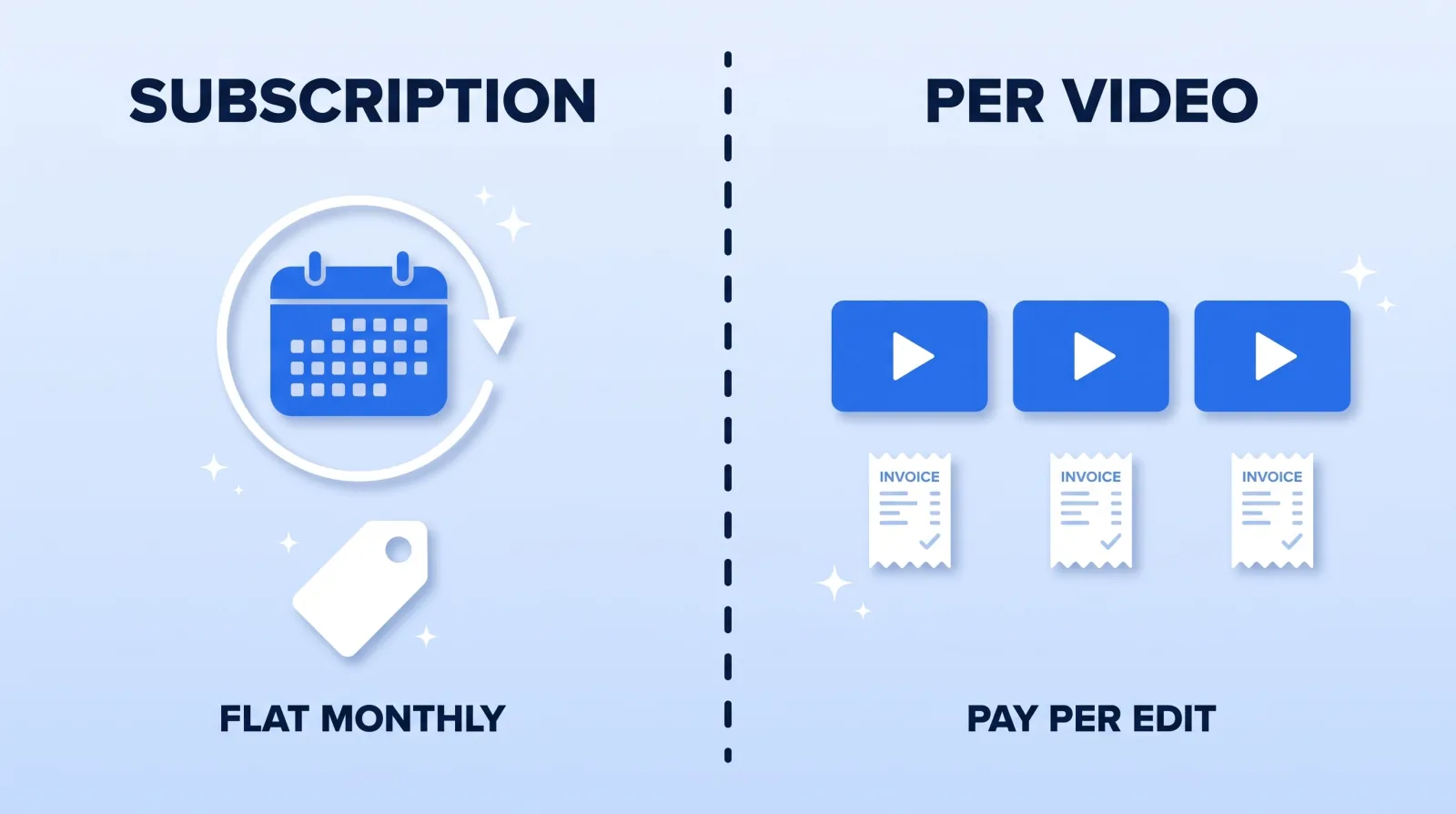
| Unlimited subscription | Per video | |
|---|---|---|
| What you buy | A slot in a production queue | A defined deliverable |
| Billing | Flat monthly, typically $700–$2,500 | One invoice per project |
| Scope control | Loose — "send whatever" | Tight — quoted against a brief |
| Output ceiling | Round-trip × slots | Whatever you commission |
| Cost of a slow month | You pay in full | Nothing |
| Cost of a busy month | Queue backs up | Budget spikes |
| Rush work | Usually unavailable or a plan upgrade | Priced as a rush fee |
| Best fit | Steady, repeatable, format-driven output | Irregular volume, or high-variance jobs |
The one-line summary: a subscription converts a variable cost into a fixed one and a fixed turnaround into a variable one. Per-video pricing does the reverse. Everything else on that table follows from those two trades.
A subscription is also not a retainer, though the words get used interchangeably. A retainer commits to a defined output — four long-form and twelve verticals a month, say — and the studio staffs to hit it. A queue subscription commits to access. If a contract does not name a deliverable count, you have bought a queue, whatever the invoice calls it.
The Queue Is the Product — and Your Review Speed Sets Its Output
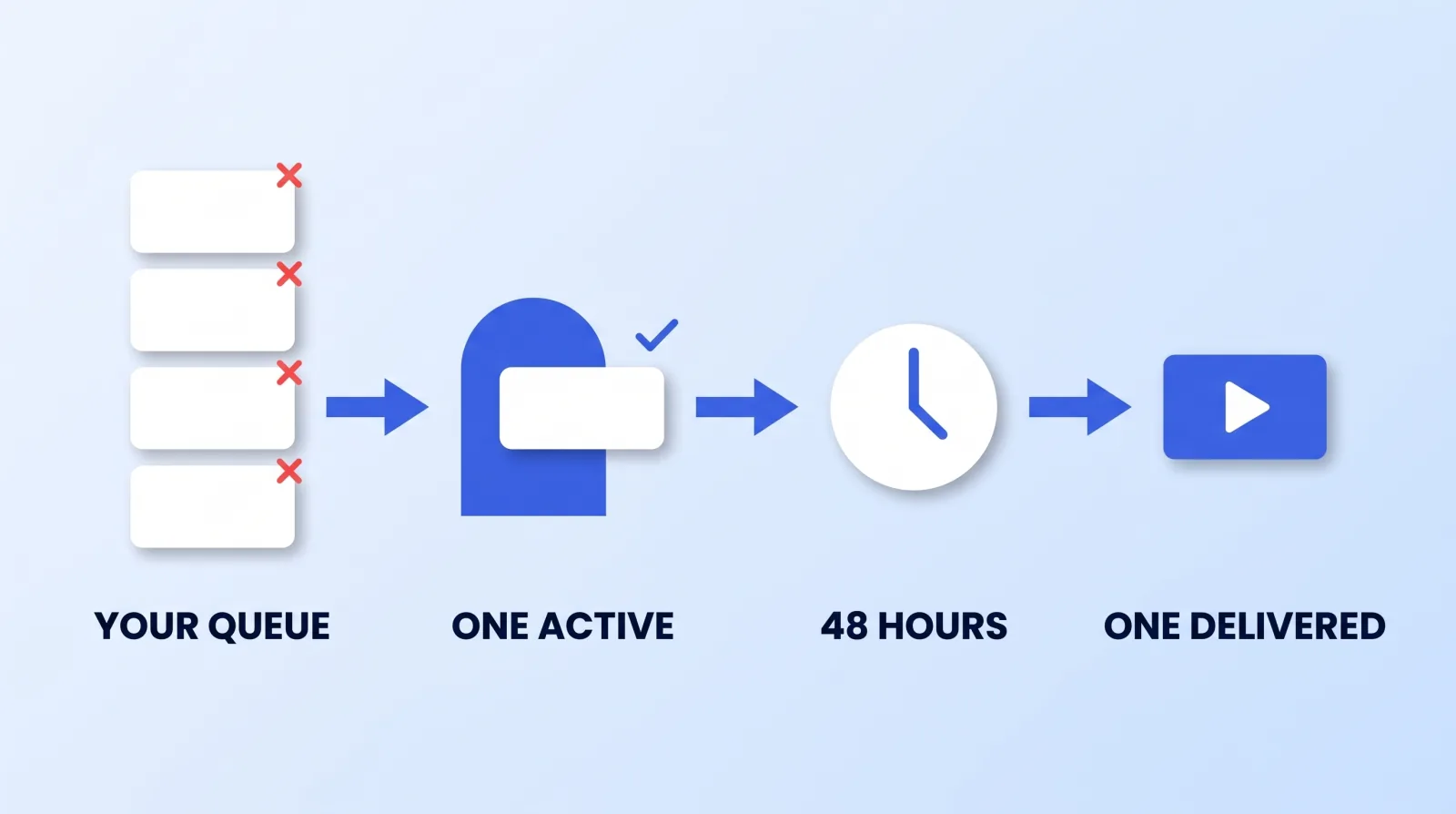
Here is the calculation almost nobody runs before subscribing. A finished video's round trip is:
round trip  =  their turnaround
             + your review latency
             + revision turnaround

videos/month per slot  =  20 working days ÷ round trip
Run real numbers through it and the result is uncomfortable:
| Their turnaround | You review in | Revision round | Round trip | Videos/month per slot |
|---|---|---|---|---|
| 24 hours | Same day | 24 hours | ~3 days | 6–7 |
| 48 hours | Same day | 48 hours | ~5 days | 4 |
| 48 hours | 2 days | 48 hours | ~7 days | 2–3 |
| 72 hours | 2 days | 72 hours | ~10 days | 2 |
| 24 hours | Same day | None needed | ~1–2 days | 10+ |
Look at rows two and three. Same plan, same studio, same turnaround — and the output halves purely because the client took two days to watch the cut instead of one. In a queue model, your own review latency is the largest single variable in what you get for your money, and it is the only one you fully control. The client who sits on approvals for 48 hours is buying half the videos of the client on the identical plan who reviews the morning it lands.
Two things fix it, both cheap. Review in a timecoded tool like Frame.io rather than over email, so a round of notes is one artefact instead of a thread. And write the notes so they land the first time — our guide to revision notes that actually get fixed exists because a vague second round costs a full round trip. Cutting your average from two rounds to one improves a queue plan's output by roughly a third, not by 10%. What each turnaround band honestly buys is broken down in 24-hour, 72-hour and one-week turnaround.
Where the Break-Even Actually Sits
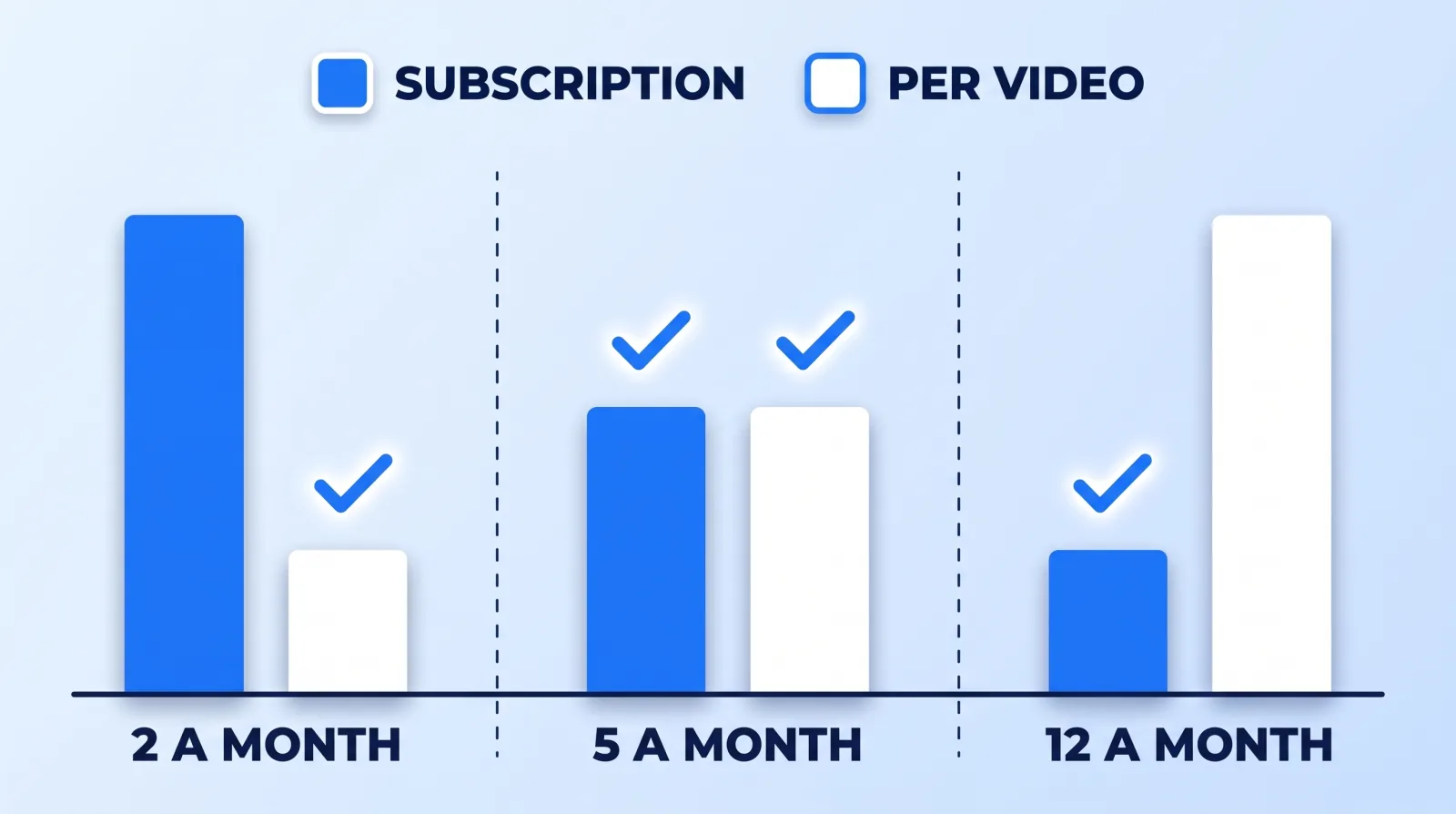
Take a mid-market subscription at $1,200 a month against a competent per-video rate of $250 — the working band from our cost breakdown, not the bargain-bin one. The US Bureau of Labor Statistics wage data for film and video editors is the floor underneath both numbers; anything far below it is buying something other than an experienced editor.
| Videos published | Subscription | Per video | Cost per video | Verdict |
|---|---|---|---|---|
| 2 a month | $1,200 | $500 | $600 vs $250 | Per video, decisively |
| 5 a month | $1,200 | $1,250 | $240 vs $250 | Level — decide on other grounds |
| 8 a month | $1,200 | $2,000 | $150 vs $250 | Subscription, if one slot can deliver 8 |
| 12 a month | ~$2,800 (2–3 slots) | $3,000 | $233 vs $250 | Subscription, narrowly |
Two things fall out of that table that the marketing never mentions.
Below roughly four videos a month, a subscription loses to paying per video — every time. Not marginally. You are paying a retainer price for a freelance volume, and the unused slot is pure loss. If your cadence is two a month, buy two videos.
Above eight, the subscription's advantage gets thinner, not fatter. Twelve finished videos is beyond one slot's throughput at any honest turnaround, so you buy a second slot and the saving compresses back toward the per-video rate you were trying to beat. The subscription still wins at twelve — by about 7%, not the 60% the eight-video row suggests. Volume requires slots, and slots cost money.
So the sweet spot is real and narrow: four to eight finished videos a month, on a repeatable format, with same-day reviews. That describes a weekly show with shorts cut from it almost exactly, which is why queue plans suit podcasters and fail campaign-driven brands. Our teardowns of VidChops and BeCreatives reach the same conclusion from different directions.
Five Situations Where a Queue Plan Is the Wrong Purchase
- You publish in bursts. A course launch, a conference, a product drop. Eight videos in one fortnight and nothing for six weeks is the worst possible shape for a single-slot queue — you pay through the quiet weeks and hit the ceiling in the loud one.
- You need a date. Queue plans quote a turnaround per request, not a delivery date for a specific video. If a sponsor has a live date, buy a project with a deadline in it.
- The work is high-variance. Multi-cam syncs, bespoke motion graphics, long-form assembly in something like DaVinci Resolve. Flat-rate economics assume a roughly constant job; a genuinely heavy edit gets refused, rationed, or delivered thinner than you wanted.
- You are still finding the format. Queue plans reward repetition — episode four is faster than episode one because the templates exist. If every video is a different experiment, you never collect that compounding and you pay a premium for a benefit you don't receive.
- You are testing a new provider. Never open a relationship with a twelve-month commitment. Buy one video at full price first; our guide to vetting a video editing service sets out the trial to run.
One thing sits outside the line either way: music and stock licensing is your cost, not the studio's. A licensed music subscription is a separate bill. Automated captioning through something like Submagic may or may not be — ask which, before the first invoice rather than after.
Work Out Your Own Break-Even in Five Steps
- Count your real published cadence for the last three months. Not the one you intend to hit — the one you actually shipped. Divide by three.
- Get a per-video quote for one representative edit. One real quote against one real brief beats any published rate card.
- Ask for the active-slot count and stated turnaround, then add your own honest review latency and a revision round. That is your round trip; divide 20 working days by it.
- Compare cost per finished video, not cost per month. Monthly price flatters the subscription. Divide by the number step 3 says you will receive, not the number you hope to submit.
- Price the failure mode. What does the subscription cost if your cadence drops for two months? What does the queue cost if it spikes? Whichever answer you can least afford is the model to avoid.
If the two land within 10% of each other — which is what a five-a-month cadence does — stop optimising on price. Decide instead on what actually varies between providers: who owns the project files, what happens when your editor is unavailable, and whether anyone is accountable for the schedule. Those are the dimensions that separate a freelancer from an agency from an in-house hire, and they outrank a $50 monthly difference by a wide margin.
The Bottom Line
An unlimited editing subscription does not sell you unlimited videos; it sells you a slot in a queue, and the output of that slot is round-trip length divided into twenty working days. Below four videos a month, paying per video is cheaper every time. Between four and eight, on a repeatable format with same-day reviews, the subscription is genuinely the better buy. Above that, you are buying more slots and the advantage narrows. Run the round-trip calculation before you run the price comparison — the price question answers itself once you know how many videos you are actually going to receive.