The Editor Quoting You Is Probably Not in the Salary Survey
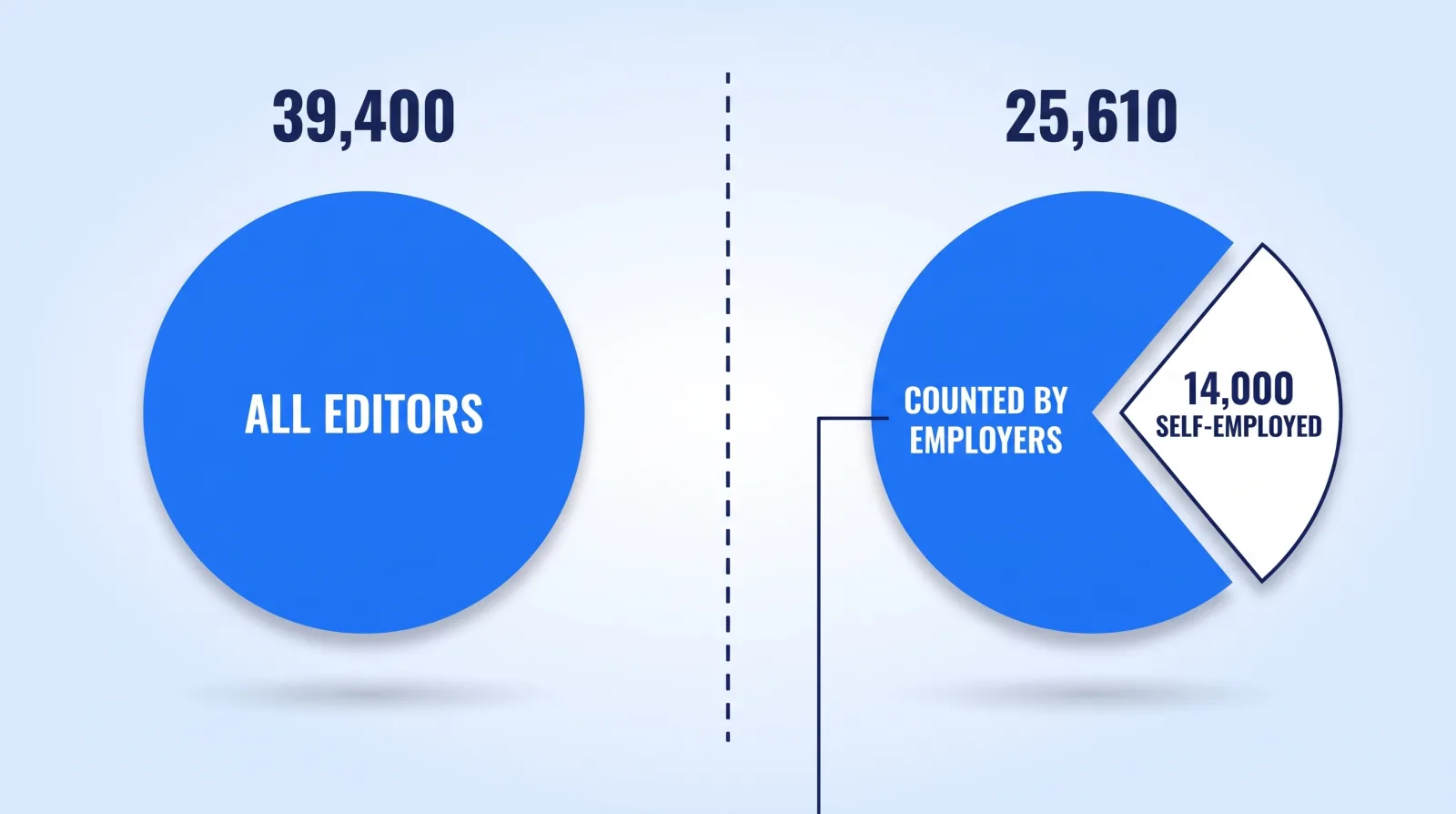
About 39,400 people worked as film and video editors in the United States in 2025, and 14,000 of them — 35.5% — were self-employed, according to BLS Employment Projections. Roughly one in three editors is a freelancer or runs their own shop.
That matters the moment you try to sanity-check a quote, because the number almost everyone reaches for is the wrong one. The widely cited median annual wage for film and video editors comes from the Bureau's employer survey, which counted 25,610 wage-and-salary editor jobs in May 2025. The survey asks employers what they pay staff, so by design it excludes the self-employed entirely. Divide that salary by 2,080 hours, land on something like $36 an hour, and conclude that a $90 hourly quote is a markup — and you have just compared a staff job against a business, using a dataset that never contained the person you are talking to.
We have priced and delivered more than 10,000 editing projects at Mark Studios — work sitting behind 200M+ views and over $10M in client revenue — and the single most common pricing objection we hear traces back to this exact comparison. It is not a negotiating tactic. It is a buyer using the only public number they could find, and that number describing a different job.
What a Salary Number Leaves Out of a Freelance Rate
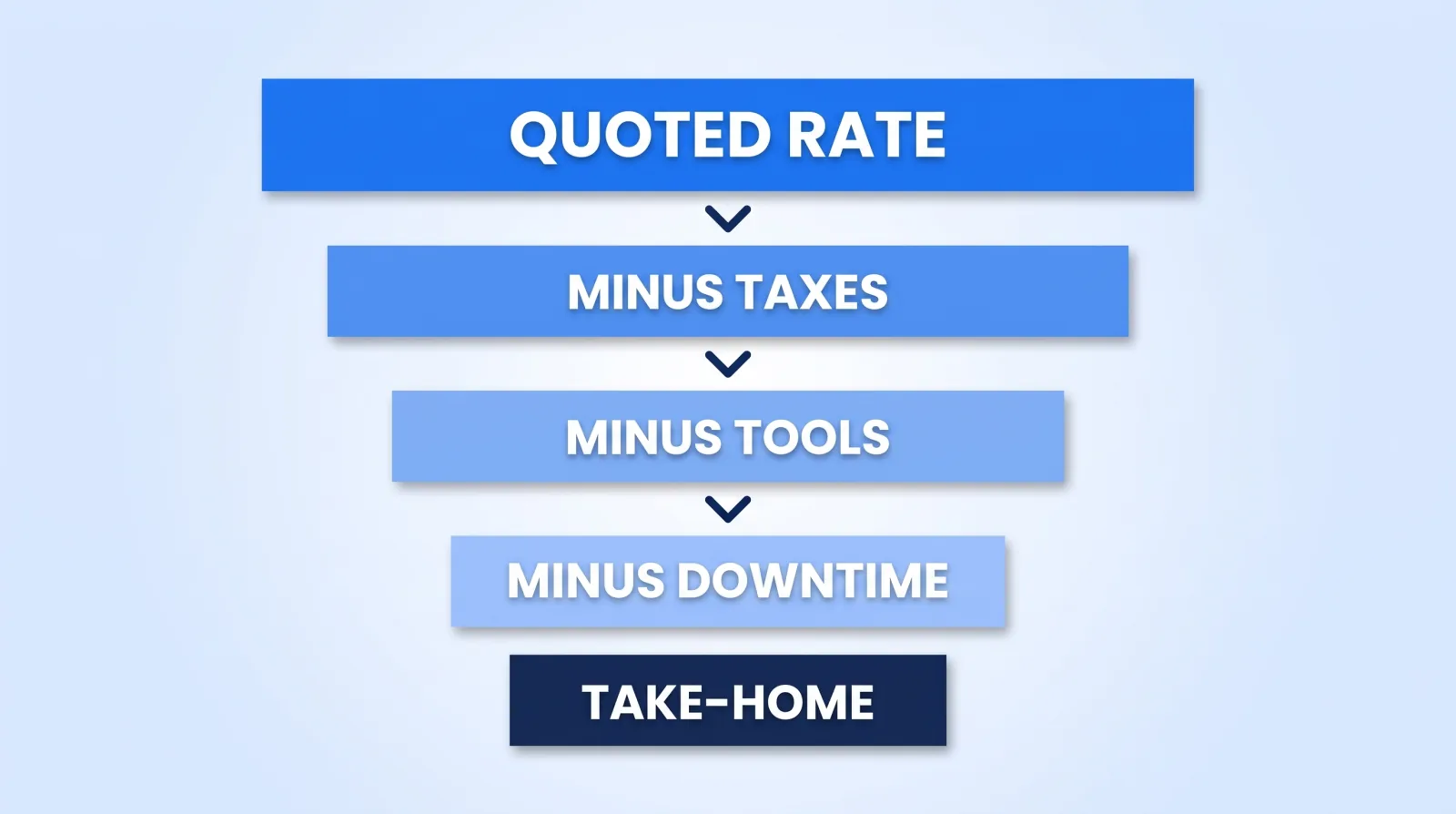
A staff salary is the visible slice of a much larger employer cost. When the employer disappears, every line below moves onto the editor's own rate — which is why a freelance hourly figure has to start higher to end up in the same place.
| Cost | Who carries it on staff | Who carries it freelance |
|---|---|---|
| Payroll tax | Employer pays half | Editor pays both halves — 15.3% self-employment tax |
| Health cover, PTO, sick days | Employer | Editor, unsubsidised, and unpaid time off is simply unpaid |
| Software and hardware | Employer | Editor — NLE subscriptions, storage, a machine that renders |
| Unbilled hours | Paid regardless | Quoting, briefing calls, invoicing, chasing payment: all free |
| Downtime between projects | Paid regardless | Zero revenue |
That last row is the one buyers consistently underestimate. A freelance editor who is booked 60% of available weeks — a healthy year — has to recover a full year of costs across roughly seven months of billable work. The rate is not the pay. The rate is the pay divided by how much of the year is billable, plus everything the employer used to absorb.
None of which means a high quote is automatically justified. It means the salary comparison cannot tell you whether it is. The framework that actually can is in what video editing costs in 2026 — pricing models and market bands, not annual wages.
Three Things the Freelance Share Actually Predicts
A market where a third of the workforce is self-employed behaves differently from one where nearly everyone is on payroll. Three consequences show up in every engagement we run.
- Capacity is bursty, not elastic. A freelancer is one person with a finite week. When your launch collides with two other clients' launches, no amount of budget creates a second editor. This is the pressure that pushes growing channels toward a studio or a small team, and the thresholds where it bites are mapped in agency vs freelancer vs in-house.
- The rate spread is enormous and largely uninformative. Self-employed pricing is set individually, so it reflects each editor's costs, confidence and pipeline — not a market rate. Two editors of identical skill can quote 4× apart simply because one is fully booked. Price alone will not rank them.
- Continuity is a live risk, not a hypothetical. Sole operators get ill, take salaried jobs, and change careers. There is no colleague holding your project files. The questions that surface that exposure before you sign are in what to do when your video editor disappears.
Five Questions That Turn a Rate Into a Comparable Number
Two quotes are only comparable once you know they describe the same job. Ask these before you compare anything.
- Is this a rate or a price? An hourly rate with no estimated hours is not a quote. Ask for the expected total on a defined deliverable.
- How many of my videos can you take in a month, at peak? Get a number for your busiest month, not your average one.
- What is included before revisions start counting? Two rounds is standard. Confirm what resets the counter.
- Who owns the project files, and how do I get them? Standard practice varies; what matters is that the answer exists in writing.
- What happens if you are unavailable for two weeks? A named backup, a studio bench, or nothing. All three are valid answers — only one of them is a surprise later.
Note how few of these are about money. Rate is the easiest variable to compare and the least predictive of what you will actually pay, because the real cost lands in your own management hours — a bill we quantified in the hidden cost of managing your own editor.
What This Means When You Are Choosing How to Buy
If you came to the salary figure because you were weighing an in-house hire, it is genuinely the right benchmark — for that option, and only that option. The loaded cost of a staff editor, once you add payroll tax, benefits, software and the weeks where there is nothing to cut, is laid out in our in-house editor comparison.
If you are hiring per project instead, you are buying in the self-employed market, where quality signals are individual and screening is entirely on you. That is the trade-off behind the freelance marketplace comparison — cheap to enter, expensive to get wrong twice.
Founders feel this hardest, because they are the ones translating a creative cost into a line item a board will accept, which is most of what our founder-focused editing work exists to absorb. And the demand side is not softening: Wyzowl's video marketing research has shown video use holding above 90% of marketers for several years running, against an editor workforce the BLS projects growing only modestly.
The Bottom Line
The average editor salary is a real number describing a job most editors do not have. Two-thirds of the market it is drawn from is salaried; the third quoting you is running a business that pays its own tax, tools and downtime out of that rate. Benchmark a staff hire against salary data, benchmark a freelance quote against other quotes for the same defined deliverable, and never against each other.