The Number Most Buyers Pick Is the One No Editor Can Move
Ask an editing agency whether they will grow your channel and most will say yes. Then, ninety days later, the conversation is about subscribers — a number neither party controls. YouTube's own description of how recommendations work puts the mechanism plainly: "Understanding a user's viewing behavior, likes, dislikes, subscriptions, and feedback, including from satisfaction surveys, helps us do this most effectively," with suggestions built from "their watch history, broader viewer trends, and current video topics." That is a system responding to millions of individual viewers, not to your vendor's invoice.
So the useful question is not "will you grow my channel." It is "which parts of growth are you willing to be measured on, and how will we read them?" An agency that can answer that in specifics is a different proposition from one that cannot. This post is what happens after you have already decided to hire — vetting who to trial and choosing between agency, freelancer and in-house are the two decisions before it.
Three Tiers, and Only One of Them Belongs in a Contract
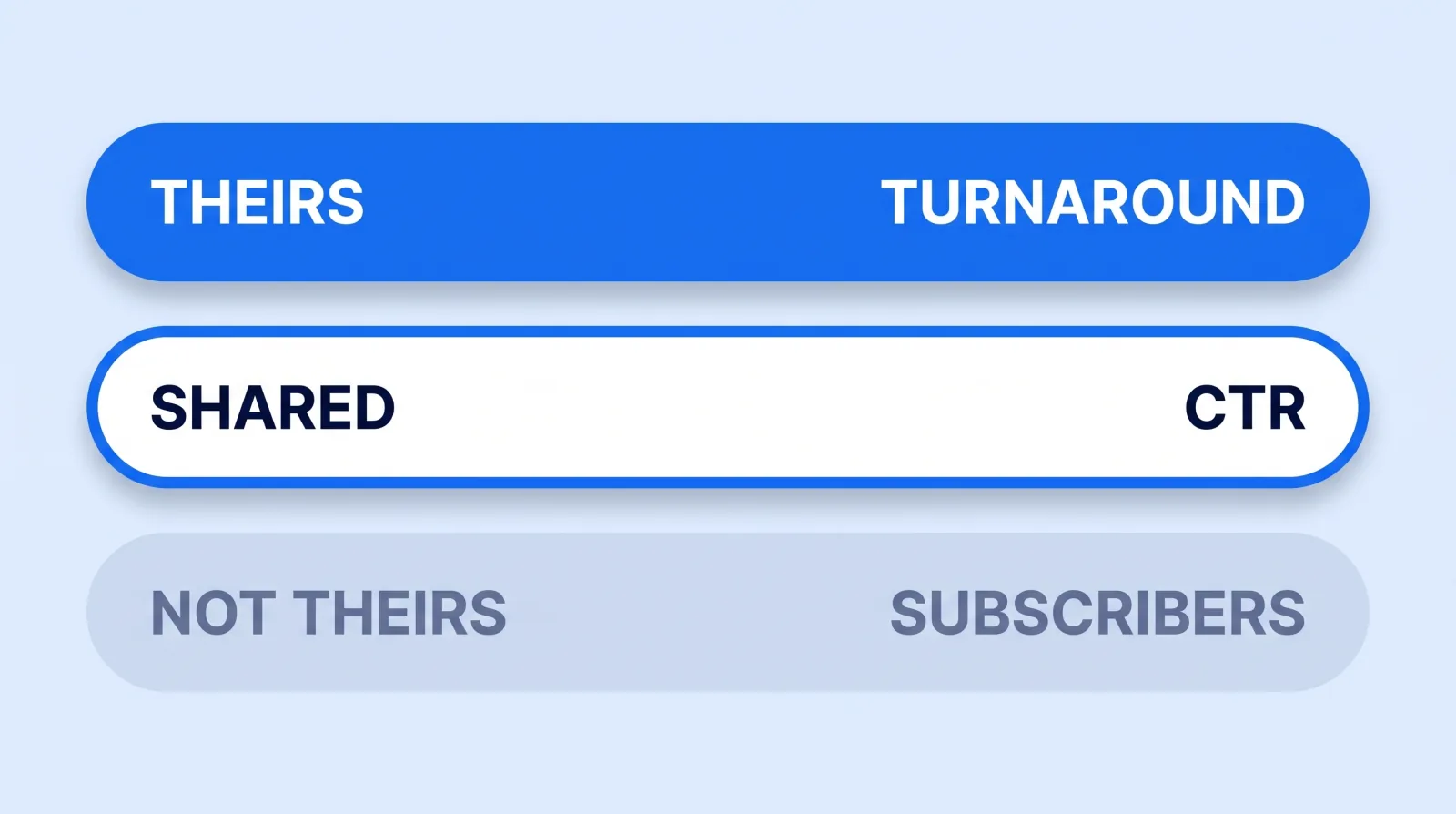
| Tier | Examples | Who it belongs to |
|---|---|---|
| Theirs outright | Turnaround adherence, revision rounds consumed, defect rate (audio, sync, spelling, export), whether named retention drops actually got fixed | The agency. Measurable from week one, no excuses available |
| Shared | Click-through rate, average view duration, retention shape after the hook | Both. They execute the packaging and pacing; you choose the topic and show up on camera |
| Not theirs | Subscribers, revenue, RPM, whether your niche has demand, how often you publish | You and the market |
Putting a bottom-row metric in an agreement does not transfer risk, it just guarantees an argument in month three. It is the same category error as judging a quote against an employer salary survey, which is what the self-employment data actually shows.
The top row is where an agency earns or loses the account, and it is the row most buyers never write down. Turnaround adherence — hit rate against the promised window, not the window itself — is the single best predictor we see, and it is why what each turnaround tier buys is worth agreeing before the first invoice.
What You Can Actually Read at 30, 60 and 90 Days
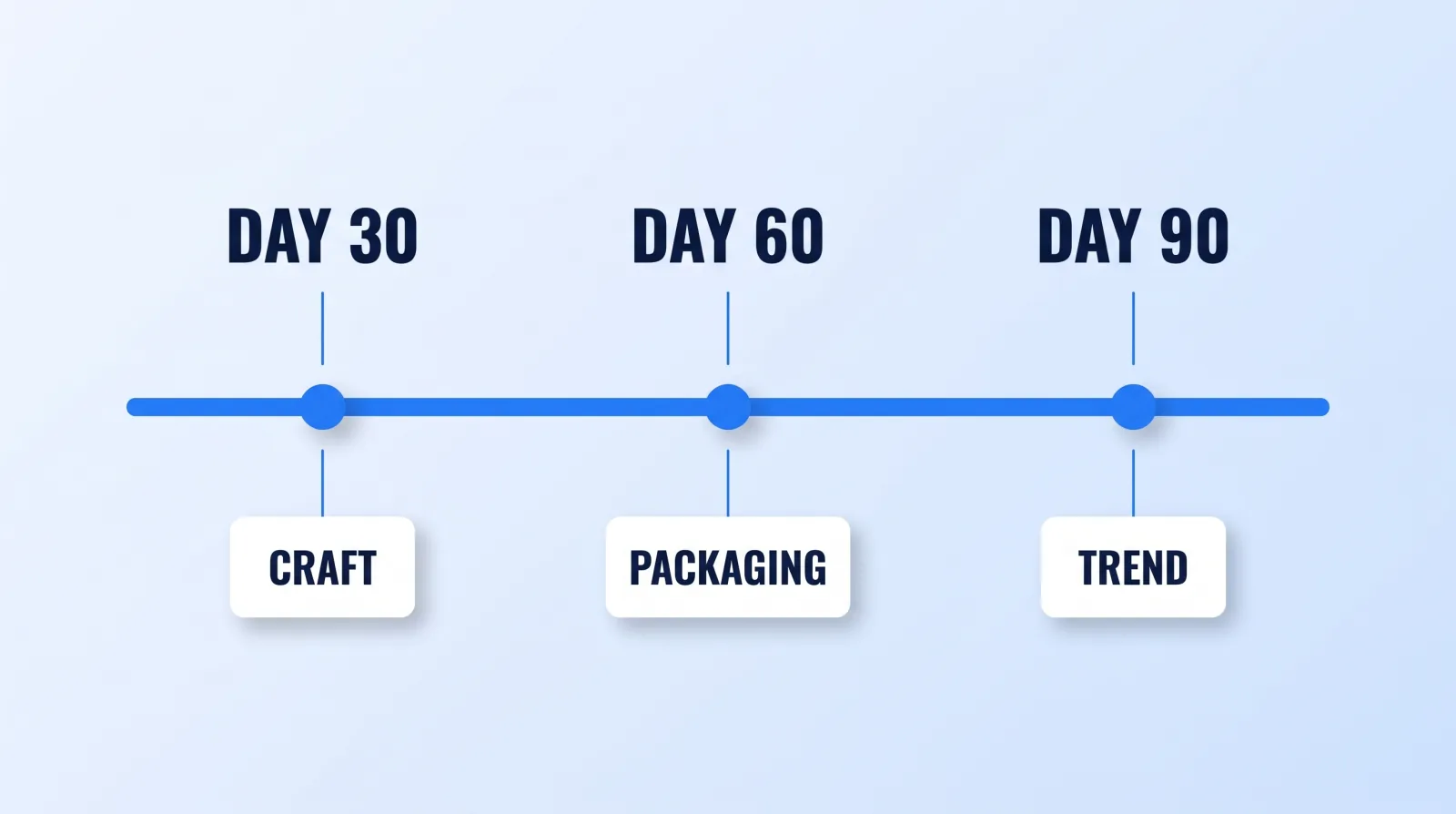
Most ninety-day reviews fail because they ask every question at every checkpoint. The data does not arrive that way.
Day 30 — craft and reliability only. You have four or five videos. That is enough to judge defect rate, turnaround adherence, how many revision rounds each video consumed, and whether notes were understood the first time. It is not enough to judge anything in Analytics, and an agency presenting a performance chart at day 30 is showing you noise.
Day 60 — packaging becomes readable. Click-through rate needs accumulated impressions before it means anything, and impressions are narrower than people assume: YouTube counts one only when the thumbnail is shown "for more than 1 second and at least 50% of the thumbnail is visible on the screen," and does not count them at all on "external websites and apps (for example, links and embeds outside of the YouTube website)." For a benchmark, YouTube's own CTR guidance states that "half of all channels and videos on YouTube have an impressions CTR that can range between 2% and 10%" — a band wide enough that your own trend line matters far more than the absolute number.
Day 90 — a trend, and only a trend. Now you can look at retention shape across a dozen videos. YouTube's key moments documentation defines top moments as "moments in your video where almost no one dropped off while watching," and recommends that "if the top moments are occurring in a later portion in the video, consider introducing the compelling content earlier." That is an editing instruction, which makes it fair game for a scorecard. Note the threshold, though: the graph needs a video "at least 60 seconds long and have at least 100 views," so a small channel will have fewer readable data points than it expects. Which metrics belong on the card at all is the subject of the KPI shortlist; the Engagement tab is where watch time and average view duration live.
Six Questions That Turn a Promise Into a Scorecard
Ask these before signing. The answers, not the reel, tell you what you are buying:
- Which metrics will you accept as yours? If the answer includes subscribers, they are overselling. If it includes nothing measurable, they are underselling.
- What is your turnaround hit rate, in numbers, over the last quarter? Not the advertised window. The percentage of deliveries that met it.
- How do you define a defect, and what happens when one ships? A partner without a defect definition has no quality bar, only taste.
- Who reads the retention curve, and how does it change the next edit? This separates an editing supplier from an editing partner. Ask them to walk one of your own videos.
- What do you need from me to hit these numbers? A serious answer names your inputs — brief quality, footage timing, review turnaround. A vendor who claims to need nothing has not done this before.
- What would make you tell me to stop paying you? The best answer we have ever heard from a competitor was "if your topics aren't landing, editing won't fix it." That is the answer of someone who intends to be there in year two.
Across 10,000+ delivered projects and 200M+ views, the accounts that renew are not the ones where every metric went up. They are the ones where both sides agreed in advance which metrics counted — and then read them honestly at the checkpoints. The channel audit we run exists to set that baseline before any of it starts.
The One Signal Worth Leaving Over
Not a bad month. Not a video that underperformed. Leave when the same note has to be given twice.
A partner who fixes a named retention drop once has done their job. A partner who needs the same correction on video nine that they needed on video three is not learning your channel, and no amount of reporting fixes that. Everything else — a slow week, a thumbnail that missed, a quarter where the topics did not land — is normal, and churning over it costs you the onboarding cost twice.
That accountability loop is what our video editing service is built around, and where a channel needs the strategy layer on top of the edit, channel management is where the scorecard actually gets run. It matters most where someone internal has to justify the spend upward — which is why we run B2B SaaS channels as their own track. If you are weighing us against an unlimited-subscription model, the VidChops comparison sets out where that model's incentives differ from this one.
The Bottom Line
An editing agency cannot be held to your subscriber count, and any agency that accepts it is telling you they do not understand the system they work in. Hold them to what they control — turnaround adherence, defect rate, revision efficiency, and whether named retention drops get fixed — read packaging at 60 days and trend at 90, and treat a repeated note as the only real exit signal.