

The Short Answer: How to Hire a Voice Actor
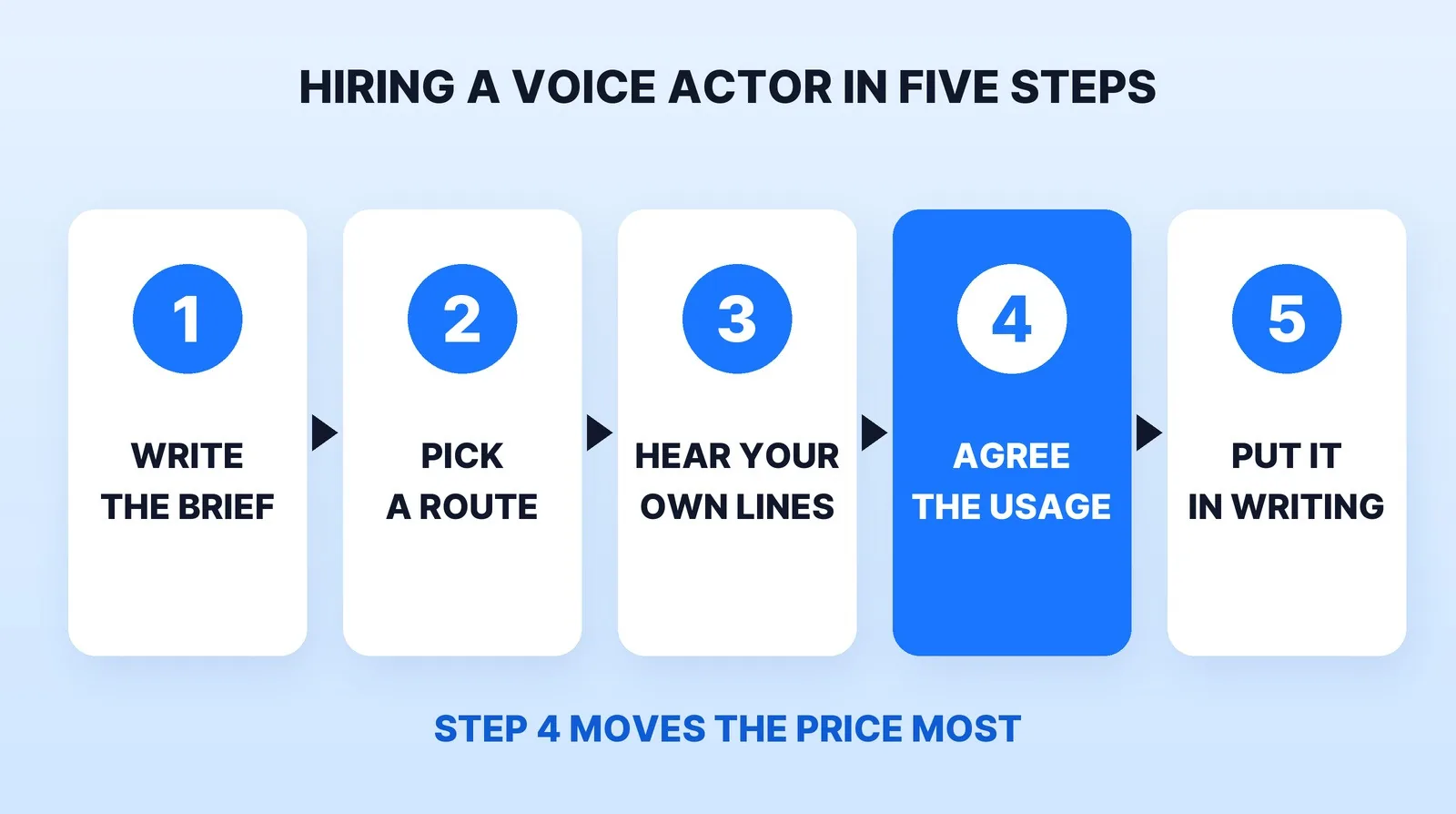
To hire a voice actor, write a brief with the finished script, its word count and where the video will run. Pick a route (a marketplace, a casting site, or an actor's own rate card), ask two or three actors to read a few of your own lines, and agree the usage before you book. Then get pickups, files and the license in writing.
Usage is the step buyers skip, and it moves the price most. Voice actor Rick MacIvor's rate card says his prices are "for corporate or client single platform use only" and leave out broadcast, TV, radio and internet ad usage. What a read costs by route and length is in our guide to voiceover cost. This post covers choosing the person and setting up the booking.
Step 1: Write the Brief Before You Search
A voice actor prices and casts from the brief, so finish it first. Send:
| What to send | Why it matters |
|---|---|
| The final script, with the word count | Rate cards price per word, per finished minute or per 200 words |
| Where it runs and for how long | Unpaid use and paid ads are licensed differently (Step 4) |
| The voice: age range, accent, tone, a reference clip | Lets actors self-select and audition for the right read |
| Pronunciations for names, products and terms | Saves a pickup session later |
| Deadline and live-direction needs | Rush delivery and directed sessions cost more |
| File format, and how files are split and named | File splits can be billed per file |
Lock the script before anyone records. Christa Lewis's 2026 rate card bills script changes after recording at 50% of the base rate, and MacIvor and John Kissinger both list late script changes, live client direction and complex file splits as reasons a price goes up.
Step 2: Pick the Route
There are four ways in, and they suit different jobs:
| Route | How it works | Best for |
|---|---|---|
| Marketplace | Fiverr's voice over category showed 22,000+ results on November 25, 2026, with page-one gigs priced per 200 words | A fixed-price read with reviews to compare |
| Casting site | Voice123 lets you post a casting project for free and "cast, search, and negotiate with voice actors directly"; Bunny Studio lists 13,000 vetted voices and lets voice pros pitch you in a contest | Hearing many auditions for one script |
| Direct | The actor's own site and rate card, with usage terms written out | Repeat narration, ads, long-term voices |
| AI voice | A text-to-speech plan with a commercial license | Drafts, pickups, internal videos |
Some Fiverr links on this page are affiliate links: Mark Studios may earn a commission if you buy through them, at no cost to you.
Whichever route you take, judge the actor on your lines, not the platform. Our comparison of freelance marketplaces covers how Fiverr and Upwork handle fees, disputes and refunds.
Step 3: Hear Your Own Lines
A demo reel is a voice at its best, cut from many sessions. Ask your top two or three for a short custom read: two or three lines from your actual script, including the hardest name or number in it. On a casting site the auditions are the custom read; when you go direct or through a marketplace, ask for it.
Listen for three things: whether the read sounds like a person talking rather than reading, whether the pace fits the cut (a 30-second ad leaves no room for slow reads), and whether the audio is clean, with no room echo, hum or clipped words. Then ask how they take direction: a self-directed session, notes after a first take, or a live session where you listen in. Chris Butera's rate card adds $150 for a directed session.
Step 4: Agree the Usage Before You Book
Where the voice runs decides what you're buying. Rate cards price unpaid use: a course, a website, an organic post. Once you pay to put the video in front of people, it's an ad, and the voice is licensed by media and time.
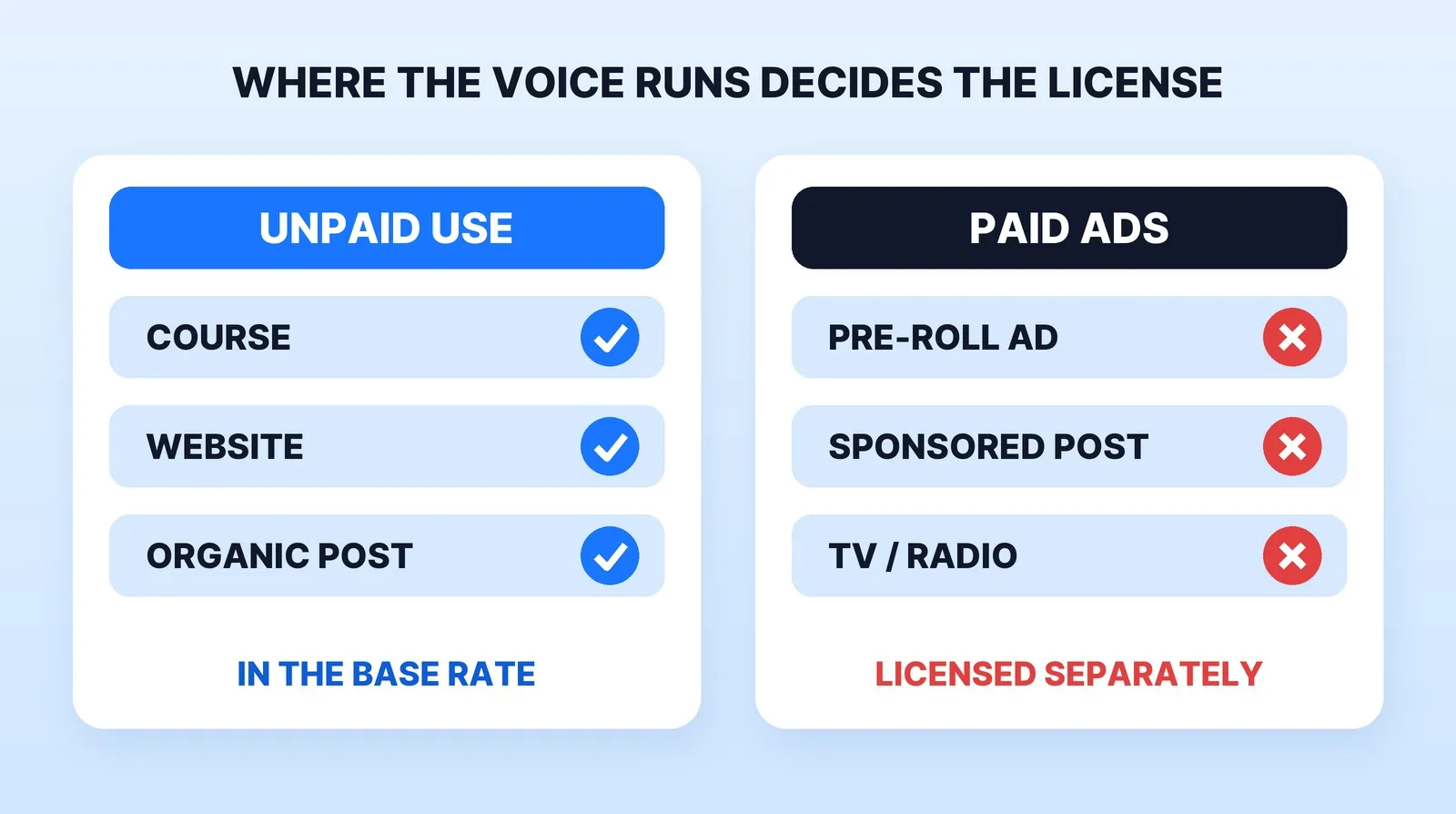
The voice actors' own rate cards show the split:
- Kissinger prices "General corporate/client platform usage or single video usage only", leaving out TV, broadcast and web advertising, on his rate card.
- Lewis includes "a worldwide, in-perpetuity license for unpaid/organic media" in her non-broadcast rates, and starts paid digital and social at $450 for a 3-month run and $750 for a year.
- Butera lists a web usage full buyout at $750.
- Carlos Kasse charges a $150 session fee for commercials, with usage rights "negotiated separately based on the scope and duration of the campaign."
So say in the brief whether the video will run as an ad, where, and for how long. If a video might become an ad later, ask for the price of that license now. A voice licensed for an organic post can't run as a YouTube pre-roll without a new license.
Step 5: Put It in Writing
Before the session, get these five terms in the quote or an email:
- Pickups and retakes. Lewis includes "one round of minor performance pickups"; ask how many, and what a fix of your own mistake costs.
- Files. Format, sample rate, how files are split and named, and when they arrive. Lewis charges $1 per split file with a $50 minimum.
- Turnaround. Kissinger lists delivery in under 24 hours as a reason the price goes up.
- License transfer. Lewis's terms say "Licensing transfers only upon full payment", so the voice isn't yours to publish until the invoice is paid.
- AI use. Lewis's card prohibits using her files "for the purpose of training, simulating, or cloning an Artificial Intelligence (AI) voice." Expect that clause, and don't feed a hired voice into a cloning tool without written permission. Tennessee's ELVIS Act extended the state's personal-rights law to protect a person's voice from AI misuse.
If you use an AI voice instead, make the final read on a paid plan: ElevenLabs lists a "Commercial License" from its Starter plan. YouTube requires creators to disclose realistic AI content, such as making a real person appear to say something they didn't, but lists cloning your own voice for voiceovers or dubs as a use that needs no label. Our guide to AI voice cloning covers where synthetic narration holds up.
Where Mark Studios Fits
Voiceover or narration came up in 66 of 698 first messages from buyers in our inbox from July to September 2026. If you already have a voiceover, Mark edits the video to it: faceless YouTube editing starts from your script and recorded narration. If you need a voice as well, animated videos come with voiceover, music and sound, and AI voiceover and voice cloning run through AI and automation. Narrating lessons? Our video work for course creators shows that route. Mark Studios has completed 8,000+ orders with 4,500+ reviews, 99% on time, with work behind 100M+ views, and is Top Rated on Fiverr with a 4.9★ rating.
The Bottom Line
Write the brief with the final script and where it runs, hear two or three actors read your own lines, and agree the usage before you book, because an ad license costs more than an organic one. Then get pickups, files, turnaround, license transfer and the AI clause in writing before anyone records.


