

The Short Answer: Medical Animation Cost
Medical animation from a studio costs $2,000 to $50,000+ per minute in 2026, and 2D versus 3D decides most of that range. Freelance gigs on Fiverr start at $5. A fixed-price studio makes a 60-second 2D healthcare explainer for $2,400 and up (Broadcast2World), or $2,000–$3,500 per 2D minute (MotionGility). Higher-end healthcare animation runs $18,000–$25,000 (Demo Duck). Detailed 3D medical animation reaches $50,000 or more per minute (Nucleus Medical Media).
Time matters as much as money. Delivery runs from 2–3 weeks for a 2D explainer to 14–16 weeks for pharma work that goes through medical-legal review.
Those are market prices, not ours. Mark Studios prices each animation from your script and emails the quote within one business day. Every figure here links to the page that published it, checked October 15, 2026.
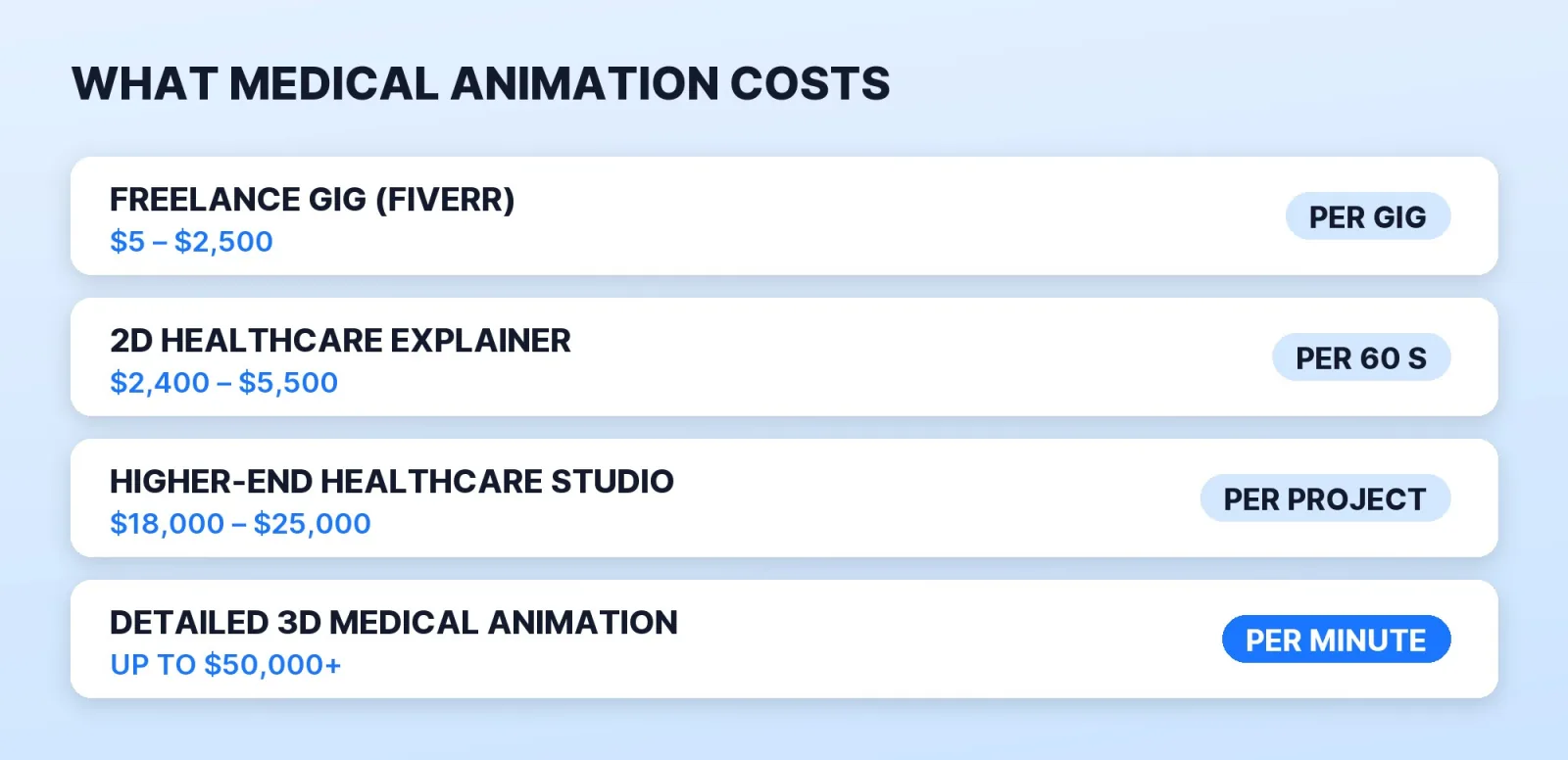
Medical Animation Prices in 2026
| Route | Published price | Timeline | What it is |
|---|---|---|---|
| Freelance marketplace (Fiverr) | Page-one gigs start at $5–$2,500, plus a 5.5% service fee | Set by each gig | 2D and 3D anatomy, procedure and device clips; accuracy depends on the seller |
| Fixed-price healthcare studio (Broadcast2World) | 60 seconds starts at $2,400 (whiteboard, flat infographic), $3,500 (character, 2D mixed media) or $5,500 (2.5D character, 3D infographic); extra runtime starts at $750 per 30 seconds | 4–6 weeks; 6–10 with medical, legal and regulatory review | Fixed-fee packages with compliance review built into the schedule |
| 2D healthcare studio (MotionGility) | $2,000–$3,500 for a custom 1-minute 2D video | Often 2–3 weeks | 2D healthcare and medical explainers |
| Medical explainer producer (Beverly Boy) | $2,500–$50,000 in most cases; about $6,000 a minute basic, $7,500 average, $10,000 for 3D | Not published | Animated and live-action medical explainers |
| Custom animation studio (Yum Yum Videos) | Calculator estimates start at $6,000–$15,000 and run to $25,000–$62,000 | Not published | Estimate depends on the goal, video type, quantity and script |
| Higher-end healthcare studio (Demo Duck) | $18,000–$25,000 for most higher-end healthcare animation | Usually 8–12 weeks | Custom healthcare animation and live action |
| 3D medical animation studio (Nucleus Medical Media) | $5,000 a minute for simpler 2D up to $50,000+ for detailed, high-end 3D | 6–8 weeks for custom animation under 2 minutes | Custom animation, plus a licensed library of existing medical art |
| Medical animation specialist (Ghost Medical) | Quoted per project | Average 10 weeks for finished animation | Surgical, device and anatomy animation |
| Pharma animation studio (Random42) | Quoted per project; full global copyright included | Average 14–16 weeks, with revisions and med-legal review | Mechanism-of-action and scientific animation |
If the video is a general product or service explainer with no medical review, our guide to animated explainer video cost covers that market.
2D Explainer or 3D Medical Animation?
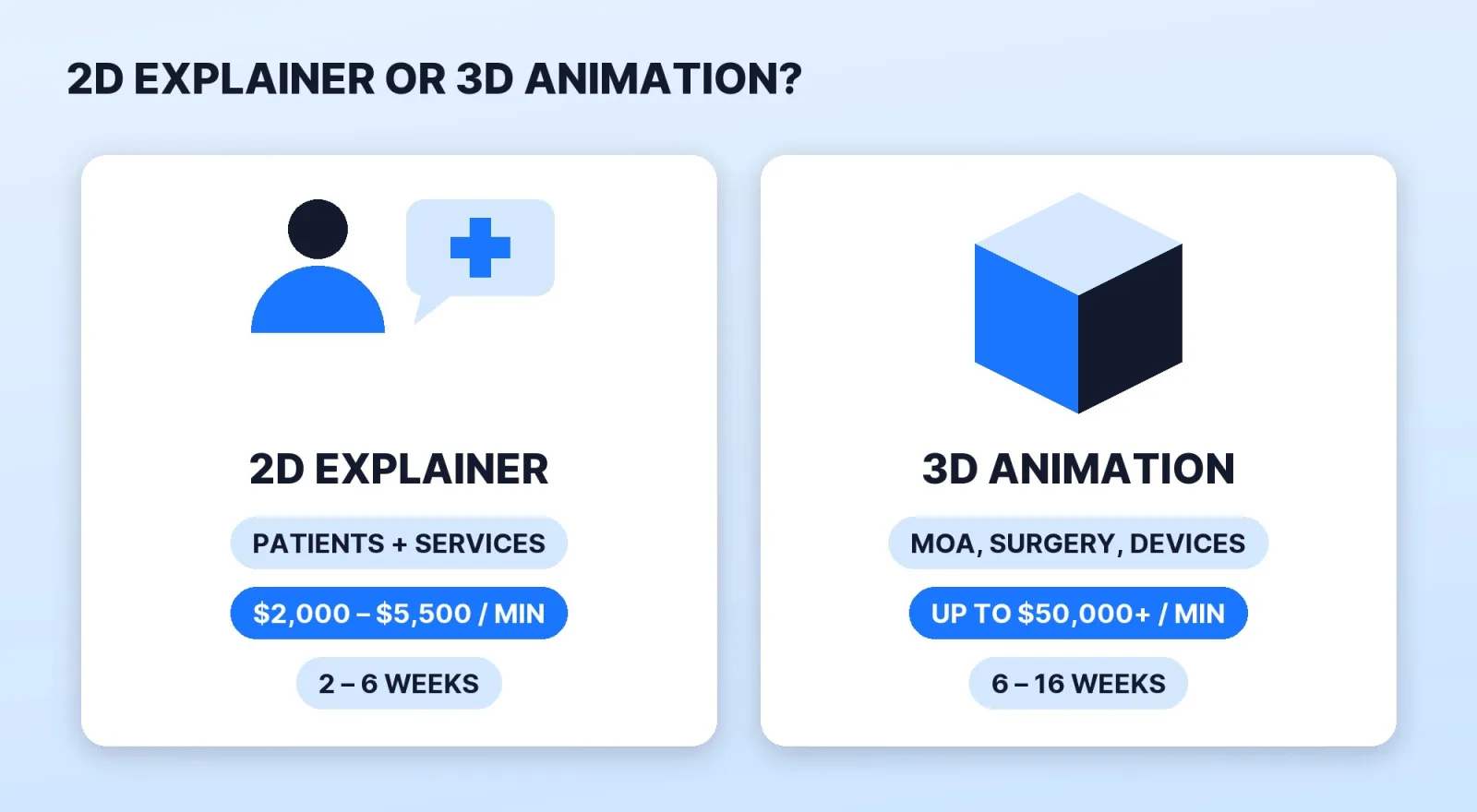
A 2D explainer uses illustrated characters, icons and on-screen text. It suits patient education, a clinic's services, a health app or a benefits program, where the job is to make one idea clear. Fixed-price studios publish $2,000–$5,500 for about a minute.
3D medical animation builds the body, the drug or the device as a model and moves a camera through it. Pharma, biotech and medtech teams use it to show a mechanism of action (MOA) or mechanism of disease (MOD), a surgical procedure or how a device works. Accuracy is the product, so scientists and medical illustrators check every frame. That's why Nucleus Medical Media's range runs to $50,000+ per minute and why Ghost Medical's finished animations average 10 weeks.
Pick the cheaper style the audience will accept. Patients and buyers rarely need molecular detail. Doctors and regulators often do.
Why Medical Animation Takes Longer
Review rounds set the schedule. Broadcast2World quotes 4–6 weeks for a healthcare animation and says medical, legal and regulatory (MLR) review can stretch it to 6–10. Random42's average project is 14–16 weeks because revisions and med-legal review are part of the plan.
For a prescription drug, review doesn't end with your team. Federal rules require drug companies to submit promotional labeling and ads to the FDA when they are first used, with Form FDA-2253. Tell the studio up front how many reviewers sign off and how long each round takes, because that, not the animation, usually sets the delivery date.
What Moves the Price
- 2D or 3D. The biggest single factor. 3D needs models, lighting and rendering, and accuracy checks on each.
- Length. Broadcast2World charges $750 and up for each extra 30 seconds. A 90-second script costs more than a 60-second one at every studio.
- Scientific accuracy. A patient explainer can simplify. An MOA animation for physicians has to match the science, and the studio's experts bill for that work.
- Review rounds. Each MLR round adds revisions and weeks. Budget for them before you sign.
- Licensing. Random42 includes full global copyright. Nucleus Medical Media also licenses existing animations, and its license terms typically run one to five years, with the duration changing the price.
- Voiceover and languages. A second language means new narration and often new on-screen text.
How to Get an Accurate Quote
Send these with your first message and every quote back will price the same job:
- Audience: patients, clinicians, investors, sales reps or trainees.
- The one thing to show: a condition, a procedure, a device or how a treatment works.
- Style and length: 2D or 3D, and the target runtime.
- Who signs off: the reviewers, the number of rounds and how long each takes.
- What you already have: a script, clinical references, device CAD files, brand guides.
- Where it runs: website, waiting room, trade show, sales deck or paid ads, and for how long.
- Deadline: a launch, congress or trade-show date.
Where Mark Studios Fits
Mark Studios makes 2D animated explainers and doctor-led explainers for practices, clinics and health brands. Mark writes the script, storyboards it, animates it and adds the voiceover, music and sound, and you approve the script and storyboard before anything moves. Send the brief and Mark emails your exact price within one business day, and the quote states the delivery date. We're not a 3D MOA or surgical animation studio. For that work, our list of the best medical animation companies names the specialists. In Palm Beach, Broward and Martin counties we also film practitioners on site for health and wellness video. We've delivered 10,000+ projects for 4,500+ clients at a 4.9★ average, with 100M+ views generated. Planning a live-action patient or practitioner story instead? See what a testimonial video costs, or compare healthcare video production companies.
The Bottom Line
Medical animation costs $2,000–$5,500 for about a minute of 2D healthcare explainer at fixed-price studios, $18,000–$25,000 for higher-end healthcare animation, and up to $50,000+ per minute for detailed 3D. Choose 2D or 3D by who will watch it. Then plan the schedule around review, because sign-off adds more weeks than the animation does.


