

The Short Answer: What a Video Editor Does for a Doctor
A video editor for doctors turns your recorded explanations into finished YouTube videos. That means cutting restarts and tangents, adding diagrams and on-screen citations, captioning clinical terms correctly, proposing thumbnails, and cutting Shorts from each long video. You keep the parts only a licensed professional can do: choosing the topic, making the medical argument on camera, and signing off on every on-screen line.
There's a platform reason to do it well. Since October 2022, YouTube has let licensed healthcare professionals apply for its health features: a health source information panel under each video, and a place in the health content shelves that appear when people search a condition. To qualify, a channel needs more than 1,500 public watch hours in the past 12 months (or 1.5 million Shorts views in 90 days), per YouTube's eligibility page. Watch hours come from videos people finish, and that's the editor's job.
Step 1: Split the Work Between You and Your Editor
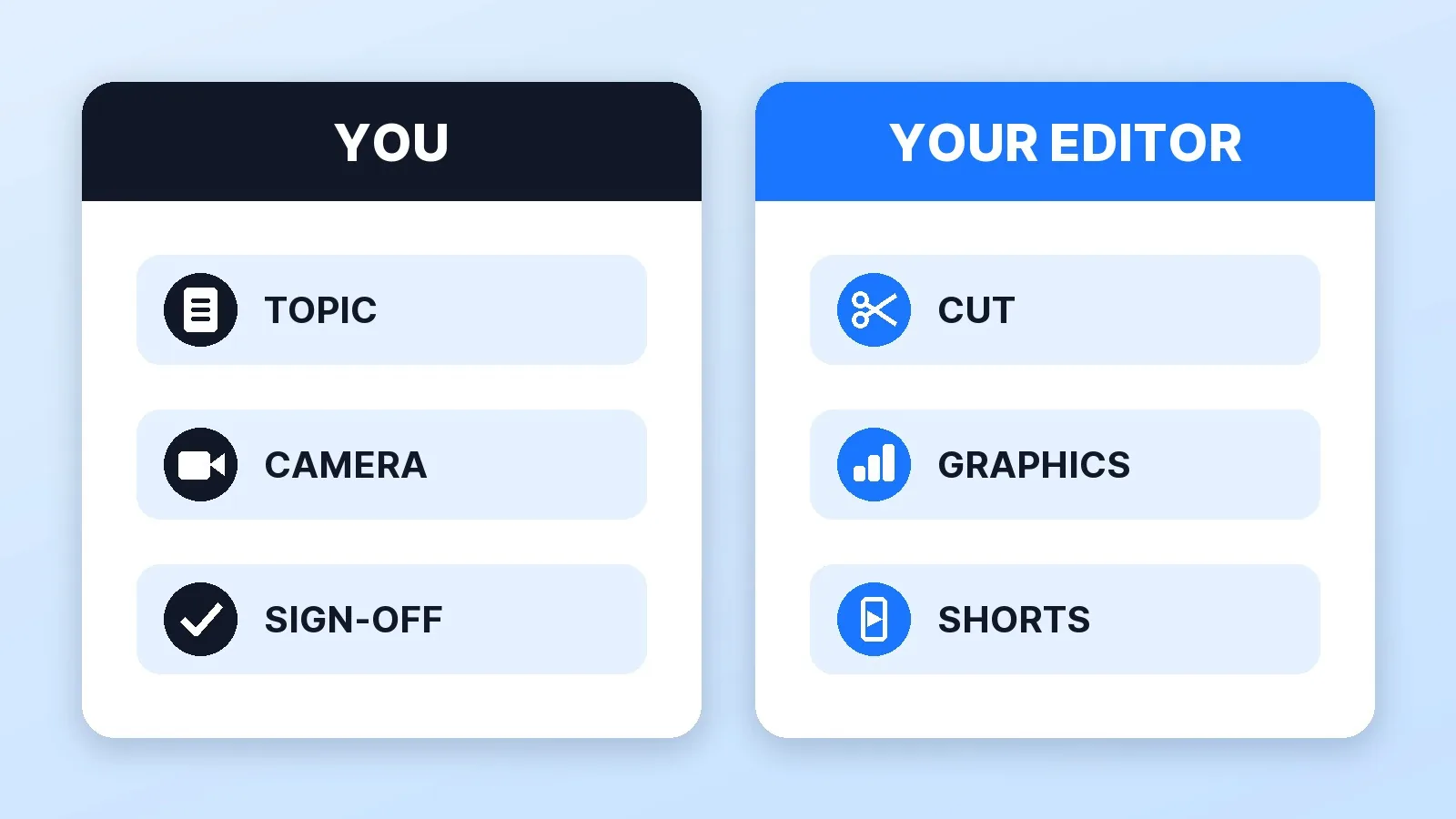
| Task | Who | Why |
|---|---|---|
| Topic and the medical argument | You | Clinical judgment can't be delegated |
| Recording | You | Your face, voice and credentials are the channel |
| Cutting restarts, tangents and pauses | Editor | The biggest time cost, and pure craft |
| Diagrams, on-screen citations, b-roll | Editor, from your sources | Shows the science as you explain it |
| Captions and medical spelling | Editor; you check the terms | A misspelled drug name costs trust |
| Thumbnail and title options | Editor proposes, you choose | Packaging decides who clicks |
| Shorts cut from the long video | Editor | One recording, several uploads |
| Final review of every on-screen line | You | Your name is on every claim |
Give your editor access through YouTube's channel permissions, not your password. The Editor role can upload and publish, but can't delete the channel or manage permissions. If you've never handed off a video, our guide on how to brief a video editor covers what to send with the first file.
Step 2: Record in Batches, Review in One Sitting
Most practicing doctors can't film every week, so batch it. Here's an example plan for one long-form video a week; treat it as a starting estimate, not a rule:
Week 1, Monday     Pick four topics; list the papers or guidelines behind each
Week 1, Tuesday    Record all four in one sitting, one section at a time
Week 1, Wednesday  Send the raw files and sources to your editor
Every week         Editor delivers one cut plus 2-3 Shorts cut from it
Every week         You review the list of on-screen lines and approve or correct
Week 5             Batch the next four
Recording one section at a time makes restarts cheap: stop, breathe, say the sentence again, and the editor keeps the clean take. A 90-day content calendar keeps your topics ahead of your recording days.
Step 3: Apply for YouTube's Health Source Label
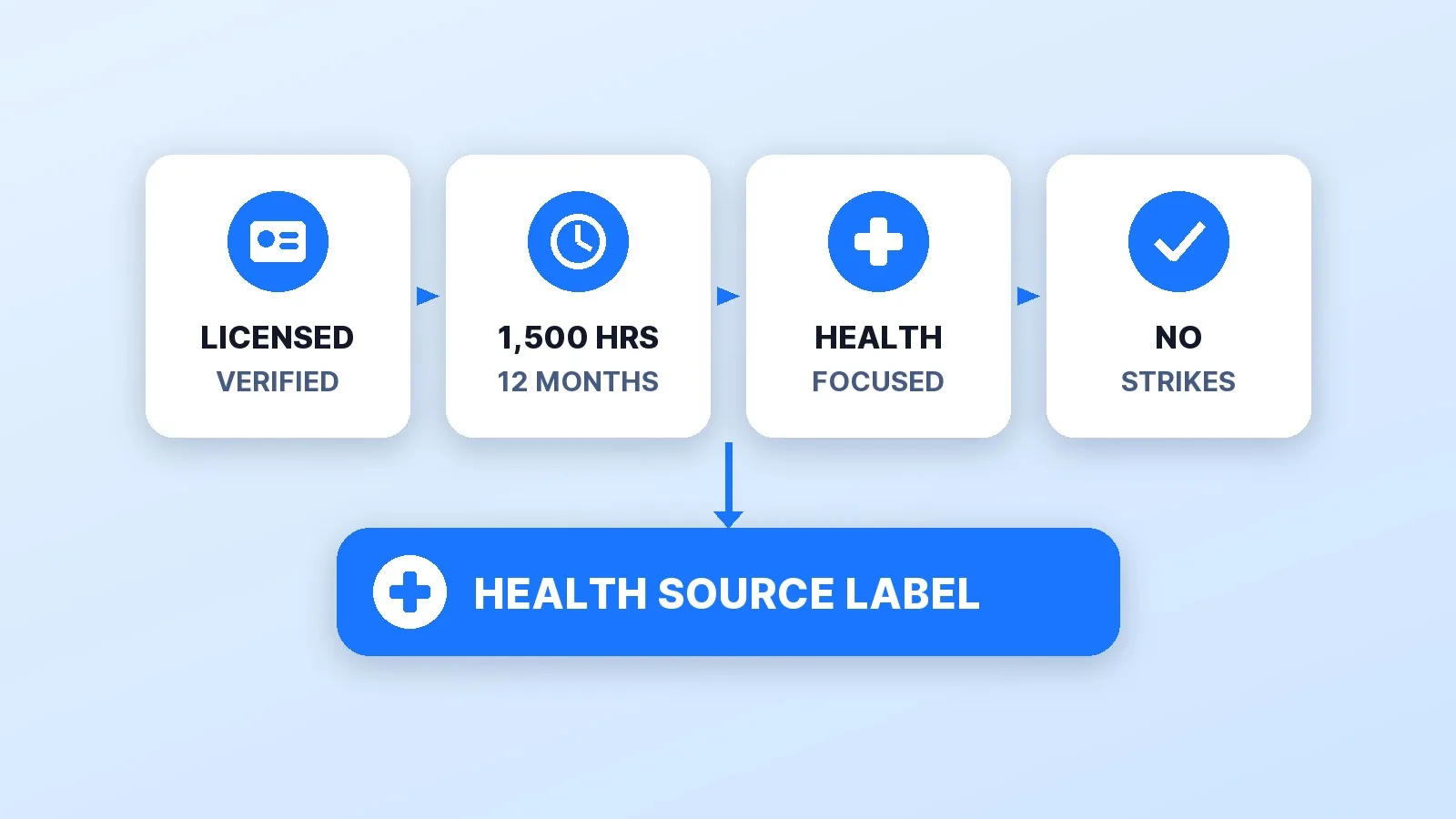
| Requirement | What YouTube asks for |
|---|---|
| License | Licensed doctor, nurse, psychologist, marriage and family therapist or clinical social worker, verified by LegitScript |
| Principles | Attest to health information sharing principles set out with the Council of Medical Specialty Societies, the National Academy of Medicine and the WHO |
| Watch time | More than 1,500 valid public watch hours in the last 12 months, or 1.5 million valid public Shorts views in the past 90 days |
| Focus | The channel primarily covers health information |
| Standing | No active Community Guidelines strikes; follows monetization policies even if not monetized |
| Timing | A decision in about 1–2 months; features can start surfacing 2–3 months after acceptance |
Channels run by pharmaceutical companies, health insurers or medical device makers aren't eligible. YouTube explains how the panels and shelves work on its health information page. We read these requirements on YouTube's pages on November 14, 2026.
Step 4: Protect Your Patients and Your License
Hiring an editor doesn't change your obligations, so build them into the workflow:
- Patients on camera need written consent. The Federation of State Medical Boards' social media guidance says not to post patient images or videos without the patient's express written consent. A patient story used to market your practice generally needs a HIPAA authorization under 45 CFR 164.508. Ask your compliance adviser; this isn't legal advice.
- No individual advice. The same guidance says not to give specific patients medical advice online, and to post under your name and credentials.
- Stay inside YouTube's medical rules. Under its medical misinformation policy, YouTube doesn't allow content that poses a serious risk of egregious harm by contradicting local health authority guidance on prevention or treatment, and the policy covers descriptions and links too.
- Blur what the lens catches. A chart on a monitor, a name on a whiteboard, a patient in the hallway behind you. Your editor should blur them and flag anything unclear.
- Review a text list, not just the video. Ask for every caption and on-screen line as a document, so you can check drug names and doses without scrubbing the timeline.
- Your editor adds no claims. Graphics illustrate what you said, sourced to what you cited.
Our healthcare video editing page sets out how we handle consent, clinical review and patient stories for practices.
A Worked Example: Dr. Nick Norwitz
Dr. Nick Norwitz, a Harvard MD with an Oxford PhD in human metabolism, explains metabolic health to 1.32M YouTube subscribers, and Mark Studios edited his long-form videos in 2024 and early 2025. His brief was to keep every scientific claim, citation and nuance while still editing for retention. So the work leaned on diagrams, on-screen citations and pacing that gives the science room, with no fake suspense stings. "I Ate 720 Eggs in 1 Month" was the most-viewed long-form video on his channel for over a year and now sits at 637K views. In his words: "I went through about 20 editors before I found Mark Santos."
Mark Studios has delivered 8,000+ orders and holds a 4.9★ rating across 4,500+ reviews. It's Top Rated on Fiverr, with 99% on-time delivery, and you work directly with Mark.
In-House Hire or Outsourced Editor?
A full-time in-house editor makes sense once you publish several videos a week. Below that, an outsourced editor usually costs less than a salary and scales with how often you record. Our in-house vs outsourced comparison lays out the trade-offs, YouTube video editing cost gives market ranges, and how to find a video editor covers building a shortlist.
The Bottom Line
Your time is the scarce input. Spend it on the topic, the camera and the final check, and hand the rest to an editor who keeps the science intact. A channel people finish watching earns the watch hours YouTube's health label asks for, and that label tells new viewers a licensed professional is speaking.


