We ran every caption in 387 public videos, 139 from NASA and 248 recorded MIT OpenCourseWare lectures, through our caption checker: 339,521 captions measured against the Netflix, BBC and DCMP limits for reading speed, line length, time on screen and gaps. Here is how fast real captions run, and which limits they break.
In 378 of 387 videos (98%), at least one caption is faster than Netflix's limit of 20 characters a second for adult programs. In the median video, 18.4% of captions are. See details
All 248 MIT OpenCourseWare lectures had captions over that limit. Only 9 of 139 NASA videos (6%) kept every caption under it. See details
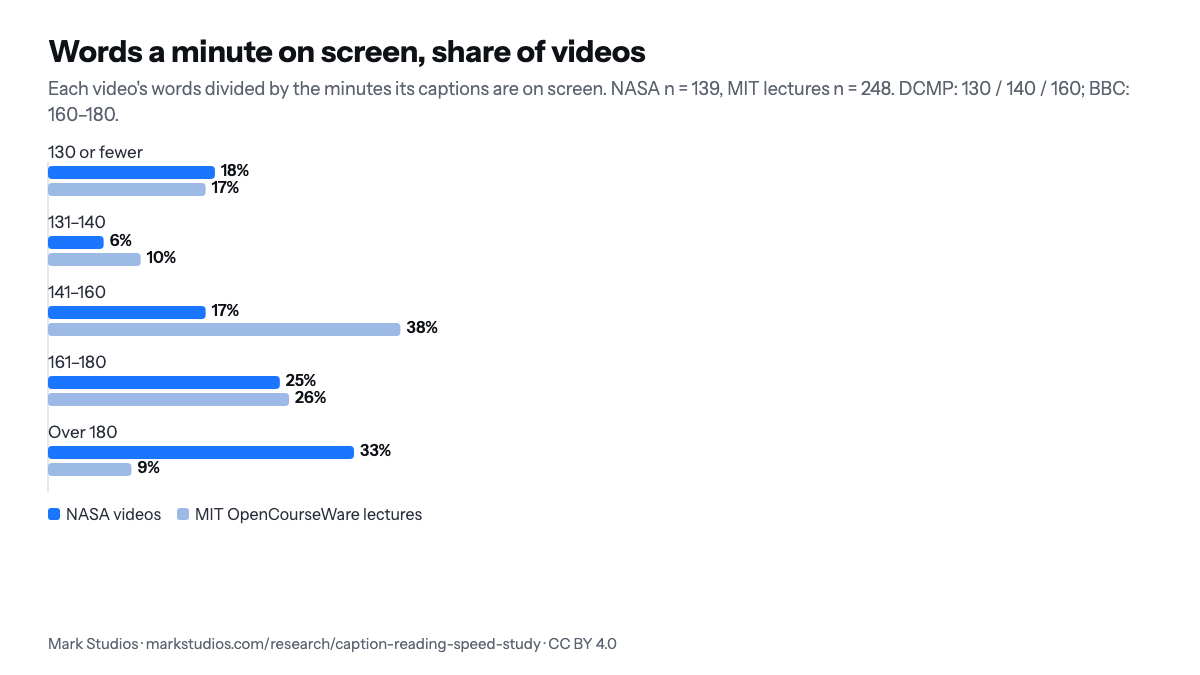
Measured as DCMP defines presentation rate, words a minute on screen, the median NASA video ran at 170 words a minute and the median MIT lecture at 151; 81 of 139 NASA videos (58%) and 87 of 248 lectures (35%) averaged more than 160, DCMP's ceiling for upper-level educational media. See details
Line length was rarely the problem. The longest line in the median lecture was 32 characters, and in the median NASA video 42, exactly Netflix's limit. But 101 of 139 NASA videos (73%) had lines longer than the BBC's 37-character broadcast limit. See details
379 of 387 videos never put more than two lines on screen. See details
In the median video, 9.4% of captions stayed up for less than DCMP's minimum of 40 frames (1.33 seconds at 30 frames a second), and 2.6% for less than Netflix's 5/6 of a second. See details
Back-to-back captions are the norm: in the median video, 94.6% of captions are followed by the next with less than Netflix's minimum gap of two frames. See details
NASA's live coverage (launch broadcasts and news conferences, 18 videos) ran faster than its produced videos: in the median live video, 24.2% of captions passed 20 characters a second, against 16.4% in produced ones. See details
How fast do real captions run?
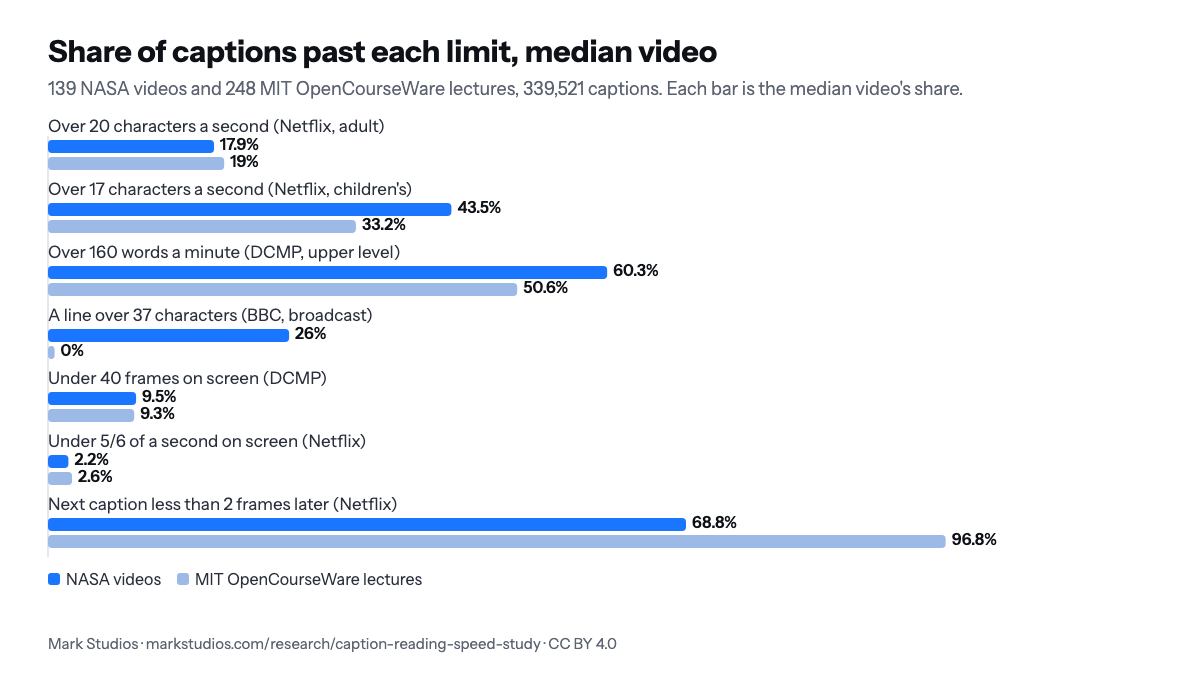
Most captions sit under Netflix's limit, but almost no video keeps all of them there. The median caption ran at 16.4 characters a second in NASA's videos and 14.3 in MIT's lectures (the median of each video's median). Speech is uneven, though: a fast sentence or a short caption on a long phrase pushes single captions well past the limit. In the median video, 18.4% of captions were faster than the 20 characters a second that Netflix's English style guide allows for adult programs, and 35.8% were faster than the 17 it allows for children's programs.
NASA videos
MIT OpenCourseWare lectures
Videos measured
139
248
Captions measured
64,567
274,954
Median caption speed (median of each video)
16.4 characters a second
14.3 characters a second
Captions over 20 characters a second, median video
17.9%
19%
Captions over 17 characters a second, median video
43.5%
33.2%
Videos with at least 10% of captions over 20
103 (74%)
183 (74%)
Videos with every caption at 20 or under
9 (6%)
0 (0%)
Characters include letters, spaces and punctuation, but not line breaks or formatting tags. Speed is a caption's characters divided by the seconds it is on screen.
Share of captions past each limit, median video139 NASA videos and 248 MIT OpenCourseWare lectures, 339,521 captions. Each bar is the median video's share.
DCMP's Captioning Key measures presentation rate in words a minute and says educational captions should optimally not exceed 130 words a minute for lower-level material, 140 for middle-level and 160 for upper-level. The BBC's subtitle guidelines give 160 to 180 words a minute. We counted every word a video's captions show and divided by the minutes they are on screen.
NASA videos
MIT OpenCourseWare lectures
Median video, words a minute
170
151
Middle half of videos
142–184
138–166
Videos over 130 words a minute
114 (82%)
206 (83%)
Videos over 160 words a minute
81 (58%)
87 (35%)
Videos over 180 words a minute
46 (33%)
23 (9%)
Captions over 160 words a minute, median video
60.3%
50.6%
Words a minute on screen, share of videosEach video's words divided by the minutes its captions are on screen. NASA n = 139, MIT lectures n = 248. DCMP: 130 / 140 / 160; BBC: 160–180.
DCMP's levels are for educational media for students; recorded university lectures sit above them, so 160 words a minute is the most generous of its ceilings rather than a rule these lectures were written to. DCMP itself describes the debate: organizations of deaf and hard of hearing people favor verbatim captions, while parents and teachers ask for editing because verbatim rates can be hard to follow, and DCMP supports editing.
Are caption lines too long?
Rarely by Netflix's measure. No line passed Netflix's 42 characters in the median video of either source. MIT's lecture captions are narrow: the longest line in the median lecture was 32 characters, and 244 of 248 lectures never passed 37. NASA's captions use wider lines that stop at Netflix's limit in the median video, so most NASA videos break the 37 characters the BBC allows on broadcast platforms.
NASA videos
MIT OpenCourseWare lectures
Longest line, median video
42 characters
32 characters
Videos with a line over 42 characters (Netflix)
62 (45%)
2 (1%)
Videos with a line over 37 characters (BBC broadcast)
101 (73%)
4 (2%)
One-line captions, median video
42.6%
27.8%
Videos with any caption over two lines
4
4
How long do captions stay on screen?
Short flashes are more common than long holds. In the median video, 9.4% of captions were on screen for less than DCMP's minimum of 40 frames (1 second and 10 frames, 1.33 seconds at 30 frames a second), and 2.6% for less than Netflix's 5/6 of a second. At the other end, Netflix allows 7 seconds and DCMP 6.
NASA videos
MIT OpenCourseWare lectures
Under 5/6 of a second (Netflix minimum), median video
2.2%
2.6%
Under 40 frames (DCMP minimum), median video
9.5%
9.3%
Over 6 seconds (DCMP maximum), median video
0%
3%
Over 7 seconds (Netflix maximum), median video
0%
1.3%
Videos with any caption over 7 seconds
48 (35%)
229 (92%)
Do captions leave gaps between them?
Almost never. Netflix's timing guidelines ask for at least two frames between captions, so the viewer sees one caption change to the next. Most files run captions back to back instead: in the median video, 94.6% of captions were followed by the next one with less than two frames between them (68.8% for NASA, 96.8% for MIT), and only 3 of 387 videos had none. The BBC and DCMP set no minimum gap, so this is a delivery rule for Netflix rather than a reading problem. We measured gaps at 30 frames a second. Overlapping captions were rare: 5 of 387 videos had any.
Are live captions faster than produced ones?
Yes, in NASA's videos. We split NASA's sample by title into live coverage (launch broadcasts, news conferences and briefings, 18 videos, a median of 55.2 minutes long) and produced videos (121, a median of 3.2 minutes).
NASA
Live coverage
Produced videos
Videos
18
121
Captions over 20 characters a second, median video
24.2%
16.4%
Words a minute, median video
178
166
Under 5/6 of a second, median video
4.3%
1%
Live captions follow the speaker as it happens, so they can't be condensed or retimed the way captions for a finished video can.
What this means for your captions
If your captions are a word-for-word transcript of natural speech, expect about one caption in five to run faster than Netflix's 20 characters a second, and expect the words-a-minute rate to land near the 150–170 of the videos here. Whether that is a problem depends on where the video goes: Netflix and other platforms with a style guide will flag it, while an accessibility review may prefer verbatim captions. To bring a caption under a limit:
Cut words before you cut time. Netflix's guide favors text reduction, deletion and condensing when editing for reading speed.
Borrow time. Start the caption a little earlier or end it later where there is room; DCMP suggests borrowing up to 15 frames before or after the audio.
Split long captions into two at a natural break, and keep each line within the standard's character limit.
Merge flashes. A caption on screen for less than a second is usually better joined to its neighbor.
Our free caption checker flags every caption that breaks a limit in an .srt or .vtt file, in the browser, against the same three standards used here. Our guide to burned-in vs closed captions covers which kind to use, and the video captions statistics page has the numbers on who uses captions and why.
How we ran the study
NASA. NASA's Image and Video Library listed 1,158 videos dated 2025 or 2026 when we queried its public API on October 15, 2026. We shuffled them with a fixed seed and took the first 250 that carry an .srt caption file, which nearly all of them do. The sampled videos are dated 2025-01-08 to 2026-10-06.
MIT OpenCourseWare. We shuffled the OpenCourseWare course list with the same seed, kept courses with a video gallery, and took the WebVTT caption file of up to six lectures from each, until we had 250 lectures from 47 courses.
Cleaning. Of the 500 files, 67 were duplicates (the same NASA video published at 720p, 1080p and 4K, or identical caption text) and 46 had fewer than five captions with text, mostly music-only b-roll. That left 387 videos and 339,521 captions.
Measuring. Every file went through the open-source caption-checker library, the same code that runs our online checker, with no changes. Characters count letters, spaces and punctuation on each line, but not line breaks or formatting tags. Words are runs of characters that hold a letter or a digit. Frame-based limits (Netflix's two-frame gap, DCMP's 40 frames) use 30 frames a second. Each video counts once: we report the median video and the number of videos past each limit, so a three-hour launch broadcast does not outweigh a two-minute clip. We checked the results for a random set of files with a separate script, and they matched.
The collection and analysis scripts are public in the study folder of the caption-checker repository, and the per-video results are in the CSV below. Each limit was read on the standard's own page on October 15, 2026. Neither NASA nor MIT reviewed or endorsed this study.
Limitations
Two publishers. NASA's videos and MIT's lectures are not all video. Short social clips, films and TV are not in this sample.
The standards were written for different media. Netflix's limits are for subtitles on its service, the BBC's for its programs, and DCMP's for educational media for students. None of the videos here were made to Netflix's guide.
Lectures cluster by course. Up to six lectures come from each of 47 courses, so one fast or slow lecturer can move several rows.
We can't see how a caption was made. The files don't say whether captions were written live, edited or generated, or whether they are verbatim.
Frame rate. Gaps and the 40-frame minimum assume 30 frames a second; at other rates those counts shift slightly.
Mark Studios. "Caption Reading Speed Study." Published Oct 15, 2026. https://www.markstudios.com/research/caption-reading-speed-study
Our measurements and the per-video CSV are free to reuse under CC BY 4.0 with a link to this page. The caption files remain NASA's and MIT OpenCourseWare's, under their own terms.
We plan to rerun the study each year with a fresh sample, and to add more publishers. Corrections go to contact@markstudios.com.
Oct 15, 2026: First published: 387 videos, 339,521 captions.
Frequently asked questions
How fast should captions be?
Netflix's English style guide allows up to 20 characters a second for adult programs and 17 for children's programs. The BBC's subtitle guidelines give 160 to 180 words a minute. The DCMP Captioning Key, written for educational media, says captions should optimally not exceed 130 words a minute for lower-level, 140 for middle-level and 160 for upper-level material.
How fast are real captions?
In our study of 387 public videos, the median caption ran at 16.4 characters a second in NASA's videos and 14.3 in MIT OpenCourseWare lectures. Overall, the median NASA video showed 170 words a minute and the median lecture 151. In the median video, 18.4% of captions were faster than Netflix's 20-characters-a-second limit.
Are verbatim captions too fast to read?
Often, by the published limits. Captions that keep every spoken word run at the speaker's pace: 87 of 248 MIT lectures (35%) averaged more than 160 words a minute, DCMP's highest ceiling for educational media. DCMP recommends editing captions to its rates while keeping the meaning and essential vocabulary; organizations of deaf and hard of hearing people that DCMP cites prefer verbatim captions.
Why do most captions break Netflix's 2-frame gap rule?
Because most caption files run captions back to back. In the median video, 94.6% of captions were followed by the next one with less than two frames between them. Netflix asks for a minimum gap of two frames so viewers see a change; the BBC and DCMP set no such minimum, so this is a Netflix delivery rule rather than a readability problem.
How can I check my own captions?
Open the .srt or .vtt file in our free caption checker, which runs in the browser and flags every caption that breaks the Netflix, BBC or DCMP limits. The same checker is free and open source as a command-line tool, and it is the code we used for this study.
Can I use this data?
Yes. Our measurements and the per-video CSV are free to reuse under CC BY 4.0, with a link to this page. The caption files themselves belong to NASA and MIT OpenCourseWare and stay under their own terms; we publish only measurements and links to the files.