Every figure on this page links to the organization that produced it, and each was re-checked against that source before publishing. How many SEC-registered advisers list YouTube and other social media on Form ADV and how active their channels are (our own count of SEC filings), how many financial advisers there are counted six ways, what they earn, how many Americans use an adviser and check one first, where investors get investing information, what the SEC and FINRA rules say about testimonials, video and social media, how other countries compare, and where the popular adviser marketing numbers came from.
13.0% of SEC-registered advisers list a YouTube address on Form ADV, against 62.6% that list LinkedIn; 65.7% list at least one social media account. (Our count of SEC Form ADV filings, January 2025 to September 2026)See details
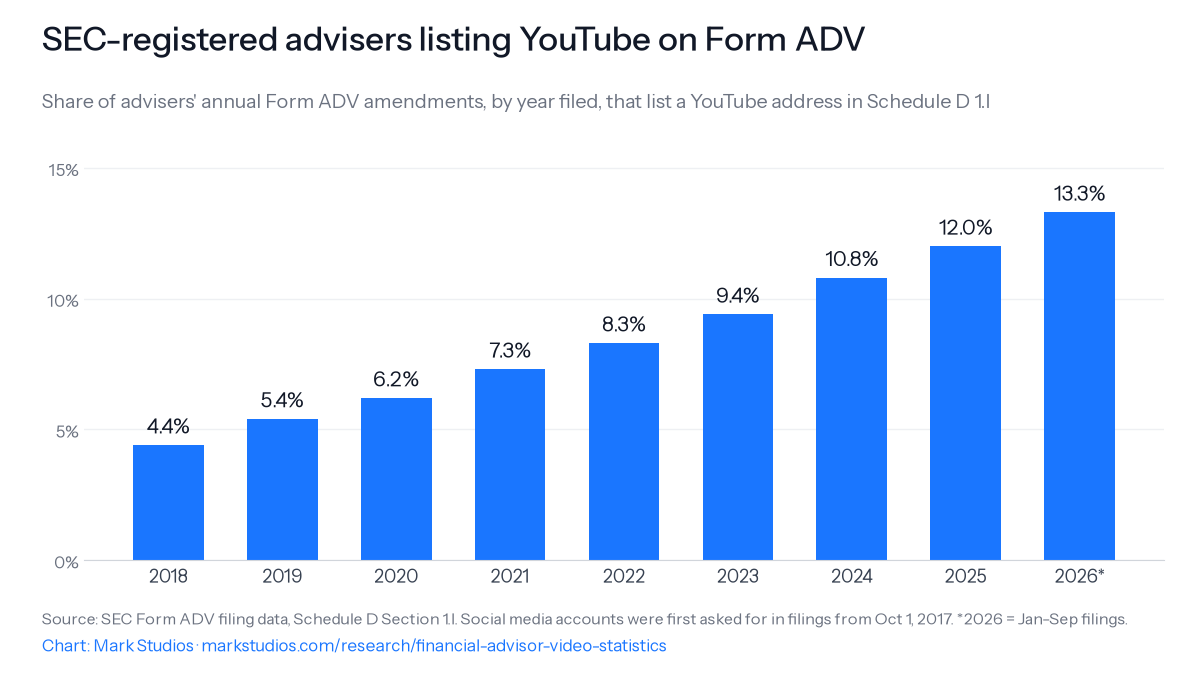
The share of advisers listing YouTube tripled in eight years: 4.4% of annual Form ADV amendments filed in 2018 and 13.3% of those filed in 2026. (Our count of SEC Form ADV filing data)See details
Only 6.1% of SEC-registered advisers list a YouTube channel that posted in the 90 days to October 29, 2026, and the median listed channel had 60 subscribers. (Our count, SEC data and YouTube Data API)See details
48.0% of advisers with more than 250 employees list YouTube, against 7.1% of those with five or fewer. (Our count of SEC Form ADV filings)See details
Advisers that list YouTube are more likely to use testimonials in advertising: 29.0% do, against 8.0% of advisers that do not list it. (Our count of Form ADV Item 5.L)See details
There is no single count of financial advisers: FINRA registered 639,723 people at the end of 2025, BLS counted 266,800 personal financial advisor jobs on payrolls in May 2025, and CFP Board 107,529 CFP professionals. (FINRA; BLS; CFP Board)See details
30% of U.S. investors used YouTube for investing information in 2024, and 26% made investment decisions based on a finfluencer. (FINRA Investor Education Foundation)See details
Only one in five U.S. investors (20%) has ever checked a financial professional's background with a regulator. (FINRA Investor Education Foundation, 2024)See details
The SEC's marketing rule, mandatory since November 4, 2022, lets advisers use testimonials with disclosures; 10.6% reported using them in advertising in 2025. (SEC; Investment Adviser Association)See details
'92% of advisors gain clients through social media' is Putnam's 2018 survey of advisors who already used social media; Putnam's 2023 edition found 51%. (Putnam Investments)See details
'70% of widows fire their advisor' began as 70% who had considered it within three years; measured, 13.7% of recent widows changed advisers. (InvestmentNews, 2009; Kehrer Group and RFI Global, 2026)See details
How many financial advisers use YouTube and social media?
About one in eight SEC-registered investment advisers lists a YouTube address on its Form ADV: 13.0% of the 17,163 advisers we read, against 62.6% that list LinkedIn. These are our counts from the SEC's own data. Since October 1, 2017, Form ADV has asked every adviser to list its website and the social media accounts it controls in Schedule D, Section 1.I SEC Release IA-4509, a change the SEC adopted on August 25, 2016SEC. We matched each adviser in the SEC's October 2026 list of registered advisers to its latest Form ADV filing made from January 2025 to September 2026, sorted every address it listed by platform, and published the result as form-adv-social.csv.
65.7% of SEC-registered advisers list at least one social media account. LinkedIn is the default. Facebook comes next at 26.1%, then X (Twitter) at 20.1%, Instagram at 12.9% and TikTok at 1.5%. The counts cover firm accounts only: Form ADV asks about accounts the adviser controls, not the personal pages of the people who work there.
Advisers that serve individuals use the consumer platforms more. 10,902 of the advisers in our data report individual clients in Form ADV Item 5.D. Their profile looks different from that of advisers who manage money only for funds and institutions:
Share of SEC-registered advisers listing each platform on Form ADV, by whether they report individual clients (our count, latest filing January 2025 to September 2026)
Platform
Advisers with individual clients
Advisers without individual clients
LinkedIn
61.3%
64.8%
Facebook
36.1%
8.7%
YouTube
15.9%
8.0%
Instagram
15.7%
8.0%
Bigger firms are far more likely to list a channel. Among advisers with five or fewer employees, 7.1% list YouTube. The share rises to 11.7% at 6 to 10 employees, 15.4% at 11 to 50, 23.0% at 51 to 250, and 48.0% at firms with more than 250 employees. LinkedIn follows the same pattern, from 45.3% of the smallest firms to 83.6% of the largest. Small firms are the majority: the median SEC-registered adviser had 8 employees in 2025, according to the Investment Adviser Association IAA and Comply.
SEC-registered advisers listing YouTube on Form ADV, by yearShare of advisers' annual Form ADV amendments, by year filed, that list a YouTube address in Schedule D Section 1.I. Form ADV first asked for social media accounts in filings from October 1, 2017. The 2026 bar (lighter) covers filings from January to September.
The share listing YouTube has tripled since the question changed. In annual Form ADV amendments filed in 2018, the first full year of the new question, 4.4% of SEC-registered advisers listed YouTube; in those filed from January to September 2026, 13.3% did. The full series, from form-adv-social-by-year.csv:
Share of SEC-registered advisers' annual Form ADV amendments listing each platform, by year filed (our count; one filing per adviser per year)
Two cautions. Filings before October 2017 asked only for websites, so earlier years are not comparable and are left out. And the 2026 row covers January to September; most advisers file their annual amendment by the end of March, so it already includes nearly all of them.
How active are financial advisers' YouTube channels?
Most adviser channels are small, and about half are active. We looked up every YouTube address that SEC-registered advisers list on Form ADV through the YouTube Data API on October 30, 2026. 2,012 of the 2,236 advisers listing YouTube linked a channel we could identify. The rest linked a handle or name YouTube no longer recognizes, a search page or YouTube's home page, or a channel ID typed in capital letters, which breaks YouTube's case-sensitive IDs. Of the advisers with an identifiable channel, 65.9% had a channel that posted in the 12 months to October 29, 2026, and 52.1% one that posted in the last 90 days.
That leaves a small active group. Only 6.1% of all SEC-registered advisers list a YouTube channel that posted in those 90 days, and 7.0% of advisers with individual clients.
The YouTube channels SEC-registered advisers list on Form ADV, read through the YouTube Data API on October 30, 2026 (our count; one row per distinct channel in youtube-channels.csv)
Measure
Value
Median subscribers
60
Channels with fewer than 100 subscribers
57.4%
Channels with 1,000 or more subscribers
20.0%
Channels with 10,000 or more subscribers
6.6%
Channels with no public videos
7.0%
Channels that posted in the 12 months to Oct 29, 2026
60.7%
Videos posted in those 12 months by the median active channel
21
Channels that posted 52 or more videos in the 12 months (about weekly or more)
17.8%
Active channels that posted at least one Short
52.0%
The median listed channel had 60 subscribers, and only 6.6% had 10,000 or more; those are mostly the channels of large asset managers and a few advisers who host a radio show or podcast. The channel list, with subscriber and upload counts, is in youtube-channels.csv.
Advisers with a YouTube channel use testimonials more
Form ADV also asks whether an adviser's advertisements include testimonials, endorsements or third-party ratings (Item 5.L), the practices the SEC's marketing rule opened up in 2022. In our data, 10.7% of SEC-registered advisers say their advertising includes testimonials, 17.4% endorsements and 18.7% third-party ratings. That matches the trade association's count of the same answers, 10.6% for testimonials in 2025 IAA and Comply. Advisers that list YouTube are far more likely to use testimonials: 29.0% do, against 8.0% of advisers that do not list it. The data cannot say whether the testimonials appear in the videos.
How many financial advisers are there in the U.S.?
It depends on who counts: the answers run from 107,529 CFP professionals to 639,723 people registered with FINRA. There is no single register of "financial advisers". The SEC and the states register advisory firms, FINRA registers the individuals who work for broker-dealers, the Bureau of Labor Statistics counts jobs with the occupation title "personal financial advisor", and CFP Board counts the people who hold its certification. Each counts a different group:
U.S. financial advisers counted six ways, with what each count measures
Count
What it counts
Date
Source
639,723
Individuals registered with a FINRA broker-dealer, client-facing or not
The counts overlap heavily. Of FINRA's representatives, 331,802 were also registered as investment adviser representatives at the end of 2025, 51.9% of the total and more than the 307,921 registered with a broker-dealer only, and another 94,562 people were registered only as investment adviser representatives FINRA Industry Snapshot 2026. In all, 734,285 individuals were registered in the U.S. securities industry FINRA. The household survey's 576,000 is about twice the employer count because people describe their own jobs; the employer survey uses the occupation codes payroll offices assign.
How many advisory firms are there?
Roughly as many advisory firms register with the states as with the SEC. The Investment Adviser Association, which counts from Form ADV, put SEC-registered advisers at a record 16,544 in 2025 IAA and Comply; the SEC said in its April 2026 budget request that it oversees more than 16,300SEC. Smaller firms, generally those managing $100 million or less, register with their state instead: NASAA counted 16,162 state-registered advisers at the end of 2025 NASAA, down from 16,575 a year earlier NASAA and 16,897 at the end of 2023 NASAA. In 2020 the SEC counted about 17,932 state-registered advisers SEC.
The SEC side keeps growing. The SEC counted 13,724 registered advisers in August 2020 SEC, and said in late 2023 that the number had grown 17 percent from 2018 to over 15,400SEC. The trade association's series runs from 14,806 in 2021 IAA and Comply to 15,870 in 2024 IAA and Comply. Firms that grow past the state threshold move to the SEC, which is part of why one list grows as the other shrinks. Another 6,436 exempt reporting advisers, mostly managers of private funds, reported to the SEC in 2025 IAA and Comply.
FINRA's broker-dealer count is falling while its people count holds. There were 3,184 FINRA member firms at the end of 2025 FINRA, 2,832 of them small firms with 150 or fewer representatives FINRA, with 146,826 registered branch offices FINRA. FINRA counted 639,385 registered representatives at the end of 2015, almost exactly the number ten years later FINRA. In 2025 46,795 people joined and 41,570 left FINRA.
The CFP count is the one rising fastest. CFP Board counted 95,137 CFP professionals at the end of 2022 CFP Board, 98,875 at the end of 2023 CFP Board, 103,093 at the end of 2024 CFP Board and 107,529 at the end of 2025, and its demographics page listed 110,974 on October 1, 2026 CFP Board. CFP Board is the certifying body, not a regulator; the title "financial adviser" itself requires no certification.
How big are financial advisory firms?
Most are small businesses. 92.8% of SEC-registered advisers employed 100 or fewer people in 2025, and the median adviser had 8 employees and $446.9 million in regulatory assets under management, according to the Investment Adviser Association's count of Form ADV filings IAA and Comply. In 2024, 87.7% had fewer than 50 employees IAA and Comply. State-registered firms are smaller still: 84.2% had two or fewer employees at the end of 2025 NASAA, and 72% of the state-registered advisers NASAA examined in 2023 were one-person firms NASAA.
The money is concentrated at the top. The SEC estimates that the largest 5% of advisers manage over 85% of all regulatory assets SEC, and that the median SEC-registered or exempt reporting adviser had about $324 million, against a mean of about $7 billion SEC. SEC-registered advisers managed $176.8 trillion in 2025 IAA and Comply for 73.7 million clients IAA and Comply; state-registered firms managed $384.6 billionNASAA.
Two-thirds of SEC-registered firms serve individuals. 66.2% provided asset management to individuals in 2025 IAA and Comply, serving 61.0 million individual investors IAA and Comply. 5,478 firms focused on individual clients, with an average of 2,563 individual clients each IAA and Comply, and 46.1% offered financial planning IAA and Comply. Individuals made up 610,420 of the 779,301 clients of state-registered advisers at the end of 2025 NASAA. These shares come from the same Form ADV client-type answers our own count uses (Item 5.D).
The industry counts by establishment tell a similar story. BLS counted 91,096 private portfolio management and investment advice establishments in 2025, employing 522,613 people at an average pay of $307,153BLS QCEW. That average includes portfolio managers, traders and support staff, so it is not adviser pay. NAICS merged investment advice and portfolio management into one code in 2022; in 2019 the two had 42,636BLS QCEW and 22,598BLS QCEW establishments, 65,234 together, so the count grew 39.6% in six years. The Census Bureau's 2022 Economic Census counted 71,935 such establishments with paid employees U.S. Census Bureau, with $372.9 billion in revenue U.S. Census Bureau. Investment advice firms alone reported $61.8 billion in revenue in 2024 U.S. Census Bureau.
What do personal financial advisors earn, and who are they?
The median personal financial advisor on a U.S. payroll earned $105,070 in May 2025, according to the Bureau of Labor Statistics BLS OEWS. The spread is wide, because pay often depends on assets or sales:
Pay of U.S. personal financial advisors (SOC 13-2052), May 2025 (wage and salary jobs only; BLS OEWS)
These figures cover employees only. They leave out self-employed advisers, who were 9.7 percent of the occupation in 2025 BLS, and BLS advises against comparing OEWS estimates from year to year. Most payroll advisers work in securities and investment firms: 192,160 of them in May 2025 BLS OEWS, against 46,240 in banks, credit unions and other credit intermediation BLS OEWS. California had the most, 32,200BLS OEWS, followed by New York with 21,550BLS OEWS, Florida with 21,490BLS OEWS and Texas with 18,200BLS OEWS; the New York metro area alone had 23,980BLS OEWS. BLS does not publish estimates for a few states, including Massachusetts and Connecticut.
BLS expects slow growth. It projects 303,500 jobs in 2035 BLS Employment Projections, growth of 1.4 percent from 2025 against 3.5 percent for all occupations BLS Occupational Outlook Handbook, with about 17,100 openings a year, mostly to replace advisers who retire or change jobs BLS. 65 percent of the jobs were in securities, commodity contracts and other financial investments BLS.
The occupation is older, more male and less diverse than the workforce. In the 2025 Current Population Survey, 32.8 percent of employed personal financial advisors were women, against 47.1 percent of all workers BLS CPS; 7.6 percent were Black BLS CPS, 8.0 percent Asian BLS CPS and 8.3 percent Hispanic or Latino BLS CPS. Their median age was 43.6BLS CPS. Among CFP professionals, women numbered a record 25,601 at the end of 2025, or 23.8% CFP Board, and 11,195 were racially or ethnically diverse CFP Board; CFP Board's last published counts by group were 1,899 Black CFP Board and 3,016 Hispanic CFP professionals at the end of 2023 CFP Board.
How many Americans use a financial adviser?
Between about a fifth and a third of U.S. adults, depending on the question. 22.8% of adults said in spring 2024 that they had ever met with a financial adviser for advice, in the Federal Reserve Bank of Philadelphia's survey Philadelphia Fed; 34% said in January 2025 that they work with one, in Northwestern Mutual's survey Northwestern Mutual. The surveys ask different things, so they should not be compared as a trend:
Use of financial advisers in the U.S., by survey and question wording
Northwestern Mutual sells financial advice, so its survey is labeled as a company survey. The Federal Reserve's 2025 Survey of Consumer Finances gives no percentages for advice; it reports only that families relied most on the internet, personal connections and business professionals for investment decisions Federal Reserve Board. 31.8% of adults told the Philadelphia Fed they had never used financial advice from any source, and friends or family were the most common source, used by 42% Philadelphia Fed. Forty-seven percent of adults said in October 2025 that they were mostly or very comfortable choosing and managing their own investments Federal Reserve Board. Among investors, 45% execute trades by contacting a financial professional FINRA Foundation.
Do people trust financial advisers?
More than any other source of advice, but not by a lot. Financial advisers were the most trusted source of financial advice in the Philadelphia Fed's 2024 survey, with a net trust score of +33.7 (the share trusting minus the share distrusting), while social media scored -45.8Philadelphia Fed. 33% of adults named financial advisors as the source they trust most in Northwestern Mutual's 2025 survey, against 4% for online influencers and social media Northwestern Mutual. Gallup does not rate "financial advisers"; the nearest professions it rates are stockbrokers, rated highly honest by 9% of adults in December 2025 Gallup, and bankers, by 20% Gallup. Among households advised by a CFP professional, 73% said they strongly trust their adviser, against 52% of households using other advisers CFP Board. Finding one is the hard part: in SEC-commissioned research in 2018, only 13% of adults not getting advice agreed that it is easy to find a trustworthy financial professional SEC and RAND, and only 36% knew that investment advisers are typically paid as a share of client assets SEC and RAND. 70.3% of adults rate an adviser's professional qualifications as important Philadelphia Fed.
Do investors look up an adviser before hiring one?
Only about one in five ever does. One in five U.S. investors (20%) said in the FINRA Investor Education Foundation's 2024 survey that they had ever checked a financial professional's background, registration or license with a state or federal regulator FINRA Foundation. The share has barely moved in a decade:
U.S. investors who have checked a financial professional's background with a regulator (FINRA Investor Education Foundation surveys)
Investors who use social media for investing decisions check more often, 36% against 14% of those who do not FINRA Foundation. Few use the lookup tools: 7% of investors had ever used FINRA's BrokerCheck in 2018, unchanged from 2015, and 9% had used the SEC's Investor.gov FINRA Foundation. In 2015, 16% had heard of BrokerCheck, against 81% who had heard of CarFax FINRA Foundation, and 14% had heard of the SEC's Investment Adviser Public Disclosure database FINRA Foundation. 58% of investors who use an adviser said professional designations are very important, yet fewer than a quarter had checked one FINRA Foundation.
BrokerCheck searches fell 52.2% from 2021 to 2023, by FINRA's own counts in its rule filings: almost 41 million in 2019 FINRA, 38 million in 2020 FINRA, 38.3 million in 2021 FINRA and about 18.3 million in 2023 FINRA. FINRA gives no reason, and it describes what it counted in slightly different words each time. CFP Board's planner-search site, LetsMakeAPlan.org, had 3,679,279 users in 2025 CFP Board.
Complaints to FINRA doubled. FINRA received 24,899 investor complaints directly in 2025 FINRA, against 11,908 in 2024 FINRA.
Where do investors get investment information? YouTube and finfluencers
YouTube is the social platform investors use most for investing information, in every survey we found. In the FINRA Foundation's 2024 investor survey, 30% of U.S. investors used YouTube for information about investing, more than any other social media channel FINRA Foundation, and 43% relied on online videos about business and finance when deciding what to invest in, the same share as in 2021 FINRA Foundation. Among investors who follow social media personalities, 77% used YouTube FINRA Foundation.
YouTube's share among people using social media for money or investing information, by survey
Finfluencers shape many investors' decisions. 26% of U.S. investors said in 2024 that they make investment decisions based on recommendations from a social media personality FINRA Foundation, rising to 61% of investors under 35 and falling to 6% of those 55 and older FINRA Foundation. 29% relied on social media groups or message boards FINRA Foundation, and among investors who rely on social media, 86% also relied on online videos about business and finance FINRA Foundation.
Across all adults, the share is lower. 19.5% of U.S. adults had ever used social media as a source of financial advice in spring 2024 Philadelphia Fed, from 38.0% of adults 18 to 35 to 2.7% of those 66 and older Philadelphia Fed. In April 2025, 24% of adults used social media for information about managing money FINRA Foundation, and 38% of investors got information about potential trades from a financial professional they pay FINRA Foundation. In February 2024, social media was an information source for 12% of adults, against 63% for financial professionals FINRA Foundation.
Many people say they struggle to judge what they see. Only 40% of adults were very or extremely confident they could tell whether information about managing money is good or bad FINRA Foundation, and just 5% said the most important test is whether many people liked or recommended it FINRA Foundation. 23.4% agreed that an unqualified financial adviser on social media is credible if they show knowledge in their videos Philadelphia Fed. 57% of Americans 25 to 64 with incomes over $50,000 said they had made a financial decision they regretted based on misleading online information CFP Board. 20% of adults said they would be interested in financial advice from artificial intelligence FINRA Foundation.
What do the SEC and FINRA rules say about adviser videos, testimonials and social media?
SEC-registered advisers may now use testimonials and endorsements, with disclosures and oversight, under a marketing rule that became mandatory on November 4, 2022; before it, SEC staff read the old advertising rule as banning testimonials of any kind. This section summarizes dated facts from the regulators' own texts. It is not legal or compliance advice; a firm's compliance team decides what its videos may say.
Key dates and thresholds for adviser and broker-dealer marketing, from the regulators' texts
Rule or event
Date or number
Source
SEC advertising rule adopted (testimonial ban as staff read it)
De minimis pay for a testimonial or endorsement over 12 months: at or below it, no written agreement or disqualification check is required (the disclosures still are)
Use of testimonials grew after the rule but remains a minority practice. The trade association's count of Form ADV answers found 6.8% of SEC-registered advisers using testimonials in advertising in 2022 IAA and Comply, 8.0% in 2023 IAA and Comply and 10.6% in 2025; endorsements reached 17.4%IAA and Comply and third-party ratings 19.2%IAA and Comply. When it adopted the rule, the SEC counted 13,724 registered advisers SEC and assumed for its cost estimate that half of them, 6,862, would be affected by the testimonial and endorsement requirements SEC; the actual share using testimonials has stayed well below that. The SEC received more than 90 comment letters on the proposal SEC.
How often are the marketing rules enforced?
The SEC ran a sweep of marketing rule cases in 2023 and 2024, then went quieter. On September 11, 2023, it charged nine advisers over hypothetical performance on their websites, with $850,000 in combined penalties SEC; five more settled on April 12, 2024 for $200,000SEC, and nine more on September 9, 2024 for $1,240,000 over untrue statements, testimonials, endorsements and third-party ratings SEC. Two cases involved video and social media directly. Howard Bailey Securities, one of the nine, paid $90,000 for advertising a paid non-client's endorsements in videos and on social media without the required disclosure SEC, and on November 1, 2024 Wahed Invest agreed to $250,000 over social media and website ads with paid athletes' endorsements SEC. The SEC said the initiative produced settled charges against more than a dozen advisers in fiscal 2024 SEC. Its fiscal 2025 results, 456 enforcement actions in all, do not mention the marketing rule SEC; the latest marketing rule settlement we found, against Meridian Financial on September 4, 2025, was $75,000SEC. A December 16, 2025 SEC risk alert found advisers using social media influencers and lead-generation firms without recognizing them as endorsements SEC, after a June 8, 2023 alert put testimonials and endorsements on the exam list SEC.
FINRA fined M1 Finance $850,000 on March 18, 2024 for influencer posts that were not fair or balanced, its first formal action over a firm's influencer program FINRA. About 1,700 paid influencers had helped M1 open and fund more than 39,400 accounts FINRA. FINRA's sweep of influencer programs, launched in September 2021, led to five formal enforcement actions FINRA.
FINRA reviews tens of thousands of broker-dealer communications a year. It reviewed 70,728 advertisements and sales communications in 2025 FINRA. Firms filed 68,414 marketing communications that year, led by website content FINRA, of which 1,107 were audio or video FINRA Industry Snapshot. From 2023 to 2025, FINRA reviewed 172,898 retail communications filed after first use FINRA. Twenty-four percent of those filed before use were noncompliant, against 10% of those filed after FINRA, and about 69% of new member firms' first-year filings were noncompliant FINRA.
State examiners find advertising problems often. NASAA's 2025 coordinated exams of state-registered advisers found 3,402 deficiencies across 23 categories, advertising among them NASAA. In its 2017 exams, 19.1% of examined advisers with assets under management had an advertising deficiency NASAA, and 44.5% of those deficiencies were on websites and 21.9% on social media NASAA; in 2021 advertising was the fifth most common deficiency area, at 19.7%NASAA. The SEC warned on Feb. 6, 2026 that scammers impersonate registered advisers on social media SEC.
How do other countries count financial advisers and regulate finfluencers?
Each regulator counts differently, and far fewer people take advice elsewhere than in the U.S. In the UK, 8.6% of adults received regulated financial advice on investments, pensions or retirement in the 12 months to May 2024, according to the Financial Conduct Authority's Financial Lives survey FCA, little changed from 8.3% in 2022 FCA. In Australia, 12% of adults had received personal financial advice in the previous 12 months in ASIC's 2018 survey ASIC. Canada is closer to the U.S.: 61% of Canadian investors said in 2024 that they have a financial advisor, the lowest share since the Canadian Securities Administrators began tracking CSA.
Financial adviser counts outside the U.S., with each regulator's definition
Country
Count
What it counts
Source
UK
31,000
Financial advisers in firms that give financial advice (about; stable since 2021)
Australia's count fell 43.7% in four years. The register held 28,522 advisers at the end of 2018 and 16,049 by December 2022 Australian Treasury; the Treasury review that reported the fall does not tie it to one cause. After the January 1, 2026 qualifications deadline, ASIC's review left 26 advisers who lost their authorisation ASIC. The FCA's own figures for UK adviser posts have been restated: its July 2026 release gives 37,660 for 2024 FCA, its November 2025 release 37,441 for the same year FCA. Both are shown; the newer is the FCA's current figure.
YouTube and finfluencers outside the U.S.
YouTube leads in other countries too, at lower levels. 10% of UK investors used YouTube to research investments in the 12 months to May 2024 FCA, 19% used social media of any kind FCA and 6% used influencers, bloggers or vloggers FCA. In Canada, YouTube was the most-used site for investment information in 2024, at 29%CSA; 53% of investors used at least one social media site for it CSA, and 82% of Canadians aged 18 to 24 did CSA. In an Ontario Securities Commission survey, 35% of retail investors had made a financial decision based on a finfluencer's advice OSC and 34% used YouTube for financial information OSC; those who had acted on finfluencer advice were 3.1 times less likely to work with an adviser OSC. 63% of Australians aged 18 to 28 use social media for financial information ASIC, and 52% somewhat or completely trust finfluencers ASIC. In the EU, only 5% of respondents in 2022 based personal finance decisions on social media or influencers, against 45% on bank staff or other advisers European Commission. 45% of Europeans are not confident that the investment advice they get from intermediaries is in their best interest, the European Commission says European Commission.
Regulators abroad act directly against unauthorised finfluencers. The FCA finalised its guidance on financial promotions on social media on 26/03/2024FCA. It interviewed 20 finfluencers under caution in October 2024 FCA, and in an April 2026 week of action asked platforms to take down 120 finfluencer accounts FCA. Its figures for a June 2025 international week of action changed between releases: 3 criminal proceedings in the June 2025 release FCA, 6 in the 2025/26 annual report release FCA. That week's warning alerts were set to produce over 650 takedown requests FCA. Firms amended or withdrew 19,766 financial promotions after FCA interventions in 2024 FCA. ASIC sent warning notices to 18 finfluencers in June 2025 ASIC and in April 2026 began reviewing how licensees supervise 15 who work as their authorised representatives ASIC; unlicensed financial services carry up to five years in prison for an individual ASIC. The OSC reviewed 87 finfluencers in June 2025 OSC. In the EU, ESMA said on 28 October 2021 that people posting investment recommendations on social media fall under the market abuse rules ESMA, and its 2023 review of marketing under MiFID II covered 208 firms ESMA. The FCA's often-quoted line that 62% of 18-to-29-year-olds follow influencers comes with no survey, sample or dates in the FCA's text FCA.
What the popular financial adviser marketing numbers really say
Advisor-marketing blogs repeat a handful of figures without sources. We traced six of them to where they began, and checked what the original actually measured.
"92% of advisors gain clients through social media"
This is Putnam Investments' 2018 survey, and it covered only advisors who already used social media for business. In 2026 it still appears with no source, date or base, for example in a July 2026 social media playbook DataAlly and a June 2026 software blog that turns it into "asset gains" Cloud Campaign. Putnam's 2018 survey of 1,021 advisors found 92% of advisors using social media for business said it had helped them gain clients, which was 83% of all advisors Putnam Investments. Its 2014 edition had put the figure at 66%Putnam Investments. Putnam's own 2023 edition, of 1,043 advisors, found only 51% gained new business from social media, down from 89% in 2020 Putnam Investments. In Broadridge's 2020 survey of 400 advisors, 37% had ever turned a social media lead into a client Broadridge. The "more than 60% of advisors use LinkedIn to gain clients" variant Advisor Websites drops a qualifier: LinkedIn's 2013 summary said more than 60% of advisors who prospected on LinkedIn gained clients LinkedIn. Use instead: Putnam's 51% (2023), and our count of what advisers actually list on Form ADV: 65.7% list a social account and 13.0% list YouTube.
"Viewers retain 95% of a video message" and "video lifts conversions 80%"
Both started as marketing claims by small vendors. Advisor-marketing agencies credit the 95% to Forrester Research Midstream Marketing or to SocialPilot Indigo Marketing Agency. Insivia, the agency it traces to, now says on its own site that the 95% came from a small survey it ran over 16 years ago and was directional, not a study Insivia; the survey covered around 200 B2B buyers Insivia. The 80% is credited to HubSpot Midstream Marketing, but it began in a 2010 white paper by EyeView Digital, a landing-page video vendor, which said the lift was over 80% "in some cases" among its own clients EyeView Digital. When Unbounce analysed about 35,000 customer landing pages in each of three periods in 2020 and 2021, it found video had a minimal or negative effect on conversion Unbounce. Our video advertising statistics page traces the 95% figure in more detail. Use instead: no figure; there is no independent measurement of video's effect on adviser conversions.
"The average financial advisor is 56, and a third retire within ten years"
The age has no source; the retirement share is a projection. Forbes' August 2025 Next-Gen Wealth Advisors list opens by putting the average advisor's age at "hovering around 56" without a source Forbes. Cerulli Associates, the research firm behind most retirement figures, projected in June 2022 that 37% of advisors would retire within 10 years Cerulli Associates and in 2025 put it at 37.4% of headcount Cerulli Associates. J.D. Power's 2025 survey of 3,698 advisors found 46% within 10 years of retirement J.D. Power and 26% already 65 or older J.D. Power. BLS's household survey counts far fewer older advisers: 47,000 of 576,000 employed personal financial advisors were 65 or older in 2025 BLS, and their median age was 43.6. The surveys cover different people: Cerulli and J.D. Power count advisors at the firms they survey, BLS everyone whose job is personal financial advisor. Use instead: BLS's median age of 43.6, and Cerulli's 37.4% labeled as a projection.
"An advisor adds 3% a year"
Vanguard's paper says the opposite of "a year". An advisory firm's 2025 explainer says Vanguard estimates advisors add 3% or more in net returns annually Heisten Financial. Vanguard's Advisor's Alpha paper says its framework can add about 3% in net returns, but that this cannot be expected annually and is likely to be very irregular Vanguard; behavioral coaching is the largest part, at 150 basis points Vanguard. Morningstar's 2013 "Gamma" paper put the value of five planning decisions for a retiree at the equivalent of 1.59% a year in return Morningstar, or 22.6% more income than a simple withdrawal rule Morningstar. Russell Investments' 2026 estimate of 4.92% is a hypothetical projection Russell Investments, and 2.30% of it is the gap between the S&P 500's return and a fund category's investor return over 15 years Russell Investments. Use instead: each estimate with its owner and its assumption, and never as an annual figure.
"70% of widows fire their financial advisor within a year"
The earliest version said "considered" and "three years". Russell Investments' advisor blog in March 2023 credits the figure to McKinsey Russell Investments, and a July 2025 article on RFI Global's site credits NAIFA RFI Global. The earliest printing we found, a June 2009 InvestmentNews article, reported that 70% of widows who used advisers had considered firing them in the first three years, citing Allianz Life studies InvestmentNews; we could not find the Allianz study itself. McKinsey's 2020 report says 70 percent of women switch within a year of a spouse's death, citing a 2019 magazine column that gives no source McKinsey & Company. When Kehrer Group and RFI Global measured it in four waves of a survey of over 4,000 households, 13.7% of recent widows had changed advisers Kehrer Group and RFI Global, against 4.7% of other households Kehrer Group and RFI Global. Cerulli found in 2024 that 85% of advised investors stayed with their adviser after a spouse's death Cerulli Associates. Use instead: 13.7% of recent widows, about three times the rate of other households.
"90% of heirs fire their parents' advisor"
We found no study that measured 90%. An RIA platform's April 2026 blog post uses the figure as its headline Savvy Wealth. The direction holds but the size does not: Cerulli's 2025 survey found 27% of affluent investors expecting an inheritance would keep the benefactor's adviser, falling to 20% among those who had already inherited Cerulli Associates, and in 2023 that just 19% of affluent investors use the same adviser as their parents Cerulli Associates. Use instead: Cerulli's 27% and 20%, with Cerulli's own definitions.
None of these six claims appears on other markstudios.com pages; where our pages mention the 95% and 80% video figures, it is to trace them.
We started from the questions people search for about financial advisor video statistics and looked for the organization that actually produced each answer. Every figure on this page sits in an evidence ledger with its source, the exact table or paragraph it came from, the measurement period, the population measured, and the date we checked it. This edition holds 370 figures from 32 publishers.
On October 30, 2026, each of the 259 sourced figures on this page was re-fetched with the fetch cache cleared and matched against the recorded wording: 16 BLS wage-survey figures through the BLS data API and the rest against the publisher's page or file or a dated Internet Archive capture. 50 figures cite Internet Archive captures, mostly because finra.org, bls.gov and several older pages refuse automated requests or have moved. We left out what we could not read or check: Cerulli Associates' paid reports (only its own press releases are cited), the Allianz Life widow study of 2009, which we could not find, the 2022 CFA Institute investor trust study, which has no newer edition, the Federal Reserve's 2025 Survey of Consumer Finances percentages on information sources, which it does not publish, Census nonemployer counts, which do not separate investment advice, and CFP Board's current counts by race, which load only in a browser. The 111 figures marked as our calculations are listed with their formulas below. Most come from our own reading of SEC data: the SEC's October 2026 list of 17,210 registered advisers, each adviser's latest Form ADV filing from January 2025 to September 2026 and every annual Form ADV amendment filed since 2012 (Schedule D Section 1.I addresses and Item 5 answers), plus the YouTube Data API for the channels advisers list, read on October 30, 2026. The results are published as form-adv-social.csv, form-adv-social-by-year.csv and youtube-channels.csv.
We only cite the producer: government agencies, regulators, company filings and official posts, and the survey owner's own report. We do not cite statistics roundups, Statista-style aggregators, or salary sites without a public method. We did not bypass paywalls or sign-up forms; where a full report was gated, we used only the figures its publisher states publicly.
Figures marked "our calculation" are arithmetic on the cited numbers, and anyone can reproduce them:
This edition contains no Mark Studios customer data.
Limitations
Form ADV covers firm accounts only. Advisers list the websites and social media accounts they control; the personal pages of individual advisers and representatives are not reported, so our counts understate how many advisers appear on YouTube or LinkedIn. Some firms list nothing, list a page that no longer exists, or list several affiliated firms' shared accounts.
Our count covers SEC-registered advisers, not everyone called a financial adviser. State-registered advisers (about 16,000 smaller firms) and broker-dealer representatives are not in the SEC files we used.
We classified addresses by domain. A youtube.com address counts as YouTube even when it points to a single video or a search page; 2,012 of the 2,236 advisers listing YouTube gave a channel we could identify, and the channel figures use those. Legacy custom YouTube addresses have no lookup in the YouTube Data API, so 149 links were matched to the handle with the same name. Upload counts were read up to 300 per channel.
Adviser counts differ by source because each counts something different: firms or people, employees or everyone, registered or certified. Each is labeled with its definition.
Several sources sell into this market or represent it. The Investment Adviser Association is the advisers' trade association and Comply sells compliance services to them; Northwestern Mutual, Putnam, Broadridge, Cerulli, J.D. Power, Vanguard, Morningstar and Russell sell advice, products or research to advisers; CFP Board certifies planners. Each is labeled where it appears.
Survey figures depend on wording. "Ever met with an adviser", "work with an advisor" and "use as an information source" are different questions, and the surveys use different samples and dates.
The rules section is not legal or compliance advice. It lists dates and thresholds from the regulators' texts; a firm's compliance team decides what its marketing may say.
How to cite this page
For a single figure, cite the original publisher named next to it, and link here if the verification trail is useful to your readers. Each figure has its own anchor, so you can link straight to it, for example https://www.markstudios.com/research/financial-advisor-video-statistics#DRV-005. To cite the page as a whole:
Mark Studios. "Financial Advisor Video Statistics." Last verified Oct 30, 2026. https://www.markstudios.com/research/financial-advisor-video-statistics
APA
Mark Studios. (2026, October 30). Financial advisor video statistics. https://www.markstudios.com/research/financial-advisor-video-statistics
MLA
“Financial Advisor Video Statistics.” Mark Studios, 30 Oct. 2026, www.markstudios.com/research/financial-advisor-video-statistics.
Chicago
Mark Studios. “Financial Advisor Video Statistics.” Last modified October 30, 2026. https://www.markstudios.com/research/financial-advisor-video-statistics.
BibTeX
@misc{markstudios_financial_advisor_video_statistics_2026,
  author = {{Mark Studios}},
  title = {{Financial Advisor Video Statistics}},
  year = {2026},
  month = oct,
  url = {https://www.markstudios.com/research/financial-advisor-video-statistics},
  note = {Last verified 2026-10-30}
}
Our calculations and the evidence table are free to reuse with attribution and a link to this page. Each underlying figure remains the claim of its original publisher, and some publishers ask for a link when their figures are reused.
U.S. Securities and Exchange Commission (Office of the Investor Advocate) and RAND Corporation, The Retail Market for Investment Advice (2018). Accessed 2026-10-30.
Australian Government, the Treasury (Quality of Advice Review, Michelle Levy), Quality of Advice Review: Final Report (2023-02-08). Accessed 2026-10-30.
We re-verify every figure quarterly and when a major source publishes a new edition. The next scheduled review is January 2027. Corrections go to contact@markstudios.com.
Oct 30, 2026: First published with 370 figures from 32 publishers, each checked against its original source.
Oct 30, 2026: Corrected the same day: the SEC marketing rule's $1,000 de minimis threshold frees a paid testimonial or endorsement from the written-agreement and disqualification requirements, not from the disclosures; a sentence on new FINRA members' filings lost the word noncompliant; Wahed Invest's $250,000 settlement is dated November 1, 2024, apart from the September 9 batch; and NASAA's 2017 advertising figure covers examined advisers with assets under management.
Frequently asked questions
How many financial advisors use YouTube?
About one in eight SEC-registered investment advisers lists a YouTube address on Form ADV: 13.0% of the 17,163 advisers in our count of SEC filings made from January 2025 to September 2026, and 15.9% of those with individual clients. Only 6.1% of all SEC-registered advisers list a YouTube channel that posted in the 90 days to October 29, 2026.
What social media do financial advisors use most?
LinkedIn. In our count of SEC Form ADV filings, 62.6% of SEC-registered advisers list LinkedIn, 26.1% Facebook, 20.1% X (Twitter), 13.0% YouTube, 12.9% Instagram and 1.5% TikTok. 65.7% list at least one social media account.
How many financial advisors are there in the U.S.?
It depends on the definition. FINRA counted 639,723 registered representatives at the end of 2025. BLS counted 266,800 personal financial advisor jobs on employer payrolls in May 2025, or 299,400 including the self-employed. CFP Board counted 107,529 CFP professionals, and 16,544 advisory firms were registered with the SEC in 2025.
How much do financial advisors make?
The median annual wage of personal financial advisors on U.S. payrolls was $105,070 in May 2025, and the mean was $156,670, according to BLS. The lowest-paid 10% earned less than $50,190 and the highest-paid 10% more than $357,020. These figures exclude the self-employed.
What percentage of Americans have a financial advisor?
Between about a fifth and a third, depending on the question. 22.8% of U.S. adults told the Federal Reserve Bank of Philadelphia in 2024 that they had ever met with a financial adviser; 34% told Northwestern Mutual, which sells advice, in January 2025 that they work with one.
Where do investors get information about investing?
Financial professionals remain the main source, but YouTube is the leading social platform. In 2024, 69% of U.S. investors relied on a financial professional who advises them personally, 43% on online videos about business and finance, and 30% used YouTube for investing information, according to the FINRA Investor Education Foundation.
Can financial advisors use testimonials in videos?
SEC-registered advisers may use testimonials and endorsements under the SEC's marketing rule, with required disclosures and oversight; the rule took effect in May 2021 and compliance was required from November 4, 2022. Broker-dealer communications follow FINRA Rule 2210, which requires disclosing a testimonial as paid when more than $100 is paid for it. This is not legal advice; a firm's compliance team decides what its videos may say.
How often is this page updated?
Every figure is re-checked against its original source each quarter, and the Form ADV and YouTube counts are recomputed when the SEC posts new monthly filing data. The Last verified date changes only after that check, and each change is recorded in the change log.