Every figure on this page links to the organization that produced it, and each was re-checked against that source before publishing. How big the stock companies are, who controls the market, what happened to the Getty Images and Shutterstock merger, how many clips the libraries hold, what contributors earn, what a licence costs and covers, how generative AI is changing the business, and which popular stock footage statistics do not survive being traced to their origin.
Getty Images and Shutterstock reported about $1.97 billion of revenue between them in 2025, across photos, video, editorial and data licensing. (SEC filings; our calculation)See details
The CMA estimated Getty and Shutterstock together held [60-70]% of global paid stock content by revenue, with Adobe Stock at [20-30]%. (UK Competition and Markets Authority)See details
The Getty Images–Shutterstock merger was terminated on July 7, 2026, after the CMA made its clearance conditional on a sale of Shutterstock's editorial business. (Shutterstock Form 8-K)See details
Getty held 39 million videos in June 2026; Shutterstock's last filed count was 59 million footage clips at the end of 2024. (Getty Images; Shutterstock)See details
Only 15.9% of Getty's paying downloaders licensed any video in 2025. (Getty Images 10-K)See details
Subscribers are falling at both companies: Shutterstock down about 11.4% in the year to June 2026, Getty down about 11.5% in 2025. (SEC filings; our calculation)See details
Pond5 has paid exclusive video artists 40% since January 2025; in September 2023 it said exclusive artists earned 60%. (Pond5)See details
Getty paid over $220 million in royalties in 2025, at least 22.4% of its revenue. (Getty Images 10-K; our calculation)See details
Licence protection is capped: $10,000 on a Shutterstock video licence, up to $250,000 on an iStock extended licence. (Shutterstock; iStock)See details
33% of surveyed UK stock customers had sourced images or video from AI generators in the past year; of those who had generated AI images, about 46% did so in place of stock. (UK CMA customer survey)See details
The '7% of marketers use stock video' claim comes from a 2018 survey where 7.1% named videos and presentations as the visual they used most. It never asked about stock video. (Venngage)See details
How big are the stock footage companies?
The two public stock-content companies reported about $1.97 billion of revenue between them in fiscal 2025, by our addition of their annual reports. Getty Images Holdings reported $981.3 million in its 2025 Form 10-K, and Shutterstock reported $989.9 million in its own. Both totals include editorial news pictures, data licensing and other services as well as stock photos and video, and neither company reports video revenue separately. No filed figure measures a stock footage market on its own.
The product mix is different at each company. At Getty, creative stock (royalty-free photos, illustrations, vectors and video) was 56.7% of 2025 revenue, down from 63.1% in 2023, while editorial news, sport, entertainment and archive content was 37.7%. At Shutterstock, content licensing was about 79.5% of revenue, and the line that holds its AI data-licensing deals, Data, Distribution, and Services, grew 16% to $203.3 million.
Fiscal 2025, as filed
Getty Images
Shutterstock
Paying customers
689 thousand purchasing customers
over 3.5 million customers
Subscribers
278 thousand active annual subscribers
1,032,000 at year end
Paid downloads
92 million
453.1 million
Other metric
15.9% of paying downloaders took video
average revenue per customer $281
Employees
nearly 1,650
1,565 full-time
The two companies count differently, so the rows are not like for like. Shutterstock customers made about 4.9 paid downloads for every one made at Getty in 2025, which reflects Shutterstock's subscription-heavy, lower-price model rather than a bigger business: revenue was almost identical. Getty's figure for video is the more useful one for anyone editing with stock. Fewer than one in six of its paying downloaders licensed any video at all in 2025.
Subscriptions are shrinking at both. Getty's active annual subscribers fell about 11.5% in 2025. Shutterstock ended June 2026 with 951,000 subscribers, down about 11.4% on a year earlier, according to its second-quarter 10-Q. Getty's revenue for the same quarter was $229.1 million.
Who controls the paid stock market?
Three suppliers hold most of it. The UK Competition and Markets Authority estimated in its May 2026 final report that Getty and Shutterstock together held [60-70]% of global paid stock content supply by revenue in 2023, 2024 and the first nine months of 2025. It is the only independent market-share estimate we found for this industry, and it was produced under statutory powers to compel data from the companies and their rivals. The CMA publishes ranges in square brackets rather than exact shares to protect confidential figures.
Supplier
Share of global paid stock content, by revenue, 2023 to Sept 2025
Getty Images and Shutterstock combined
[60-70]% (above)
Shutterstock alone, the largest single supplier
[30-40]%
Adobe Stock
[20-30]%
Getty and Shutterstock combined, UK only, 2024 (phase 1)
[70-80]%
Editorial content, the news and event pictures and clips that stock libraries also sell, is more concentrated still. At phase 1 the CMA found Getty alone held [60-70]% of UK editorial supply in 2024. Its final report put the combined company's UK editorial share between [50-60]% and [70-80]%, and even on the companies' own analysis at [30-40]%. The CMA's summary is that the merged business would have held a UK editorial share close to or above 50%, by a significant margin over anyone else.
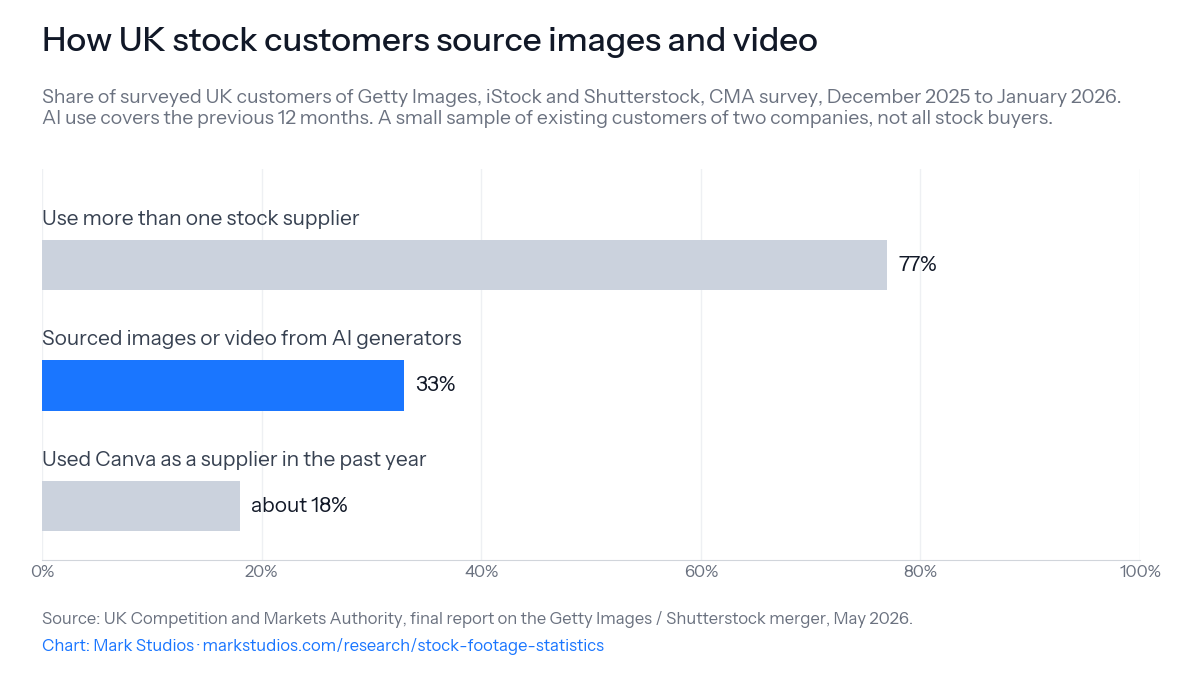
Customers shop around. In the CMA's survey of UK Getty and Shutterstock customers, 77% said they use more than one stock supplier. The merging companies and Adobe were each used in the past year by over 30% of respondents, and Canva by about 18%. The survey was run by DJS Research, which sent 11,200 email invitations between December 2025 and January 2026 and received between 117 and 127 completed responses in each of four customer groups, per its published method. That is a small sample of existing customers of two companies, not of stock buyers in general.
What happened to the Getty Images and Shutterstock merger?
It was abandoned. The merger agreement was terminated on July 7, 2026, according to Shutterstock's Form 8-K, after the CMA would clear the deal only if Shutterstock's editorial business was sold and Getty's board resolved not to sell it. The two companies continue to report separately, and every figure on this page is for one or the other, not a combined group.
January 2025: the companies announced the deal, putting the combined enterprise value at approximately $3.7 billion in their joint announcement. The CMA later described it as over £3 billion.
The companies projected cost synergies of $150-200 million a year by year three. That is their own estimate, as recorded by the CMA, not a finding.
February 2026: the companies said the U.S. Department of Justice review ended with the waiting period expiring without conditions. We found no statement from the Department of Justice itself; this is the companies' account.
15 May 2026: the CMA's final report cleared the merger only on condition that Shutterstock's global editorial business was divested. That business holds around 100 million news, sport and entertainment images and videos.
7 July 2026: Getty gave the CMA written assurance the merger had been abandoned, and the CMA cancelled its inquiry.
What came next: on October 21, 2026, Getty Images began voluntary prepackaged Chapter 11 proceedings for certain of its U.S. entities in the U.S. Bankruptcy Court for the District of Delaware, to carry out a financial restructuring agreed with its main lenders and investors in a Restructuring Support Agreement dated October 12, 2026. The plan includes an equity investment of up to $533 million from members of the Getty family and affiliates of Koch Equity Development, and Getty said it expects to complete the restructuring by year end and emerge as a privately held company, with operations, contributors and customers unaffected in the meantime, according to its October 21 press release, filed with the SEC. Its shares were already trading over the counter (OTCPK: GETY).
How many stock video clips are there?
Getty Images held 39 million videos at the end of June 2026, the most recent library count either public company has filed. Its video collection was 36 million at the end of 2025, up about 28.6% in two years, inside a total collection of over 645 million images and videos. Shutterstock last filed a count for the end of 2024, 59 million footage clips across its brands, and dropped the figure from its 2025 annual report.
Everyone else's number is marketing copy on their own website, and most of them do not separate video from everything else. The table sets out what each library says about itself, in its own words, on or near 22 September 2026.
Library
What it says
Counts video only?
Pond5
over 50 million stock videos
Yes
Adobe Stock
nearly a billion images, videos, music tracks and more
No
Shutterstock Unlimited Plus plan
more than 100 million premium assets including video, music and sound effects
No, and one plan only
Envato Elements
29+ million creative assets
No
Storyblocks homepage
over 10 million assets
No
Storyblocks video page
5 million+ pre-licensed assets
Unclear
Storyblocks company timeline
10 Million library assets
No
Pixabay (free)
over 240,000+ free stock video clips, of 6.2M+ media assets
Yes, for the first figure
Storyblocks' own pages disagree: its homepage and company timeline say 10 million assets, its video page 5 million+, which is why those rows are marked as a conflict in the evidence table. Neither is wrong in a way we can prove; the pages may be counting different things without saying so. Pixabay, owned by Canva, reports 6B+ downloads of its free media.
The biggest moving-image collections are not commercial. The U.S. National Archives holds more than 520,400 film reels and 170,925 video recordings in its College Park, Maryland facility, and the Library of Congress held 1.8 million moving images in fiscal 2023. Wikimedia Commons hosted 411,710 video files on 22 September 2026, and the Internet Archive's Prelinger Archives collection, a well-known source of public domain ephemeral film, held 10,468 items. The last two are live counters and will have moved by the time you read this.
On the supply side, Getty's footage and photos come from more than 600,000 photographers, videographers, illustrators and partners, and Getty separately advertises a network of more than 340,000 creators available for commissions. Its newsroom adds that it covers more than 160,000 news, sport and entertainment events a year. Pixabay counts 400K+ creators, Pexels 600K+, and Storyblocks says it is used by 10,000+ brands and creators. Getty's newsroom also gives a creator count, over 600,000 across its Getty Images, iStock and Unsplash brands, which agrees with its filing.
What do stock footage contributors earn?
Most per-licence video royalties sit between 20% and 40% of the licence fee, and the published rates have been falling. The table uses each platform's own contributor terms as published in September 2026.
Platform
Video royalty, as the platform states it
Shutterstock
six earnings levels, 15% up to 40%, reset to Level 1 every January 1st
iStock
20% non-exclusive; exclusive starts at 25% and needs 45,675 downloads a year to reach 45%
Getty Images and partner channels
20% non-exclusive, 25% exclusive
Adobe Stock
35% on video, against 33% on stills
Pond5
30% non-exclusive, 40% exclusive video
Envato Elements
a pooled 50% of net subscription revenue on Base-tier plans, 25% on Enterprise
Artlist (footage)
a pooled 30% of net subscription revenue, paid once a year
Pooled schemes are not comparable with per-licence rates. On Envato and Artlist, a contributor's income depends on their share of all downloads in the period, so the percentage describes the pot rather than what any single clip earns.
The direction of travel is down. Shutterstock replaced fixed per-download payments with a percentage model from June 1, 2020. In September 2023 Pond5 said all exclusive artists earned 60%; from January 15, 2025 exclusive video artists get 40% and everyone else 30%. Envato Market ended exclusivity on 1 July 2026 and moved every author to a 50% author fee, which Envato says cuts exclusive authors' earnings; non-exclusive authors' fee fell from 55% to 50%. On iStock subscription downloads, Getty applies a floor: royalties on exclusive Signature video are calculated on a minimum price of $10.00, and on non-exclusive video on a minimum of $0.10.
In aggregate, Getty paid over $220 million in royalties to contributors and content partners in 2025, equal to at least 22.4% of its revenue. Shutterstock does not disclose a royalty total; its cost of revenue, of which royalties are the largest part, was $406.8 million. Shutterstock's contributor site says it has paid over $1 billion to contributors since 2003, and Envato states $1.4B in contributor earnings across its marketplaces, both as read in September 2026. Neither gives a breakdown.
Getting paid has thresholds. Shutterstock contributors can set a minimum payout from $25, Adobe pays out from $25 once 45 days have passed since the first sale, Pond5 pays automatically on the 15th of each month above $25, Envato from $50, and iStock from $100. Getty reports each month's licences on the 20th of the following month and pays on the 25th of the month after that, so January sales are paid on March 25.
What does a stock footage licence cost, and what does it cover?
On the platforms' own pricing pages, read from July to September 2026, list prices started at $16.50 a month for an unlimited-download subscription, and at $39 for a single clip bought outright on Pond5. These are the platforms' public list prices in U.S. dollars on the day they were captured; they change often, vary by region, and are usually discounted for annual billing.
Platform and plan
List price as shown
Envato Core (unlimited downloads)
$16.50 a month billed annually, $39 billed monthly
Storyblocks Essentials (unlimited footage)
$21 a month, billed annually
Adobe Stock entry plan
US$29.99 a month, up to 1 video a month
Adobe Stock credit packs
8-20 credits per HD or 4K video
Shutterstock video subscription
$59 a month, billed yearly, for the default plan option
Shutterstock on-demand video pack
$275 for the default HD option
iStock Premium + Video
$99 a month, new-customer annual price
iStock credits
6 credits for a basic clip, 18 for premium
Pond5 single clip
from $39
Pond5 Footage Plus
$199 a month for 10 downloads
The licence terms matter more than the price for anything that will be broadcast. Shutterstock's standard video licence covers web, social and app use only while the audience stays under 500,000, and excludes broadcast, cable, streaming and cinema. Adobe's standard licence sets the same kind of cap, fewer than 500,000 expected viewers, and its enhanced licence removes it.
The legal protection attached to a licence is capped, and the caps differ by a factor of a hundred:
Shutterstock: liability capped at $10,000 for both standard and enhanced video licences.
Adobe Stock: indemnification up to US$10,000 on individual plans.
iStock: $10,000 per item on a standard licence, $250,000 on an extended one.
Pond5: $15,000 on an individual licence, $250,000 business, $1,000,000 premium.
Storyblocks: US$20k on an individual licence, which also stops covering new use once the subscription ends.
Subscription libraries handle cancellation differently. Envato's licence for an item becomes perpetual once it is used in a finished project during an active subscription, but unfinished projects lose it. Getty's licence also requires a disclaimer when a clip showing identifiable people or property is used with a subject that would be unflattering or controversial, the so-called sensitive-use rule.
How is generative AI changing stock footage?
Competitors' submissions and internal documents put the share of stock content already replaced by generative AI at approximately 10%, the CMA reported in May 2026. In the regulator's customer survey, run from December 2025 to January 2026, 33% of UK Getty and Shutterstock customers had sourced image or video content from an AI generator in the previous year, and about 46% of those who had generated AI images said they did so in place of stock. The survey is a small sample of existing customers and the 10% is the competitors' own estimate, but they are the only published measurements of substitution we found.
How UK stock customers source images and videoShare of surveyed UK customers of Getty Images, iStock and Shutterstock, from the customer survey in the UK Competition and Markets Authority's final report on the Getty Images and Shutterstock merger (May 2026; fieldwork December 2025 to January 2026). The AI question covers the previous twelve months. A small sample of existing customers of two companies, not of all stock buyers.Use this chart on your site
The stock companies are also AI suppliers. Shutterstock says its partnership with OpenAI began in 2021, and in July 2023 it signed a six-year agreement to supply training data. It passes a share to contributors through its Contributor Fund, at an average royalty of 20% of data-licensing revenue. Getty's "Other" revenue line, which includes data licensing, was 5.6% of 2025 revenue; Getty does not break out the AI portion. Getty launched its own generator, trained on its creative library, on September 25, 2023.
Adobe trained its first Firefly model on Adobe Stock images, openly licensed content and public-domain content, citing Adobe Stock's hundreds of millions of licensed images, and reported over two billion images generated during the 2023 beta. It paid a Firefly bonus to eligible Adobe Stock contributors on September 17, 2025, and for three months cut their minimum payout to $1.
At the same time the libraries prohibit customers from doing the same thing. Shutterstock's licence bars using licensed content as training data for any AI system, and Getty's bars use for machine learning or AI purposes unless separately licensed. Shutterstock's contributor policy, in an article dated July 16, 2025, says it does not accept AI-generated submissions.
The biggest legal test so far is Getty's own case against Stability AI. Getty's February 2023 U.S. complaint alleged Stability AI copied more than 12 million photographs, and named 7,216 as examples. In the UK, the High Court handed down judgment on 4 November 2025. Getty had relied on eleven sample works at trial, and the judgment records that the LAION-5B dataset behind Stable Diffusion's training subsets contains 5.85 billion URL-text pairs. Getty's own annual report says the UK court then awarded Stability AI interim costs of $5.8 million for the matters on which Getty did not prevail or that it dropped, and that Getty refiled its U.S. case in California in August 2025 over approximately 12.0 million images. The 12 million figures are Getty's allegations, not findings. In the UK case Getty also stated that there are likely more than 50,000 photographers and contributors who own copyright in content exclusively licensed to it.
For wider context, the U.S. Copyright Office received more than 10,000 public comments on its 2023 inquiry into AI and copyright, which fed its reports on copyrightability and on training.
What the popular stock footage numbers really say
Five figures do most of the work in articles about stock footage. We traced each to the earliest document we could date. Most describe something other than what they are quoted for, are out of date, or have no findable source at all.
"The stock footage market is worth $X billion"
Every version of this number we found starts on a market-research reseller's sales page, where the headline is the free summary of a paid report and the method sits behind the paywall. We did not buy or bypass any of them, so no figure from them appears on this page. The three we checked disagree on almost everything: one describes a projected increase in market value over five years rather than a market size, and the other two give 2025 sizes for differently defined markets, one of which folds image and audio products into "footage". Quoting any one of them as the size of the market lends it a precision it does not have.
What to use instead: the filed revenue of the two public companies, about $1.97 billion combined in 2025 across everything they sell, and the CMA's finding that those two companies held [60-70]% of global paid stock content by revenue. Neither is a footage-only figure, and no filed one exists.
Library sizes quoted for Shutterstock and Pond5
Roundups give Shutterstock a video library figure that matches none of the counts Shutterstock has filed. The company's own annual reports stated its footage collection each year until the 2024 report, which gave 59 million clips, counted across all its brands including Pond5. The 2025 annual report dropped the count entirely. Any Shutterstock video library figure dated after 2024 is therefore not from Shutterstock.
Pond5's own 2022 blog post calls it the largest stock video site with a figure that the company's current site has since overtaken: its stock footage page, captured in August 2026, says over 50 million stock videos. Quote the current page, with its date.
"A stock footage clip earns about $X a year"
The most specific version, 3.38 dollars per clip per year, traces to a single contributor's drone-footage portfolio, described second-hand in a 2022 post on the blog of Xpiks, a company that sells software to stock contributors. It is one person's results, from one niche, before the royalty cuts described above. A second common version, about a dollar per clip per month, appears unsourced on a 2024 stock-footage buyer's guide; we found no origin for it at all.
What to use instead: the platforms' own published royalty rates and payout thresholds, which set what a clip can earn per licence. No platform publishes average earnings per clip.
"Only 7% of marketers use stock video"
This line, usually paired with "40% use stock photography", appears in a January 2019 blog post that names no survey. The numbers match a 2018 survey of online marketers by Venngage, but that survey asked which type of visual marketers used most, and the option chosen by 7.1% was "videos and presentations", which includes webinars and animation. It never asked about stock video. The published survey post does not give its 2018 sample size or field dates. A newer claim, that a set share of digital marketers use stock videos according to the U.S. Bureau of Labor Statistics, appeared on a market-research sales page between March 2025 and February 2026. BLS runs no survey that asks this, and we found no source for it.
"Pond5 pays contributors 50-60%"
These were real rates, and fee-comparison pages still quote them in 2026. Pond5 announced to contributors that from January 15, 2025 artists earn a 30% royalty and exclusive video artists 40%, in a dated notice on its contributor site. Five months earlier it had replaced contributor-set pricing, which it said had produced over 1,000 price points, with two fixed video tiers. A royalty rate quoted for Pond5 without a date is probably from before 2025.
We started from the questions people search for about stock footage statistics and looked for the organization that actually produced each answer. Every figure on this page sits in an evidence ledger with its source, the exact table or paragraph it came from, the measurement period, the population measured, and the date we checked it. This edition holds 145 figures from 21 publishers.
On September 22, 2026, every figure was re-fetched from its source on a cleared cache and matched against the recorded wording; all 135 sourced figures in the evidence table re-verified automatically. The one row in our working ledger that did not is an archived market-research sales page, recorded as an unsupported claim, which prints no figure here. Sources that refuse automated requests — Shutterstock's and Pond5's pricing and licence pages, Adobe's help pages, and several library home pages — were read from dated Internet Archive captures of the publisher's own pages, recorded as such in the evidence table. Getty's contributor help pages are rendered by script, so their figures were read from the site's own article endpoint. Market-size estimates from market-research resellers were checked but not published, because their methods sit behind a paywall we did not cross. No U.S. Department of Justice statement on the merger review could be fetched, so its outcome is given only as the companies reported it.
We only cite the producer: government agencies, regulators, company filings and official posts, and the survey owner's own report. We do not cite statistics roundups, Statista-style aggregators, or salary sites without a public method. We did not bypass paywalls or sign-up forms; where a full report was gated, we used only the figures its publisher states publicly.
Figures marked "our calculation" are arithmetic on the cited numbers, and anyone can reproduce them:
This edition contains no Mark Studios customer data.
Limitations
No one publishes a stock footage market size you can check. The public companies report revenue across photos, video, editorial, music and data licensing together, and the CMA's shares cover all paid stock content. Every footage-only market figure we found traces to a market-research reseller with no checkable method.
Library counts are marketing copy. Apart from Getty's filed video count, every library size here is a company describing itself on its own website, often without saying what it counts. Storyblocks' own pages give different sizes.
List prices are snapshots. Prices were read from U.S. storefronts, several through Internet Archive captures dated in July to September 2026. They change often and are not what large customers pay.
The CMA survey is small and UK-only. It sampled existing UK customers of Getty and Shutterstock, with between 117 and 127 completed responses per customer group, so its AI substitution figures are indicative rather than a market-wide measurement.
Shutterstock has stopped filing library and contributor counts. Its last library figure is for the end of 2024 and will not be updated from filings.
Live counters drift. The Wikimedia Commons and Internet Archive counts are dated snapshots from 22 September 2026.
How to cite this page
For a single figure, cite the original publisher named next to it, and link here if the verification trail is useful to your readers. Each figure has its own anchor, so you can link straight to it, for example https://www.markstudios.com/research/stock-footage-statistics#REG-001. To cite the page as a whole:
Mark Studios. "Stock Footage Statistics." Last verified Sep 22, 2026. https://www.markstudios.com/research/stock-footage-statistics
APA
Mark Studios. (2026, September 22). Stock footage statistics. https://www.markstudios.com/research/stock-footage-statistics
MLA
“Stock Footage Statistics.” Mark Studios, 22 Sept. 2026, www.markstudios.com/research/stock-footage-statistics.
Chicago
Mark Studios. “Stock Footage Statistics.” Last modified September 22, 2026. https://www.markstudios.com/research/stock-footage-statistics.
Our calculations and the evidence table are free to reuse with attribution and a link to this page. Each underlying figure remains the claim of its original publisher, and some publishers ask for a link when their figures are reused.
We re-verify every figure quarterly and when a major source publishes a new edition. The next scheduled review is December 2026. Corrections go to contact@markstudios.com.
Sep 22, 2026: First published with 142 figures from 21 publishers, each checked against its original source.
Oct 3, 2026: Storyblocks' company timeline now gives 10 million library assets as its latest milestone, up from 7 million when we published. We updated the library table. Its homepage (8 million) and video page (5 million+) figures were unchanged.
Oct 25, 2026: Storyblocks' homepage now also says over 10 million assets, so the library table shows that.
Oct 30, 2026: Corrected two descriptions. Envato's July 2026 change raised exclusive authors' author fee to 50% and lowered non-exclusive authors' from 55% to 50%, so non-exclusive authors keep more, not less; we had it the wrong way round. And the CMA's 46% is of respondents who generated AI images in the past 12 months, not of those who sourced content from AI generators.
Oct 30, 2026: Added Getty Images' October 21, 2026 prepackaged Chapter 11 filing and its up-to-$533 million equity investment (FIL-026 to FIL-028), from its press release filed with the SEC; the merger FAQ notes it too.
Oct 31, 2026: Added dates and windows some sentences were missing: the CMA's customer survey ran from December 2025 to January 2026 and asked which suppliers customers had used in the past year, its 10% substitution estimate is from its May 2026 final report, Adobe's two billion Firefly images were generated during the 2023 beta, and the Shutterstock and Envato contributor payout totals were read in September 2026.
Nov 5, 2026: Envato Elements' 29+ million now links to an Internet Archive capture of its homepage from September 22, 2026, the table's snapshot date; the live page says 30+ million.
Frequently asked questions
How big is the stock footage market?
No checkable figure exists for footage alone. The two public stock companies, Getty Images and Shutterstock, reported $981.3 million and $989.9 million of revenue in 2025, about $1.97 billion together, but that covers photos, editorial, music and data licensing as well as video. The UK Competition and Markets Authority estimated the two held [60-70]% of global paid stock content by revenue. Footage-only market sizes in circulation come from market-research resellers whose methods are not published.
Did Getty Images and Shutterstock merge?
No. The merger announced in January 2025 was terminated on July 7, 2026. The CMA's final report of 15 May 2026 cleared it only if Shutterstock's editorial business was sold, and Getty's board declined. The U.S. review had ended without conditions, according to the companies. On October 21, 2026, Getty began a prepackaged Chapter 11 restructuring and said it expects to emerge as a privately held company by year end.
How many stock video clips are there?
Getty Images held 39 million videos at the end of June 2026. Shutterstock's last filed count was 59 million footage clips at the end of 2024, and Pond5 says it has over 50 million stock videos. Adobe describes its whole Adobe Stock collection as nearly a billion images, videos, music tracks and more without separating video.
How much do stock footage contributors earn per sale?
It depends on the platform's published royalty rate. Adobe Stock pays 35% on video. Pond5 pays 30%, or 40% to exclusive video artists. Shutterstock pays video contributors between 15% and 40% depending on their level, which resets every January. iStock pays non-exclusive video contributors 20%. No platform publishes average earnings per clip.
Can I use stock footage in a TV broadcast?
Usually not on a standard licence. Shutterstock's standard video licence covers web, social and app use while the audience is under 500,000 and excludes broadcast, cable, streaming and cinema. Adobe's standard licence is capped at fewer than 500,000 expected viewers, and an enhanced licence removes the cap. Check the specific licence before a clip goes into a broadcast edit.
Is generative AI replacing stock footage?
Partly, on the evidence published so far. The UK CMA reported that competitors' submissions and internal documents put the share of stock content already replaced by generative AI at approximately 10%. In the CMA's customer survey, 33% of UK Getty and Shutterstock customers had sourced images or video from AI generators in the past year, and about 46% of those who had generated AI images said they did so in place of stock.
Can stock footage be used to train an AI model?
Not under a standard licence from the largest libraries. Shutterstock's licence prohibits using licensed content as training data for any AI system, and Getty's prohibits machine learning or AI use unless separately licensed. Both companies sell training data under separate deals; Shutterstock's data, distribution and services revenue, the line that includes those deals, was $203.3 million in 2025.
How often is this page updated?
Every figure is re-checked against its original source each quarter, and sooner when a major source publishes a new edition, such as a Getty Images or Shutterstock annual report. The Last verified date changes only after that check, and each change is recorded in the change log.