We compared YouTube's automatic English captions with the human-made caption track on 299 recent videos from six channels that publish their own captions, 111 hours and 938,047 words in all. Here is how often the automatic track gets words wrong, which words it gets wrong, and why published accuracy figures for auto-captions disagree so much.
In the median video, YouTube's automatic captions got 98.2% of the human captions' words right: 1.8% were wrong or missing. Pooled across all 938,047 words, 2.9% were. See details
Only 74 of 299 videos (25%) reached 99%, 1% or fewer words missed. 277 (93%) were within 5% and 295 within 10%; the four beyond that include human tracks that also caption on-screen text nobody says aloud. See details
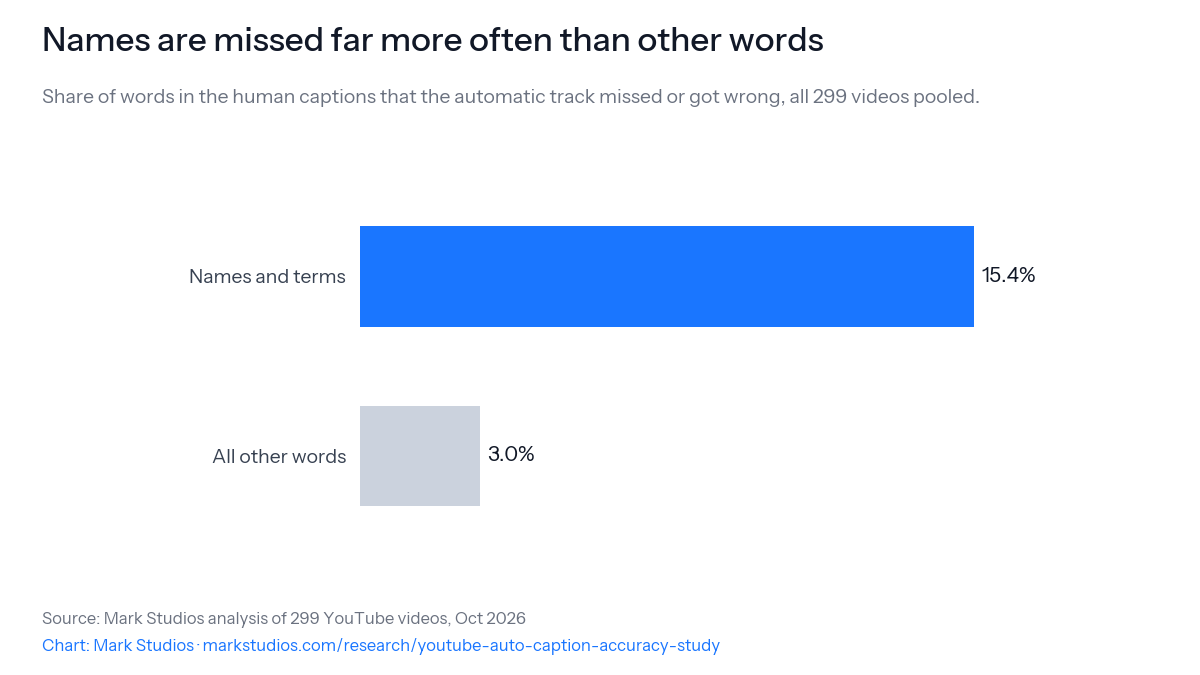
Names and other capitalized terms were missed 5.1 times as often as other words: 15.4% against 3.0%. See details
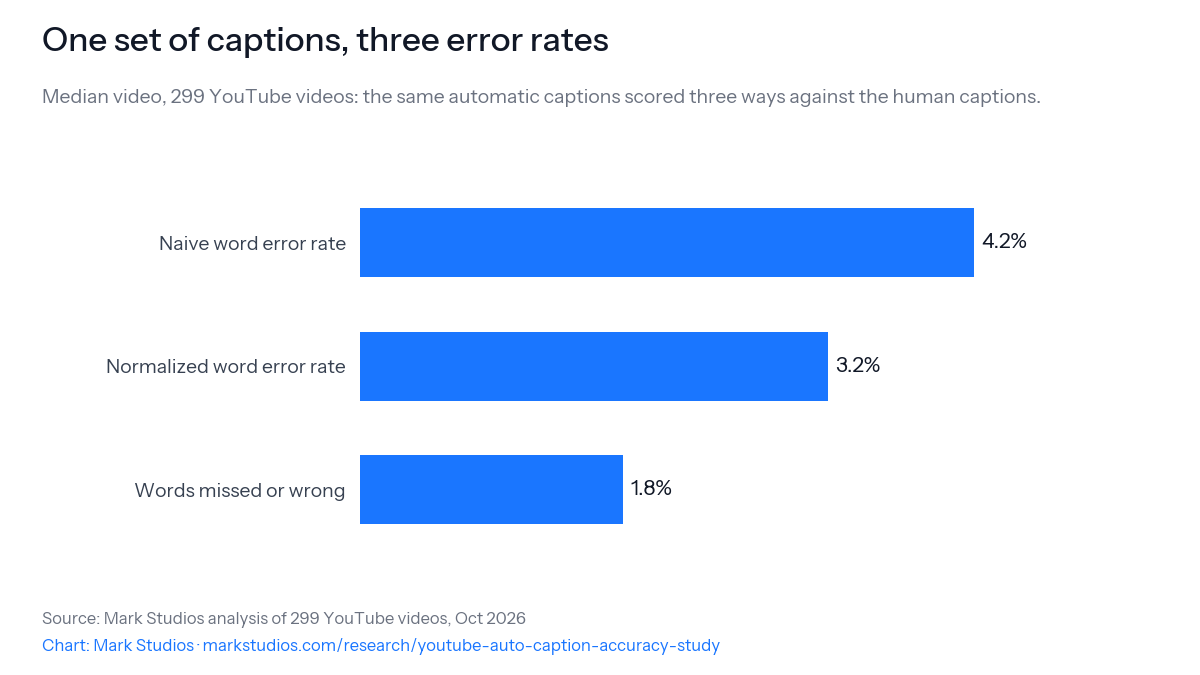
How you score changes the answer. The same captions give a median word error rate of 4.2% scored naively (lowercase, punctuation removed), 3.2% after standard normalization of numbers, spellings and fillers, and 1.8% when you count only words the automatic track got wrong or left out. In MIT's lectures the gap is 12.7% against 2.9%. See details
61% of all differences were words the automatic track had and the human track didn't. In our hand check, 63% of those were words the human captioner had edited out, such as fillers and false starts. See details
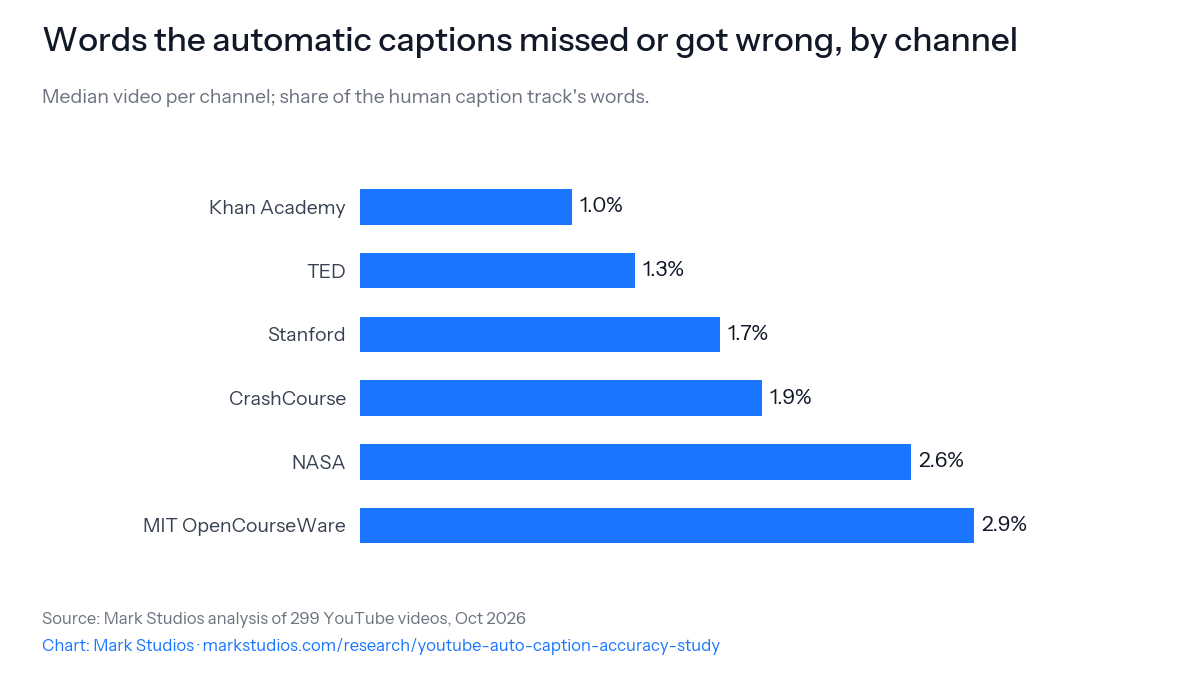
Khan Academy's narrated lessons had the fewest misses (1.0% in the median video); MIT OpenCourseWare's recorded university lectures the most (2.9%). See details
In a hand check of 240 random words the automatic track got wrong or dropped, 48% were real recognition errors, 21% the same words written another way, and 11% mistakes in the human captions that the automatic track got right. Human captions are not always the better track. See details
The "60-70% accurate" figure that some accessibility guides still repeat came from a University of Minnesota Duluth help page that gave no source or date for it; that page is now offline. In this sample, 295 of 299 videos got at least 90% of words right. See details
Accessibility rules require captions but set no accuracy percentage. The closest thing to a standard, the FCC's rule for TV, asks that captions match the spoken words without substituting words for proper names and places: the words automatic captions miss most. See details
How accurate are YouTube's automatic captions?
More accurate than their reputation, but rarely word-perfect. In the median video, YouTube's automatic English captions got 98.2% of the words in the channel's own human captions right: 1.8% were transcribed as a different word or left out. Pooled across all 938,047 words in the human tracks, 2.9% were. Nine videos in ten missed 4.2% or less.
Almost no video was perfect. Only 74 of 299 reached 99%, the level at which roughly one word in a hundred is wrong. 172 (58%) missed 2% or less and 277 (93%) 5% or less. On a ten-minute video at 150 words a minute, a 3% miss rate is about 45 wrong or missing words.
Words missed or wrong
Videos
Share
1% or less (99%+ right)
74
25%
2% or less
172
58%
5% or less
277
93%
10% or less
295
99%
The human captions are the yardstick here, as they are in most tests of speech recognition. They are not perfect: our hand check found places where the human track left out or reworded what was said, so a small part of what counts as a miss is the human captioner's edit, not the machine's error.
Why do auto-caption accuracy figures disagree so much?
Because the same captions give very different error rates depending on what counts as an error. We scored every video three ways:
Naive word error rate: lowercase both tracks, strip punctuation, count every substituted, missing and extra word. Median video: 4.2%. This is close to how youtube-transcript.ai scored its August 2026 study of 264 videos, which reported a median of 9.9%; the mix of videos matters as much as the method, and MIT's lectures alone come out at 12.7% on this measure.
Normalized word error rate: the same count after standard text normalization, so "20" and "twenty", "okay" and "OK", "colour" and "color" match, and "um" and "uh" are ignored. We used OpenAI's open-source Whisper normalizer, a common choice for scoring speech recognition. Median: 3.2%.
Words missed or wrong: only the human captions' words that the automatic track substituted or dropped, leaving out words the automatic track added. Median: 1.8%.
One set of captions, three error ratesMedian video, 299 YouTube videos: the same automatic captions scored three ways against the human captions.Use this chart on your site
The extra words matter most in lectures. Across the sample, 61% of all differences were words the automatic captions had and the human captions didn't. Lecture captioners routinely clean up speech, dropping "kind of", "you know", repeated words and false starts; the automatic track keeps them. In our hand check, 63% of these extra words were speech the human captioner had edited out, and 6% were genuine recognition errors. Counting them as errors measures the human captioner's style as much as the machine.
So when you read an auto-caption accuracy figure, check two things: whether numbers and spellings were normalized, and whether the reference captions were verbatim.
Which kinds of video get the most errors?
Khan Academy's narrated lessons came out cleanest, with 1.0% of words missed or wrong in the median video. MIT OpenCourseWare's recorded university lectures had the most, at 2.9%.
Words the automatic captions missed or got wrong, by channelMedian video per channel; share of the human caption track's words.Use this chart on your site
All figures are for the median video in each channel. Words a minute counts the human captions' words over the video's running time.
The spread follows the kind of recording more than the subject. Khan Academy and TED are mostly one prepared speaker. MIT's lectures run a median 75.8 minutes, unscripted, with questions from the room, and NASA's uploads include launch broadcasts with radio calls and archival audio from the 1960s. The naive and normalized rates move much more than the miss rate: MIT's lectures go from 12.7% scored naively to 2.9% words missed, because their human captions leave out so much of the spoken filler.
Do automatic captions get names and terms wrong?
Yes, far more often than ordinary words. We split the human captions' words into capitalized words in mid-sentence, a stand-in for names, places, products and terms, and everything else. Automatic captions missed or mangled 15.4% of the capitalized terms against 3.0% of other words, 5.1 times the rate. Names were missed more often than other words on 6 of 6 channels.
Names are missed far more often than other wordsShare of words in the human captions that the automatic track missed or got wrong, all 299 videos pooled.Use this chart on your site
Examples from the sample: Stanford's own videos: the automatic captions wrote “Stamford” 131 times, in 11 of its 50 videos. Khan Academy's human captions name its product “Khanmigo” 246 times; the automatic captions spelled it right 87 times and otherwise wrote “kigo”, “conmigo” or “khan amigo”. In NASA's 2025 Day of Remembrance video, as the names of astronauts who died in service were read, “Christa McAuliffe” became “Christa muli”, “Kalpana Chawla” “capna chuala” and “Ilan Ramon” “Elon Ramon”. MIT lectures gave “Pareto” as “paro” and the modeling software “Vensim” as “venim”; CrashCourse's “Pasteur” became “pastor”. For this comparison both tracks were only lowercased and stripped of punctuation, with "okay"/"OK" unified and Roman numerals and figures left out of the capitalized group, so a few differences are spelling rather than recognition; the gap is too large for that to explain.
These are the words a viewer can't recover from context. A misheard "the" is easy to read past; a misheard speaker name, drug or product is not, and it is the kind of error a search for the term will never find.
Do fast talkers get worse automatic captions?
No, not in this sample. The fastest third of videos (169 to 239 words a minute) had a median of 1.6% words missed or wrong, the middle third 1.5%, and the slowest third (10 to 141) 2.5%. Slow here mostly means long recordings with pauses, questions and crosstalk, which are harder for speech recognition than a fast, clean voiceover.
Speaking rate (thirds of the sample)
Videos
Missed or wrong, median video
10-141 words a minute
99
2.5%
141-169 words a minute
99
1.5%
169-239 words a minute
101
1.6%
The rate is the human captions' word count over the running time, so pauses and music lower it. Channel and speaking style move together here, so this is a pattern in this sample, not a controlled test.
What kinds of mistakes do automatic captions make?
We drew a random sample of 240 places where the automatic track substituted or dropped words, and 120 where it added words, spread evenly across the six channels, and read each one in context in both tracks.
What the difference was
Wrong or missing words (240)
Extra words (120)
A real recognition error (wrong, missing or invented word)
48%
6%
The same words written another way (spelling, number format, compound words)
21%
19%
The human captions departed from what was said (edited-out filler, false start, paraphrase)
0%
63%
The human captions were wrong and the automatic captions right
11%
3%
Can't tell from the text
20%
8%
Most real errors are small, but some reverse the sentence. In one Stanford video, “most people can't afford the time” came out as “most people can afford the time”; in another, “the spirit of irreverence” became “the spirit of a reverence”.
The audit changes how to read the channel figures. On some channels the human captions were the weaker track: 16 of the 40 sampled NASA misses were mistakes in NASA's own human captions, such as “count town” for countdown and “deorbiting laboratory” for “orbiting laboratory”, which the automatic track got right. Khan Academy's human captions had 4 (one wrote “30 words per meter” where the automatic track had volts), and MIT's had none.
Channel
Missed or wrong, median video
Sampled misses that were real errors
Sampled misses that were errors in the human captions
Rough real error rate (our calculation)
Khan Academy
1.0%
13 of 40
4 of 40
about 0.3%
TED
1.3%
18 of 40
1 of 40
about 0.6%
Stanford
1.7%
27 of 40
2 of 40
about 1.1%
CrashCourse
1.9%
19 of 40
3 of 40
about 0.9%
NASA
2.6%
11 of 40
16 of 40
about 0.7%
MIT OpenCourseWare
2.9%
27 of 40
0 of 40
about 2.0%
The rough rate multiplies each channel's median miss rate by the share of its sampled misses that were real recognition errors. With 40 sampled misses per channel it is an estimate, not a measurement, but it shows the order of magnitude: on clear, well-recorded English, YouTube's automatic captions get roughly one word in 50 to one in 300 wrong.
Which auto-caption accuracy claims hold up?
Three figures do most of the work when people describe YouTube's automatic captions. We traced each to its source and set it against this sample.
Popular claim
What the original source says
Status
"YouTube's automatic captions are 60-70% accurate"
From a University of Minnesota Duluth Media Hub help page, which said automatic captions "typically provide about 60-70% accuracy" without citing a test or giving a date (UMN Duluth, archived August 2024). The page now returns "Access denied". In our 2026 sample the median video's automatic captions got 98.2% of the human captions' words right, and 295 of 299 videos at least 90%.
Unsourced and outdated
"YouTube's automatic captions are about 90% accurate"
From youtube-transcript.ai's August 2026 study, which found a median word error rate of 9.9% across 264 videos after lowercasing and removing punctuation. Scored that way, our videos give 4.2%; after normalizing numbers, spellings and fillers, 3.2%; and only 1.8% of the human captions' words were actually missed or wrong.
Measured, but depends on scoring
"YouTube made automatic captions 50% more accurate"
YouTube's February 2017 blog post said better speech recognition and more training data "resulted in a 50 percent leap in accuracy for automatic captions in English". It published no before or after rate, so the claim can't be turned into an accuracy figure.
No absolute rate published
Our videos come from large publishers with clear recordings, so everyday uploads with noise, crosstalk or heavy accents will do worse. But the 60-70% figure no longer describes clear English speech.
Are automatic captions good enough for accessibility rules?
Not on their own, according to U.S. federal guidance, although no rule sets an accuracy percentage. The government's Section 508 guidance says "current auto-captioning technology does not meet the minimum standard for pre-recorded media" and tells publishers to always edit automatic captions. YouTube's own help page says automatic captions "might misrepresent the spoken content" and that creators "should always review automatic captions and edit any parts that haven't been properly transcribed."
The rules themselves require captions without saying how accurate they must be. WCAG success criterion 1.2.2 (Level A) requires captions for prerecorded audio in synchronized media. The Justice Department's web accessibility rule under ADA Title II adopts WCAG 2.1 Level AA for state and local governments, with compliance dates of April 26, 2027 for those serving 50,000 or more people and April 26, 2028 for smaller ones and special districts, after an interim final rule in April 2026 extended them.
Two standards come closest to an accuracy bar. The DCMP Captioning Key, written for educational media, says "Errorless captions are the goal for each production." The FCC's quality rule for television, 47 CFR 79.1(j)(2)(i), requires captions to match the spoken words "without substituting words for proper names and places". It applies to TV programming, not YouTube, but it names exactly the words automatic captions missed most in our data: 15.4% of names and terms, against 3.0% of other words.
What this means if you publish video
Treat automatic captions as a first draft and spend the review time on names. In the median video they got 98.2% of words right, but they missed names and terms 5.1 times as often as other words, so the job is checking, not retyping. Where to spend the time:
Check every name and term first. People, places, products, drugs, course codes: these are missed 5.1 times as often as other words, and they carry the meaning.
Keep a glossary. If the same names come up in every video, a find-and-replace list fixes most of them in one pass.
Decide verbatim or clean. Automatic captions keep "you know" and false starts. If you want clean captions, edit them out; if you want verbatim, leave them.
Check the timing and reading speed too. Accurate words can still flash by too fast; our caption reading speed study found that 98% of videos had at least one caption over Netflix's 20 characters a second.
Our free caption checker flags captions that run too fast or stay up too briefly in an .srt or .vtt file. For the wider numbers on who watches with captions, see the video captions statistics page.
How we ran the study
Sample. On October 25, 2026 we listed the latest uploads of six YouTube channels that publish their own English captions: MIT OpenCourseWare, NASA, TED, Khan Academy, CrashCourse, Stanford. Going from newest to oldest, we kept every video at least two minutes long that had both a human English caption track uploaded by the channel and YouTube's automatic English track, until we had 50 per channel. Shorts, videos without both tracks and the few that failed to load were skipped; we scanned up to 200 uploads per channel. Many TED videos carry no automatic track, so TED needed the most scanning. We dropped one video whose human track had been made by editing YouTube's automatic one (its caption start times matched the automatic track's 97% of the time, against a median of under 1%). That left 299 videos (MIT OpenCourseWare 50, NASA 49, TED 50, Khan Academy 50, CrashCourse 50, Stanford 50), 111 hours, and 938,047 words of human captions.
Tracks. For each video we downloaded the human track and YouTube's original automatic track ("en-orig") through YouTube's caption service, with the open-source yt-dlp tool. We removed sound descriptions such as [Music] and (applause), speaker labels, chevrons, music notes and styling tags from both tracks.
Scoring. Both tracks were normalized with OpenAI's Whisper English normalizer, which lowercases, removes punctuation, writes numbers as digits, unifies British and American spellings and drops "um", "uh" and "hmm"; we also unified "ok" and "okay". We aligned the tracks word by word with jiwer and counted substitutions, deletions and insertions. Words missed or wrong is substitutions plus deletions over the human track's word count; word error rate also adds insertions. The naive rate uses only lowercasing and punctuation removal. The names comparison uses the naive tokens, so each word keeps its original capital letter: a word counts as a capitalized term when it starts with a capital and does not open a sentence, leaving out "I", "OK", figures and Roman numerals. Five videos whose human captions are written mostly in capital letters, as live broadcast captions often are, were left out of this comparison only.
Audit. With a fixed random seed, we drew 40 substitution or deletion spans and 20 insertion spans from each channel and classified each by reading six words of context on both sides in both tracks, without the audio.
Each video counts once: we report the median video, so one long lecture does not outweigh a short talk, and pooled figures are labeled as such. The scripts are public in the study folder of the caption-checker repository, and the per-video results are in the CSV below. None of the six channels reviewed or endorsed this study.
Limitations
The yardstick is human captions, not a verified transcript. Where the human track is wrong or edited, a correct automatic word counts as a miss. The audit found this often enough on some channels to matter, so read the miss rates as disagreement with the human captions, and the audit as the estimate of real errors.
Some human tracks caption more than speech. A few NASA tracks also transcribe on-screen titles and text that nobody says aloud; those words count as misses. Medians keep a handful of such videos from moving the headline figures.
Six large publishers. These are well-recorded videos with mostly clear, single-speaker English. Phone footage, crosstalk, music, other languages and accents underrepresented here will score differently.
Recent uploads only. The automatic track reflects YouTube's speech recognition in October 2026. Older videos may carry tracks generated by older models.
Channels cluster. MIT's latest uploads come from a handful of courses, so a few lecturers account for many rows.
Capitalization is a proxy. Capitalized mid-sentence words are mostly names and terms, but they also include some titles and emphasis.
The audit is a reading of the text. We did not listen to each clip, so some classifications are judgment calls; those we could not decide are reported as such.
Mark Studios. "YouTube Auto-Caption Accuracy Study." Published Oct 25, 2026. https://www.markstudios.com/research/youtube-auto-caption-accuracy-study
APA
Mark Studios. (2026, October 25). YouTube auto-caption accuracy study. https://www.markstudios.com/research/youtube-auto-caption-accuracy-study
MLA
“YouTube Auto-Caption Accuracy Study.” Mark Studios, 25 Oct. 2026, www.markstudios.com/research/youtube-auto-caption-accuracy-study.
Chicago
Mark Studios. “YouTube Auto-Caption Accuracy Study.” Last modified October 25, 2026. https://www.markstudios.com/research/youtube-auto-caption-accuracy-study.
Our measurements and the per-video CSV are free to reuse under CC BY 4.0 with a link to this page. The captions remain the property of the channels that published them.
We plan to rerun the study each year on the same six channels' latest uploads, so the numbers track YouTube's speech recognition over time. Corrections go to contact@markstudios.com.
Oct 25, 2026: First published: 299 videos, 938,047 words of human captions.
Frequently asked questions
How accurate are YouTube auto-captions?
In our test of 299 recent videos from six channels, YouTube's automatic English captions got 98.2% of the human captions' words right in the median video. 295 of the 299 videos got at least 90% right and 74 reached 99%. Names and technical terms were missed 5.1 times as often as other words.
Are YouTube automatic captions 60-70% accurate?
Not in our 2026 sample. The 60-70% figure traces to a University of Minnesota Duluth help page that gave no source or date for it, and that page is no longer online. In our sample, 295 of 299 videos got at least 90% of words right, and the median video 98.2%.
Why do studies of auto-caption accuracy disagree?
Partly because of how they score and partly because of what they test. Counting every difference after only lowercasing and removing punctuation gave a median word error rate of 4.2% in our data. Normalizing numbers, spellings and fillers gave 3.2%, and counting only words the automatic track got wrong or left out gave 1.8%.
Are YouTube auto-captions good enough for ADA compliance?
Neither WCAG nor the Justice Department's Title II web rule sets an accuracy percentage, so there is no pass mark to meet. YouTube itself says creators should always review automatic captions and fix what was transcribed wrong. Names and terms are where our data says to look first.
Which words do automatic captions get wrong most?
Names and other capitalized terms. In our data 15.4% of them were missed or wrong, against 3.0% of other words. In lectures, people's names, product names and technical terms were the usual misses, so checking those first is the fastest way to clean up an automatic track.
Can I use this data?
Yes. Our measurements and the per-video CSV are free to reuse under CC BY 4.0 with a link to this page. The captions belong to the channels that published them; we publish only our measurements and links to the videos, not the caption text.