

The Short Answer: What Color Grading Costs
Color grading costs about $50–$150 an hour or $700–$1,500 a day from a freelance colorist in 2026, and grading a music video typically runs $800–$3,000, according to XP-Pen's 2026 colorist career guide. YunoJuno's booking data puts the average colorist at $81 an hour. On Fiverr, video color-grading gigs start at $5–$500 for their smallest package.
These are other companies' published figures, read October 23, 2026. Mark Studios includes the grade in every edit and quotes grade-only jobs per project, so there's no Mark Studios price on this page. The range is wide because "color grading" covers two different purchases. One is the grade that comes inside an edit you're already paying for. The other is a colorist you book separately, by the hour or the day, sometimes in a calibrated room. Most buyers only need the first, but this guide prices both.
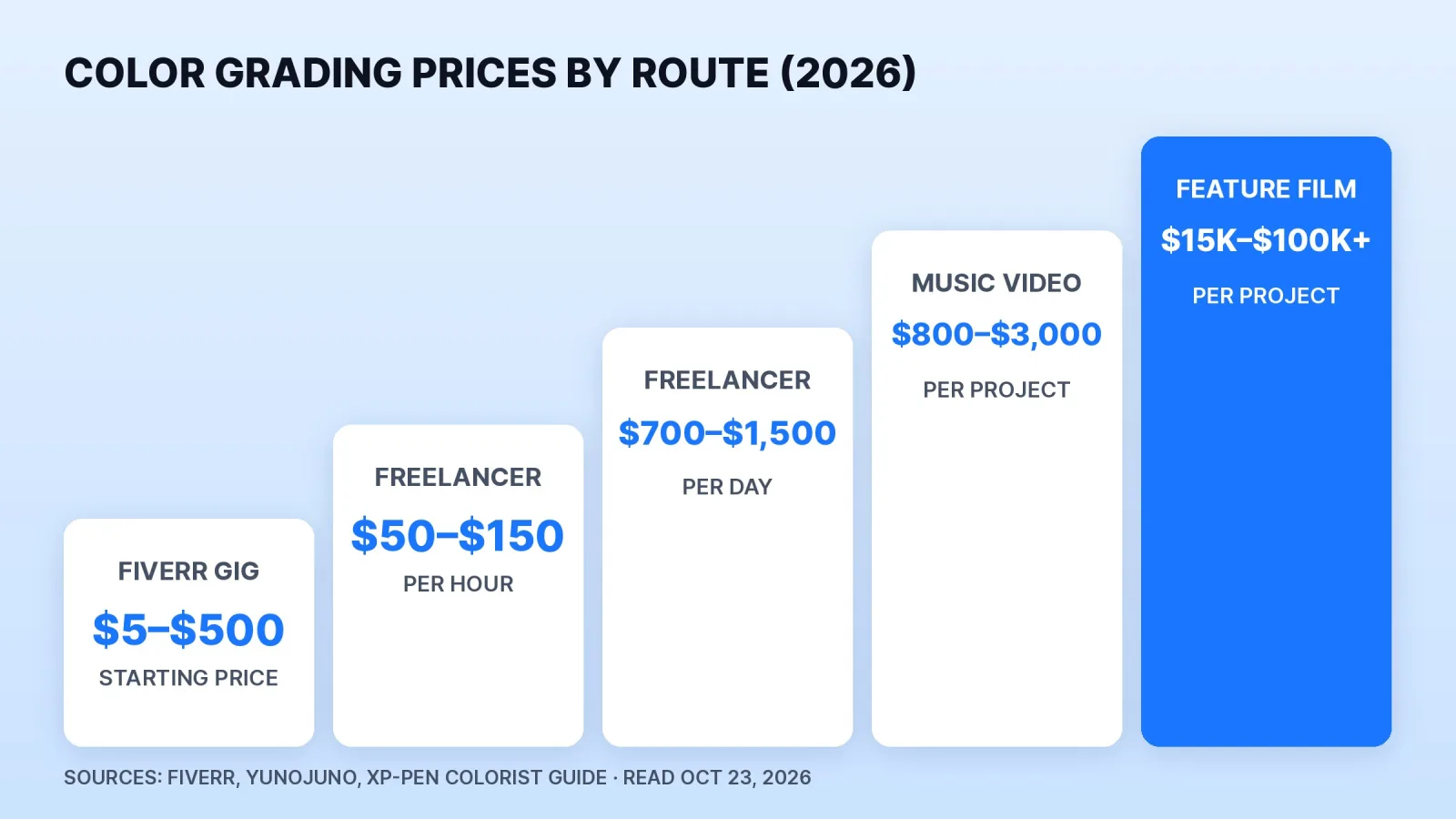
Color Grading Prices in 2026, by Route
| Route | Published price | What it usually covers | Source |
|---|---|---|---|
| Fiverr gig | The 29 video grading gigs on the results page start at $5–$500 (median $45) | The gig's smallest package, usually one short clip or a set number of minutes | Fiverr, 1,663 services listed |
| Freelance colorist, by the hour | $50–$150 an hour; YunoJuno's average is $81 | Remote sessions, short pieces and fixes | XP-Pen, YunoJuno |
| Freelance colorist, by the day | $700–$1,500 a day; YunoJuno's average day rate is £491 | The usual unit for music videos, commercials and film | XP-Pen, YunoJuno, Careers in Film |
| Grading suite hire | $70 an hour or $600 a day for one Chicago suite | A calibrated room to sit in on the grade; the colorist and software licence are not included | Tagvenue |
| Do it yourself | DaVinci Resolve is free; Resolve Studio lists at $295 ($236 on sale on Oct 23) | Your time, plus a monitor you can trust | Blackmagic Design |
Some Fiverr links on this page are affiliate links: Mark Studios may earn a commission if you buy through them, at no cost to you.
Read the table with two caveats. XP-Pen and Careers in Film write career guides for colorists, so their figures describe what colorists charge, not an invoice survey. Careers in Film puts a freelance colorist's day fee "as high as $700 to $1,000", a little under XP-Pen's range. YunoJuno's numbers are averages from its own bookings across film, TV and advertising. A Fiverr starting price is a floor of a different kind: it buys the seller's smallest package, so check the minutes, clips and revisions it includes before comparing it to a day rate.
The grade inside an edit has no line of its own. If you're pricing an edit, start with what video editing costs and confirm the quote lists color correction and grading.
What Color Grading Costs per Project
These are XP-Pen's freelance ranges by project:
| Project | Typical freelance price |
|---|---|
| Short film (under 20 minutes) | $500–$2,000 |
| Music video | $800–$3,000 |
| 30-second commercial | $1,000–$5,000 |
| Feature film | $15,000–$100,000+ |
Look at the commercial: 30 seconds can cost more than a 20-minute short film. Runtime isn't what you pay for. A grade is priced by the number of shots, the number of looks and how hard the result will be judged. A commercial goes through brand approvals, has to meet delivery specs, and every frame shows the product. A short film may be a handful of long takes. A music video sits in between, with many short shots and sometimes a different look for each scene.
That's why per-minute pricing is rare. YunoJuno says colorists most often work by the day, price long-form jobs per project, and bill hourly for remote sessions and smaller edits. On union features the rate is set for them: Careers in Film notes that Motion Picture Editors Guild members have scale rates.
What Moves a Color Grading Quote
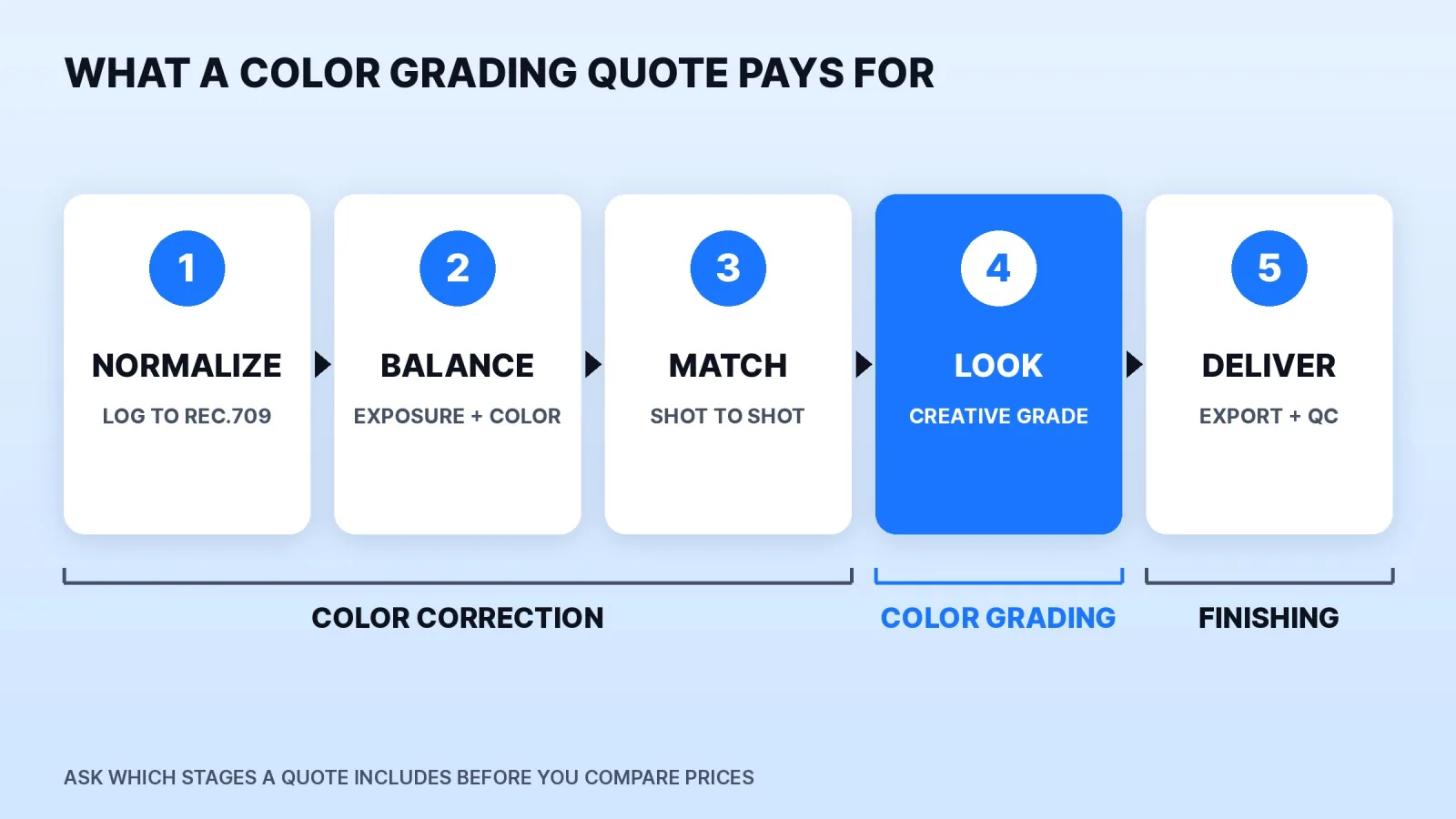
- Shots, not minutes. Every cut is a new shot to balance and match. Send the locked edit so the colorist can count them.
- The footage. Log and RAW footage keeps more range but needs converting before it looks right. Footage shot in a standard profile has less room to fix. YunoJuno lists HDR, RAW workflows and cinematic pipelines among the skills that raise a colorist's rate.
- Cameras to match. Two different cameras on one interview means every cut between them needs matching. XP-Pen calls shot matching "a huge part of the job."
- How many looks. One consistent look is faster to apply than a music video with a new palette in every scene.
- Deliverables. HDR masters, broadcast specs and extra aspect ratios each add a pass.
- The room. A supervised session in a calibrated suite costs more than a remote grade sent for review. The Chicago suite in the table rents for $600 a day before anyone is paid to grade.
Do You Need a Separate Colorist?
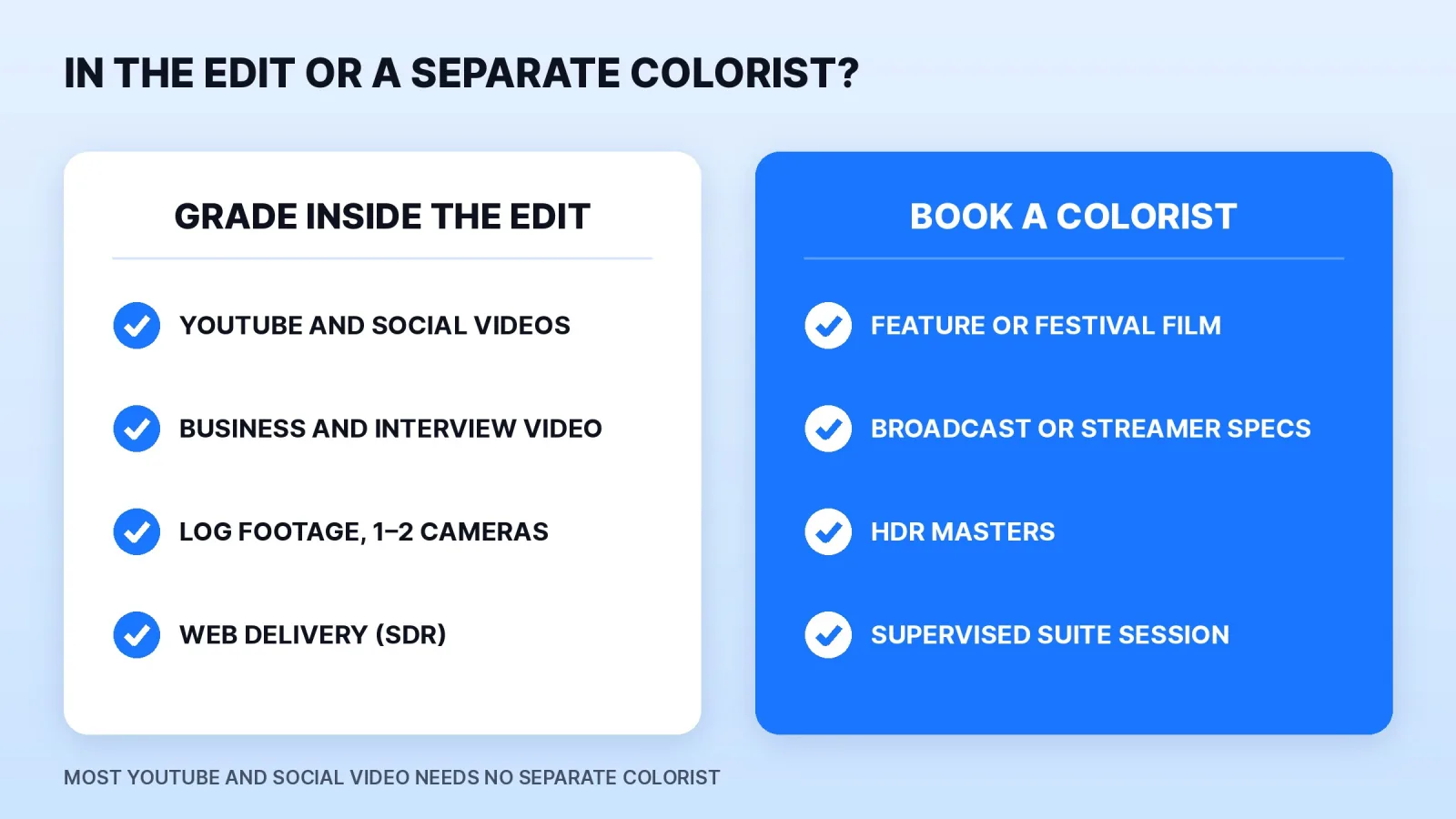
For most YouTube, social and business video, no. The grade is part of the edit. The editor corrects exposure and white balance, matches the cameras, applies one consistent look, and it ships with the cut. When you compare editing quotes, the grade should be on the list of what's included; our YouTube video editing cost guide shows what those quotes usually bundle.
Book a colorist separately when the delivery demands it: a feature or festival film, broadcast or streamer specs, HDR masters, or a session where the director sits in the room. Music videos sit on the line. A one-camera performance video grades fine inside the edit. A stylized video with a look per scene is where a colorist's day rate earns its price, which is one reason music video editing cost varies so much.
Doing it yourself costs time more than money. Blackmagic's free version of DaVinci Resolve is enough to learn on, and Resolve Studio adds the DaVinci Neural Engine tools and advanced HDR grading. Our color grading guide walks through the three-layer workflow.
Before You Ask for a Color Grading Quote: A 6-Point Checklist
- Lock the edit first. A recut after the grade means re-grading the changed shots, and that time is usually billed.
- Say what the footage is. Camera, log profile or RAW, frame rate and resolution.
- Count the shots and cameras. Or send the timeline as an XML or EDL and let the colorist count.
- Send two or three reference frames. Stills of the look you want, from your own past videos or a film.
- List the deliverables. Web delivery, HDR, broadcast specs, aspect ratios and file formats.
- Ask what the price includes. Revision rounds, remote review or a supervised session, skin-tone and tracking fixes, and the final export, in writing, so two quotes compare line for line.
Where Mark Studios Fits
Color grading is part of every edit Mark delivers, from YouTube videos to music and lyric videos for musicians. He also takes grade-only jobs: matching new footage to the look of a client's published videos, or making two camera angles match. Our guide to sending a reference shows how to share the look you want. What he doesn't sell is feature-film finishing or HDR mastering in a grading suite. For those, book a colorist.
Buyers ask for the look up front: "cinematic" appears in 51 of 698 first messages from buyers in our inbox, and 39 ask to match a style or reference. We've delivered 10,000+ projects for 4,500+ clients across 8,000+ orders, with a 4.9★ average and 100M+ views generated. If you're choosing between a marketplace freelancer and a studio, our Fiverr vs Upwork vs agency comparison lays out the trade-offs.
The Bottom Line
Color grading costs about $50–$150 an hour or $700–$1,500 a day from a freelance colorist in 2026, and roughly $800–$3,000 for a music video. Most YouTube and business video doesn't need a separate colorist, because the grade comes inside the edit. When it does, lock the edit, count the shots, and ask every colorist what the price includes.


