

What Is a Testimonial Video?
A testimonial video is a short video in which a real customer, on camera, describes their own experience with a business: the problem they had, why they chose it and what changed. It is word of mouth on video, used in the business's own marketing. The FTC's consumer review rule defines a consumer testimonial as a message that people are likely to believe "reflects the opinions, beliefs, or experiences of a consumer who has purchased, used, or otherwise had experience with a product, service, or business" (16 CFR 465.1).
It's one of the most common business videos. In Wyzowl's 2026 State of Video Marketing survey, 57% of video marketers said they make testimonial videos, behind only social media videos (69%) and explainers (68%). That's the point of the format: a customer who already paid says what the business can't credibly say about itself.
What a Testimonial Video Looks Like: 5 Formats
"Testimonial video" covers several formats. They share the same core, a real customer speaking for themselves, and differ in length, polish and where they run:
| Format | What's on screen | Where it usually runs |
|---|---|---|
| Interview testimonial | One customer answering questions from off camera, cut into a story | Website, sales page, email |
| Case study video | A longer interview plus the customer's numbers, their workplace and the product in use | B2B sales pages, sales calls |
| Short review clip | One strong line or two, captioned, often vertical | Social feeds, ads |
| Compilation | Several customers, one or two lines each, cut together | Homepage, landing pages |
| Customer-recorded | The customer films themselves on a phone or webcam, then it's edited | Social, review pages, when travel isn't practical |
Most interview testimonials are talking head videos: one person, one camera, speaking to an interviewer just off camera. That's why the edit matters so much. With nothing else on screen, the story, the cuts and the b-roll have to hold attention. For two real examples, see the short video testimonials from clients on our case studies: singer Desi G on building her YouTube channel, and Will of TheFinancialWolf on his thumbnails.
What Makes a Good Testimonial Video
A good testimonial video is specific and believable, and it follows the customer's story rather than a script. Before you film, check these six things:
- The right customer. A real buyer whose result is typical, not your one outlier. If you do feature an outlier, the FTC expects the generally expected result disclosed with it (16 CFR 255.2(b)).
- The before. The problem in their words, including what they tried first. Viewers with the same problem see themselves here.
- The decision. Why they picked you, and what they doubted. The doubt is what makes it sound true.
- The after. What changed, with a number if they have one: hours saved, sales, a date met.
- Who they are. Their name, role and company on screen. An unnamed customer is easy to dismiss.
- Permission in writing. Agreement to appear in your marketing, signed before the camera rolls.
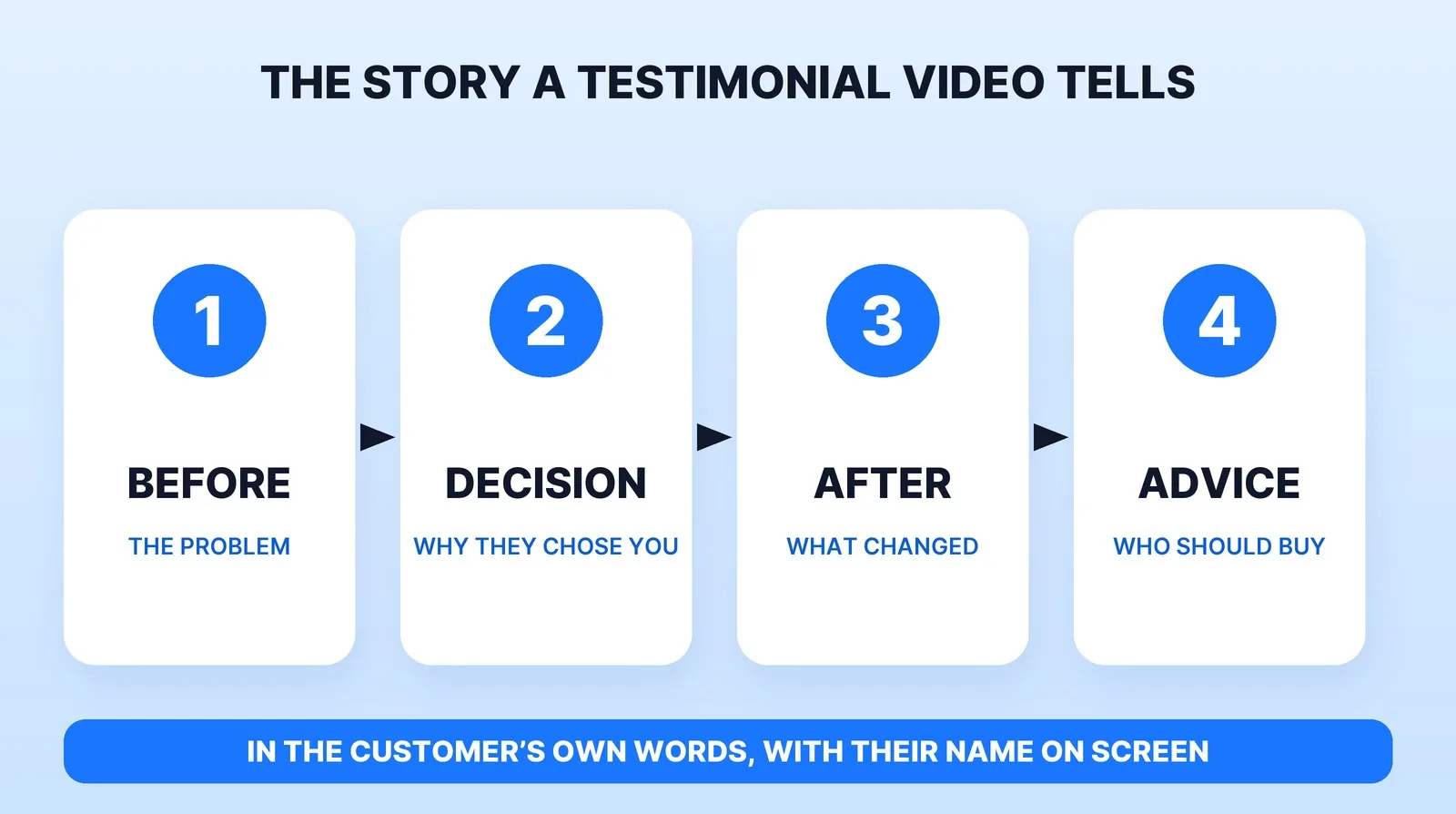
Ask open questions that follow that arc ("What was going on before you found us?", "What almost stopped you?", "What's different now?"), and let the customer talk. The best line is rarely the first answer, so record more than you need and find it in the edit.
How Long Should a Testimonial Video Be?
As long as the placement allows, and usually short. Wistia's 2026 State of Video Report, built on over 13 million videos, found that marketing videos under a minute average a 52% engagement rate, meaning viewers typically watch about half, and customer testimonial videos under a minute average 46%. For converting buyers, Wistia puts case studies in the 5- to 30-minute range.
Placement changes the job. On YouTube, viewers can skip a skippable in-stream ad after 5 seconds, according to Google Ads Help, so an ad cut opens on the customer's best line. On TikTok, people come looking for this kind of video: in a Pew Research Center survey, 62% of US TikTok users said product reviews or recommendations are a reason they use the app.
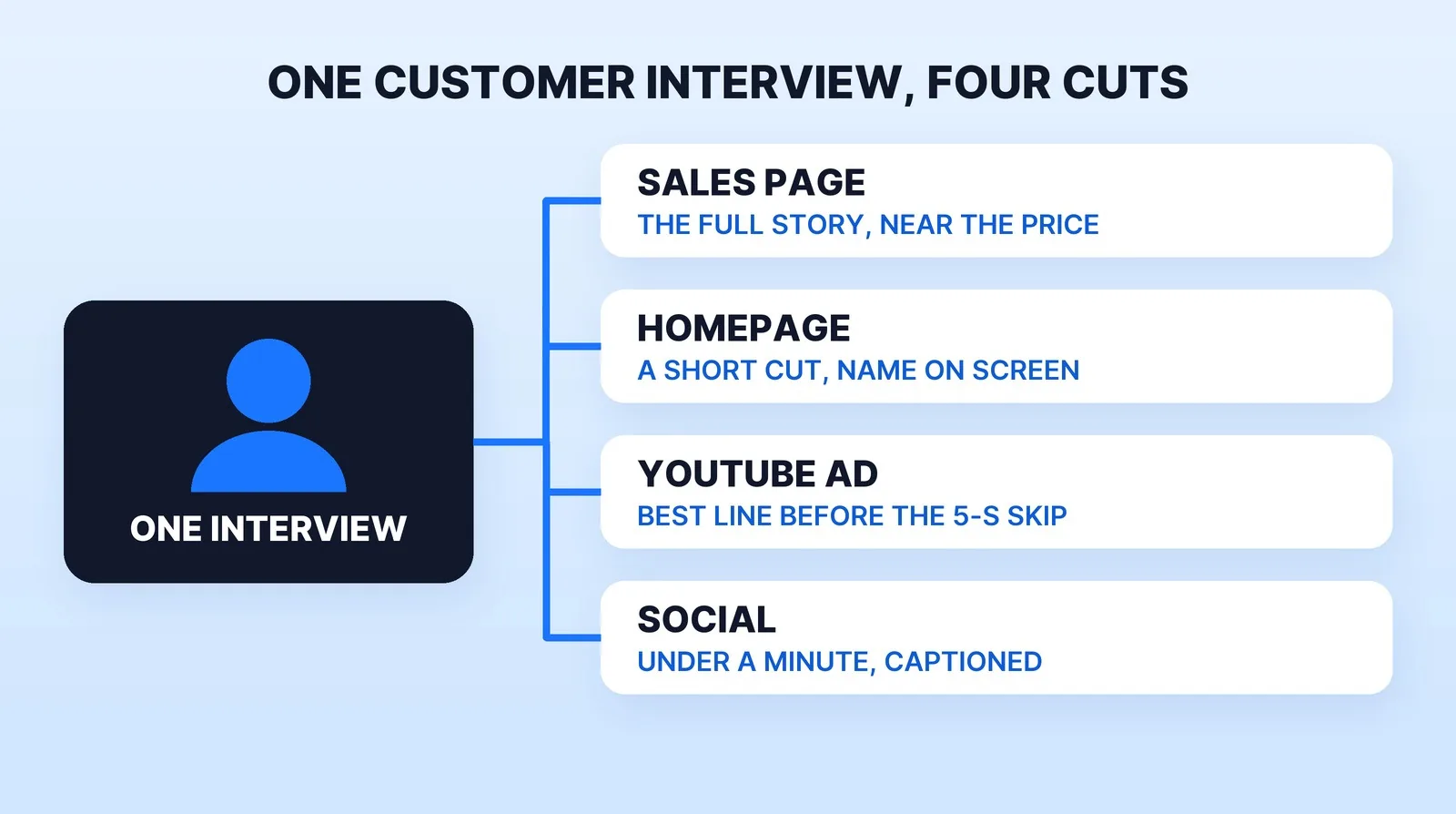
So plan for one interview and several cuts, not one video. The full story goes on the sales page, a short cut goes on the homepage, and the single best line opens an ad or a social clip. A testimonial also works as the proof section inside a video sales letter.
Testimonial Video vs UGC Ad: the Rules
A testimonial and a UGC ad can look identical: one person, a phone camera, talking about a product. The difference is who is speaking, and that changes what the FTC's Endorsement Guides require you to disclose:
| Testimonial video | UGC ad | Actor spot | |
|---|---|---|---|
| Who's on camera | A real customer | A paid creator | A hired performer |
| What they speak from | Their own purchase | A product they were sent or paid to try | A script |
| What must be disclosed | Any payment, discount or free product | The paid relationship | That they're actors, if shown as customers |
The rules behind that table:
- Real users only. An endorser who claims to use the product must have been "a bona fide user of it at the time the endorsement was given" (16 CFR 255.1(c)).
- Actors are disclosed. Ads showing "actual consumers" should use real ones, or clearly disclose that the people shown aren't actual consumers (16 CFR 255.2(c)).
- Incentives are disclosed. A payment, a discount or a free product is a material connection, and it has to be disclosed clearly when viewers wouldn't expect it (16 CFR 255.5).
- No fake testimonials. The consumer review rule bans creating a testimonial that misrepresents whether the person exists or used the product (16 CFR 465.2).
This isn't legal advice, and regulated businesses (law, health, finance) can have extra rules on top. For the numbers behind trust and conversion, see our testimonial video statistics.
Who Makes a Testimonial Video?
A testimonial video is three jobs. Finding the customer and getting permission is yours. The filming can be an on-site interview, a remote call, or the customer recording themselves. The edit picks the soundbites, builds the story, adds captions, lower thirds and b-roll, and makes the short cuts.
They're common in B2B software, where a customer case study often does more than a feature demo, and in real estate, where a past client's word sells the next listing. To compare providers, our list of customer testimonial production companies covers the field, our comparison of Fiverr, Upwork and an agency puts the fees side by side, and our testimonial video cost guide lists market rates.
Testimonial video editing at Mark Studios turns your recorded interviews into a finished story and short cuts, captioned, with names on screen, and Mark reviews every edit. Businesses in South Florida can have Mark film the customer interviews on location in Palm Beach County.
Mark Studios has completed 8,000+ orders with 4,500+ reviews, 99% on time, with work behind 100M+ views, and is Top Rated on Fiverr with a 4.9★ rating. Whoever edits yours, send the full interview rather than your favorite clips, so the editor can find the line you missed.
The Bottom Line
A testimonial video is a real customer telling their own story on camera: the problem, the decision and the result. Keep it specific, keep it short for each placement, and keep it real: real customers, typical results and any payment disclosed. Film one good interview, then cut it for every place it will run.


