

What Is a VSL?
A VSL, or video sales letter, is a scripted sales video that makes the whole case for one offer and asks the viewer to take one action: buy, book a call or sign up. It is a written sales letter turned into video, and it usually plays at the top of a sales page, inside a funnel or as a YouTube ad. HubSpot's guide defines it as "a video that pitches your product or service to a prospect."
The format came out of direct-response marketing. Copywriter Jon Benson says he made the first one by filming "just me and words on a screen," which he calls "the first ugly video sales letter," in an interview on the I Love Marketing podcast. "There were people probably doing PowerPoint-looking sales stuff," he adds, "but nobody was just doing words on a screen." That plain style is still around, though many VSLs now use a presenter, slides or both.
What "VSL" Means in a Funnel, an Ad and an Edit
The acronym means the same thing everywhere. What changes is the job the video does where it plays:
| Where you hear it | What "VSL" means there | What the viewer does next |
|---|---|---|
| Sales page | The video at the top of the page, above the order button | Buys |
| Funnel | The "watch this first" step before checkout or an application | Buys or applies |
| Call-booking page | The pitch for a high-ticket offer, such as coaching or consulting | Books a call |
| YouTube or social ad | The VSL, or a cut-down of it, run as a long in-stream ad | Clicks through to the sales page |
| An editing brief | The job of cutting that sales video from a script and footage | Approves the cut |
On YouTube, viewers can skip a skippable in-stream ad after 5 seconds, and with cost-per-view bidding you pay when someone watches 30 seconds or interacts, according to Google Ads Help. That's why the ad version of a VSL puts its hook first. Our guide to what YouTube ads cost covers the bidding.
Plenty of people who need a VSL never use the word. In our study of 698 first messages from buyers, "VSL" and "video sales letter" each appeared in fewer than 10, while "ads" appeared in 26 and "promotional" in 17. If you've been asking for a sales video, a promo or a long ad, you may be describing a VSL.
The 6 Parts of a VSL Script
The order varies, but most VSL scripts move through the same six parts a written sales letter uses:
- Hook. A first line that names the viewer's problem or promises a result. In an ad, it has 5 seconds to work.
- Problem. Who this is for and what the problem is costing them, in their own words.
- Story or mechanism. Why what they've tried hasn't worked, and the idea behind the offer that does.
- Proof. Results, testimonials, demos, credentials or data.
- Offer. What's included, the price, any bonus and the guarantee or refund terms.
- Call to action. One clear next step, usually repeated near the end.
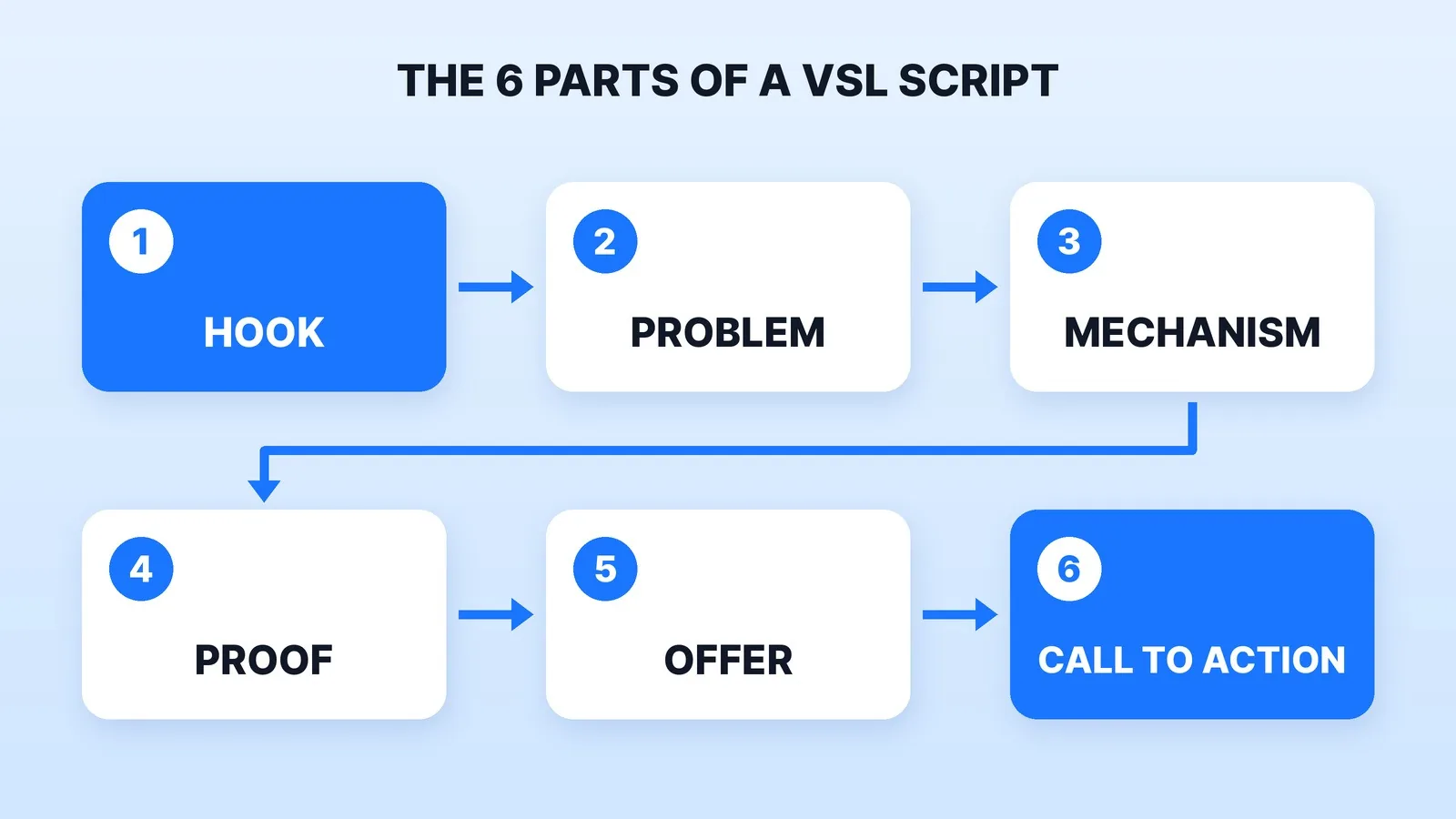
HubSpot's version has the same bones: grab attention, discuss pain points, show the product as the solution, establish credibility and inspire action.
Proof is the part with legal limits. Under the FTC's Endorsement Guides, if a testimonial shows results that aren't representative of what customers generally achieve, the ad "should clearly and conspicuously disclose the generally expected performance" (16 CFR 255.2). The same rules say a visual disclosure should stand out "by its size, contrast, location, the length of time it appears". In a VSL, that means the typical-results line goes on screen with the claim, big enough and long enough to read. This isn't legal advice, and the claims in your script are yours to have reviewed.
The 3 Common Looks
The script decides whether a VSL sells. The look decides what you have to film:
| Look | What's on screen | Fits when |
|---|---|---|
| Words on screen | Text synced to a voiceover, with no presenter | Nobody wants to be on camera, or you'll test several script versions |
| Presenter | A founder or expert talking to camera, cut with b-roll and text | The person is what's being sold: a coach, a consultant, a doctor |
| Slides or demo | Slides or a screen recording under the voice, sometimes with the presenter in a corner | Software, data-heavy or B2B offers |
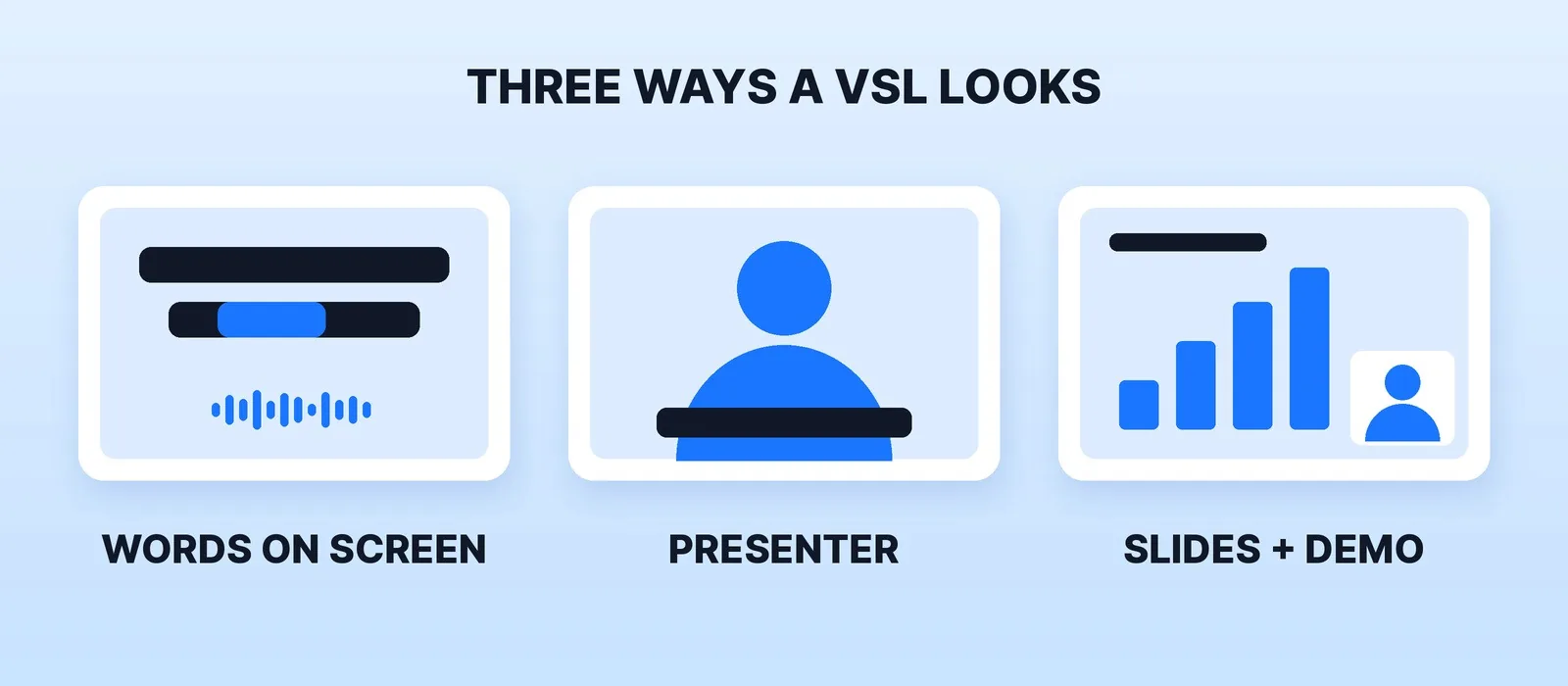
A words-on-screen VSL is the cheapest to change: a new line means a new voiceover take and new text, not a reshoot. A presenter VSL is a talking head video, so the same rule applies there: change the picture often, or one unchanging shot loses the viewer. Many VSLs mix all three.
How Long Is a VSL?
There's no standard length. A VSL runs as long as the argument for its price, so a low-priced offer may need a few minutes and a high-ticket program much longer. In the same interview, Benson says people asked who would watch an 18-minute VSL of words on screen, and that VSLs had since stretched to 30 and 40 minutes.
For marketing video in general (not VSLs specifically), Wistia's 2026 State of Video Report, built on over 13 million videos, found that videos of 5 to 30 minutes average a 9% click-through rate, that engagement declines after the five-minute mark, and that engagement drops 11% once a video passes 30 minutes.
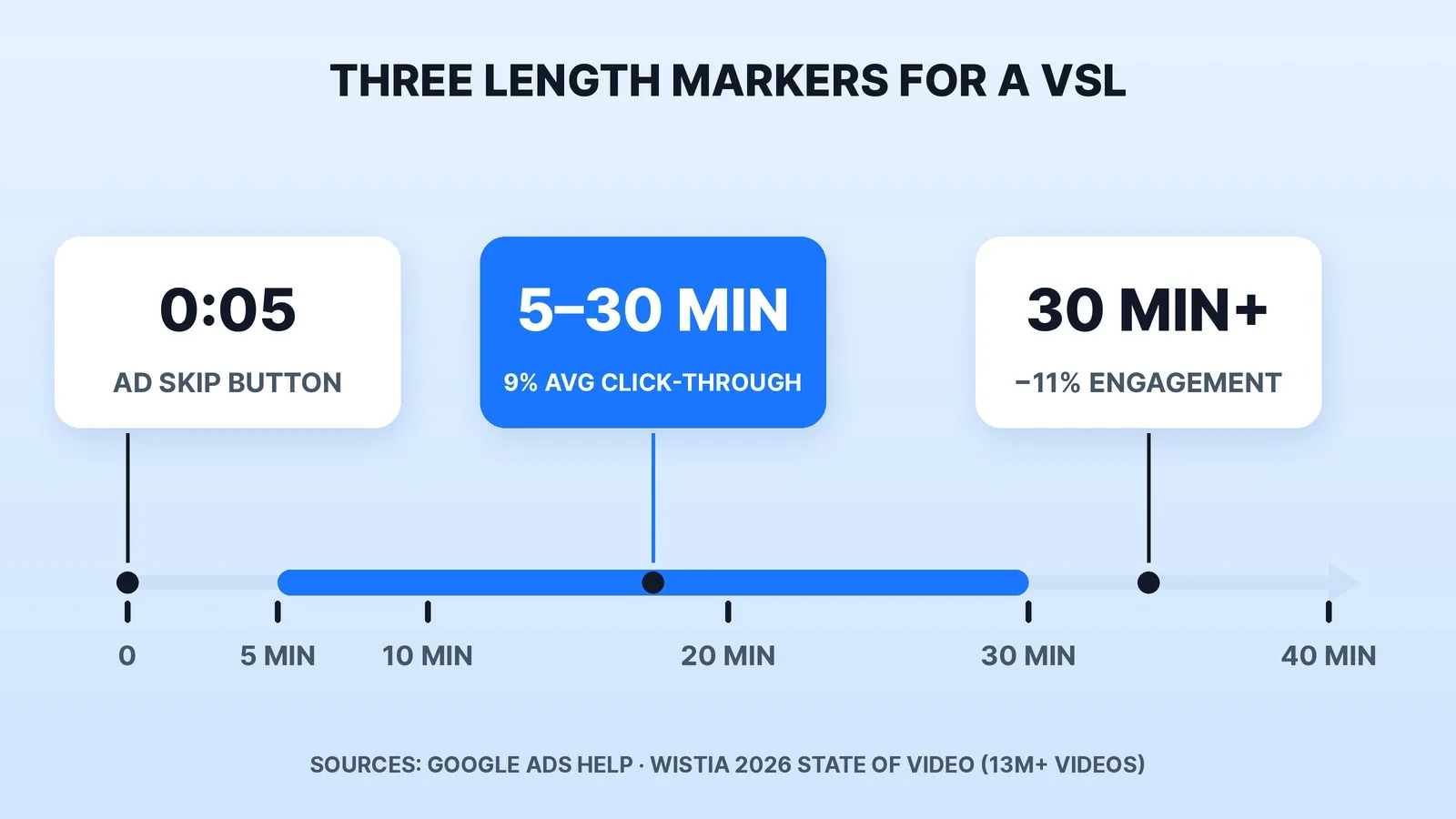
So cut whatever doesn't sell, keep the price argument whole, and make a short ad version that earns the click in its first 5 seconds. Runtime also sets the price of the edit: our VSL cost guide lists market rates by length.
Do You Need a VSL, and Who Makes It?
A VSL earns its place when you sell one offer to people who don't know you yet, at a price high enough that they need the full argument before they buy. That's why it's common with coaches, course creators, software companies and high-ticket services. It's the wrong tool for a cheap impulse buy, or for repeat customers who already trust you.
One VSL is three jobs. The script, often by a copywriter and billed separately. The footage: you on camera, a screen recording, or none at all for a words-on-screen VSL. And the edit, which syncs the text and slides, places the proof and disclaimers, cuts the dead air and makes the hook variants you'll test. For that last part, our guide on how to hire a VSL editor covers what to send and how to judge samples, and our list of the best VSL and video ad editors compares 11 options. If you're weighing a marketplace freelancer against a studio, our comparison of Fiverr, Upwork and an agency puts the fees side by side.
VSL and sales video editing at Mark Studios turns your approved script and recordings into the finished sales video, with on-screen text for each claim, your disclaimers exactly as written and hook variants on request, and Mark reviews every edit. If you'd rather not film yourself on a phone, Mark films founders and experts on location in Palm Beach County.
Mark Studios has completed 8,000+ orders with 4,500+ reviews, 99% on time, with work behind 100M+ views, and is Top Rated on Fiverr with a 4.9★ rating. Whoever edits yours, send the final script with the six parts marked, so the editor knows where the proof and the offer land.
The Bottom Line
A VSL is a sales letter in video form: one offer, one action and one argument from hook to call to action. The look matters less than the script and the proof, and the length should follow the price. Write the argument first, then film only what it needs.


