Hiding a Video Costs You More Than Leaving It Up
Unlisting an old video feels like tidying. It isn't. YouTube's qualified watch hours for the Partner Program count only public long-form videos, archived live streams and podcasts — private, unlisted and deleted videos contribute nothing. So the quiet Sunday cleanup where a creator unlists eleven weak videos also removes every watch hour those videos earned from their monetization progress. Deleting is worse and it is final: YouTube's own replace or delete documentation confirms a deleted video is permanently deleted, and that its URL and title stop appearing in Analytics entirely.
We've delivered 10,000+ projects for 4,500+ clients, and "should I delete my old stuff?" is a question channel owners bring us often. The answer is almost always no. The video you want gone is rarely a liability — it's an asset with the wrong packaging on it, and the four cases where removal genuinely is correct have nothing to do with how it performed.
The Channel-Average Myth
The belief underneath most deletions is that YouTube keeps a running score for your channel, like a GPA, and that a flop drags the average down and suppresses everything you publish next. That isn't how YouTube describes its system. Its recommendations overview says it learns from "a user's viewing behavior, likes, dislikes, subscriptions, and feedback, including from satisfaction surveys." It does weigh "the reputation and the quality of a channel," but nothing in that description treats one low-view upload as a mark against the next. A video nobody watched didn't spend your credibility. It just stopped being offered.
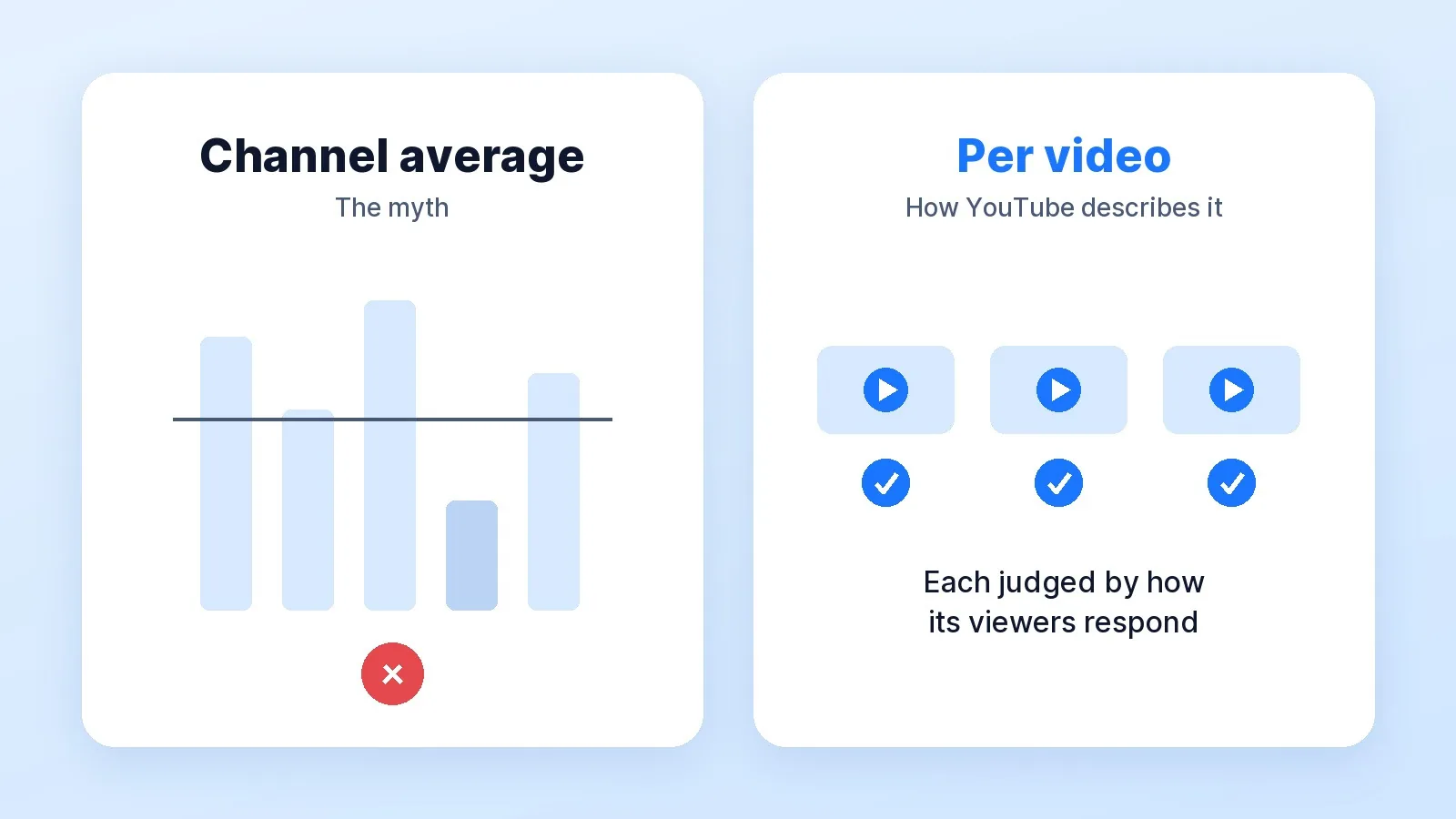
The myth produces the exact wrong behaviour. If you believe weak videos are a tax, you delete them and feel better. If you understand they are inert, you fix the ones with traffic they failed to convert. The second habit compounds; the first just shrinks your library.
What Removal Actually Costs, Including Unlisting
Deletion and unlisting are not two intensities of the same action. They lose you different things, and "unlisted" is not the safe middle option creators assume it is.
| Public | Unlisted | Private | Deleted | |
|---|---|---|---|---|
| Findable in search and suggested | Yes | No | No | No |
| Reachable by anyone with the link | Yes | Yes | No | No |
| Counts toward qualified watch hours | Yes | No | No | No |
| Existing embeds keep working | Yes | Yes | No | No |
| Reversible | — | Yes | Yes | No |
| Keeps its Analytics row | Yes | Yes | Yes | No |
YouTube's video privacy settings define unlisted as visible to anyone holding the link, which is why it is a distribution choice and not a hiding place — and if the video predates 2017, older unlisted content carries its own legacy link behaviour worth reading before you rely on it for anything sensitive. Private is the real hide. Deleted is the only row in that table you cannot undo.
The costs people forget are off-platform. Every external link, embed, newsletter mention and course module pointing at a deleted video becomes a dead end, any search ranking it held is gone and does not transfer, and you lose the record of what its retention curve was trying to tell you — the data a proper youtube channel audit runs on. Write-ups on when to delete old YouTube videos land where we do; some argue you should never delete YouTube videos at all.
The Pre-Flight Gate: Seven Questions Before You Change Any Video's Visibility
Run this before you touch the visibility dropdown. If you cannot answer all seven, you are not ready to decide.
- Is there a legal, licensing or consent problem? If yes, skip the rest of this list and go to the next section. Nothing below outweighs it.
- How many watch hours has it earned in the last 12 months? Pull the number. Unlisting or deleting removes it from your Partner Program pool — the eligibility rules PPC Land covered when YouTube clarified them are unforgiving, and pre-monetization channels routinely hand back hundreds of hours they needed.
- Where does its traffic come from? A video that still earns search impressions is working, whatever its view count looks like next to your best upload.
- Is anything pointing at it? Check embeds, your own site, playlists, end screens, pinned comments and any course or newsletter you've shipped. Each one becomes a 404.
- Is it under 30 days old? Then it is still in discovery and you do not have a result yet. Leave it alone.
- Are impressions high and click-through low? That is a packaging failure, not a content failure, and it is the single best re-packaging candidate on your channel.
- Would you be embarrassed if a new subscriber found it, or only if a peer did? Be honest. Peer embarrassment is not a business reason.
The Four Cases Where Removal Is Right
Removal is a response to risk, not to performance. Four situations qualify.
Legal or licensing exposure. Unlicensed music, footage you no longer have rights to, a trademark problem. Here you act immediately and you use Private, not Unlisted — an unlisted video is still one shared link away from the public.
Advice now wrong in a way that could cost someone money or safety. Not "slightly dated." Wrong. A tutorial pointing at a deprecated setting needs a pinned comment or a re-record; a video telling people to do something that now breaks their account comes down.
A person in the video withdrew consent, or there is a safety issue. A guest, a client, a child, an address or a licence plate in frame. Not negotiable, and the one case where deletion rather than Private is often correct.
A contractual obligation ended. A sponsor's term expired, or a client engagement specified a takedown date. Diarise these when the deal is signed rather than discovering them two years later.
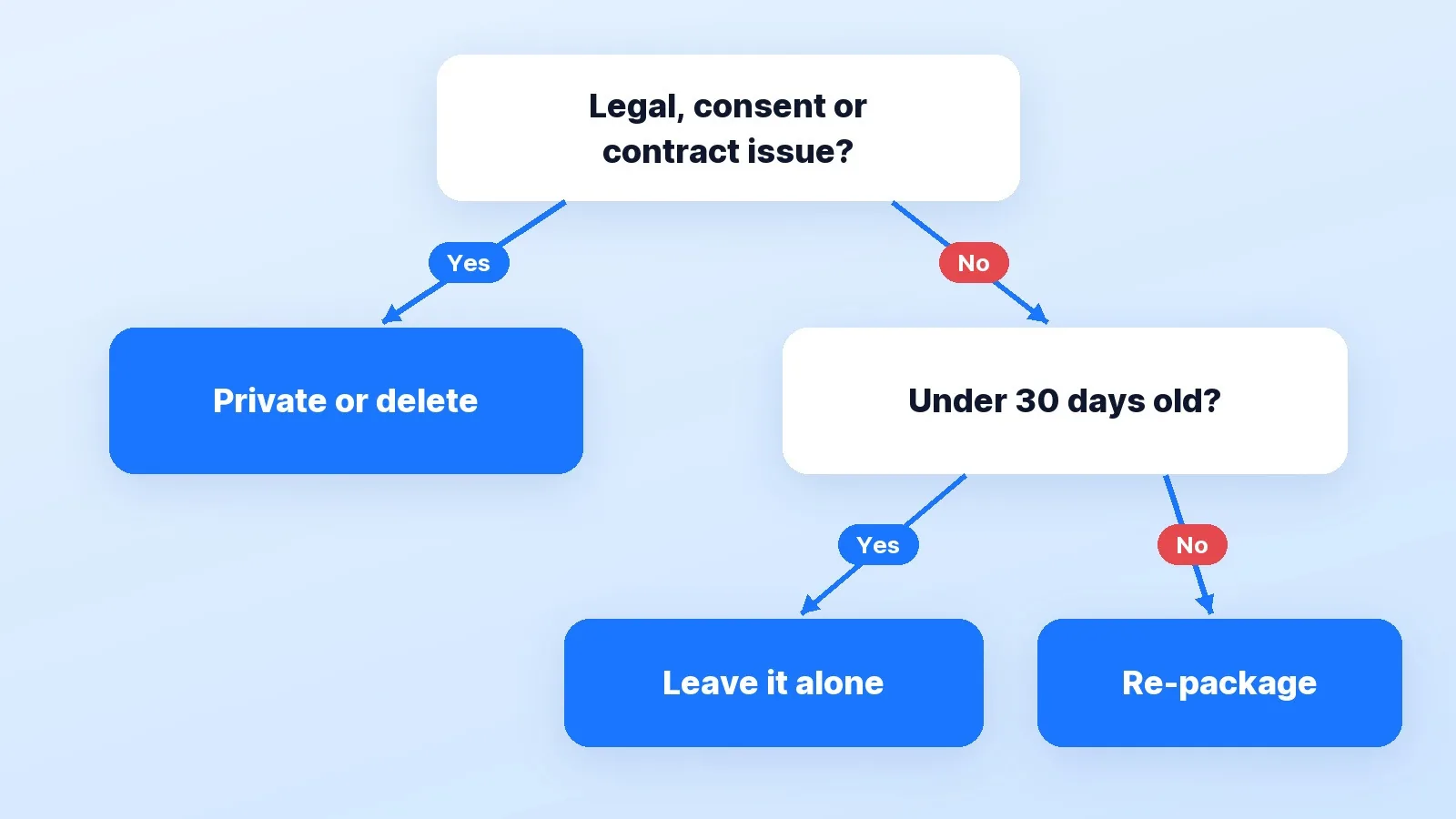
Notice what is not on that list: low views, an old thumbnail style, a pivot in your content direction. A youtube channel pivot does not require a purge — your back catalogue keeps earning while the recommendation system relearns who to serve you to.
Re-Package Instead: What We Do With a Weak Video
For the videos that fail the embarrassment test but pass the risk test, the work is packaging and placement.
Sort by impressions (12 months, descending)
  → high impressions + low CTR   → new title and thumbnail
  → low impressions + high CTR   → it needs a playlist, not a redesign
  → low impressions + low CTR    → leave it; it is inert, not harmful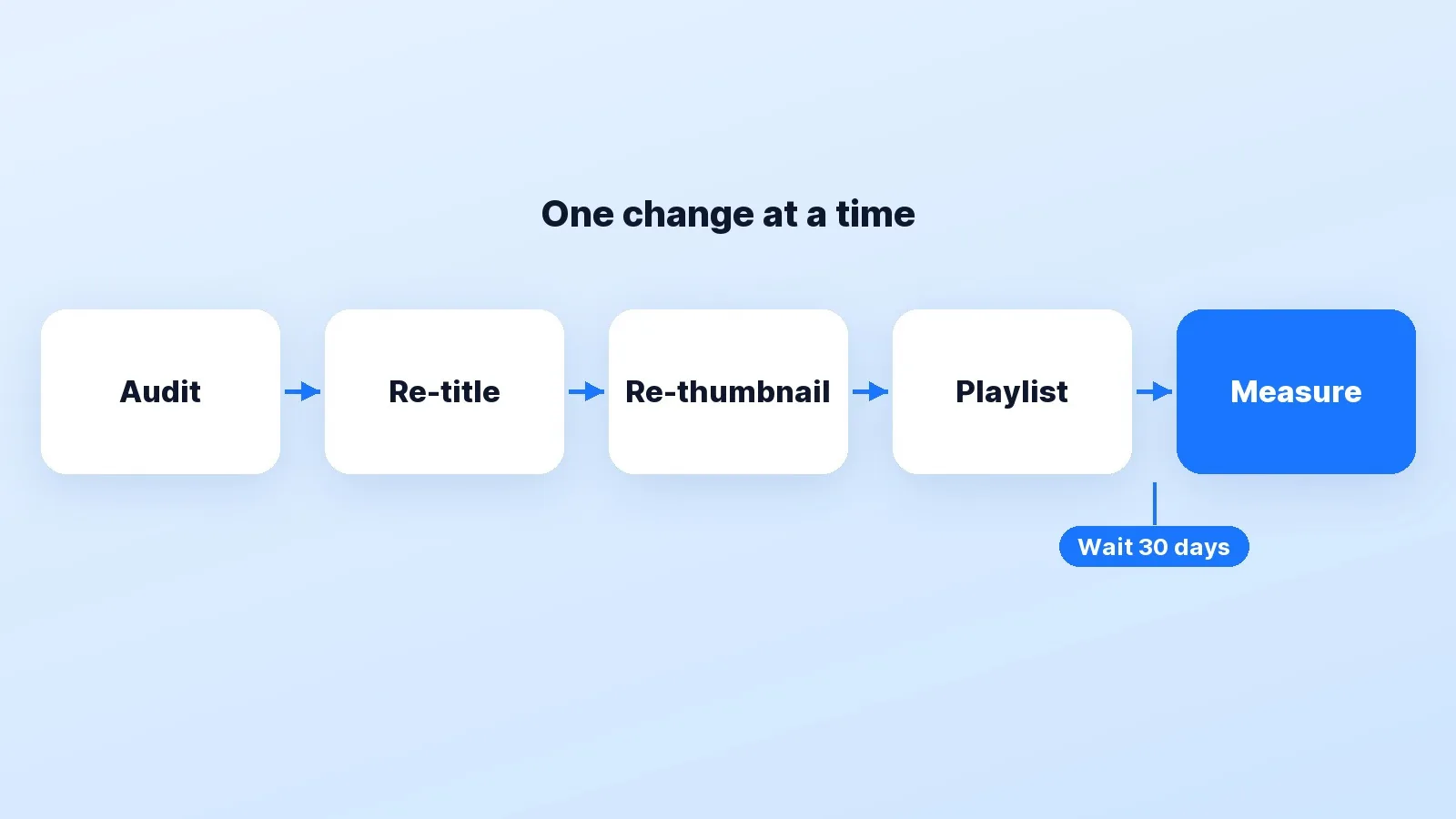
Editing a published video's title, description or thumbnail does not reset its views, comments or analytics — any re-ranking comes from viewers responding to it differently. Change one variable at a time, hold it for 30 days, and apply the same thumbnail gate you would use on a new upload. Then put the video somewhere: an old video with no playlist home is invisible to the surfaces that build youtube session time, and sorting last year's uploads into playlists does more for them than another purge.
One thing we never do: re-upload. A fresh upload of the same video throws away the original's accrued signals, its comments and its links, in exchange for a publish date. It is deletion with extra steps.
The Bottom Line
Deleting underperforming videos solves a feeling, not a problem — it is irreversible, it strips watch hours out of your Partner Program progress, and it breaks every link pointing at your own work. Remove a video when there is a legal, consent or contractual reason to, make it Private rather than Unlisted when you do, and re-package the rest.
If you'd rather have someone else run the audit, our YouTube strategy engagement starts with a channel audit and turns it into a 90-day plan your own team can run.