

The Short Answer: How to Hire a Short-Form Video Editor
To hire a short-form video editor, decide whether you need clips cut from long videos or edits built from raw vertical footage, then shortlist three editors whose Shorts, Reels or TikToks you've watched on real accounts. Pay your top two for the same small test batch, check it against the specs below, and put volume, turnaround, originality and rights in writing.
Short-form is what buyers ask for most: Shorts, Reels or TikTok videos came up in 240 of the 698 first messages from buyers that we analysed. What a short-form editor costs per clip and per month is in our separate guide to short-form video editing cost. This guide covers choosing the person and setting up the work.
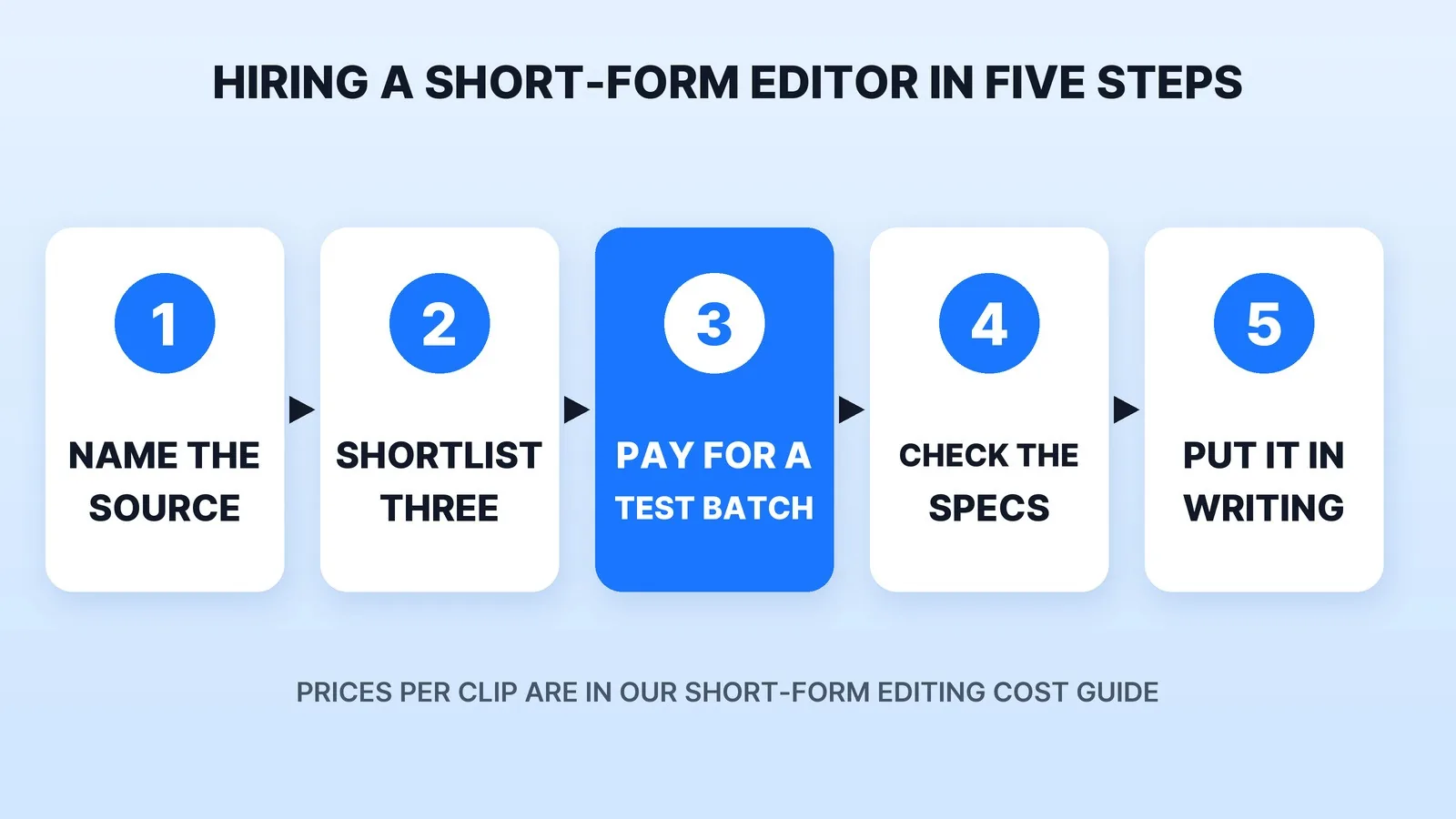
Step 1: Name the Source Footage
Short-form editors split into two jobs, and the difference decides who you hire:
| What you have | What the editor does | Look for |
|---|---|---|
| Long videos (podcasts, YouTube videos, webinars, streams) | Watches the whole thing, picks the moments that stand alone, reframes to 9:16 | Judgement: clips that make sense to someone who never saw the long video |
| Raw vertical footage (phone clips, b-roll, talking-head takes) | Builds each video from scratch: hook, pacing, captions, music | Craft: the first second, the rhythm, the loop |
An AI clipper can cut the first kind automatically. Our comparison of AI clippers and a human editor shows what that saves and what it misses. Write down which you have, how many videos a week, and which apps they go to.
Step 2: Shortlist Three From Accounts You've Watched
Short-form portfolios are easy to fake with one viral clip. Ask each candidate for three accounts they edit every week, then scroll the last 20 posts on each. You're looking for consistency: captions that are always readable, hooks that land in the first second, and a recognisable style that still changes with the content.
Look on freelance marketplaces and ask creators in your niche who edits their Shorts. Our list of the best short-form video editing services compares providers side by side, and our freelance marketplaces comparison lays out the trade-offs between a marketplace seller and a managed service. For the interview itself, use the five questions in our piece on why quality editors matter in short-form.
Step 3: Pay Your Top Two for the Same Test Batch
Give both finalists the same real footage and the same brief, and ask for three to five finished videos. One clip shows luck; a batch shows whether they can repeat it. Pay both. Then compare:
- Do the clips stand alone? Watch each one as a stranger would: no context, sound off for the first second.
- Is the hook in the first second, or after a slow lead-in?
- Are the captions accurate, in your fonts and colours, and readable at phone size?
- Do the clips look like a set, with matched colour and loudness?
- How did they handle your notes on the first round?
Step 4: Check the Batch Against the Specs
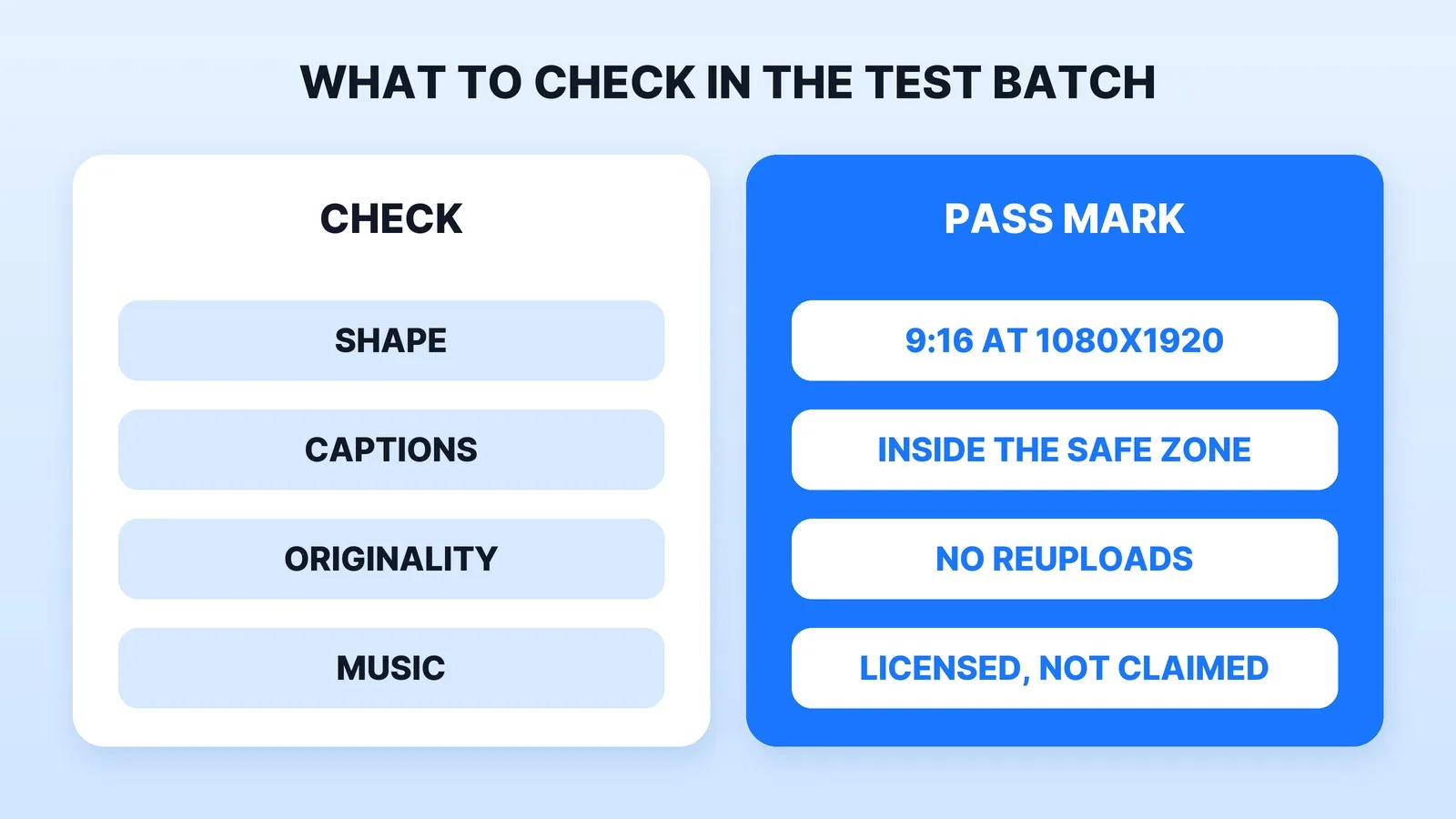
- Shape and size. 9:16 at 1080x1920 for Shorts, Reels and TikTok.
- Safe zones. Each app draws its buttons, captions and username over the bottom and right of the video. Drop a frame into our YouTube Shorts safe zone tool to see whether the editor's captions sit clear of them.
- Length. YouTube's Shorts help page says Shorts can be up to 3 minutes long. Agree a target length per platform rather than leaving it open.
- Originality. YouTube's Shorts monetization policies list non-original Shorts as ineligible for engaged views, naming "unedited clips from others' movies or TV shows", reuploads of other creators' content, and "compilations with no original content added". Its reused content policy applies to the channel as a whole. An editor who builds your feed from other people's clips puts your monetization at risk.
- Music. YouTube's Content ID scans every upload against files submitted by copyright owners, and YouTube's Shorts policies say Shorts over one minute that contain claimed content are blocked. Ask where every track comes from, and whether its licence covers each platform you post to.
Step 5: Put It in Writing
Before the first paid month, agree on:
- Volume and cadence: how many videos a week, and on which days they're due.
- Turnaround, counted from when you send the footage, and the number of revision rounds.
- What's delivered: the 9:16 masters, any feed or square versions, caption files if you need them, and cover frames.
- Ownership. Under the U.S. Copyright Office's work-made-for-hire rules, commissioned work counts as made for hire only in nine listed categories, one of which is a part of "a motion picture or other audiovisual work", and only with a written agreement signed by both sides. Get that signed agreement, or a written transfer of copyright.
- Access without passwords. Share footage through a folder link, and if the editor uploads for you, add them with a limited role on each account rather than sharing your login.
Where Mark Studios Fits
Mark Studios edits short-form video in batches: 9:16 masters at 1080x1920, captions in your fonts kept inside each app's safe zone, and 5 to 15 clips picked from one long video by watching all of it. For volume, our StreetInterview case study covers 146 vertical videos, including one batch of 50. Our fitness creators page covers channels that post mostly Shorts. Mark Studios has completed 8,000+ orders with 4,500+ reviews, 99% on time, with work behind 100M+ views, and is Top Rated on Fiverr with a 4.9★ rating. Our short-form video statistics page has the wider data.
The Bottom Line
Decide whether you need clips cut from long videos or edits built from raw vertical footage, shortlist three editors from accounts you've watched for weeks, and pay your top two for the same test batch. Check it for 9:16 framing, safe-zone captions, length, originality and claimed music, then put volume, turnaround, deliverables and copyright in writing.


