OpusClip vs a Human Editor: Which Is Better for Clips?
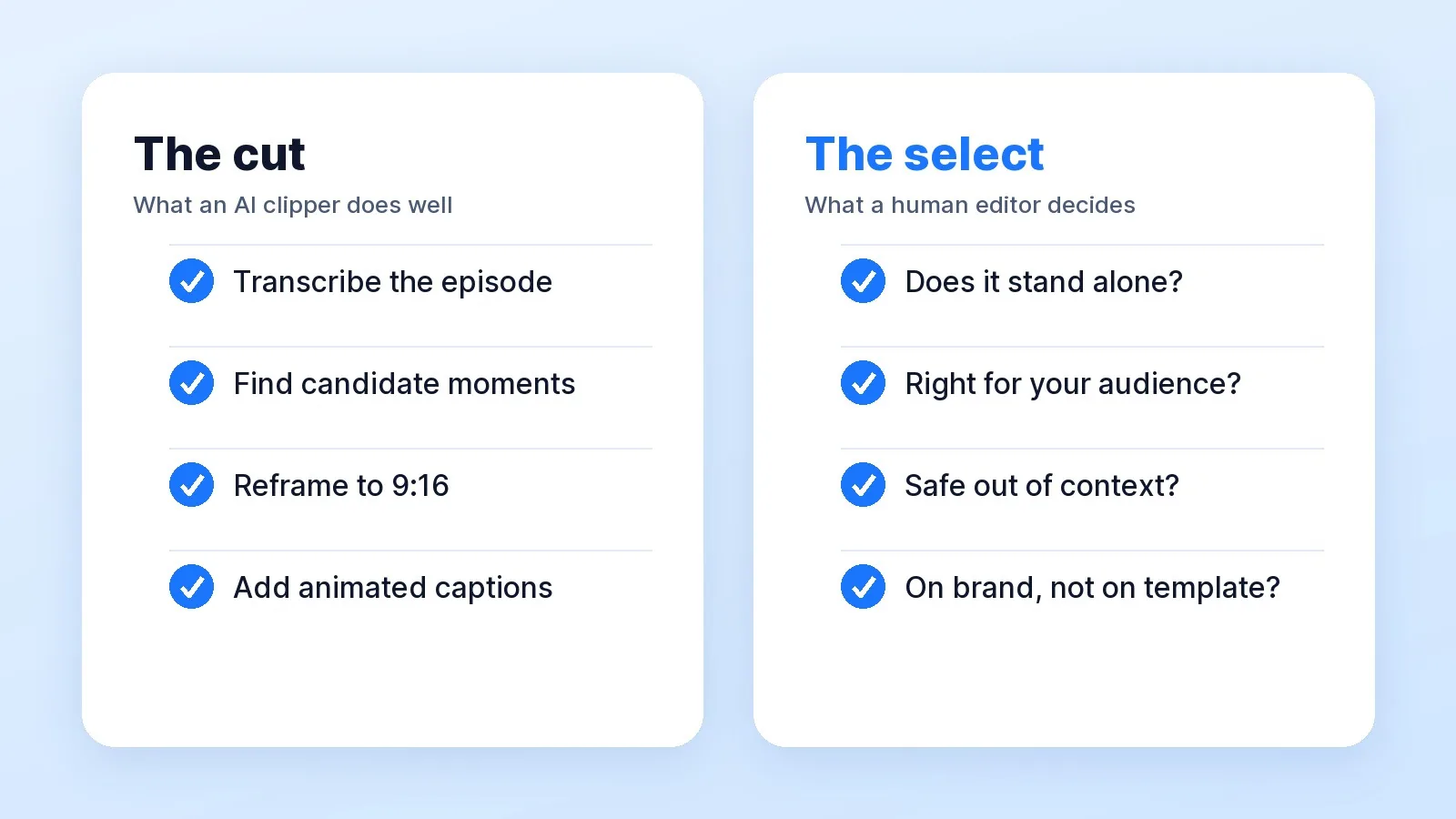
An AI clipper like OpusClip or Klap wins the cut: it transcribes an episode, reframes it to vertical and captions it in minutes, for roughly $14–$39 a month. A human editor wins the select, deciding which moments deserve to be clips at all. For most shows, the best way to turn a podcast into clips is both: the tool proposes, a person picks.
Creators say as much about AI output in general. In Adobe's 2026 Creators' Toolkit Report, 57% of creators said their creative AI output typically needs moderate or extensive editing before it's ready to share. The figure, with its sample and date, is on our AI video editing statistics page. With clips, most of that editing is choosing. A clipper's draft can be technically finished and still be the wrong moment.
What an AI Clipper Does Well
Credit where it's due. These tools do the mechanical half of clipping faster than any person can:
- OpusClip advertises AI clipping with a Virality Score, animated captions in 20+ languages, auto reframe, and export to Premiere Pro or DaVinci Resolve, per its pricing page.
- Klap sells AI clipping metered by clips generated, 100 a month on its Basic plan, per its pricing page.
Both pages were checked on October 6, 2026. Here's how the job splits:
| Clipping task | AI clipper | Human editor |
|---|---|---|
| Transcribe the episode | Automatic, in minutes | Works from the same transcript |
| Surface candidate moments | Many at once; OpusClip ranks them with a Virality Score | Slower, from notes and a watch-through |
| Reframe to 9:16 and caption | Automatic, from templates | Styled to your brand |
| Decide which moments are worth posting | A prediction from the clip itself | A judgment that knows your audience |
| Set the in and out points | Set by the model, adjustable by you | Trimmed to the setup and the payoff |
What AI Clippers Miss: The Select
A podcaster comparing clippers summed it up: "it's not the cut, it's the select." The complaints from other hosts line up. One wrote that "the AI keeps picking the most boring parts of the conversation, or the captions look terrible." Another, who tried Riverside's Magic Clips and OpusClip, found "they often don't capture the real 'aha moments'."
That isn't a settings problem. A clipper scores a moment on what's inside the clip. The select depends on things outside it:
- Context. A great line often lands because of a setup two minutes earlier. Someone has to decide whether to bring the setup along or pick a moment that stands on its own.
- Your audience. A score can't know which topic your viewers saw last week, or which guest your buyers already trust.
- Risk. A guest's line can sound fine in the episode and bad on its own. Someone with your brand in mind has to catch it before it posts.
- Brand. The caption style, the hook text on the first frame and the colors should look like your show, not like the tool's default template.
Our four-check clip test (stands alone, hooks fast, holds one idea, sounds clean) is the select written down. A clipper handles the mechanics of the cut. The checks need someone who knows the show.
What Each Option Costs
Market prices, checked on each vendor's own pricing page on October 6, 2026:
| Option | Price | What you get |
|---|---|---|
| OpusClip Starter | $15/month, monthly only | 150 credits a month; 1 credit = 1 minute of video processed |
| OpusClip Pro | $29/month, or $14.50/month billed annually | 300 credits a month |
| Klap Basic | $14/month, billed yearly | 100 clips a month |
| Klap Pro | $39/month, billed yearly | 300 clips a month |
| Freelance clip editor | $20–$50 per clip | The cut, plus the select if you ask for it |
Sources: OpusClip pricing, Klap pricing, and the r/podcasting rule of thumb to "expect $20–$50 per clip."
Run the numbers for a weekly 60-minute show. That's about 260 minutes a month, past Starter's 150 credits and inside Pro's 300, so the tool costs about $29 a month. At seven clips a week, roughly 30 a month, the freelance rate comes to $600–$1,500. The tool is far cheaper per clip. What it doesn't buy is the person who watches the candidates, rejects most of them, fixes the in and out points and checks every caption. If that person is you, the clipper isn't cheap. You pay for it in hours.
AI is pulling work in-house either way. In Wistia's AI Video Marketing Trends for 2026 survey, 64% of marketing teams said AI had led them to outsource less to agencies or content houses. For the cut, that's the right call. Whether it's right for the select depends on whose time you're spending.
When a Clipper Is Enough, and When to Hire an Editor
Run this check before you choose:
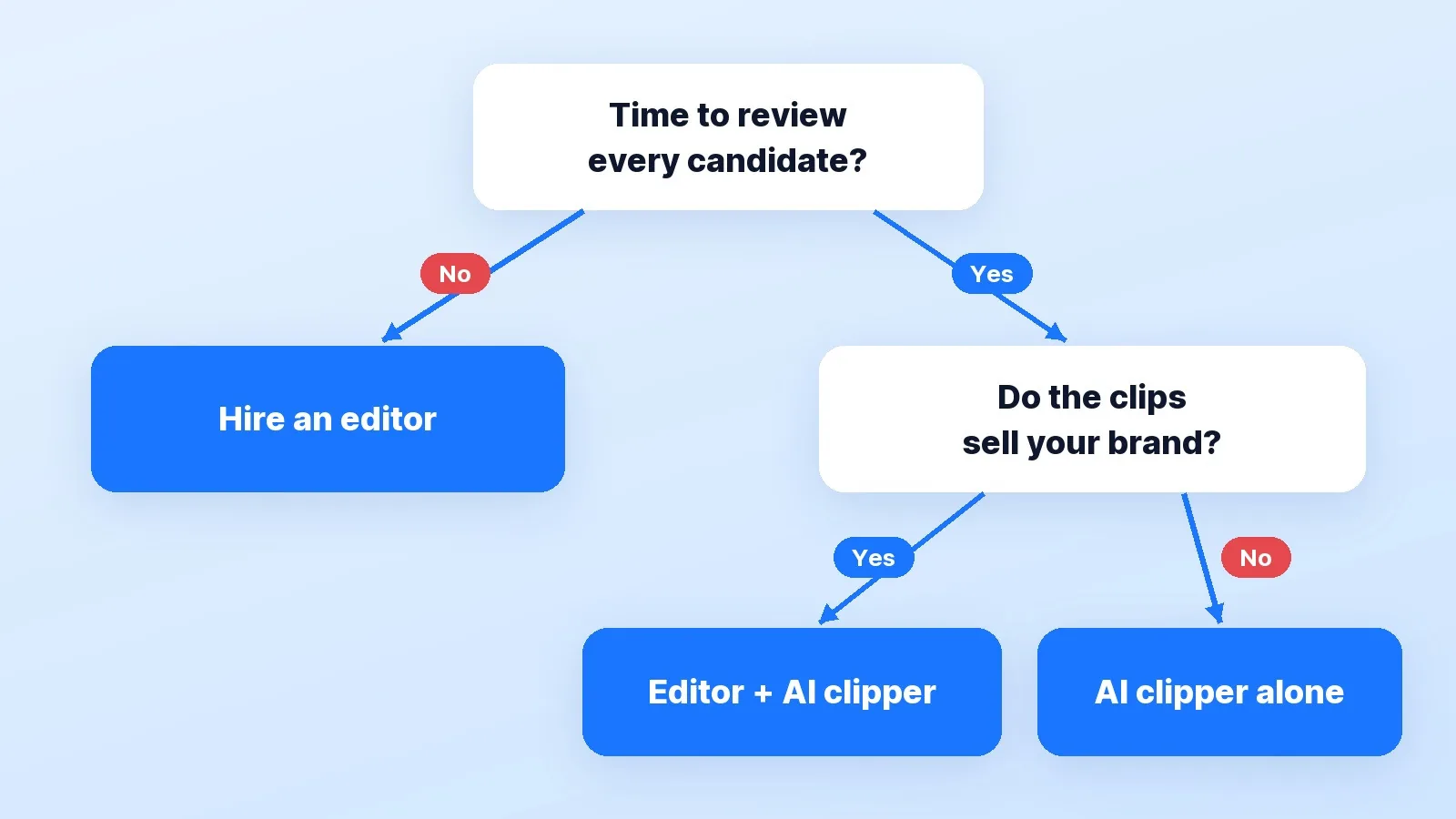
- Do you have time to review every candidate each week? If not, a clipper only moves the work from cutting to sorting.
- Do your clips sell something? If a clip is the first thing a buyer sees of a coach, a law firm or a founder, a weak pick costs more than the subscription saves.
- Is it one voice or several? In a multi-guest conversation the point often lands across two speakers, and someone has to choose where the clip starts and stops.
- Do you need a consistent look? OpusClip's Pro plan includes brand templates, but someone still has to apply them and catch the clips where they don't fit.
If you answered no to the first question, or yes to the second, hand off the select. If the clips are cheap volume tests, a clipper on its own is fine.
How We Combine Them
We use AI the same way: for the first pass. Our AI editing stack puts long-form-to-shorts clippers in the "used carefully" tier, good for surfacing candidates and never the final pick. We make the select by hand, trim each clip to its setup and payoff, style the captions to the show, and check every clip against the clip test before it ships. If the source is a long YouTube video rather than a podcast, the 10-cut framework for repurposing long-form into Shorts maps which moment types to look for.
One thing no clipper can change: if you post clips of other people's shows, auto-captions and templates don't make them original under YouTube's October 2026 Shorts update. Clips cut from your own episodes aren't the target (what changed in the Shorts original-content update).
Buyers have caught on to the difference. One podcaster's request for an editor said it in capitals: "I DO NOT want someone who just plug it into an AI system". They wanted someone who knows how to clip. We've delivered 10,000+ projects for 4,500+ clients across 8,000+ orders at a 4.9★ rating, and short-form is the service buyers ask us for most. Across 698 first messages from buyers in our inbox, 240 (34%) asked for Shorts, Reels or TikTok edits.
The Bottom Line
An AI clipper is a fast, cheap way to make the cut. It isn't a way to make the select, and the select decides whether a clip gets watched. Use the tool for candidates and a person for the pick, or hand both halves to someone who does it every week.
If you're choosing who that is, our podcast video editing service cuts captioned vertical clips from every episode, and we run podcasters as their own track. To weigh a freelancer against a managed service, see our comparison of freelance marketplaces, or the best short-form video editing services side by side.