Does YouTube Penalize Re-Uploaded Shorts Now?
Yes. On October 1, 2026, YouTube announced on its Help Community that it is updating the Shorts recommendation system to "further prioritize original content" and reduce the reach of videos re-uploaded from other creators "without adding anything of your own." Channels that mainly aggregate or re-upload other people's videos without significant changes will likely see less distribution in the Shorts feed.
Key takeaways:
- What changed: the Shorts recommendation system now gives less reach to Shorts re-uploaded from other creators without significant changes.
- What doesn't count as original: crops, flips, speed changes, filters, transcribed captions, template-based bulk edits and voiceovers that only narrate the action.
- What does: your own commentary, analysis or storytelling built around a clip, and footage you filmed.
- Not affected: Shorts cut from your own long-form videos.
- Recovery: YouTube says reach is re-evaluated when a channel shifts to original content.
What Did YouTube Announce on October 1, 2026?
The announcement makes two asks, and both are about the creator, not the file:
- Focus on originality. If you use clips, add real value through your own commentary, unique edits or storytelling.
- Add your own perspective. Bring your voice, a story or a distinct point of view, rather than "minor technical edits or template-based changes" made simply to alter a video.
YouTube's Creator Insider team went further, per Search Engine Journal's coverage: voiceovers that only describe what's happening on screen don't count either. The same coverage notes there's no published timeline and no tool that tells you your reach was reduced. You'll see it in the numbers before anyone tells you.
Is This the Same as the Reused Content Monetization Policy?
No. They're two separate penalties, and this update adds the second one. YouTube's reused content policy already kept channels out of the YouTube Partner Program if they repurposed others' videos "without adding significant original commentary, substantive modifications, or educational or entertainment value." Reposting was also covered by the spam and deceptive practices policy.
| Reused content policy | October 2026 Shorts update | |
|---|---|---|
| What it limits | Monetization (YPP eligibility) | Reach in the Shorts feed |
| Who it applies to | Channels applying for or in YPP | Every channel posting Shorts |
| Triggered by | Repurposed content without significant original value | Re-uploads of other creators' content without significant changes |
Before this update, a clip channel that never monetized could still get distribution. That's the part that's going away.
What Counts as Original Content on YouTube Shorts?
Original content on Shorts means your contribution is the reason to watch: commentary, analysis, a story you built, or footage you filmed. This is where most clip channels will get caught, because the edits people relied on to make a re-upload look different are exactly the ones YouTube named.
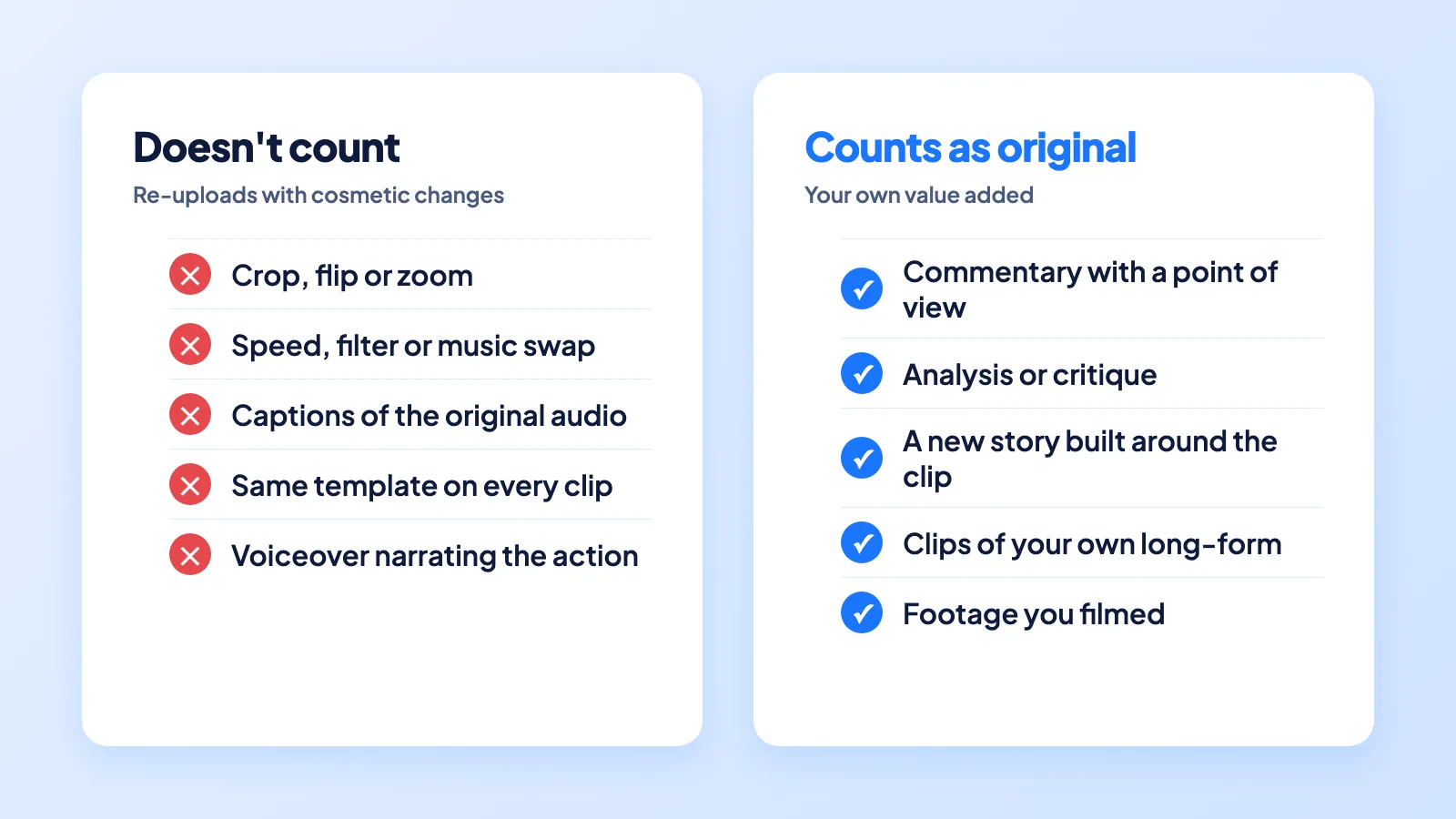
| Edit | Counts as original? | Why |
|---|---|---|
| Crop, flip, zoom or change the aspect ratio | ❌ | A technical change. Same content, different frame |
| Speed up, add a filter, swap the music | ❌ | YouTube's reused-content policy already rejects pitch- and speed-shifted songs |
| Captions that transcribe the original audio | ❌ | Adds readability, not perspective |
| The same template applied to hundreds of clips | ❌ | "Template-based bulk changes" is named directly |
| A voiceover narrating what's on screen | ❌ | Named by Creator Insider |
| Commentary, analysis or critique of the clip | ✅ | Your point of view is the content |
| A clip used as evidence inside a story you're telling | ✅ | New structure, new meaning |
| Footage you filmed yourself | ✅ | Original by definition |
The test is the same one we described when Instagram ran its own repost crackdown: would a viewer see your version as essentially the same video as the source? If yes, a different crop doesn't save it.
Can You Still Clip Your Own Long-Form Videos Into Shorts?
Yes. Here's who the update hits and who it doesn't.
Hit hardest: compilation channels, "best moments" pages, podcast-clip accounts posting other people's shows, movie-scene pages and anyone running a high-volume faceless operation on borrowed footage. We covered the monetization side of that model in our faceless YouTube channel guide. This update adds a reach penalty to the revenue one.
Not the target: creators cutting Shorts from their own long-form videos. The announcement is about content "re-uploaded from other creators," and clips of your own podcast, vlog or tutorial are yours. Repurposing your own long-form into Shorts is still the most efficient way to feed the Shorts shelf. If anything, it gets easier to stand out, because aggregators were competing for the same recommendation slots.
The grey zone: official clip programs, where a creator lets fans or agencies clip their show. Permission doesn't make a clip original. YouTube's reused-content policy says "promotion of other people's content (even if you have permission)" isn't enough. A clipper who adds nothing is still re-uploading, permission or not.
How to Recover Shorts Reach After the Update
YouTube says that if a channel was aggregating or re-uploading and shifts to original content, the recommendation system will re-evaluate its reach. There's no appeal form and no published timeline, so recovery comes from the uploads themselves:
- Stop new re-uploads first. Every borrowed clip you post keeps the channel looking like an aggregator.
- Audit what's already up. Sort Shorts by views since October 1, 2026 and note which formats fell. Private or delete the pure re-uploads that no longer earn views.
- Rebuild the format around your voice. Keep the topic your audience followed you for, but make commentary, analysis or your own footage the content.
- Give it a few weeks of consistent uploads before judging, because the system re-evaluates the channel as a whole, not one Short.
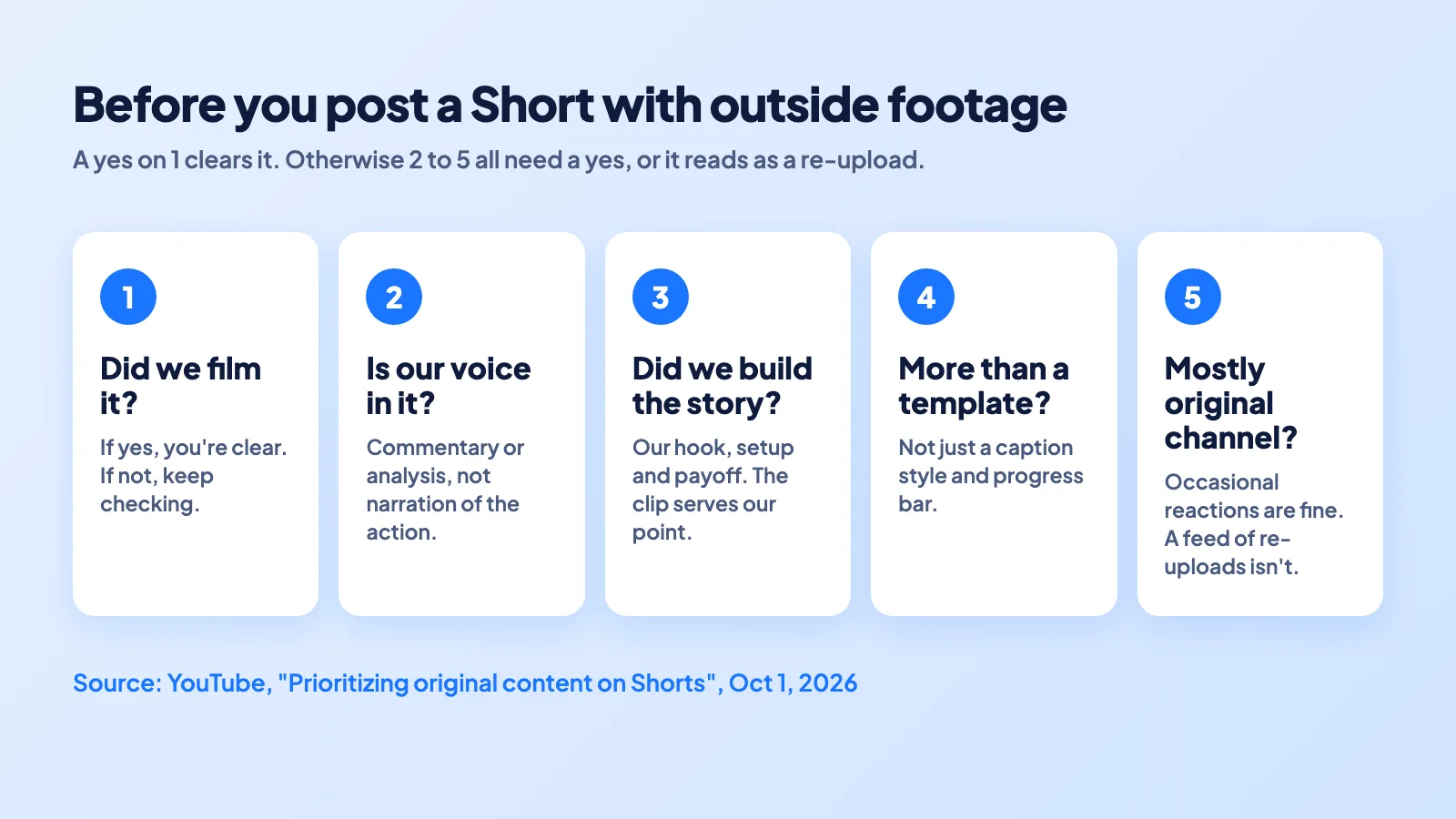
The Five-Point Check Before You Post a Short
Run every Short that uses footage you didn't film through this:
- Did we film this? If yes, you're clear. If not, keep going.
- Is there a voice in it that isn't the source's? Commentary, a reaction with real opinions, analysis. Narrating the action doesn't count.
- Does it tell a story the source didn't? A hook, a setup and a payoff that you built, with the clip serving your point.
- Would it survive without the template? If the only thing distinguishing it from the next 50 uploads is the caption style and the progress bar, it's a bulk change.
- Is this most of the channel? YouTube is judging channels "primarily" aggregating. An occasional reaction Short on an original channel isn't the same as a feed built from other people's work.
What Does the Update Mean for Your Editing Budget?
The cheap version of Shorts production was always "find a viral clip, reframe it, caption it." That workflow is now the one YouTube is down-ranking. What replaces it costs more thought per clip: picking the moment that carries your argument, building a hook around it, and cutting so your perspective is the point. As we argued in why quality editors matter in short-form, the edit decisions are where the value is, not the template.
At Mark Studios we've delivered 10,000+ projects for 4,500+ clients, with a 4.9★ average across 8,000+ orders and 100M+ views on work we've edited. Clipping a creator's own long-form (podcasts, streams, talking-head videos) is the format this update protects. If you run a show, our podcast video page covers how we turn one episode into a week of Shorts. If you're weighing a dedicated clipping service against an agency, our VidChops review and alternatives is a useful starting point. For the editing itself, see short-form video editing.
The Bottom Line
Since October 1, 2026, YouTube down-ranks Shorts that re-upload other creators' work with only cosmetic changes, and crops, speed changes, templates and narration don't count as making it yours. Clips of your own long-form, commentary that carries a real point of view, and footage you filmed are what the feed now favors. If your channel leans on borrowed clips, shift it toward original work now. YouTube says it will re-evaluate reach when you do.