

The Ads Next to Your Short Do Not Pay You
Almost every creator we onboard believes Shorts revenue works like long-form revenue: ads run against your video, and you get a cut of what those specific ads earned. That is not how it works, and the gap between the two models explains nearly every confused question we get about a Shorts payout.
YouTube's Shorts monetization policy describes the actual mechanism: all revenue from ads running between Shorts in the Shorts Feed is pooled monthly, music licensing costs are paid out of that pool, and what remains — the Creator Pool — is distributed to monetizing creators based on their share of total engaged views. YouTube states the allocation plainly: if a creator accounts for 5% of all eligible engaged Shorts views, they are allocated 5% of the Creator Pool. Creators then keep 45% of that allocation.
Read that twice, because the consequence is counter-intuitive: the advertisers who appeared next to your Short are irrelevant to your payment. You are paid a slice of a national pot, sized by your share of views in it.
The Creator Pool in Four Steps
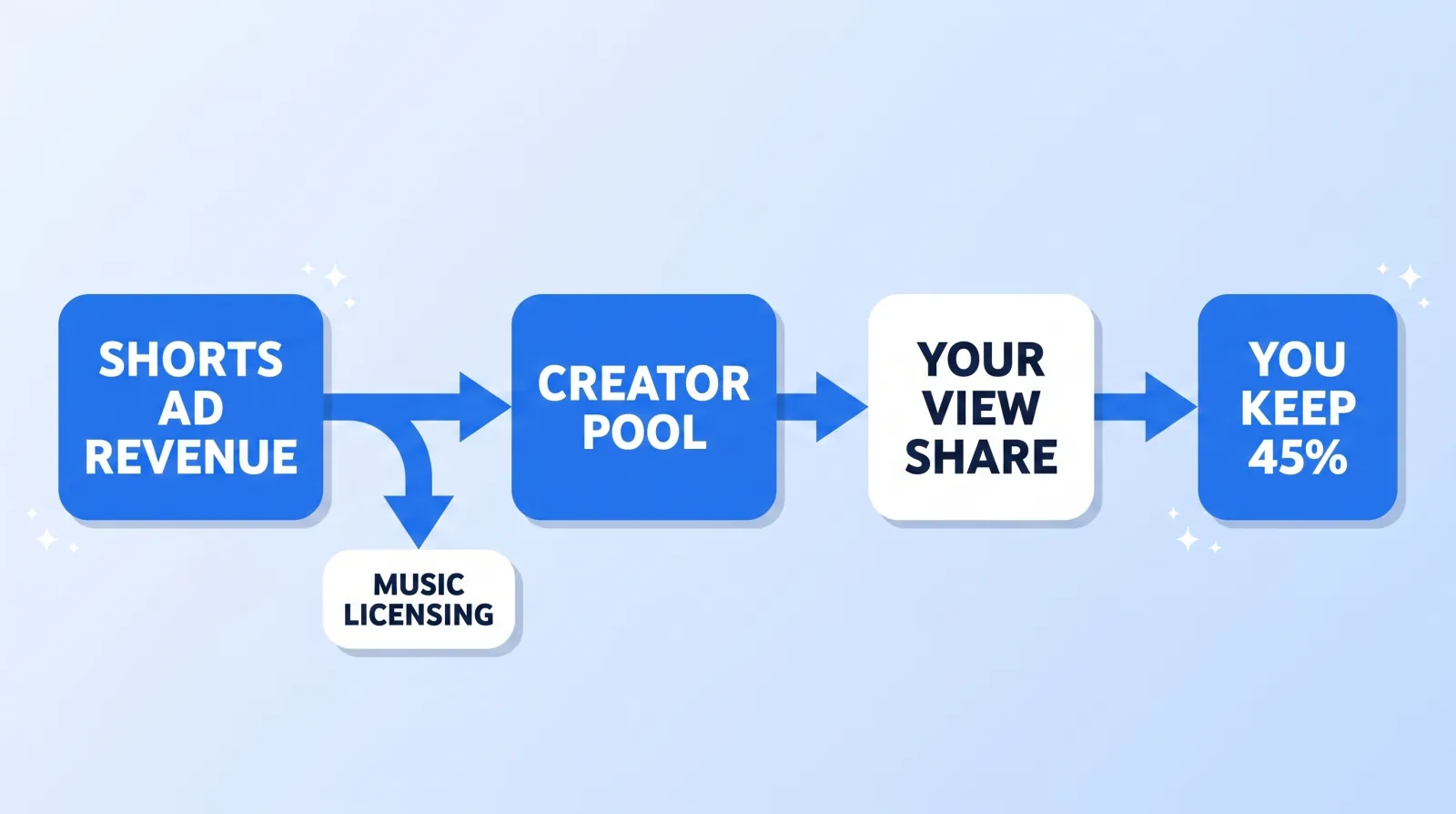
- Pool. Every dollar of Shorts Feed ad revenue in a country, for a month, goes into one bucket.
- Pay the labels. Music licensing costs come out first. A Short with one licensed track contributes only half its revenue to the Creator Pool; a Short with two tracks contributes a third.
- Allocate by view share. What's left is divided across monetizing creators in proportion to engaged views on their Shorts.
- Split 45/55. You keep 45% of your allocation. YouTube keeps the rest.
Note what is not in that list: your niche, your CPM, your audience's purchasing power, whether a finance advertiser or a mobile-game advertiser bid on your viewer. In long-form, those are the dominant variables. In Shorts they are averaged away into the pool before your slice is measured.
The Music Myth Worth Correcting
The most persistent piece of Shorts folklore is that using a trending track guts your payout. It is worth correcting precisely, because the truth is more useful.
Your Short's contribution to the pool does shrink when you add licensed music. But your allocation out of the pool does not. YouTube's documentation is explicit that each monetizing creator is allocated on 100% of the engaged views on their Shorts regardless of whether music was used, and that "using music in a Short won't affect a creator's allocation from the Creator Pool or their revenue share rate."
So the cost of licensed music is real, but it is socialised. Your track choice dilutes the pot everyone draws from; it does not single out your cheque. Practically, that means you should choose music on whether it earns the view, not on whether it costs you money — a different calculation from long-form, where a bad music decision can trigger a claim that redirects an entire video's revenue. We covered that side of it in our guide to YouTube music licensing and Content ID.
One more variable deserves attention: payouts run on engaged views, not the headline view counter. YouTube does not publish what qualifies as engaged, and the distinction got wider on August 24 when the platform changed what counts as a view. Expect your Shorts view number and your Shorts revenue to correlate loosely at best.
The RPM Gap Is Structural, Not a Glitch
Pooled, music-deducted, 45%-shared revenue produces an RPM an order of magnitude below long-form. vidIQ's 2026 breakdown puts most channels in the $0.03–$0.10 per 1,000 Shorts views band. Set that against the long-form RPM bands we published in our channel unit economics breakdown, and the shape of the problem is obvious.
| Format and niche | Typical RPM | Views needed for $100 |
|---|---|---|
| Long-form — entertainment, gaming, vlogs | $1–$4 | 25,000–100,000 |
| Long-form — lifestyle, education, how-to | $4–$9 | 11,000–25,000 |
| Long-form — finance, B2B, SaaS, legal | $12–$35 | 2,900–8,300 |
| Shorts — every niche | $0.03–$0.10 | 1,000,000–3,300,000 |
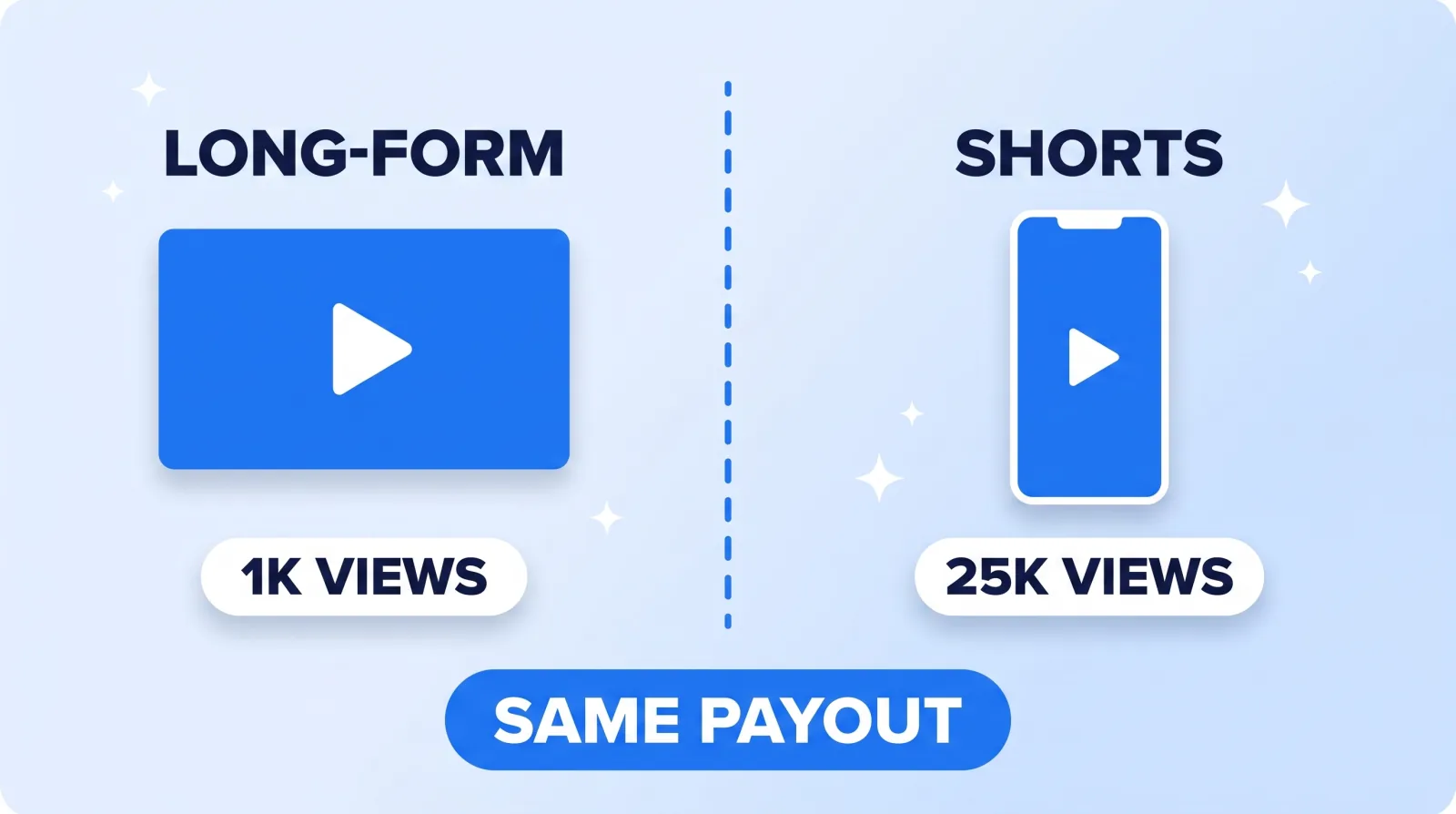
Take the friendliest possible comparison — the weakest long-form niche against the strongest Shorts RPM — and you still need about 25,000 Shorts views to match 1,000 long-form views. In an education or finance niche the ratio runs past 100×. Across the 10,000+ projects our short-form editing team has delivered, on channels that have generated 100M+ views, we have never seen a channel where Shorts ad revenue alone paid for the production of the Shorts.
That is not an argument against Shorts. It is an argument against treating Shorts AdSense as the reason to make them. Shorts are a discovery instrument — the cheapest reach on the platform — and the money arrives downstream, through subscribers who watch long-form, through brand deals priced on total audience, and through products. Our cross-platform short-form playbook and the system for turning one long video into ten Shorts are both built on that assumption.
What Changes on February 1, 2027
This is the part worth acting on now, because it has a date attached.
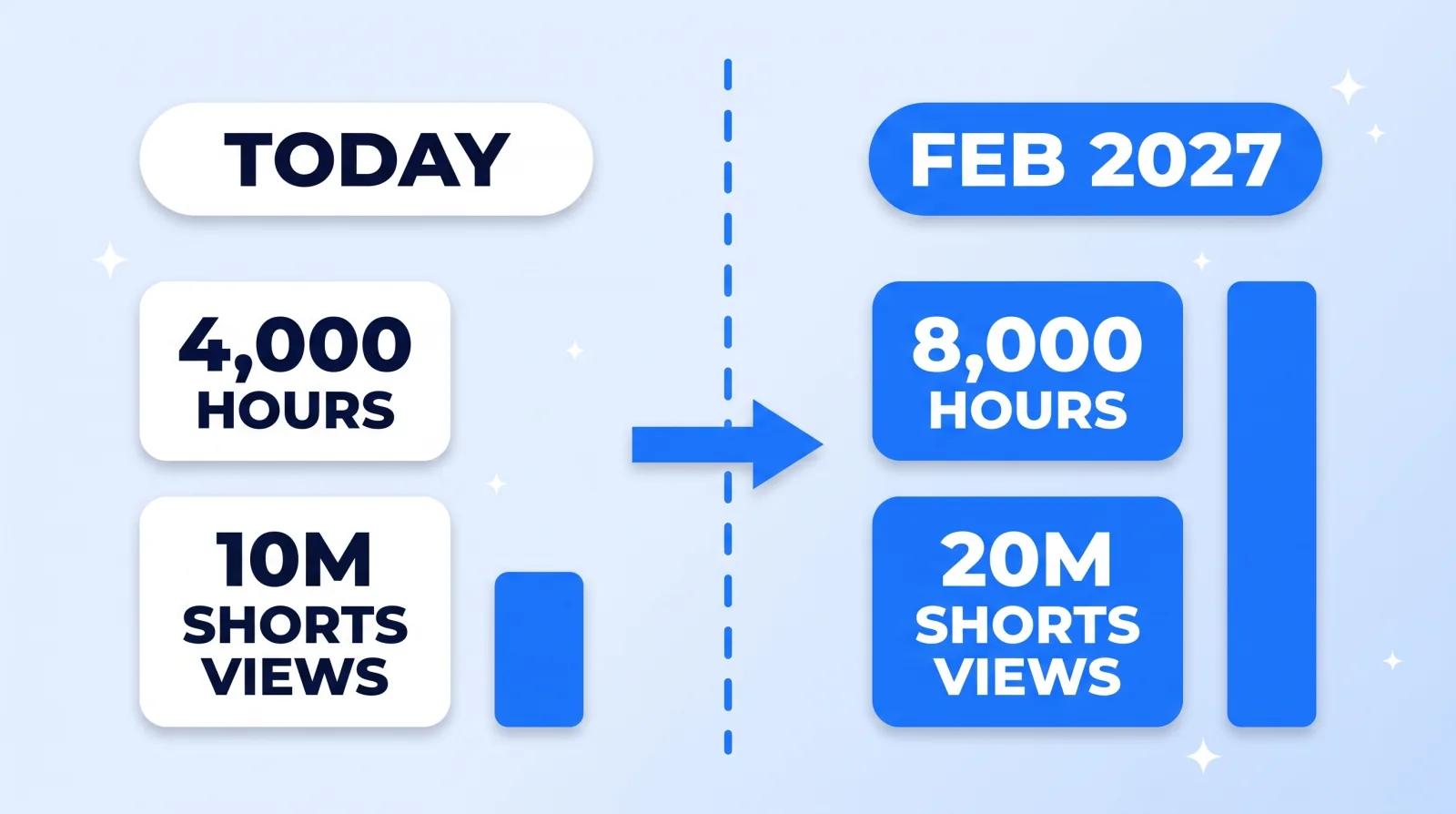
YouTube announced three changes taking effect that day:
| Change | Today | From Feb 1, 2027 |
|---|---|---|
| YPP entry — watch hours route | 4,000 hours / 365 days | 8,000 hours / 365 days |
| YPP entry — Shorts route | 10M Shorts views / 90 days | 20M Shorts views / 90 days |
| Shorts ad + subscription revenue share | Included with YPP | Requires 10M qualified Shorts views / 90 days |
Three things to be precise about:
- Existing partners are grandfathered. YouTube states the entry-threshold update "won't impact creators already in YPP." If you are monetizing today, the doubled entry bar is not your problem.
- The Shorts revenue gate is separate, and it is not grandfathered. From that date, access to ads and subscription revenue sharing on Shorts requires 10 million qualified Shorts views in the trailing 90 days. A channel in YPP that falls below keeps its membership and loses Shorts monetization until it recovers.
- Below the gate, the model changes shape. YouTube is routing smaller channels toward milestone-based earnings instead — YouTube Shopping bonuses, brand-deal incentives, and payments for starting and growing trends. That is a shift from passive ad revenue to programme participation, and it rewards a different kind of operator.
If you are still working toward the Partner Program thresholds, the practical read is that the window to enter on the current numbers closes at the end of January 2027, and the expanded YPP tiers remain the earlier on-ramp for fan funding.
The 90-Day Gate Before You Bet on Shorts
Run this before you commit a quarter of production capacity to short-form. If your Shorts plan relies on other creators' clips, read YouTube's Shorts original content update first: since October 1, 2026, re-uploads get less reach in the feed.
- ✅ Pull your actual Shorts RPM from YouTube Analytics — not a screenshot from a YouTube video, not an estimate. It is the only number that describes your channel.
- ✅ Divide Shorts revenue by Shorts production hours. If the result is below your hourly rate, Shorts are a marketing cost, and should be budgeted as one.
- ✅ Check your trailing-90-day qualified Shorts views against the 10 million gate. Know now whether February 2027 changes anything for you.
- ✅ Measure the subscriber-to-long-form conversion. Shorts that never send a viewer to a long-form video are the ones genuinely earning $0.05 per thousand.
- ✅ Price brand deals on total audience, not on AdSense. A Short's sponsorship value is nowhere near its ad value.
- ✅ Confirm you are inside the platform's published revenue-share model before assuming any third-party RPM claim applies to you.
Step 4 is the one that decides everything. A Shorts strategy that feeds long-form is a growth engine; a Shorts strategy that terminates in the Shorts Feed is unpaid labour with good reach.
The Bottom Line
Shorts pay from a shared national pot divided by view share, not from the ads beside your video — which is why the niche premium that makes long-form profitable does not exist in short-form, and why a 25× to 100× RPM gap is structural rather than fixable. Use Shorts to buy attention cheaply and convert it into long-form watch time, subscribers, and sponsorships.
Then put February 1, 2027 in your calendar. If you are not yet in the Partner Program, the entry bar doubles that day. If you are, the 10-million-view Shorts gate is a number you should already be tracking.


