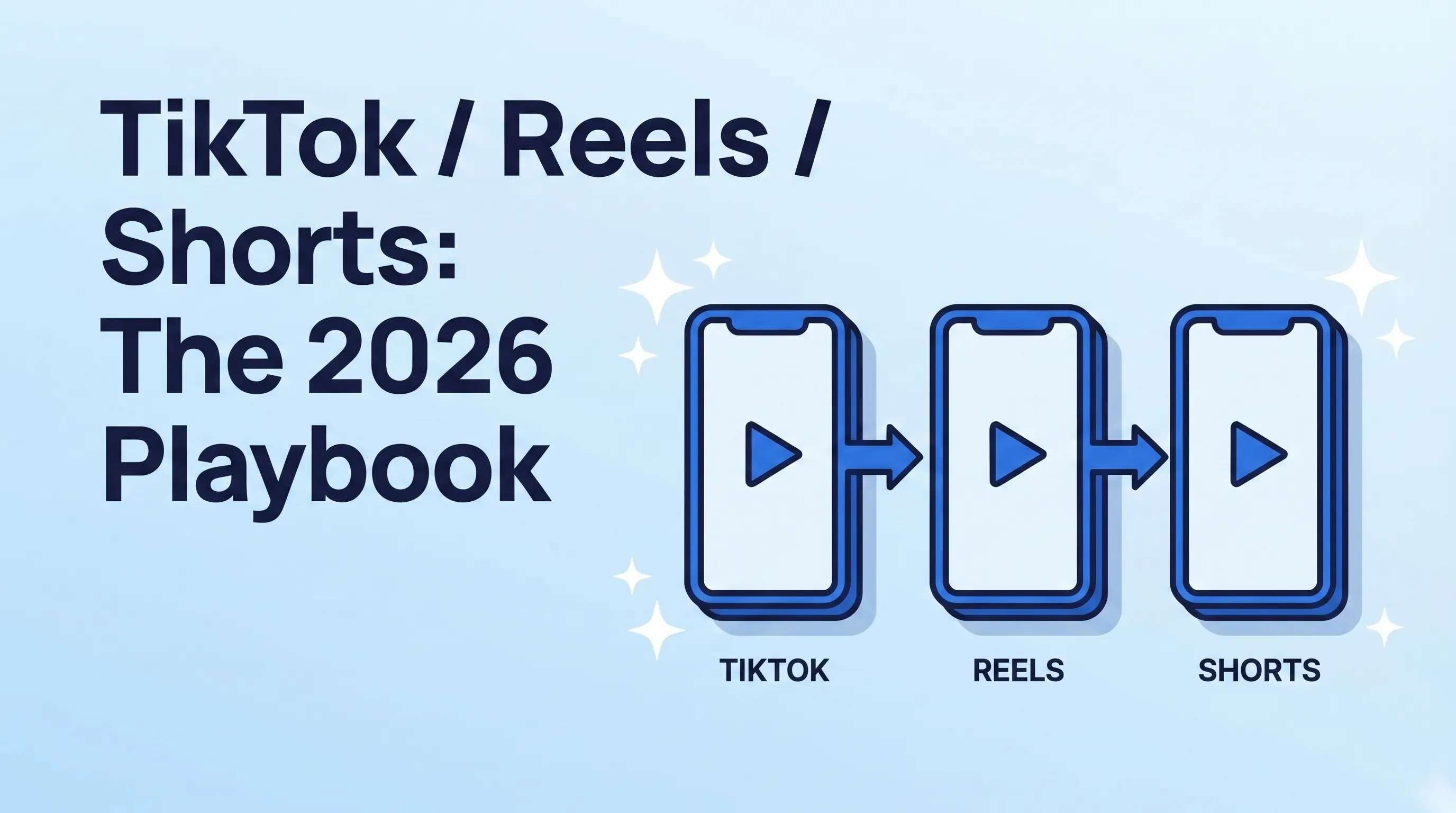
Short answer: yes, cross-post between TikTok, YouTube Shorts and Instagram Reels in 2026, but never the same file. Export one clean master with no watermark, then change three things per platform: the hook, where the captions sit, and the on-screen style. Upload natively in each app. Instagram says it makes "watermarked reels" and "reels that have already been posted on Instagram" less visible (Instagram ranking explained), so a TikTok download with the logo on it starts at a disadvantage.
Three Platforms, Three Different Cultures
The instinct most creators have is to film one vertical video and cross-post it everywhere. The instinct is wrong.
YouTube Shorts (averaging 200 billion daily views), TikTok (ads that reach about 1.59 billion adults, per ByteDance figures compiled by DataReportal), and Instagram Reels each have a different audience, different algorithm, and different aesthetic. A video that hits 1M views on TikTok will often flop on Shorts — not because the content is bad, but because the cultural fit is off.
At Mark Studios we produce short-form video for creators and brands on all three platforms, and our roundup of short-form video editing services compares providers' published prices. For local businesses the platforms are discovery channels too: in DoorDash's 2025 survey, 18% of U.S. consumers named TikTok and 16% named YouTube as places they find new restaurants (food video marketing statistics). Here's what works on each one in 2026.
TikTok: Native, Raw, Trend-Driven
What wins: sound-driven trends, low-production raw aesthetic, "POV" and "reaction" formats, fast cuts, big text overlays.
Algorithm signals:
- Watch-completion rate is the strongest signal. TikTok's own explanation of the For You feed says a strong indicator such as "whether a user finishes watching a longer video from beginning to end" gets "greater weight than a weak indicator".
- Re-watches and shares tell the algorithm more than a like does.
- Comment depth — long reply chains in the first 24 hours signal the video is conversation-worthy.
Editing rules:
- Use a trending audio within 7 days of it peaking. Rising sounds help discovery on TikTok.
- Hook in 1–2 seconds, not 3. TikTok viewers swipe faster than YouTube viewers.
- Captions burned in to the video, not native CC. TikTok's native captions are inconsistently displayed.
- Vertical 9:16, 1080×1920, 30fps. Higher framerates get re-encoded weirdly.
Instagram Reels: Polished, Aesthetic, Aspirational
What wins: clean aesthetics, "lifestyle" framing, aspirational visuals, music-driven cuts, polished motion graphics, B-roll-heavy.
Algorithm signals:
- Sends (DM forwards) are the strongest single signal in Reels. Adam Mosseri has stated this publicly repeatedly. A reel with 500 saves and 50 sends is weaker than one with 50 saves and 200 sends.
- Profile visits driven by the reel — Instagram pushes reels that drive profile traffic because that's what monetizes for them.
- Time-on-content including loops.
Editing rules:
- Higher production value than TikTok. Reels viewers expect polish. Color-grade. Use stabilization. Premium sound.
- Music selection matters more than trend-jacking. Reels rewards music that fits the brand aesthetic, not just whatever's trending.
- Hook with motion, not faces. Reels viewers respond to dynamic B-roll opens better than talking-head opens.
- 3–5 second loops at the end (last frame matches first frame) add watch time because the reel auto-loops.
If you'd rather hand the Reels cut off, our Instagram Reels editing service delivers 9:16 at 1080×1920 with captions kept inside Instagram's safe zones.
YouTube Shorts: Long-Tail, Topic-Driven, Cross-Format
What wins: topic-led content, educational/informational, hooks that promise specific value, less trend-driven, more evergreen.
Algorithm signals:
- Subscriber conversion is heavily weighted in Shorts because YouTube wants Shorts to feed long-form viewership. A short that drives subscribes gets pushed harder.
- Watch-time on subsequent videos — if your Short leads viewers to your long-form, the algorithm rewards future Shorts.
- Likes-per-impression carries more weight on Shorts than the other platforms.
Editing rules:
- Title in the description matters more than on TikTok/Reels. Shorts surfaces in YouTube search; titles drive long-tail traffic.
- Promote your long-form in the first comment or the description. Shorts is a top-of-funnel for your channel.
- Don't over-edit. Shorts viewers respond to clarity over flash. The most-watched Shorts are often single-shot videos with clear narration.
- Use YouTube's native Shorts remix feature to create from your own long-form catalog.
TikTok vs YouTube Shorts vs Reels: What to Change When You Cross-Post
One master edit, three versions. This is what changes between them:
| TikTok | Instagram Reels | YouTube Shorts | |
|---|---|---|---|
| Signal to optimize | Watch-through and re-watches | Sends (DM shares) | Subscribers and long-form viewing |
| Hook style | Raw and fast, in the first 1–2 seconds | Visual and polished, motion first | A specific promise of value |
| Captions | Burned in, clear of the on-screen buttons | Burned in, higher in the frame (the UI covers the bottom) | Burned in; the title also feeds YouTube search |
| Before you post | Pick a rising sound if it fits the video | No other app's watermark; nothing already posted on Instagram | Link the related long-form video; write a searchable title |
| Edit order | The master cut | Re-cut: slower pacing, graded, music-fit | Re-cut: long-form CTA, captions reframed |
The Cross-Posting Rules
Short answer: don't cross-post identical videos. Long answer:
- TikTok-native first, repurpose elsewhere. A video downloaded from TikTok carries the TikTok watermark, and Instagram says it makes watermarked reels less visible.
- Post from the master, not a download. Export a clean file from your editing app for each platform instead of re-downloading from another app.
- Reframe per platform. TikTok captions sit lower; Reels captions sit higher (Instagram UI covers the bottom). Re-position text per platform.
- Different hooks per platform. TikTok's hook can be raw and casual; Reels's needs to be visually polished; Shorts's needs to promise specific informational value.
The 80/20 Rule for Multi-Platform Creators
If you have to pick — pick one platform and dominate it before going multi-platform. The math:
- A creator with 100K followers on one platform beats a creator with 30K on three platforms — every time. Brand deals, monetization, and audience compounding all reward concentration.
- Multi-platform makes sense after 100K on your primary platform. Below that, you're spreading thin and losing the algorithmic compounding.
The usual pattern is to win one primary platform first.
Production Workflow That Actually Scales
Here's the workflow our team runs for clients producing short-form at volume across all three platforms:
- Film vertical native. One filming session, raw 9:16 footage.
- Edit a master TikTok cut first — full trend-aware, native style.
- Re-cut for Reels — slower pacing, polish color grade, swap audio for music-fit.
- Re-cut for Shorts — strip overt TikTok markers, add long-form CTA, reframe captions.
- Schedule with native upload on each platform, not a cross-poster (cross-posters add metadata that signals "automated").
- Track per-platform metrics weekly — watch-completion (TikTok), sends (Reels), subscribers (Shorts).
It is more editing work than posting one file everywhere, but each platform gets a video built for the way it ranks content.
The Bottom Line
Short-form in 2026 isn't one channel — it's three channels with different rules. Treating them the same is the #1 reason creators feel like "short-form doesn't work for me."
If you want our team to handle short-form production at scale, our monthly plans are scoped to your weekly volume across all three platforms.