The Math That Changes Everything
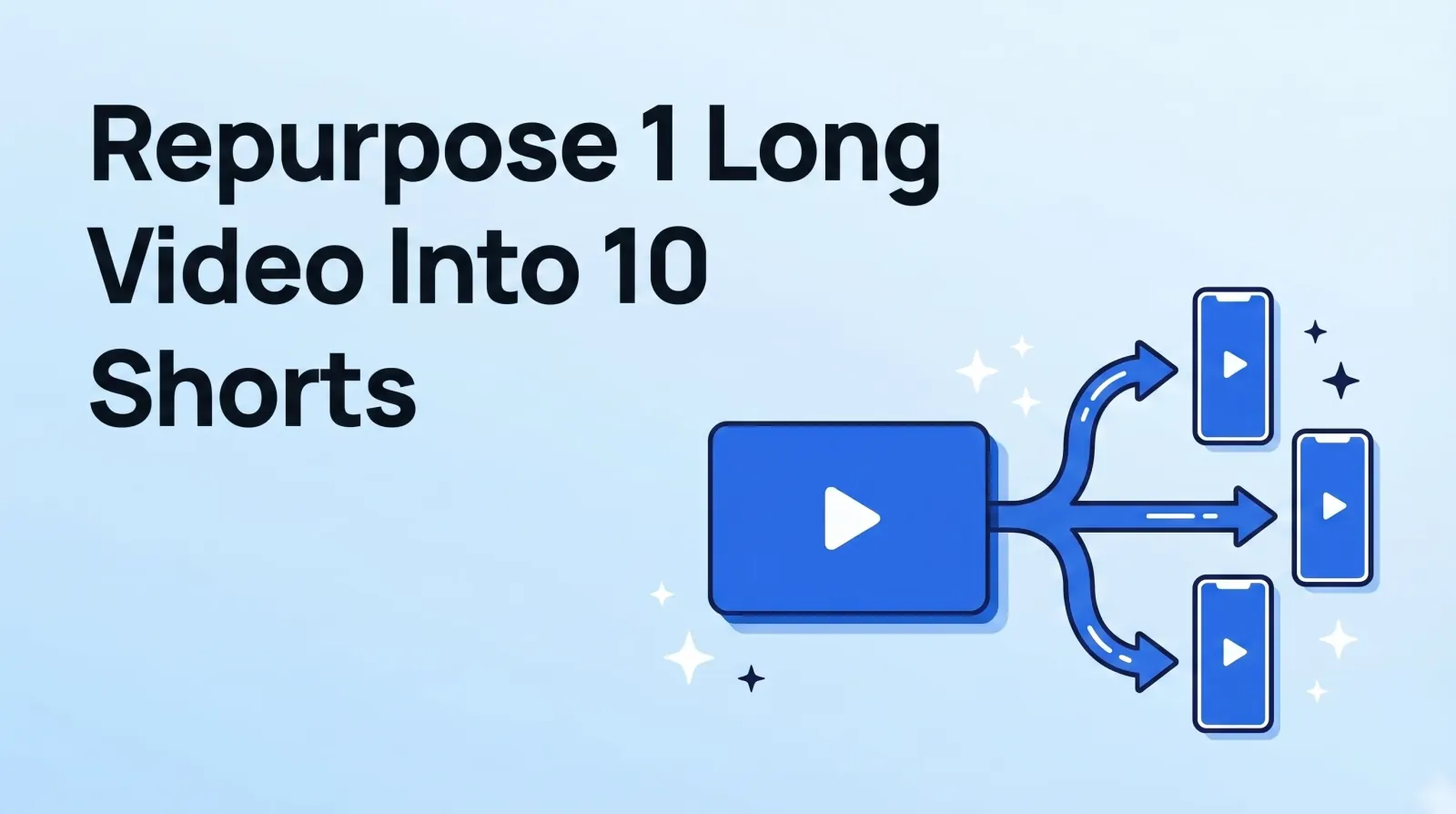
The single biggest leverage point we've found across our client roster: one well-edited 20-minute long-form video, repurposed correctly, becomes 8–12 short-form videos plus 3–5 graphics plus 1 newsletter and 1 blog post.
That's roughly 13–19 pieces of content from one filming session. For a creator publishing weekly long-form, that's ~70 short-form videos a month — without filming a single extra second.
The audience for that output is not in doubt. Meta says Reels made up 50% of the time spent on Instagram in April 2024, and YouTube reports more than 200 billion daily Shorts views, although it counts a view every time a Short starts to play. What each platform's number does and doesn't measure is in our short-form video statistics.
We've built the repurposing pipeline — from long-form YouTube editing on the source video to short-form cutdowns and Instagram Reels edits on the output — for creator channels. This is the system.
Why Most "Repurposing" Fails
Most creators "repurpose" by taking the long-form video, cropping it to vertical, and posting random 30-second clips. Results: low views, no growth, "short-form doesn't work for me."
The problem isn't short-form — it's that those clips were never designed as short-form. A great long-form moment isn't automatically a great short-form moment. They need different hooks, different pacing, different framing.
The correct mental model: the long-form is the raw material; the shorts are new productions. Treat them as new productions and the math works.
The 10-Cut Framework
For every long-form video, we extract 10 short-form clips that fall into specific structural categories:
Cut 1 — The Hook (the strongest 30 seconds)
Find the single most compelling moment in the long-form. Usually this is a counter-intuitive claim, a stat, a "wait, what?" beat, or the emotional climax. Extract 30–45 seconds around it. This is the short most likely to go viral.
Cuts 2–4 — The Three Best Lessons
Pull three distinct teachable moments. Each should answer one question completely. Format: question hook ("Why do most YouTubers fail before 1K subs?") → answer (the long-form clip) → CTA ("Full breakdown in the long-form, link in bio").
Cuts 5–6 — Stat / Quote Highlights
Two short clips (15–25 seconds each) where the creator drops a memorable stat or one-liner. These work as "screenshot bait" — viewers screenshot and share.
Cuts 7–8 — Behind-the-Scenes / Personality
Two clips that show the creator's personality outside the topic. Bloopers, side comments, unexpected reactions. Builds parasocial connection, which is a big part of why viewers subscribe.
Cuts 9–10 — Niche-Specific Educational
Two clips for the specific corners of your niche where the long-form briefly touches a topic that has its own audience. Example: in a long video about "YouTube growth," there might be 90 seconds about thumbnail design — that 90 seconds becomes its own short for the thumbnail-design audience.
The Editing Rules for Repurposing
Critical: each short is a new edit, not a crop:
- Re-hook every clip. The long-form had its own hook. Each short needs its own — usually a question or counter-intuitive statement in the first 1–2 seconds. The original moment from the long-form usually starts at second 3–5 of the short.
- Captions burned in. Even if the platform offers native CC, burned-in captions are visible on every device, on muted autoplay, and read better.
- Reframe to vertical with intent. Don't auto-reframe the whole long-form clip. Crop tight on the speaker's face for talking heads, crop wide for B-roll moments. Adobe's Auto Reframe is a starting point, not a finishing point.
- Add platform-specific text overlays. TikTok-style bouncy captions on TikTok cuts. Cleaner motion-graphic captions on Reels cuts. Smaller, tighter captions on Shorts cuts.
- Different music per platform. Reels cuts with a trending audio. TikTok cuts with a trending audio (different from Reels). Shorts cuts with original audio or licensed music — Shorts doesn't reward trending audio the same way.
The Distribution Schedule
A long-form goes live Monday. The 10 shorts get distributed over the next 2–3 weeks:
| Day | Cut | Platform priority |
|---|---|---|
| Mon | Long-form | YouTube |
| Tue | Cut 1 (Hook) | TikTok native, then Reels, then Shorts |
| Wed | Cut 2 (Lesson 1) | TikTok |
| Thu | Cut 3 (Lesson 2) | Reels |
| Fri | Cut 4 (Lesson 3) | Shorts |
| Sat | Cut 5 (Stat) | TikTok |
| Sun | rest | — |
| Mon (wk 2) | Cut 6 (Quote) | Reels |
| Tue (wk 2) | Cut 7 (BTS) | TikTok |
| Wed (wk 2) | Cut 8 (BTS) | Shorts |
| Thu (wk 2) | Cut 9 (Niche) | TikTok |
| Fri (wk 2) | Cut 10 (Niche) | Reels |
That's two weeks of consistent posting on three platforms from one filming session. Compounding effect: by week three, the original long-form is still earning revenue from the suggested feed while the shorts are driving new subscribers to it.
The Pipeline Workflow
Here's how our team handles a typical client's weekly long-form:
- Long-form delivered Monday morning.
- Repurposing brief drafted Monday afternoon — junior editor identifies the 10 candidate moments.
- Senior editor approves the 10 cuts Monday evening, drops moments that won't work as standalone.
- Editing pass Tuesday — 10 separate short-form edits, each from scratch using the long-form clips as raw material.
- Captions + music + final polish Wednesday.
- Platform-specific reformatting Thursday morning — TikTok, Reels, Shorts versions of each cut.
- Scheduling Thursday afternoon — uploads queued in Buffer or Hootsuite for the next 2 weeks.
- Performance review end of week 2 — pull metrics, identify what worked, feed insights back into the next long-form's brief.
The whole pipeline is a real block of editing hours per long-form video, and it's the part most creators hand off first.
Common Mistakes to Avoid
- Cropping with the watermark visible. Always strip TikTok/Reels watermarks before cross-posting — every platform downranks watermarked content from the others.
- Posting all 10 cuts in 2 days. Spaces out poorly with the algorithm. Better to spread over 2–3 weeks for consistent presence.
- Same caption template on every cut. Algorithms detect "templates" and downrank batch-posted content. Vary captions, hooks, and openings.
- Skipping the new hook. The single biggest failure mode is using the original long-form opening as the short. The long-form intro doesn't hook in 1 second.
- Driving traffic away too aggressively. Overusing "link in bio for more" makes algorithms see the short as an ad. Mention the long-form in 30–40% of cuts, leave the rest standalone.
The Bottom Line
Repurposing isn't a side activity — for most creators in 2026, it's the primary growth engine. The math: many more posts on more surfaces, from one filming session.
If you want our team to run the full repurposing pipeline for your channel, it's the service buyers ask us for most: 34% of 698 first messages in our inbox asked for Shorts, Reels or TikTok edits. We quote it by volume, on how many long-form videos come in and how many clips go out. For podcasts, start with how many clips to cut from each episode.