YouTube's Monetization Policy Never Mentions Your Face
On July 15, 2025, YouTube quietly renamed one of its monetization rules. The channel monetization policies page records the change: the "repetitious content" policy became the inauthentic content policy, updated "to better clarify this includes content that is repetitive or mass-produced." The requirement it spells out is that your content "be your original creation" and "not be mass-produced, generic, repetitive, or manipulative."
Read the whole policy and you will not find the word face, camera, or presenter anywhere in it. YouTube's monetization eligibility page says the same thing from the other direction — content must be "original and non-repetitious." A channel with no on-camera host has never been against the rules. A channel where every video could have been made by any of four hundred other channels has always been.
That distinction is the entire subject of this post, and most people running faceless channels have it backwards. They assume the risk is the missing face and spend their effort hiding it. The actual risk is interchangeability. Since October 1, 2026 it costs reach as well as revenue: YouTube's Shorts original content update down-ranks re-uploaded clips in the Shorts feed.
Across 10,000+ projects at Mark Studios — work that has driven 100M+ views — we edit for faceless channels every single week. Finance explainers, history documentaries, product breakdowns, meditation channels. Some of them are the healthiest businesses on our roster. The ones that fail almost never fail because a viewer wanted to see somebody's face. What we build for them — your script and voiceover, cut against licensed stock, archival clips and motion graphics — is on our faceless YouTube editing page.
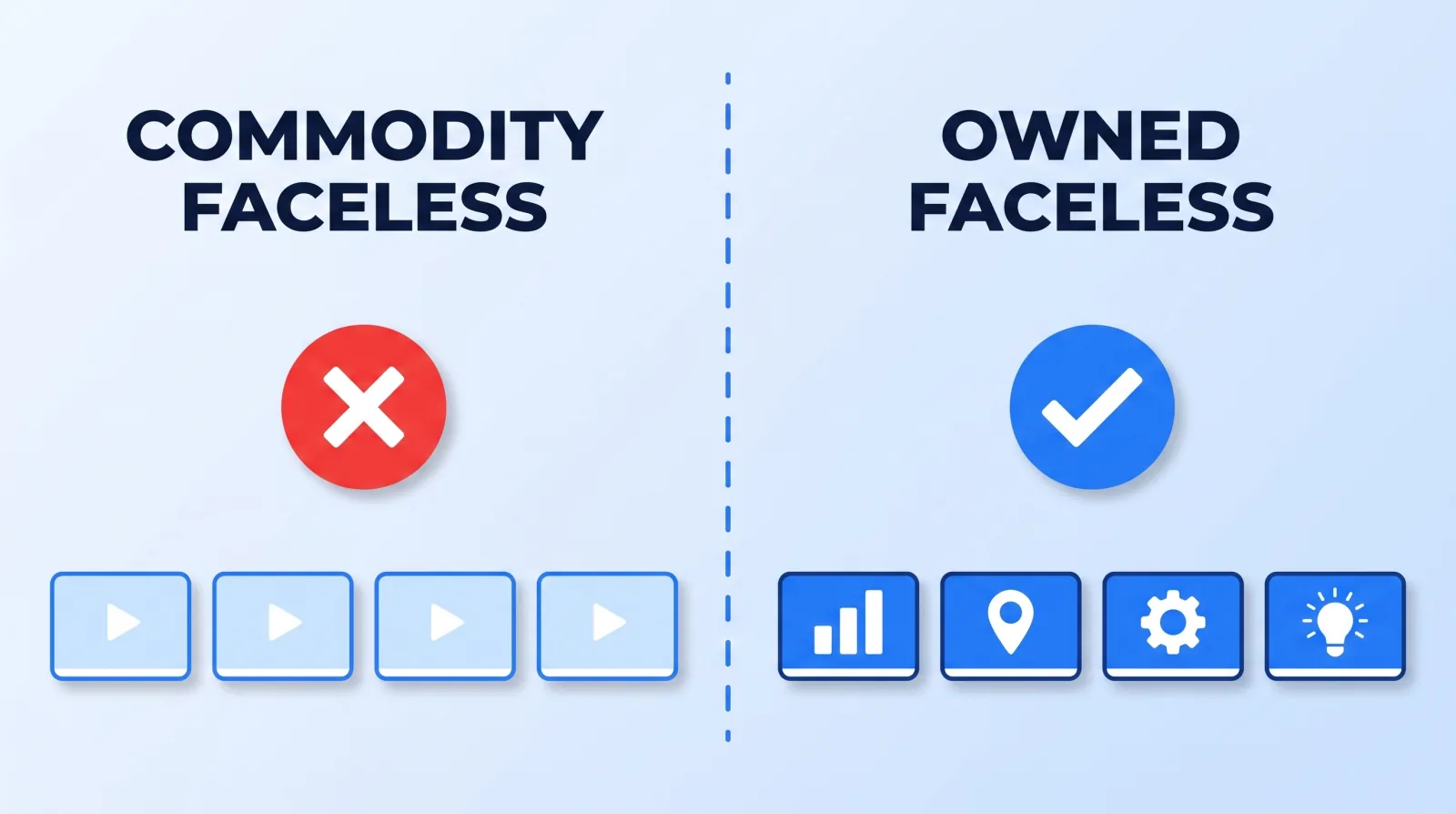
The Two Kinds of Faceless Channel
Every faceless channel we have worked on falls into one of two categories, and you can usually tell which within thirty seconds of watching.
| Commodity faceless | Owned faceless | |
|---|---|---|
| Script source | Rewritten from the top three search results | Original research, primary sources, or first-hand operating experience |
| Voice | Default synthetic voice, changed whenever a new tool ships | One voice, human or synthetic, held constant for years |
| Visuals | Generic stock, whatever matches the noun being spoken | A repeatable visual system — recurring motifs, custom charts, a fixed type treatment |
| Edit | Template applied uniformly to every upload | Pacing tuned to the specific script |
| At scale | Output rises, watch time per video falls | Output rises, each video makes the next one easier to place |
| Moat | None. Reproducible in a weekend. | The archive itself, plus a recognisable house style |
The commodity column is what the inauthentic content policy was rewritten to describe. Note that nothing in it requires AI — you could produce a commodity faceless channel entirely by hand, and people did for years before generative tools existed.
The owned column costs more per video. It is also the only version that survives its own success, because the moment a commodity channel finds a working format, thirty channels clone it inside a month and the format stops working for everybody.
The Five Layers, and Which Ones You Can Cheapen
A faceless video is built in five layers. They are not equally important, and the mistake almost everyone makes is spending on the top of the stack while the bottom is hollow.
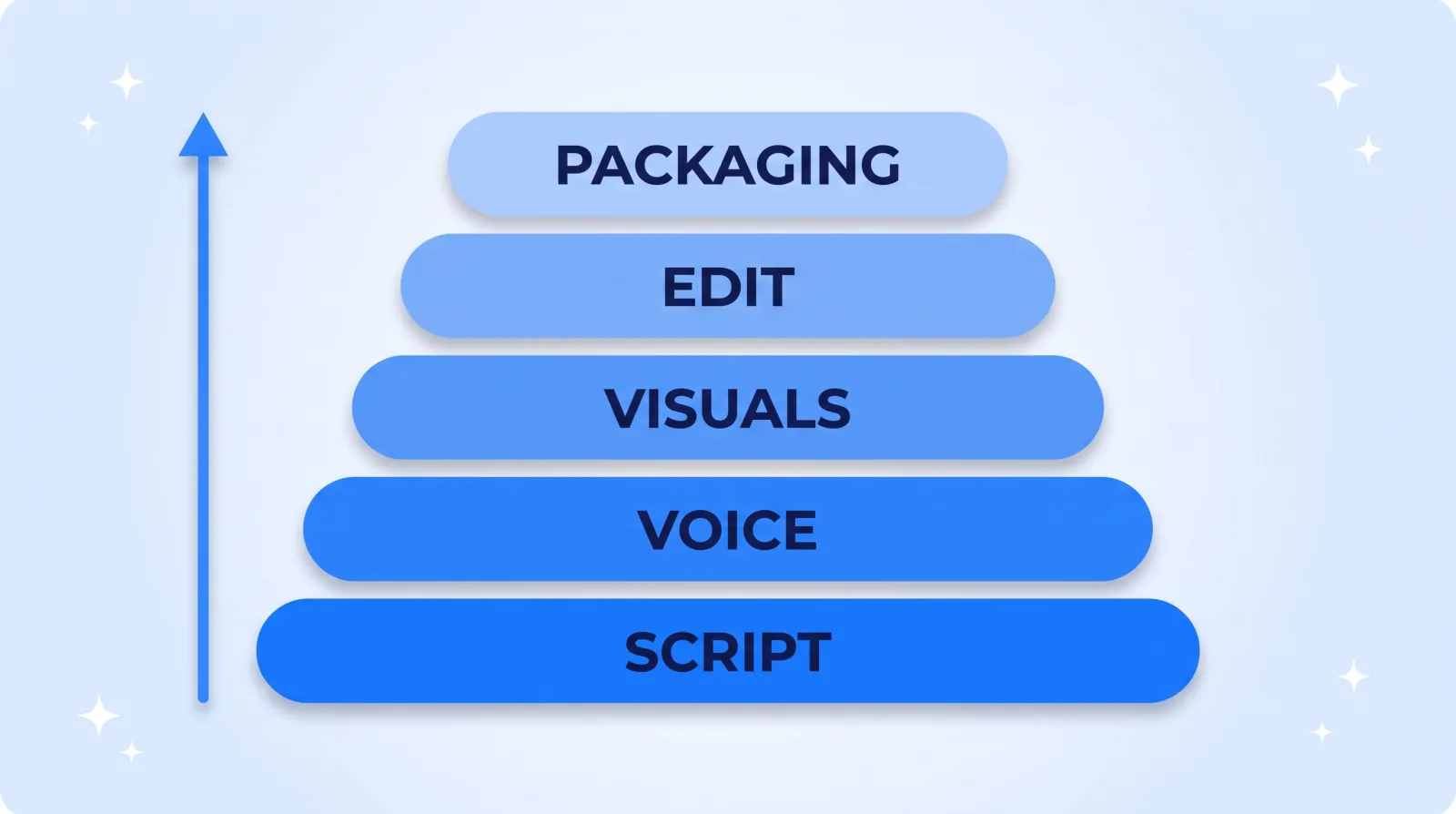
- Script — carries the whole video. On a talking-head channel, a mediocre paragraph is rescued by a presenter's delivery. On a faceless channel there is nothing to rescue it. This layer cannot be cheapened, and it is where we tell clients to put the majority of their budget.
- Voice — a fixed identity, discussed below. Cheapen this and you cheapen the only consistent human signal the channel has.
- Visuals — the layer everyone over-buys. More stock clips is not the fix; a repeatable system is. This is the same problem as building a channel visual identity system, just with a harder constraint.
- Edit — safely templated, up to a point. Pacing still has to follow the script's argument, and editing rhythm is where a faceless video either holds or leaks.
- Packaging — title, thumbnail, playlist placement. Fully systematisable, and the highest-ROI layer once the four beneath it are solid.
Cheapen from the top down, never from the bottom up.
Voice: The Decision That Costs the Most to Undo
Synthetic narration is now good enough that most viewers do not clock it, and tools like ElevenLabs and Descript have made a consistent read achievable for anyone. The question is not whether it sounds good. It is whether you can commit.
Two rules we apply to every faceless channel we run.
Pick one voice and never change it. The voice is the channel's only persistent human signal. Swapping it because a new model shipped resets whatever recognition you had accumulated. We have watched channels lose returning-viewer numbers over a voice change and blame the algorithm.
Understand what actually requires disclosure. YouTube's GenAI disclosure policy requires creators to disclose AI content "when it appears realistic" — a synthetic scene that could be mistaken for something that really happened. The policy also states plainly that "creators don't need to disclose non-realistic content that's made with AI, or edits to realistic content that are minor," and, importantly, that "disclosing AI content won't limit a video's audience or impact its eligibility to earn money."
In practice: a synthetic narrator reading your own script over stock footage is not the case the rule targets. A generated clip of a real public figure saying something they never said is. If you are also publishing in other languages, the same logic governs AI dubbing workflows — the disclosure question follows the realism of the output, not the tool used to make it.
The Anatomy That Retains Without a Presenter
A face buys you a few seconds of goodwill. Without one, the structure has to do that work, and it has to start earlier.
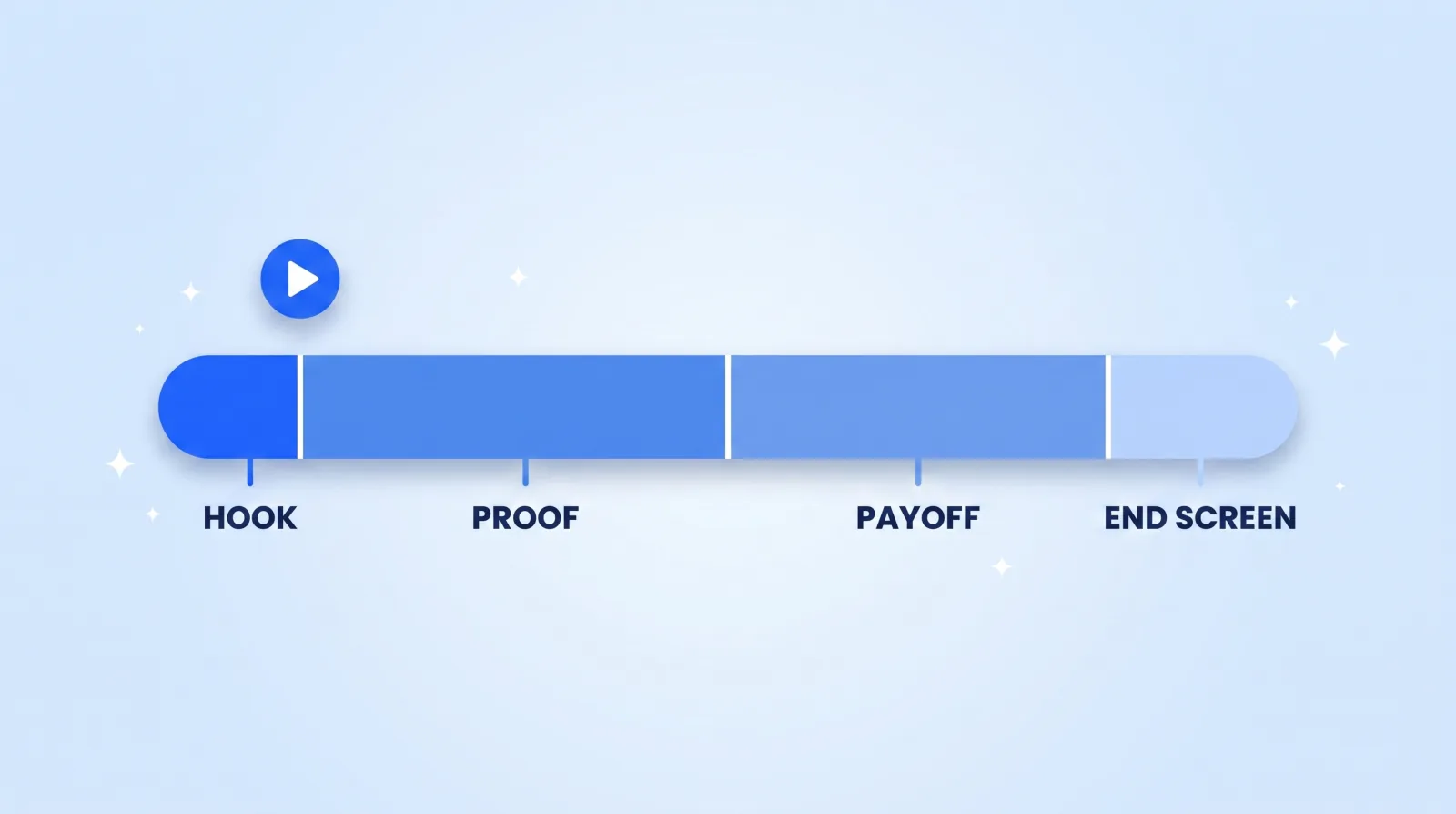
- Hook — lead with the single most specific fact in the video, not a promise about what the video will cover. Every principle in scripting hooks that retain viewers applies harder here.
- Proof — the longest stretch, and the one that separates the two columns above. Named sources, real numbers, footage you actually shot or data you actually pulled.
- Payoff — resolve the hook explicitly. Faceless scripts drift toward listing rather than concluding.
- End screen — scripted, not bolted on, and handing the viewer to a specific next video. Faceless channels are unusually good at building session time because their catalogues are topically tight.
The Pre-Publish Gate
Run this before every faceless upload. It takes four minutes and it is the difference between the two columns.
- ✅ Name the source. At least one fact in this video came from somewhere the top three search results did not have.
- ✅ Voice is unchanged from the last upload, and will be unchanged on the next one.
- ✅ No stock clip repeats from the previous two videos.
- ✅ At least one custom visual — a chart, a map, an annotated frame — that no other channel could have made.
- ✅ Music is licensed for the channel, not the video, via a service like Epidemic Sound.
- ✅ The realism test is answered. If anything on screen could be mistaken for a real event that did not occur, the AI disclosure is set.
- ✅ The thumbnail and title would still make sense if a competitor published the identical script — and if the answer is yes, the video is not differentiated enough.
Item 1 is the one that gets skipped, and it is the only one the inauthentic content policy is actually measuring. Item 7 is the one that stings.
The Bottom Line
Faceless is a format, not a shortcut. YouTube's rules have never cared whether a human appears on screen — they care whether the thing you published could have been produced by anyone, and the July 2025 policy rename made that explicit rather than new. The channels we see compound are the ones that spend on the script and hold the voice steady, then template everything above it.
If you are choosing between publishing four generic videos a week and one you could defend the sourcing on, publish the one.