You Cannot Diagnose a Short After It Fails
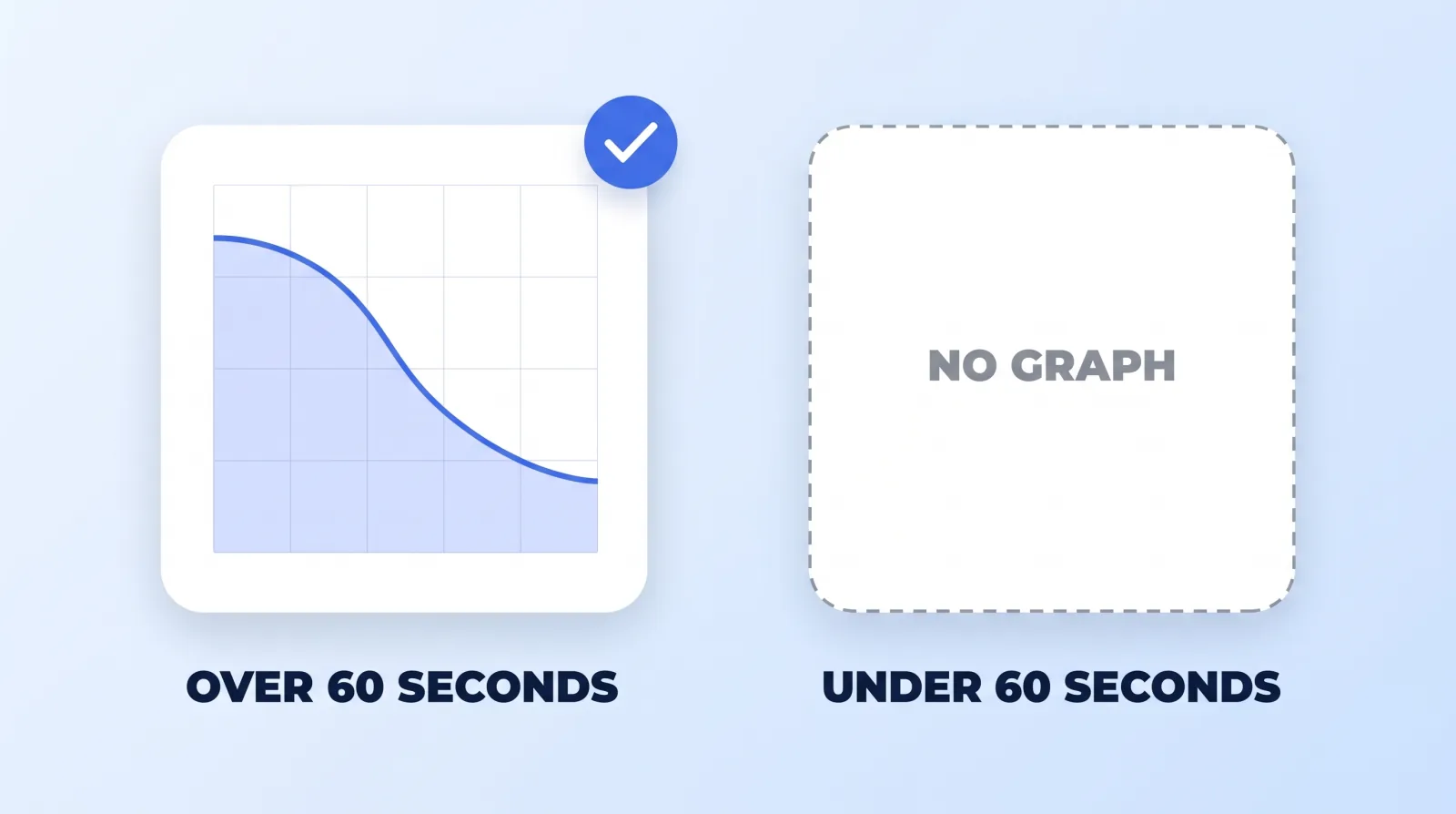
Here is the constraint almost nobody prices in. YouTube's audience retention documentation states that for the retention graph to appear at all, "your video should also be at least 60 seconds long and have at least 100 views." A forty-five second Short never clears the first condition. The curve that tells you where viewers left — the single most useful diagnostic in long-form editing — does not exist for most of your short-form catalogue.
On a twelve-minute video that does not matter much, because you get the graph, find the drop at 4:10, and fix it next time. On a Short you get a view count and nothing underneath it. You cannot iterate your way to a good Short, which means the editing decisions have to be right on the way out. That is the entire argument for craft in short-form, and it is a structural argument, not a taste one.
Decisions Per Second, Not Minutes of Runtime
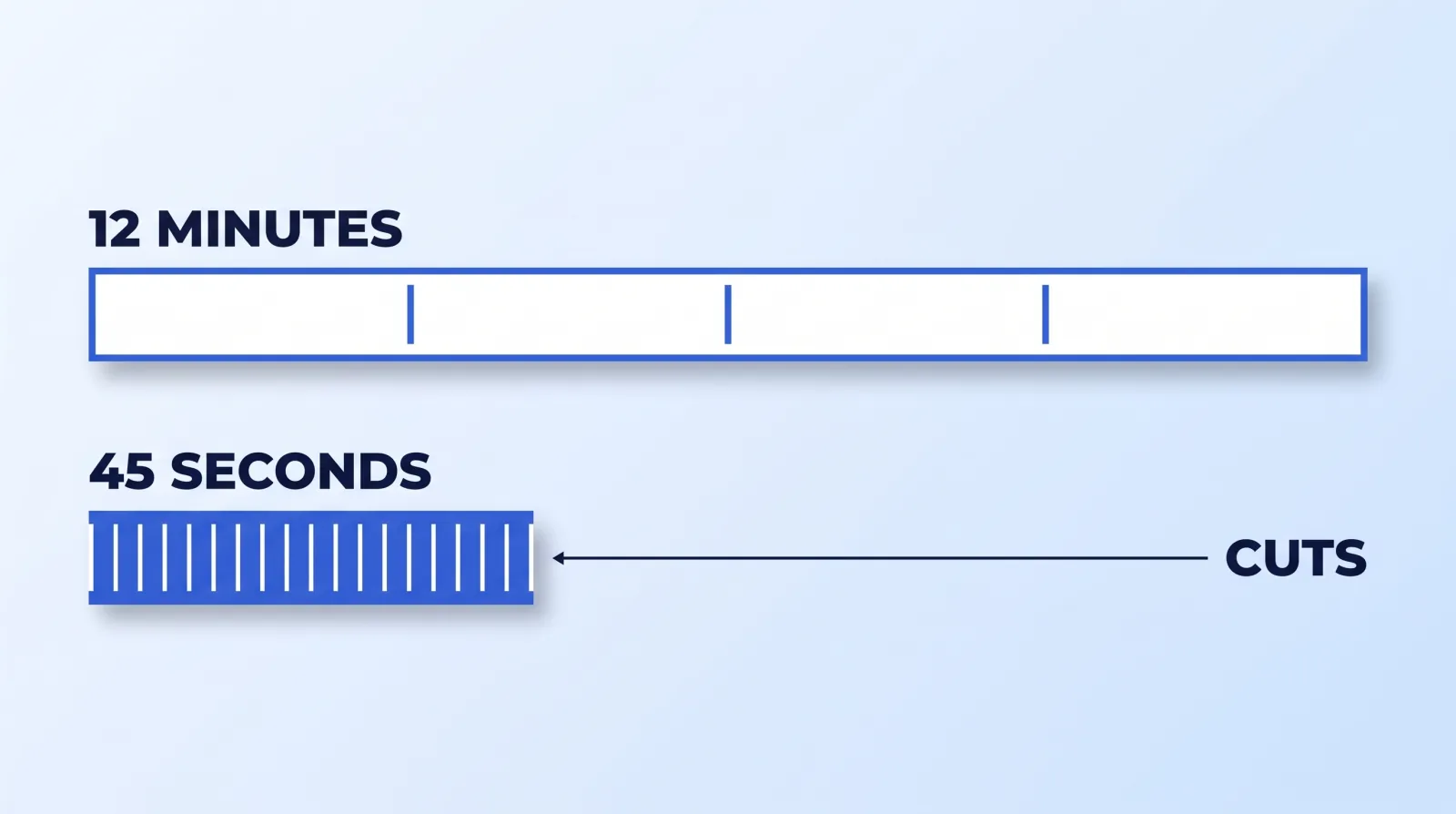
A twelve-minute talking-head video might carry sixty edit decisions — cuts, b-roll drops, a lower third, a music change. A forty-five second Short built from the same footage carries a comparable number, sometimes more, inside one-sixteenth of the runtime. Every frame is load-bearing. There is no stretch of the timeline where a mediocre choice gets absorbed by the ones around it.
This is why per-minute pricing quietly breaks on short-form. A rate card built around "minutes of finished video" prices runtime, and runtime is the one thing a Short has almost none of. We have watched buyers reason from that rate card to the conclusion that a Short should cost a twentieth of a long-form edit, then be surprised when the result looks like it cost that. What video editing actually costs sets out the three pricing models; short-form is the clearest case where the per-minute one is the wrong instrument.
What the Editor Is Actually Deciding
Short-form work is not long-form work compressed. The decisions are different in kind:
| Decision | Why it is harder in short-form |
|---|---|
| The first frame | It competes in a feed where the next video is one swipe away — YouTube's own description is that viewers "scroll to watch a never-ending stream of videos in the Shorts Feed" |
| Cut rhythm | No runway to establish pace; the rhythm has to be legible within two or three seconds |
| Caption timing | Burned-in text is read, not heard, and a late caption is a dead beat |
| Music in/out | Most tracks are usable "for up to 90 seconds in a Short up to 3 minutes," and "some tracks may be limited to 60 or 30 seconds" |
| The loop point | The end has to hand back to the beginning cleanly, a problem long-form never poses |
| Framing | A vertical crop discards most of a 16:9 frame, which is why framing a single take for both is a shoot-side decision |
None of those are visible on a rate card, and all of them are the difference between a Short that holds and one that gets swiped past. The repurposing system gets you the raw ten cuts; it does not get you ten cuts that work.
The Three-Minute Change Raised the Bar
Since October 15, 2024, "any videos uploaded on or after this date with a square or vertical aspect ratio up to three minutes in length will be categorized as Shorts." That sounds like relief — more room to tell the story. In practice it removed the excuse. A thirty-second Short that lost people at second eight could be blamed on the format. A three-minute vertical video that loses them at second eight is an editing problem, and now you are competing against people using the full three minutes well.
It also widened the gap between editors. Holding attention for twenty seconds is a trick. Holding it for two and a half minutes in a swipe feed is a craft, and it is closer to long-form storytelling than to the clip-chopping most cheap short-form work amounts to.
What Packaging Still Costs You
A Short is not exempt from packaging. Shorts surface in search and on the homepage as well as in the feed, and where a thumbnail is shown it has its own spec: YouTube's thumbnail requirements call for "2160 x 3840 for Shorts, with... a minimum height of 640 pixels for Shorts," at a 9:16 ratio. Impressions there are counted only when "the thumbnail is shown for more than 1 second and at least 50% of the thumbnail is visible on the screen," per YouTube's impressions documentation.
And the economics are unforgiving at the top of the funnel: YouTube Partner Program eligibility via Shorts requires "1,000 subscribers with 10 million qualified Shorts views in the last 90 days." Ten million. That number is the reason quality compounds — how the Shorts creator pool actually pays explains the mechanics, but the short version is that volume alone does not get you there, and a slightly better hold rate across a hundred uploads does.
The Five Questions to Ask a Short-Form Editor
Across 10,000+ delivered projects and 200M+ views, these separate a clipper from an editor:
- How do you price short-form? If the answer is a fraction of the per-minute rate, they have not done much of it.
- What do you do in the first second? A specific answer — a motion, a caption, a sound — beats "make it punchy."
- How do you decide the cut rhythm? Listen for whether they talk about the audio, not the visuals.
- How do you handle the loop? Most editors have never thought about it. The good ones have an opinion.
- What do you do when there's no retention data? The honest answer is "work from the ones that did clear 60 seconds, and from the pattern across the set" — and that is exactly right.
Short-form is where we see the widest quality spread of any format we deliver, and the cheapest work is cheap precisely because it skips every decision above. That is the case for done-for-you video editing rather than the lowest bid, and it is sharpest in categories where every upload is a Short — which is why we run fitness creators as a dedicated track. If you are comparing fixed-price short-form shops, the Tasty Edits comparison lays out where those models differ. Platform-by-platform differences on top of all this are in the cross-platform playbook.
The Bottom Line
Short-form removes your ability to learn from failure — under sixty seconds there is no retention graph — while packing the same number of edit decisions into a fraction of the runtime. That combination is why the format punishes cheap editing harder than long-form does, and why per-minute pricing is the wrong way to buy it. Pay for decisions, not for minutes.