Should Your Video Editor Write Your Scripts and Titles?
Titles, yes, as options you approve, as long as whoever writes them is accountable for your click-through rate. Scripts, only the draft: the outline, the argument and the opinion stay with you. The useful split isn't by job title at all. It's by which number each job moves, and whoever moves a number should be the one reading it afterwards.
Most channels get here backwards: they hire an editor for the hours, then notice the videos are well cut and nobody is clicking them. In a review of 704 buyer conversations in our own inbox, questions about scripts, ideas, titles and SEO were 10.9% of everything buyers asked but only 2.7% of first messages. Almost nobody opens with it. They ask once the edit is handled and packaging is what's still holding the channel back.
The Three Things You're Actually Buying
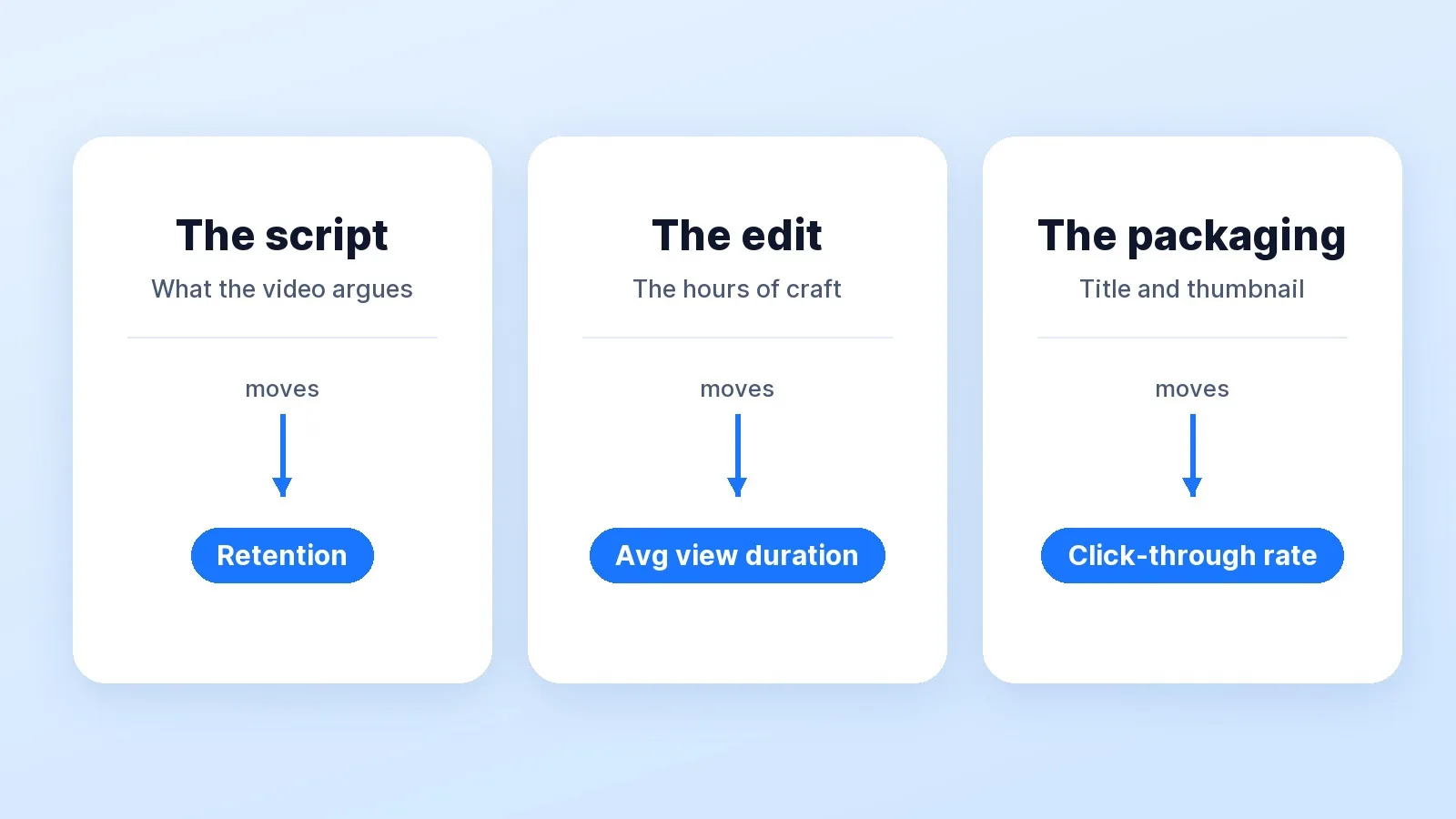
"Video editing" is usually sold as one line item, but a published video is three jobs with three different skills:
- The ideas and the script: what the video argues, in your words, from your expertise.
- The edit: the hours. Culling, pacing, sound, graphics, the craft of turning 90 minutes of footage into 11.
- The packaging: the title, the thumbnail, the description, the chapters. This decides whether the edit gets watched at all.
They fail differently, too. A weak script produces a video people leave halfway. A weak edit produces a video that feels amateur. Weak packaging produces a video nobody opens, which looks identical to not publishing. That asymmetry is why packaging is the first thing worth buying from whoever edits, and the script is the last.
What Changes When One Editor Holds the Chain
Two things break when the script, the edit and the packaging sit with three separate vendors.
The hook stops being a sequence. A hook written by someone who never sees the footage is a paragraph of text. A hook built by the person cutting the first thirty seconds is a sequence: the line, the cutaway that proves it, the beat before the title card. Our scripting, hooks and cold opens post covers the writing side; the handoff is where it usually goes wrong.
Nobody owns the match between the packaging and the video. YouTube says the title has to be accurate, and warns that if it doesn't match the content, "viewers may stop watching, which can impact discoverability" (Thumbnail & title tips). Pushed further it becomes a policy problem: YouTube's spam and deceptive practices policies treat maliciously misleading titles and thumbnails as a violation. A freelancer paid per thumbnail has no view of the finished edit and no stake in whether the promise holds. The person who cut the video does.
Packaging Means Variants, Not One Title
Packaging belongs with whoever is accountable for the numbers for a practical reason: it isn't a deliverable, it's a test.
YouTube's A/B test for titles and thumbnails compares up to three versions and picks a winner by watch time, and a test can take anywhere from a few days to two weeks. That changes the scope of the job in three ways:
- Three options per video, not one. A single title and a single thumbnail can't be tested.
- Somebody has to come back in two weeks and read the result. A per-video freelancer has already invoiced and moved on.
- The result has to change the next video. Otherwise you've bought a test and thrown away the finding.
If you buy titles and thumbnails as piecework, you get piecework: one of each, no variants, no follow-up. The published figures are collected in our thumbnail and CTR statistics, and the pre-publish pass we run is in the thumbnail checklist.
Decide by Who Owns the Number
Here's the split that holds up in practice:
| Job | Who should own it | The number it moves | What to put in the scope |
|---|---|---|---|
| Topic choice | You | None: it is the channel | Nothing. Don't delegate this. |
| Outline and point of view | You | Retention | Your outline goes to the writer, not the reverse |
| Script draft | A writer, from your outline | Retention | Your final pass on every script |
| Hook / first 30 seconds | Writer drafts, editor builds | 30-second retention | Two cuts of the hook to choose from |
| The edit | Your editor | Average view duration | Fixed turnaround, the same editor each time |
| Title | Editor drafts, you approve | Click-through rate | Three options per video |
| Thumbnail | Designed from your concept | Click-through rate | Three variants, built for A/B testing |
| Description, chapters, end screens | Your editor | Session time | Included, not an add-on |
| Publish / don't publish | You | None | Always yours |
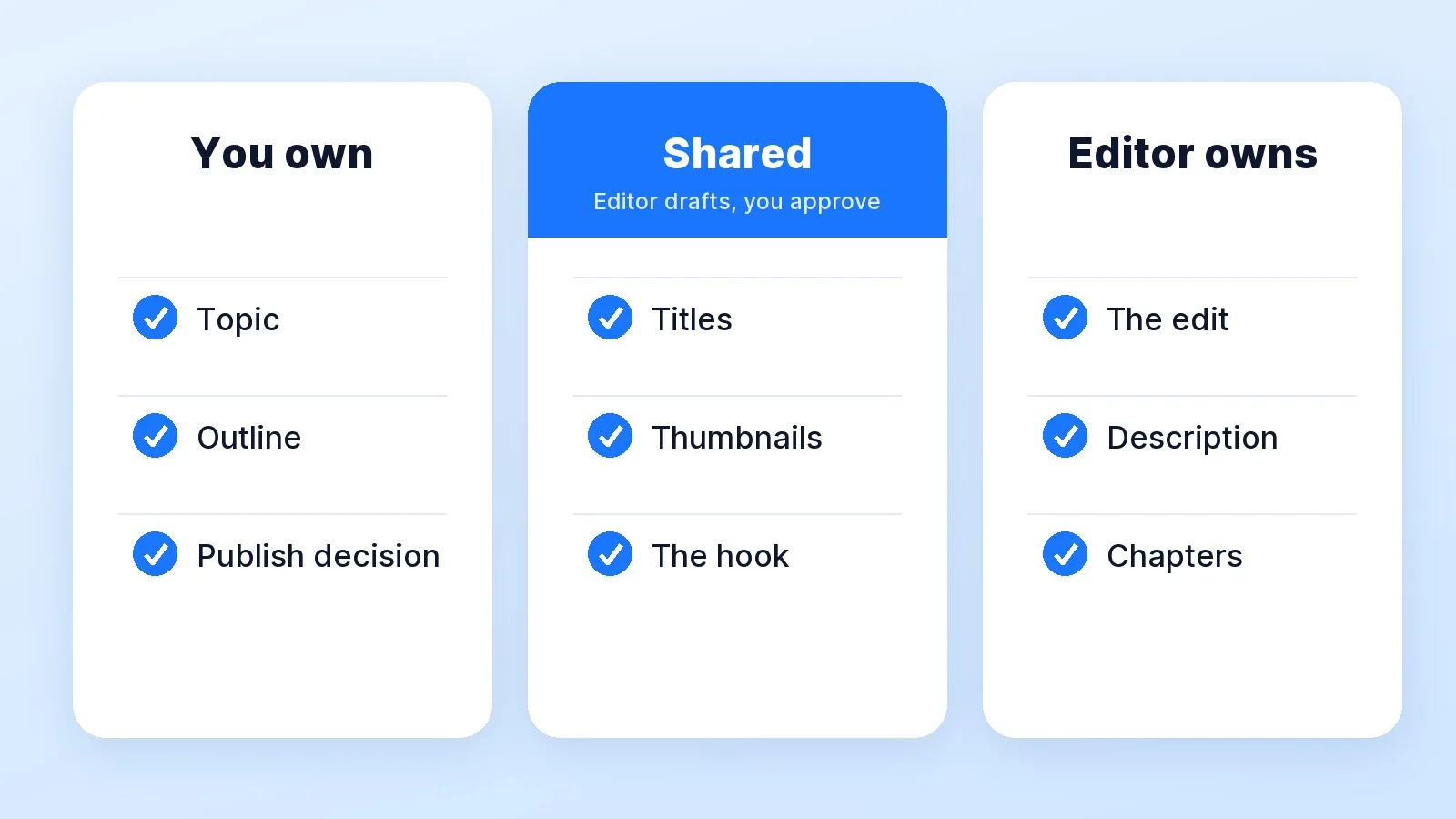
The pattern: you own what the channel is, your editor owns the hours, and packaging is shared, with a hard rule that you approve and they test. Hand over first the jobs heavy on hours and light on your personal judgement, the same logic as deciding what to outsource first when launching a channel.
What Splitting the Work Still Gets Right
Keeping everything with one provider isn't strictly better. Two arguments for separating the work are real.
The person who made the video is the worst judge of whether the title oversells it. Three weeks inside a project makes the interesting part obvious to you and invisible to a stranger. An outside packager has that stranger's eye. You can get the same effect from one provider by asking for title drafts from someone who didn't cut the video.
One vendor is one point of failure. If one provider holds your scripts, your project files and your channel access, a bad month hits everything at once. What to put in place is in what to do when your editor disappears. Voice drift, the third worry, is solvable too: see keeping your channel voice when you outsource.
How Buyers Actually Phrase This
The question arrives in our inbox almost word for word: "do you rely on me for the concepts, or…". What they're really asking is how much of their own thinking they still do after they've paid.
Of those conversations that reached a quote, 3 of 11 became clients. That base is small enough to show direction, not a reliable rate. Buyers who want ideas and the edit are buying a bigger scope, because the alternative is hiring a writer, an editor and a designer separately.
A real version of this split: Homesteading Family, a 900K-subscriber channel, works with us on title strategy, YouTube SEO and quarterly channel audits alongside its thumbnails. Packaging and strategy sit with us; the content stays theirs. In VidIQ's snapshot of May 5, 2026, about nine months in, the channel's views were up 30.1% on the previous week. The full engagement is in the Homesteading Family case study.
How to Scope It Without Guessing
If you're writing a brief or comparing two providers this week, these questions separate a real packaging service from an add-on line item:
- Who writes the first title draft, and how many options? Fewer than three means it isn't being tested.
- Who reads the A/B result two weeks later, and does it land in writing anywhere?
- Does whoever writes the titles have access to the channel's analytics? Packaging written without click-through data is guessing.
- If they write scripts, whose outline do they start from? Yours is the correct answer.
- Who has the final no on a title, a thumbnail and a publish date?
Founders usually buy the whole pipeline and keep the outline; that's the track our video editing for founders page covers. To weigh an agency against a freelancer or an in-house hire, see agency vs freelancer vs in-house and the numbers on in-house editor and freelance marketplaces. If you want the packaging system without handing over the content, that's a YouTube strategy engagement. Across 10,000+ projects for 4,500+ clients, the version that works is almost always the one where the client still writes the outline.
The Bottom Line
Let your editor write your titles, in threes, so they can be tested. Let a writer draft your scripts only after your outline exists. Keep the topics, the argument and the publish button. What matters is whether the person moving your click-through rate is the one who has to look at it next month.