Every figure on this page links to the organization that produced it, and each was re-checked against that source before publishing. How many people watch and listen, which platforms lead, how many shows are active, the money in podcast advertising, and which popular podcast statistics don't hold up.
58% of Americans 12 and older listened to or watched a podcast in the last month, and 45% in the last week. (Edison Research, 2026)See details
57% of Americans 12 and older have both listened to and watched a podcast. (Edison Research, 2026)See details
Among weekly podcast consumers, 78% watch video podcasts and 80% listen to audio-only podcasts. (Edison Podcast Metrics, Q1 2026)See details
Only 8% of weekly podcast consumers say they only watch podcasts. (Cumulus Media and Signal Hill, 2026)See details
YouTube is the platform used most for podcasts, named by 37% or 44% of weekly consumers depending on the survey. (Edison; Cumulus Media and Signal Hill)See details
YouTube says more than 1 billion people watch podcasts on it each month. (YouTube)See details
Podcast viewing on YouTube's living-room devices grew 75% in a year, to 700 million hours in October 2025. (YouTube; our calculation)See details
More than 500 million Spotify users have streamed a video podcast. (Spotify, May 2026)See details
38% of weekly video podcast watchers are 18 to 34, barely more than the 36% of audio-only listeners. (Edison Podcast Metrics; our calculation)See details
The Podcast Index lists 4,725,818 podcast feeds, but only about 10% published in the last 90 days. (Podcast Index; our calculation)See details
U.S. podcast ad revenue reached $2.86 billion in 2025, up 17.6%. (IAB and PwC)See details
76% of weekly podcast consumers say they have acted on a podcast ad. (Edison Podcast Metrics)See details
How many people listen to or watch podcasts?
58% of Americans age 12 and older, an estimated 167 million people, listened to or watched a podcast in the last month, according to Edison Research's The Infinite Dial 2026. 45%, about 130 million, did so in the last week, and 80% have ever listened to or watched one. Edison calls each an all-time high, though until 2024 the survey counted only listening.
Among Americans aged 35 to 54, 68% consumed a podcast in the last month (Edison). Pew Research Center uses a longer window and an adult-only sample: 54% of U.S. adults listened to a podcast in the past 12 months in its August 2025 survey, up from 49% in 2022.
In the UK, 27% of people aged 15 and older listen to podcasts each week, up from 23% a year earlier, according to Ofcom's 2026 audio report.
Do podcast audiences watch or listen?
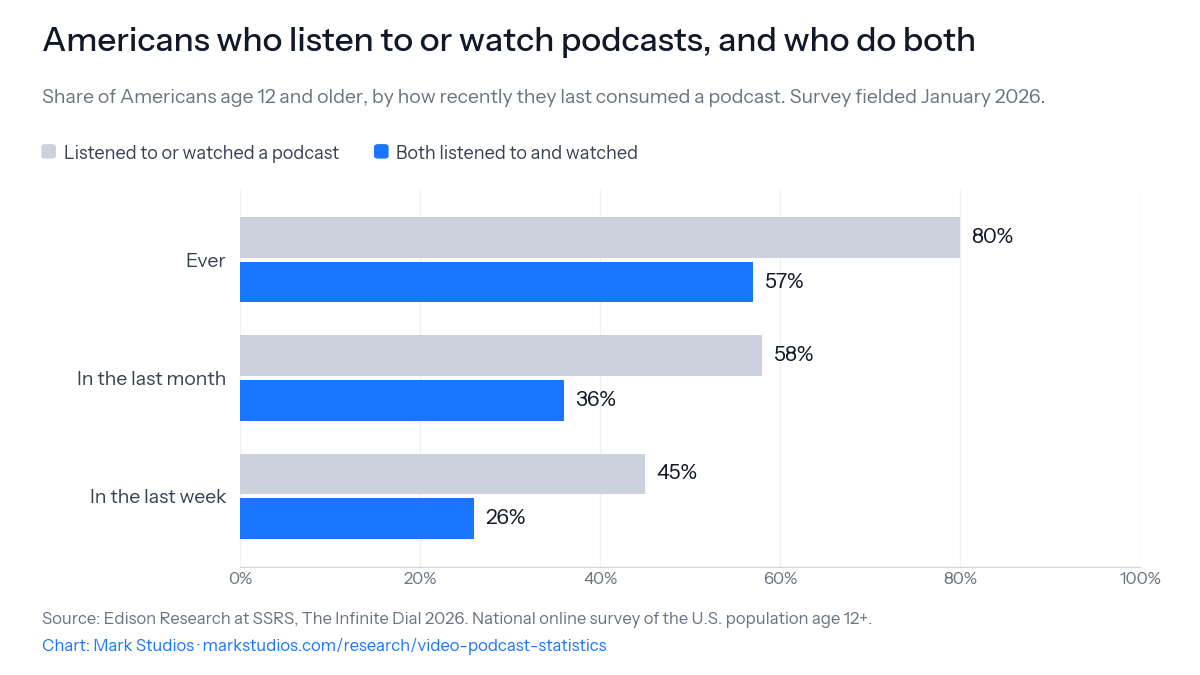
Most do both. 57% of Americans 12 and older have both listened to and watched a podcast, and 36% did both in the last month (The Infinite Dial 2026). In the last week, 26% of Americans both listened to and watched podcasts.
Americans who listen to or watch podcasts, and who do bothShare of Americans age 12 and older, by how recently they last consumed a podcast, from The Infinite Dial 2026 by Edison Research at SSRS (surveyed January 2026). People who both listened and watched are part of everyone who listened or watched.
Among weekly podcast consumers, video and audio now run level. In the first quarter of 2026, 78% consumed podcasts with video they actively watch and 80% consumed audio-only podcasts, according to Edison Research's The Podcast Consumer 2026. An earlier reading went the other way: in Q3 2025, 82% watched video and 78% listened to audio only, the first time video came out ahead in Edison's tracking (Edison).
How many prefer to watch? It depends on who is asked. In Cumulus and Signal Hill's April 2026 survey of U.S. weekly podcast consumers, 49% prefer to actively watch podcast video while listening, up from 30% in April 2022. In Sounds Profitable's The Podcast Atlas, among adults who consume both formats, 37% lean toward video, 34% have no preference, and 29% lean toward audio. In the UK in 2026, 27% of those who listen to podcasts that have video prefer to watch when a video version exists, 26% let the video play in the background, and 39% prefer audio only (Ofcom).
Most say they would follow a show across formats. 73% of U.S. podcast listeners surveyed in 2026 would follow a creator from audio to video, according to Sounds Profitable. In the UK, 68% of weekly podcast listeners already listen to podcasts that include video (Ofcom, 2026). For a show, that means the same episode has to work with the screen on and with it off, which is the core of podcast video editing.
Audiences are open to AI in the edit, within limits: 53% of U.S. weekly podcast consumers surveyed in early 2026 approve of podcasts using generative AI to edit existing video (Edison).
Are video podcast audiences younger than audio audiences?
Only slightly. Among U.S. weekly podcast consumers who actively watch video podcasts, 16% are 18 to 24 and 22% are 25 to 34, according to Edison Podcast Metrics data in The Podcast Consumer 2026. That puts 38% of video podcast watchers between 18 and 34, against 36% of audio-only listeners (our calculation from the same chart). People 55 and older make up 22% of video watchers and 23% of audio-only listeners.
Which platforms do people use for podcasts?
YouTube, in both major U.S. trackers, though they disagree on the size of its lead.
The two surveys ask different people. Edison Podcast Metrics interviews about 20,000 U.S. weekly podcast consumers age 13 and older a year; Cumulus and Signal Hill's April 2026 wave asked 600 U.S. weekly podcast consumers. Cumulus itself says that, given the much larger Edison and Triton Digital samples, it is more confident in their Spotify and Apple figures, so quote each figure with its source.
Measured by time rather than by preference, YouTube also leads: it took 32% of daily podcast listening and viewing time among Americans 13 and older in the fourth quarter of 2025, ahead of Spotify at 25% and Apple at 20%, according to Edison's Share of Ear data in The Infinite Dial 2026.
How big is YouTube's podcast audience?
YouTube says podcasts on its platform have more than 1 billion monthly active viewers (YouTube, February 2025). It first gave that figure for January 2025 and repeated it unchanged in May 2026.
Viewing is moving to the TV. Viewers watched more than 700 million hours of podcasts on YouTube's living-room devices in October 2025, up from 400 million a year earlier (YouTube), an increase of 75% (our calculation). In 2024, TV viewing averaged over 400 million hours of podcasts a month (YouTube). YouTube Premium members alone watched more than 800 million hours of podcasts in April 2026 (YouTube). These are YouTube's own figures.
Are people watching podcasts on TV?
A growing minority are. 38% of U.S. weekly podcast consumers said in April 2026 that they consume podcasts on a smart TV, up from 32% a year earlier (Cumulus and Signal Hill). As a main device the share is smaller: in 2026, 13% of weekly podcast consumers name a TV as their primary podcast device, up from 1% in 2021 (Edison), and 12% of adults who have ever consumed a podcast say a smart TV is the device they use most, up from 8% in 2024 (Sounds Profitable).
Netflix entered in January 2026. By April, 62% of U.S. weekly podcast consumers knew they could watch podcasts on Netflix (Cumulus and Signal Hill). Netflix says it has more than 60 podcasts available (Netflix, September 2026); its partners include iHeartMedia, which signed an exclusive video deal for more than 15 iHeartPodcasts shows (iHeartMedia). In its second-quarter 2026 shareholder letter, Netflix said about half of its viewing happens in the evening, while video podcasts over-index during the day and on mobile (Netflix Q2 2026 letter).
What are Spotify and Apple doing with video podcasts?
Spotify says more than 500 million users have streamed a video podcast, up nearly 50% in a year (Spotify Investor Day, May 2026). Its video catalog had grown to nearly half a million shows by November 2025 (Spotify), within more than 7 million podcast shows overall (Spotify).
Spotify paid more than $100 million to podcast publishers and creators in the first quarter of 2025 (Spotify), the most recent payout total we found. In January 2026 it cut the entry bar for its Partner Program, which pays for video consumption, to 1,000 engaged audience members, 2,000 hours consumed in 30 days and three published episodes (Spotify). The program was available in 19 markets at its fiscal 2025 annual report (Spotify Form 20-F). Spotify also estimates its podcast investments contributed more than $10 billion to the industry over five years, its own estimate without a published method.
Apple announced HLS video for Apple Podcasts in February 2026, arriving that spring in an app available in more than 170 countries and regions (Apple Newsroom). Podcast company Acast reported more than 180 shows enabled for video on Apple Podcasts by July 2026 (Acast Q2 2026 report).
How many podcasts are there, and how many are active?
There are millions of podcast feeds, but only about one in ten publishes regularly. The Podcast Index listed 4,725,818 podcast feeds on September 16, 2026, and 471,278 of them published an episode in the previous 90 days, which is about 10% (our calculation). 339,570 published in the previous 30 days.
Listen Notes, which excludes deleted, very low-quality and non-audio feeds, counts at least 3,811,315 podcasts, of which 551,764 were last active in 2026, or 14.5% (our calculation). New shows peaked in 2020; Listen Notes counts 210,689 podcasts created in 2025, against more than a million in 2020.
Few feeds label themselves as video in their metadata: 14,611 feeds in the Podcast Index use the video medium tag (Podcast Index daily counts). That tag is optional, so it understates how many shows publish video. Among the biggest shows, video is standard: 64% of Podtrac's top 200 multi-channel podcasts for March 2026 posted video episodes to YouTube (Podtrac).
How much money is in podcast advertising?
U.S. podcast advertising revenue reached $2.86 billion in 2025, up 17.6% from 2024, according to the IAB and PwC Internet Advertising Revenue Report. That report uses the traditional audio-based definition of a podcast, so ad money from video podcasts on video platforms may not be counted.
IAB's last podcast forecast trailed the market. IAB and PwC's 2024 study forecast $2,562.1 million for 2026 (IAB, May 2024), and 2025's actual revenue was already 11.7% above that figure (our calculation). U.S. ad buyers now expect podcast spend to grow 8.7% in 2026 (IAB, September 2026). Magellan AI, which tracks ads on popular podcasts, estimates spend rose 23% year over year in the second quarter of 2026 and counted 1,297 brands advertising on podcasts for the first time that quarter (Magellan AI).
The newest IAB audio and video split we found covers 2022, when video-enabled podcasts took 5% of U.S. podcast ad revenue (IAB, 2023). Treat that as a dated baseline, not a current share.
Company
Podcast-related revenue
Source
iHeartMedia
Podcast revenue $563.7 million in 2025, up 25.6%; $162.1 million in Q2 2026, up 20.7%
Acast describes itself as connecting more than 140,000 podcast creators with more than 4,000 advertisers (Acast Q3 2026 report).
Do podcast ads work?
Producer research says audiences act on them. 76% of U.S. weekly podcast consumers say they have taken an action, such as visiting a website or using a promo code, because of a podcast ad, according to Edison Podcast Metrics in The Podcast Consumer 2026. 86% of the most active podcast consumers recall ads they hear on podcasts (Sounds Profitable, 2025).
Video may add to that. In Sounds Profitable's 2026 Podcast Atlas, 15% of the most engaged video podcast consumers made an immediate purchase after an ad, against 10% of the most engaged audio consumers, and 67% took at least one action, against 63% (Sounds Profitable). Sounds Profitable describes itself as a trade association for the podcast industry, so read these as industry research.
Which popular podcast statistics don't hold up?
Podcast statistics pages repeat several figures without their dates, bases or original sources. We traced eight of the most common to the earliest source we could find.
From a December 2018 press release by podcast ad network Midroll, which commissioned the Nielsen studies behind it. It says "up to" 4.4 times better recall than display ads, and the display-ad comparison came from a separate 2017 AP-NORC survey (Scripps investor release).
2018 vendor claim
"80% of listeners hear all or most of an episode"
Edison's Infinite Dial 2018 reported two separate answers among people who had ever listened: 35% typically hear the entire episode and 45% most of it (Edison, 2018). Edison's newest reading we found is from 2019: 52% the entire episode and 41% most of it, among online monthly consumers (Edison, 2019).
Dated
"YouTube is the most popular podcast platform"
True in both major trackers. The earliest U.S. survey we found with YouTube on top is from 2019: in a February 2019 University of Florida and Futuri Media survey of regular podcast users, it was the most-used of all platforms people listened on, at 70% (Broadcast Dialogue, 2019). The earliest survey we found with YouTube first as the platform used most is Cumulus Media and Signal Hill's April 2022 study, at 24.2% against Spotify's 23.8% (Westwood One, 2022). The latest figures are 44% in that survey and 37% in Edison's.
True
"Podcast listeners are more educated and affluent"
Edison has reported this since at least 2017, when 45% of monthly podcast consumers had household income of $75,000 or more against 35% of adults (Edison, 2017). Its 2025 figures show a narrower gap: 51% of monthly consumers have college degrees against 46% of the population, and 47% earn $75,000 or more against 43% (Edison, 2025).
It is Podtrac's count for its top 250 U.S. podcasts, not all podcasts. Podtrac's February 2025 chart, published by Podnews in April 2025, puts full video on YouTube at 50.6% of those shows, and Podnews summed it up as "only half of the big shows are in YouTube as full video episodes" (Podnews, 2025). The "130% more than 2022" compares it with Podtrac's May 2022 figure of 22% for the same top 250 (Podtrac, 2022). A different ranking, Podtrac's top 200 multi-channel podcasts, reached 64% in March 2026.
We started from the questions people search for about video podcast statistics and looked for the organization that actually produced each answer. Every figure on this page sits in an evidence ledger with its source, the exact table or paragraph it came from, the measurement period, the population measured, and the date we checked it. This edition holds 91 figures from 19 publishers.
On September 16, 2026, each figure then on the page was re-opened at its source and matched against the recorded wording; figures added or updated later were checked on the dates in the change log. Web pages were fetched independently of the research pass; pages that load their text with JavaScript or block automated requests, such as Edison's summaries and Ofcom's report, were checked in a browser. Chart values in PDF reports were read from the published slides. Podcast Index and Listen Notes counts are live database counters that change daily; the page records the values observed on September 16, 2026.
We only cite the producer: government agencies, regulators, company filings and official posts, and the survey owner's own report. We do not cite statistics roundups, Statista-style aggregators, or salary sites without a public method. We did not bypass paywalls or sign-up forms; where a full report was gated, we used only the figures its publisher states publicly.
Figures marked "our calculation" are arithmetic on the cited numbers, and anyone can reproduce them:
This edition contains no Mark Studios customer data.
Limitations
Surveys measure different people. Edison's Infinite Dial covers Americans 12 and older, Edison Podcast Metrics covers weekly podcast consumers 13 and older, Cumulus Media and Signal Hill survey 600 weekly podcast consumers a wave, and Pew surveys adults. Their figures are not interchangeable.
Platform figures are self-reported. YouTube, Spotify, Netflix, Apple and Acast publish their own numbers without independent audit, except where a figure comes from a regulatory filing.
Database counts are not show counts. The Podcast Index includes inactive feeds; Listen Notes filters differently; neither is a census of shows people actually hear.
Ad revenue uses an audio definition. IAB and PwC count podcast advertising under an audio-based definition, and company revenue lines differ in scope.
Industry research has interests. Sounds Profitable, Cumulus Media and the platforms all benefit from growth in podcast advertising.
Most figures describe the U.S., with UK figures from Ofcom labeled as such.
How to cite this page
For a single figure, cite the original publisher named next to it, and link here if the verification trail is useful to your readers. Each figure has its own anchor, so you can link straight to it, for example https://www.markstudios.com/research/video-podcast-statistics#AUD-011. To cite the page as a whole:
Mark Studios. "Video Podcast Statistics." Last verified Sep 16, 2026. https://www.markstudios.com/research/video-podcast-statistics
APA
Mark Studios. (2026, September 16). Video podcast statistics. https://www.markstudios.com/research/video-podcast-statistics
MLA
“Video Podcast Statistics.” Mark Studios, 16 Sept. 2026, www.markstudios.com/research/video-podcast-statistics.
Chicago
Mark Studios. “Video Podcast Statistics.” Last modified September 16, 2026. https://www.markstudios.com/research/video-podcast-statistics.
Our calculations and the evidence table are free to reuse with attribution and a link to this page. Each underlying figure remains the claim of its original publisher, and some publishers ask for a link when their figures are reused.
We re-verify every figure quarterly and when a major source publishes a new edition. The next scheduled review is December 2026. Corrections go to contact@markstudios.com.
Sep 16, 2026: First published with 89 figures from 18 publishers, each checked against its original source.
Sep 24, 2026: SSRS, the site that hosts Edison Research's reports, stopped serving them. 16 citations now point to Edison's own copy of the same report or to an archived copy of the page, and each figure was re-checked there. One figure, TVs as the primary podcast device (AUD-015), still links to its SSRS page, which has no archived copy.
Sep 28, 2026: Traced "50.6% of shows post full videos on YouTube" to Podtrac's February 2025 count of its top 250 U.S. podcasts, published by Podnews (we had found no source), and added the 2019 University of Florida and Futuri survey as the first to put YouTube on top.
Oct 29, 2026: Moved Acast's quarterly net sales and revenue per listen or view to Q3 2026 (SEK 802.3 million, up 25%; SEK 0.69, up 20%), from its January-September 2026 interim report.
Oct 30, 2026: Corrected three descriptions. Apple announced HLS video for Apple Podcasts in February 2026, for release that spring; it had not added it then. The Cumulus Media and Signal Hill survey is of 600 weekly podcast consumers; we had described them as adults with at least an hour of weekly listening, which its public summary does not say, and we now note that Cumulus itself trusts the larger Edison and Triton samples more for Spotify and Apple. And the Infinite Dial's all-time highs come after the survey switched in 2025 from counting podcast listening to counting listening or watching.
Oct 31, 2026: Added dates some sentences were missing: the Cumulus Media and Signal Hill figures are from April 2026, the Ofcom UK figures from 2026, the Sounds Profitable cross-format figure from a 2026 survey of U.S. podcast listeners, Edison's generative AI figure from early 2026, and the TV device shares from 2026.
Frequently asked questions
What percentage of podcast listeners watch video?
Most use both formats. In Edison Research's first-quarter 2026 tracking, 78% of U.S. weekly podcast consumers consume podcasts with video they actively watch, and 80% listen to audio-only podcasts. Only 8% of weekly consumers say they only watch, according to Cumulus Media and Signal Hill, and 49% say they prefer actively watching when video is available.
Is YouTube the biggest podcast platform?
Yes. YouTube is the platform U.S. weekly podcast consumers use most, named by 37% in Edison Research's Q1 2026 data and by 44% in Cumulus Media and Signal Hill's April 2026 survey, against 21% and 14% for Spotify. YouTube also says more than 1 billion people watch podcasts on it each month.
How many podcasts are there?
The Podcast Index listed 4,725,818 podcast feeds on September 16, 2026, but only 471,278 had published an episode in the previous 90 days. Listen Notes, which filters out long-deleted and low-quality feeds, counts 3,811,315 podcasts, of which 551,764 were last active in 2026. Most podcast feeds are no longer publishing.
How much is podcast advertising worth?
U.S. podcast advertising revenue was $2.86 billion in 2025, up 17.6% from 2024, according to IAB and PwC. That figure uses an audio-based definition of podcasts, so some video podcast ad money may sit elsewhere. U.S. ad buyers surveyed by IAB expect podcast spend to grow 8.7% in 2026.
Are video podcast audiences younger than audio audiences?
Only slightly. In Edison Podcast Metrics data from the second quarter of 2025 to the first quarter of 2026, 38% of U.S. weekly podcast consumers who actively watch video podcasts were 18 to 34, compared with 36% of audio-only listeners. The widely repeated claim that 62% of video podcast viewers are 18 to 34 has no primary source we could find.
How many Americans listen to podcasts?
58% of Americans age 12 and older, about 167 million people, listened to or watched a podcast in the last month, and 45%, about 130 million, did so in the last week, according to Edison Research's The Infinite Dial 2026. Pew Research Center found 54% of U.S. adults listened to a podcast in the past year.
How often is this page updated?
Every figure is re-checked against its original source each quarter, and sooner when a major source publishes a new edition, such as Edison's The Infinite Dial or IAB's revenue report. The Last verified date changes only after that check, and each change is recorded in the change log at the bottom of the page.