Do the biggest YouTube channels still use tags? How long are their titles and descriptions, and how many add chapters, captions or translated titles? We read the metadata of 1,061 recent videos from the most-subscribed channels through YouTube's own API.
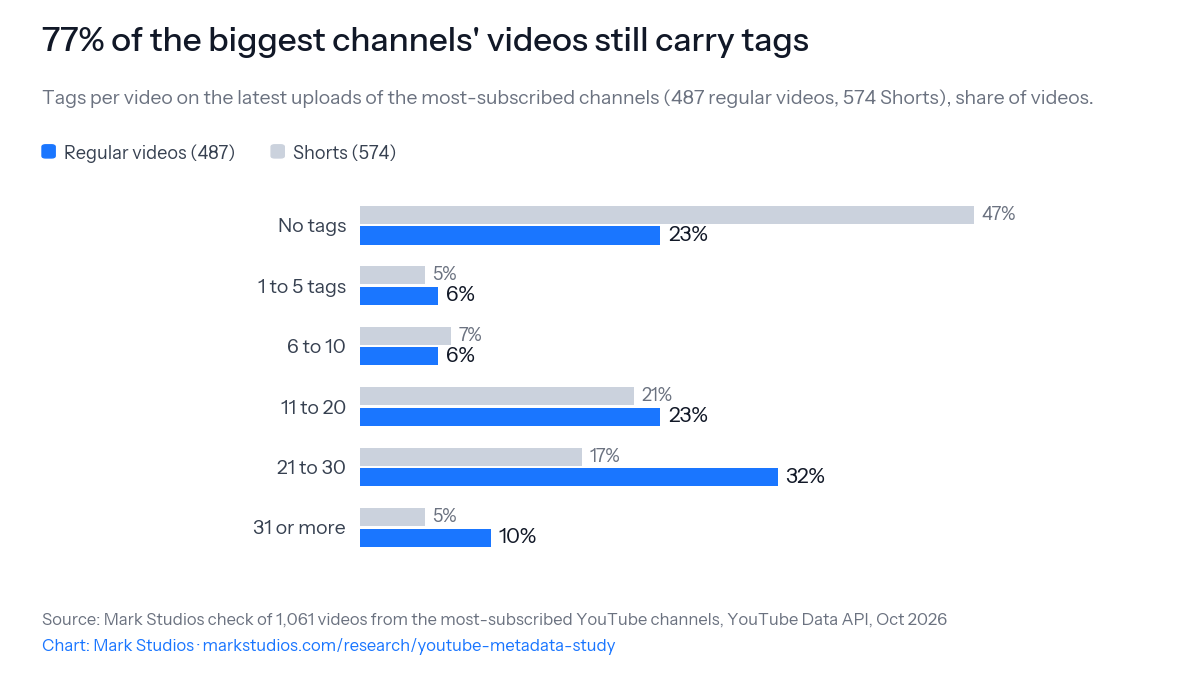
YouTube says tags "play a minimal role" in discovery, but 77% of the biggest channels' latest regular videos still carry them, a median of 21.5 tags each; 53% of their Shorts do. See details
69 of 98 channels tagged every recent video and 19, MrBeast among them, tagged none. Tagged videos use a median 395 of the 500 characters YouTube allows, and 38% come within 50 of the limit. See details
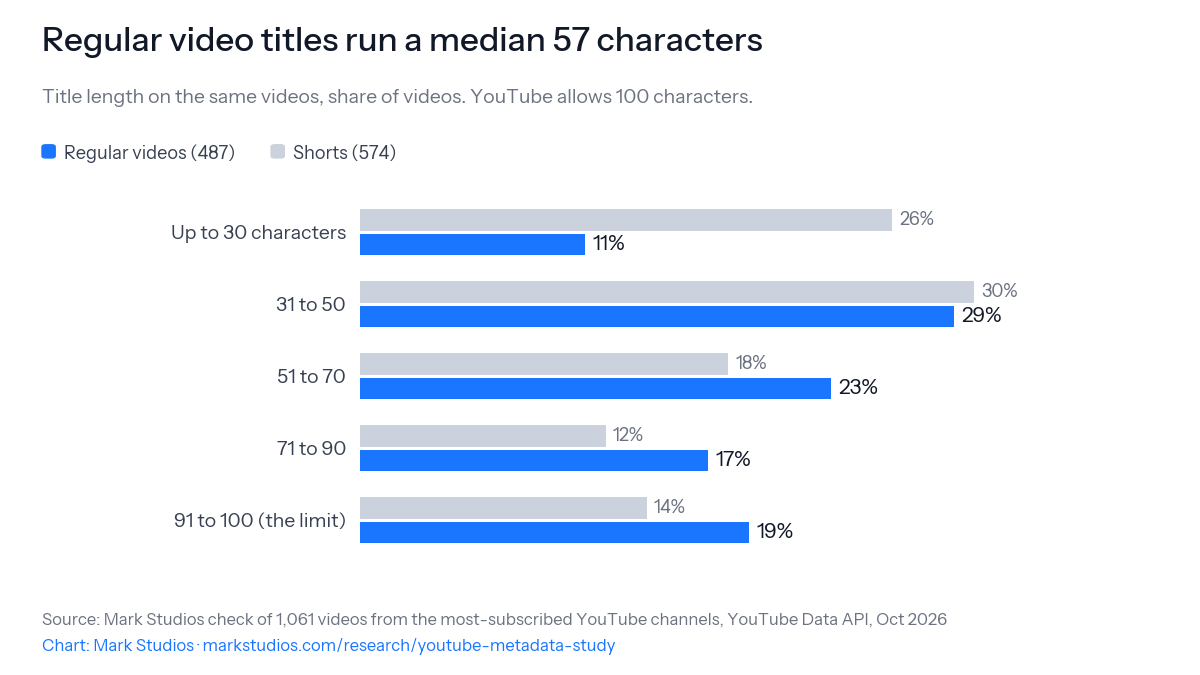
Regular video titles run a median 57 characters (49 on videos set to English audio); 19% use 91 to 100 of the 100 allowed. Shorts titles run 45. See details
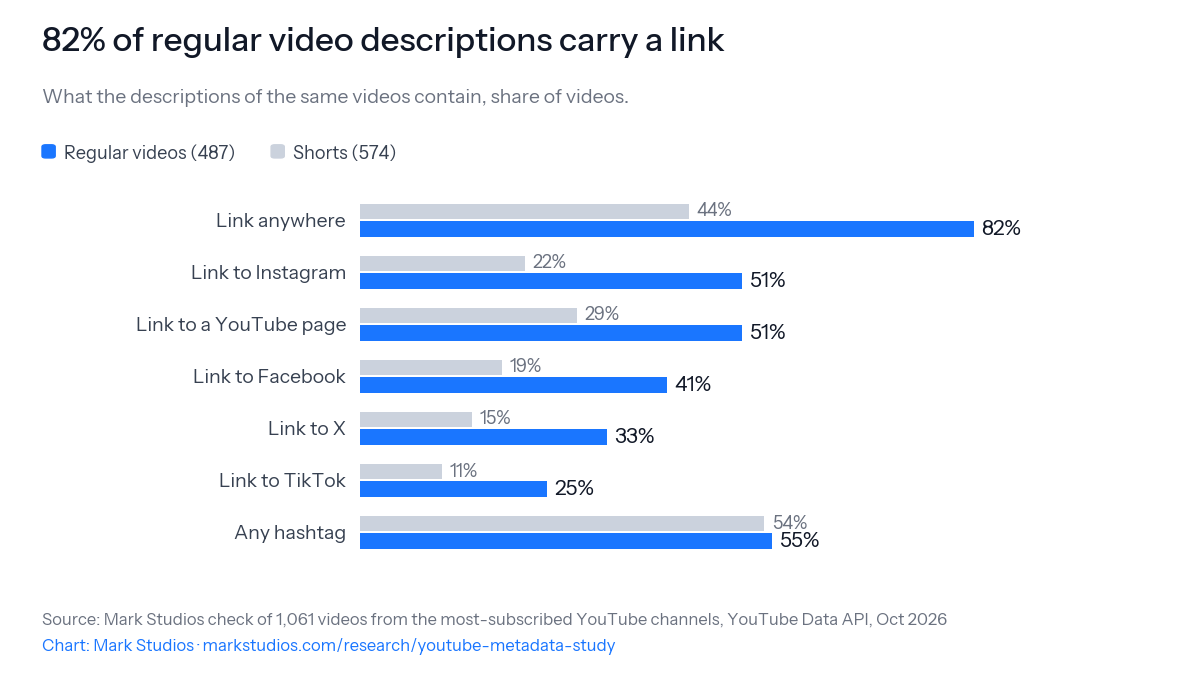
Descriptions run a median 873 characters on regular videos and 108 on Shorts; 36% of Shorts have none. 82% of regular descriptions carry a link, most often to Instagram or another YouTube page (51% each). See details
Only 40 of 487 (8%) regular videos have chapters written into the description that meet YouTube's rules. See details
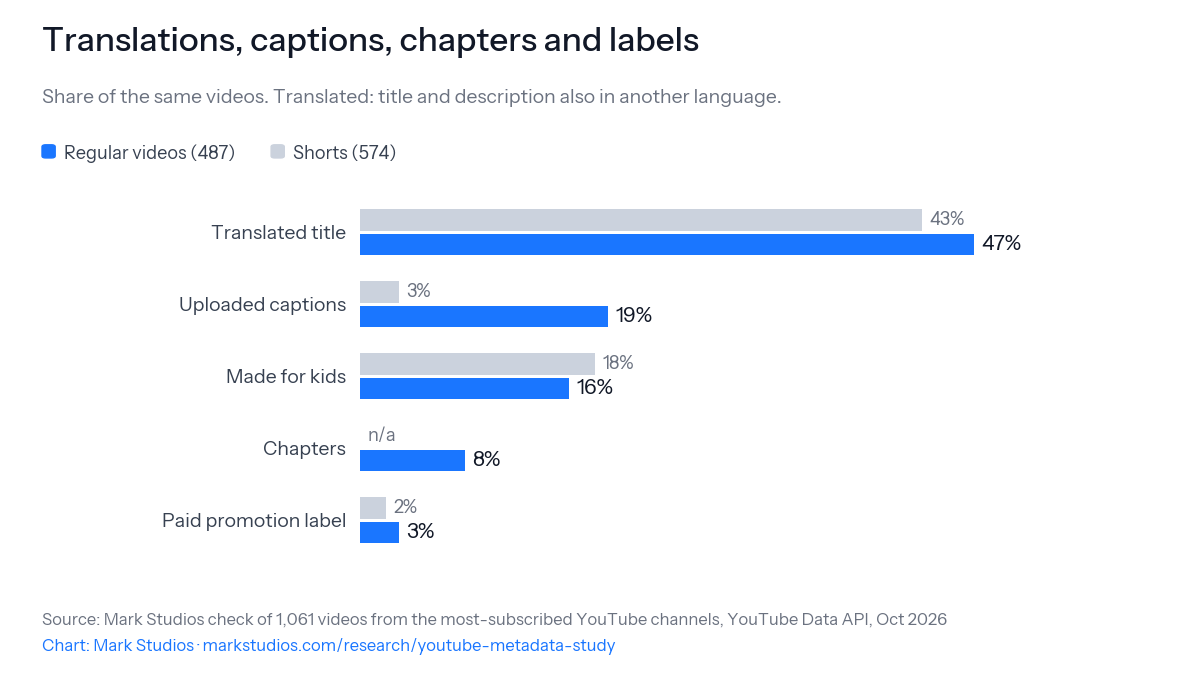
19% of regular videos and 3% of Shorts have a caption track beyond YouTube's automatic captions. See details
47% of regular videos and 43% of Shorts carry their title and description in at least one other language, a median 12 languages. See details
YouTube's paid promotion label is on 14 of 487 regular videos (3%) and 13 of 574 Shorts. See details
Shorts collect more likes per view: a median 7.2 likes per 1,000 views on regular videos against 13 on Shorts. See details
Do the biggest YouTube channels still use tags?
Most do. Of the 487 latest regular videos from 98 of the most-subscribed YouTube channels, 374 (77%) carry tags, a median of 21.5 per tagged video; half carry between 15 and 27, and the most is 49. On Shorts the habit is weaker: 306 of 574 (53%) carry tags, a median of 19.
That runs against YouTube's own advice. Its help page on adding tags says a video's title, thumbnail and description matter more, and that apart from commonly misspelled topics, tags "play a minimal role in your video's discovery."
77% of the biggest channels' videos still carry tagsTags per video on the latest uploads of the most-subscribed channels (487 regular videos, 574 Shorts), share of videos.
It's a channel habit. 69 of the 98 channels tagged every one of their recent regular videos, 19 tagged none and only 10 mixed. The most-subscribed channel of all is among the 19: MrBeast's five latest regular videos carry no tags.
Many fill the box. YouTube's Data API documentation caps the tags field at 500 characters, counting the commas between tags and two quotation marks around any tag that contains a space. By that count, tagged regular videos use a median 395 characters, and 142 of 374 (38%) use 450 or more. 63% of tagged regular videos include the channel's name in a tag.
How long are top YouTubers' titles?
A median of 57 characters on regular videos, half between 39 and 84. On the 187 regular videos whose channel set the audio language to English the median is 49. YouTube allows 100 characters, and 94 regular titles (19%) use 91 or more, 78 of them on music, entertainment and film channels, many listing song, film and cast names. Shorts titles are shorter: a median 45 characters (41 on those set to English).
Regular video titles run a median 57 charactersTitle length on the same videos, share of videos. YouTube allows 100 characters.
Shorts titles lean on emoji and hashtags. Vertical bars are mostly a music and TV habit: 132 of the 188 regular titles with one come from music and entertainment channels, which use them to separate song, film, show and cast names. Question titles are rare on both.
How long are their descriptions, and what's in them?
Regular video descriptions run a median of 873 characters (half between 358 and 1,821) out of the 5,000 YouTube allows. Shorts descriptions run a median 108, and 207 of 574 Shorts (36%) have none at all, against 25 regular videos (5%).
82% of regular descriptions carry at least one link, a median 6 on those that do. The most common destinations are Instagram (51% of regular videos), other YouTube pages such as the channel or a playlist (51%), Facebook (41%), X (33%) and TikTok (25%). Our website social links study found the same four networks at the top of the biggest websites' social links, in a different order (X first there).
82% of regular video descriptions carry a linkWhat the descriptions of the same videos contain, share of videos.
About half use any. 55% of regular videos and 54% of Shorts have at least one hashtag in the title or description. Descriptions that carry hashtags carry a median 5 on regular videos (5 on Shorts), and 171 regular descriptions carry more than three. YouTube ignores every hashtag on a video that has more than 60; the most we found was 61, counting the title and repeats (56 different hashtags), on five SET India Shorts, and no regular video carried more than 30. Hashtags in the title are mostly a Shorts habit: 36% of Shorts titles carry one, against 4% of regular titles.
How many YouTube videos use chapters?
Few on the biggest channels. 40 of 487 (8%) recent regular videos have chapter timestamps in the description that meet YouTube's rules for video chapters: the first timestamp at 0:00, at least three in ascending order, and every chapter at least 10 seconds long. 47 descriptions list three or more timestamps; the 7 that fail the rules start after 0:00 (5), list a time past the end of the video (1) or leave a last chapter under 10 seconds (1). The 40 come from 14 channels: kids' shows, Indian music labels, a speaker's talks and a few creators; 4 of them, Celine Dept, Mikecrack, Kids Diana Show and Acharya Prashant, chapter every recent video. Chapters are counted on regular videos only.
YouTube can also add automatic chapters to a video, and the Data API doesn't report those, so this is a count of chapters creators wrote themselves.
How many big channels upload their own captions?
94 of 487 regular videos (19%) and 15 of 574 Shorts (3%) have a caption track beyond YouTube's automatic captions; on regular videos set to English audio the share is 31%. The Data API's caption field says only whether captions are available. Listing the tracks of 14 videos through the captions endpoint showed what it measures: every video marked yes had a track a person or service supplied, and the videos marked no had only YouTube's automatic track or none. Our auto-caption accuracy study measures how well the automatic ones read.
How many translate their titles and descriptions?
Close to half. 230 of 487 (47%) regular videos and 247 of 574 Shorts (43%) carry the title and description in at least one language beyond the original, a median 12 languages on regular videos; 58 of the 98 channels do it on at least one recent video. MrBeast's latest videos carry 21 to 24 translations each. Translated audio is a separate step, covered in our YouTube dubbing study.
Translations, captions, chapters and labelsShare of the same videos. Translated: title and description also in another language.
14 of 487 regular videos (3%), from 7 channels, and 13 of 574 Shorts (2%), from 6 channels, have YouTube's paid promotion setting turned on, which adds a disclosure label at the start of the video. YouTube asks creators to turn it on for branded content, sponsorships and endorsements. We report the setting as the API returns it and don't judge which videos needed it.
Made for kids, comments and categories
78 regular videos (16%) and 105 Shorts (18%) are set as made for kids. Comments are off on 63 of the 1,061 videos, and 51 of those are made for kids, where YouTube turns comments off. Entertainment and Music are the most common categories, as the most-subscribed list is heavy on both:
YouTube category
Regular videos
Shorts
Entertainment
183 (38%)
236 (41%)
Music
128 (26%)
147 (26%)
People & Blogs
37 (8%)
46 (8%)
Gaming
34 (7%)
19 (3%)
Film & Animation
27 (6%)
32 (6%)
Sports
20 (4%)
24 (4%)
Education
20 (4%)
22 (4%)
Science & Technology
10 (2%)
12 (2%)
Howto & Style
10 (2%)
12 (2%)
Comedy
8 (2%)
12 (2%)
Nonprofits & Activism
5 (1%)
6 (1%)
News & Politics
5 (1%)
6 (1%)
How many likes per view do top videos get?
A median of 7.2 likes per 1,000 views on regular videos (half between 3.5 and 14.6) and 13 on Shorts (half between 9.1 and 26.8). Comments are rarer: a median 0.36 per 1,000 views on regular videos and 0.16 on Shorts. Counts were read on October 29, 2026, when some videos were only days old. Views aren't counted the same way on both: a Short has gained a view each time it starts or replays since March 31, 2025, while long videos moved to counting at the start of play on August 24, 2026, so the two ratios aren't measured on the same basis.
What this means if you publish on YouTube
Write the title and description first. YouTube ranks them above tags. Our title checker and description checker show how yours compare.
Tags are cheap insurance, not a strategy. Big channels fill them by habit; a few accurate tags, plus the misspellings people type, are enough.
Chapters are an easy gap. 8% of the biggest channels' videos have them; long tutorials, podcasts and compilations are where they help viewers most. The upload checker checks a chapter list against YouTube's rules.
Translate the title before the audio. Nearly half of these videos carry translated titles; it's the cheapest way to show up in other languages.
Videos. The 487 regular videos are the latest regular uploads (not Shorts or live streams) of 98 of the 100 channels in Wikipedia's list of the most-subscribed YouTube channels, five per channel (two for one channel), the same videos as our thumbnail study; they were uploaded between 2020-10-26 and 2026-10-25. The 574 Shorts are the six latest Shorts (fewer for three channels) of the 97 channels on that list that post Shorts, the same as our Shorts length study.
Metadata. On October 29, 2026 we read every video's public metadata through the official YouTube Data API (videos.list): title, description, tags, category, caption flag, localizations, paid promotion flag, made-for-kids status and view, like and comment counts. All 1,061 videos returned. Lengths count characters. Links are web addresses starting with http or https; hashtags must contain a letter, so "#1" is not one. A link to a site's subdomain counts for that network.
Checking the data. The tag counts follow YouTube's 500-character rule exactly: none of the 680 tagged videos goes over 500 by that count. We read every description with three or more timestamps (47) to confirm the chapter rule worked as intended, and listed the caption tracks of 14 videos, 12 of them picked at random, to confirm what the caption flag measures (14 of 14 matched).
None of the channels reviewed or endorsed this study.
Limitations
The biggest channels, not all of YouTube. These channels lean toward music, entertainment and kids' content, and many publish in Hindi, Spanish, Portuguese or Korean.
Five recent videos (six Shorts) per channel. A channel's habits can change from one upload to the next; the per-video CSV shows each one.
What the API reports. Automatic chapters, automatic captions and pinned comments aren't counted. Links written without http or https are missed, so link shares are a floor.
Audio language is the channel's own setting. Zee TV's Hindi serials and HAR PAL GEO's Urdu dramas are set to English, while WWE and Movieclips set none, so the English figures cover videos set to English, not every video in English.
Likes and views at one moment. Newer videos have had less time to collect views, likes and comments.
Mark Studios. "YouTube Tags, Titles and Descriptions Study." Published Oct 30, 2026. https://www.markstudios.com/research/youtube-metadata-study
APA
Mark Studios. (2026, October 30). YouTube tags, titles and descriptions study. https://www.markstudios.com/research/youtube-metadata-study
MLA
“YouTube Tags, Titles and Descriptions Study.” Mark Studios, 30 Oct. 2026, www.markstudios.com/research/youtube-metadata-study.
Chicago
Mark Studios. “YouTube Tags, Titles and Descriptions Study.” Last modified October 30, 2026. https://www.markstudios.com/research/youtube-metadata-study.
BibTeX
@misc{markstudios_youtube_metadata_study_2026,
  author = {{Mark Studios}},
  title = {{YouTube Tags, Titles and Descriptions Study}},
  year = {2026},
  month = oct,
  url = {https://www.markstudios.com/research/youtube-metadata-study},
  note = {Last verified 2026-10-30}
}
Our measurements and the CSV are free to reuse under CC BY 4.0 with a link to this page. The videos and their text remain the property of the channels that published them.
We plan to rerun the check every six months on the same channel list. Corrections go to contact@markstudios.com.
Oct 30, 2026: First published: 487 regular videos and 574 Shorts from the most-subscribed channels.
Frequently asked questions
How many tags do top YouTubers use?
On the most-subscribed channels' latest uploads, 77% of regular videos carry tags, a median of 21.5 per tagged video (half between 15 and 27). 53% of their Shorts carry tags, a median of 19. 19 of 98 channels used none on any recent video.
Do YouTube tags still matter?
Not much for discovery, by YouTube's own account: its help page says tags "play a minimal role" and are mainly useful when a video's topic is often misspelled. Big channels fill them anyway; 77% of their recent regular videos have tags. Titles, thumbnails and descriptions matter more, YouTube says.
How long should a YouTube title be?
YouTube allows 100 characters. The biggest channels' recent regular videos used a median 57 characters, 49 on videos set to English audio, and Shorts titles ran 45. Long titles get cut off in search and suggestions, so put the words that matter first.
How long are YouTube descriptions on big channels?
A median 873 characters on regular videos and 108 on Shorts, out of 5,000 allowed. 5% of regular videos and 36% of Shorts had no description at all. Most regular video descriptions (82%) include at least one link, most often to Instagram or another YouTube page.
How many YouTube videos use chapters?
Few, on the biggest channels: 40 of 487 recent regular videos (8%) had chapter timestamps in the description that meet YouTube's rules (start at 0:00, three or more in order, each at least 10 seconds). YouTube can also add automatic chapters, which this count doesn't include.
How many hashtags should a YouTube video have?
YouTube ignores every hashtag on a video that has more than 60. On the biggest channels, 55% of regular videos and 54% of Shorts used at least one, and descriptions with hashtags carried a median of 5. The most we found was 61, counting repeats (56 different), on five SET India Shorts.
Can I use this data?
Yes. Our measurements and the per-video CSV are free to reuse under CC BY 4.0 with a link to this page. The videos and their text belong to the channels that published them; the CSV carries counts and lengths, plus titles and links so each row can be checked.