YouTube asks creators to tick a paid promotion box when a video has a sponsor, and shows a label when they do. How often do they? We checked every video on YouTube's most-popular charts against its description.
3.4% of the 6,776 videos on YouTube's most-popular charts in Australia, Canada, the UK, India and the U.S. (October 31 to November 2, 2026) carried the creator-set paid promotion label, the notice YouTube shows at the start of a video with a sponsorship, endorsement or other commercial relationship. See details
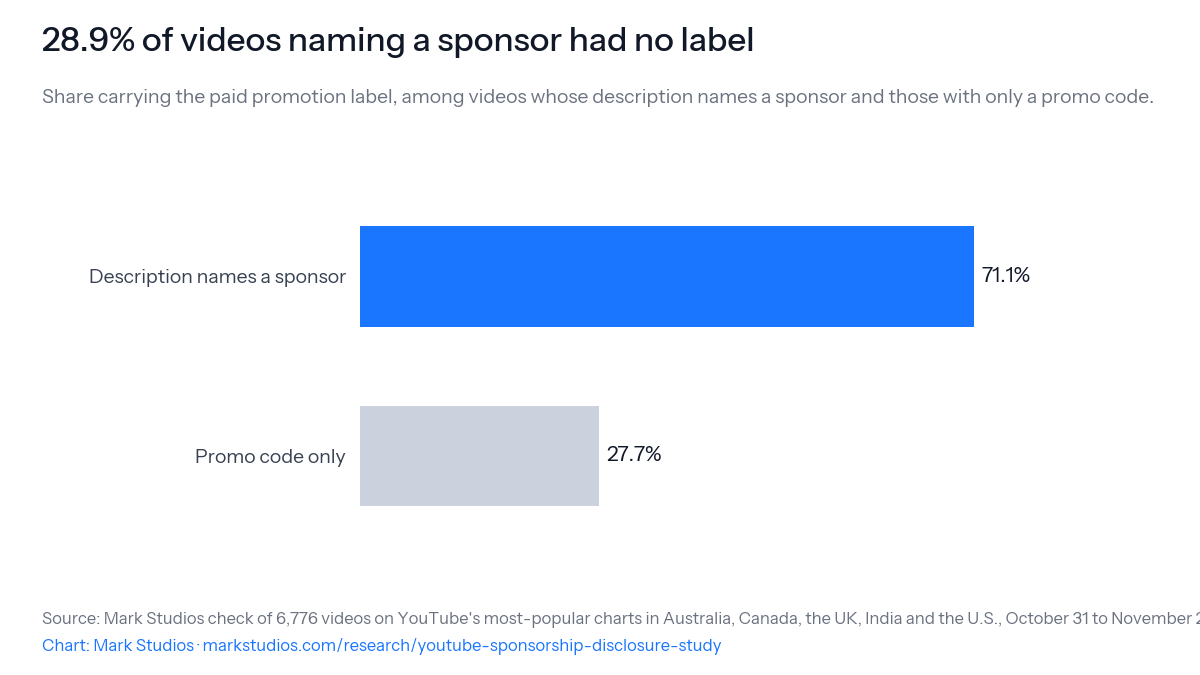
1.7% named a sponsor in the description, and 28.9% of those, 33 of 114, did not carry the label. We read every one of them; a channel's standing list of sponsors, a nonprofit plug or an equipment credit did not count. See details
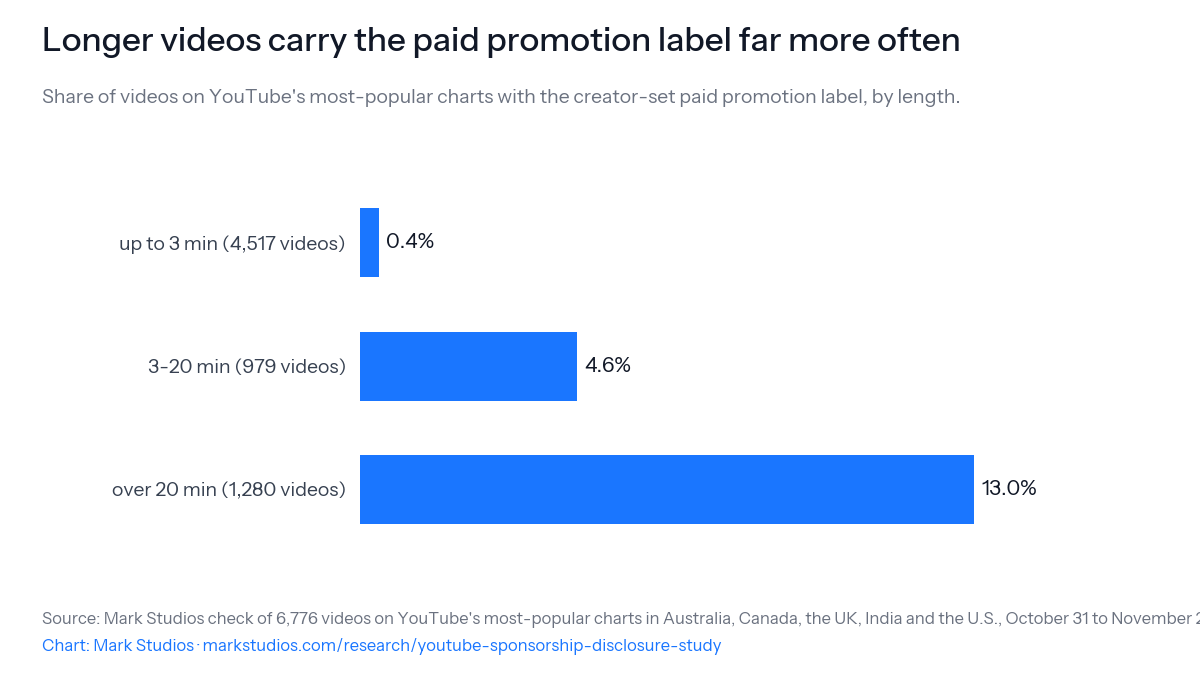
Length decides most of it: 13.0% of videos over 20 minutes carried the label, against 0.4% of videos up to 3 minutes, most of them Shorts. See details
48.3% of labelled videos named no sponsor or promo code in the description, so the sponsorship is mentioned only in the video itself. See details
Videos with only a brand promo code in the description, often a standing deal, carried the label 27.7% of the time. See details
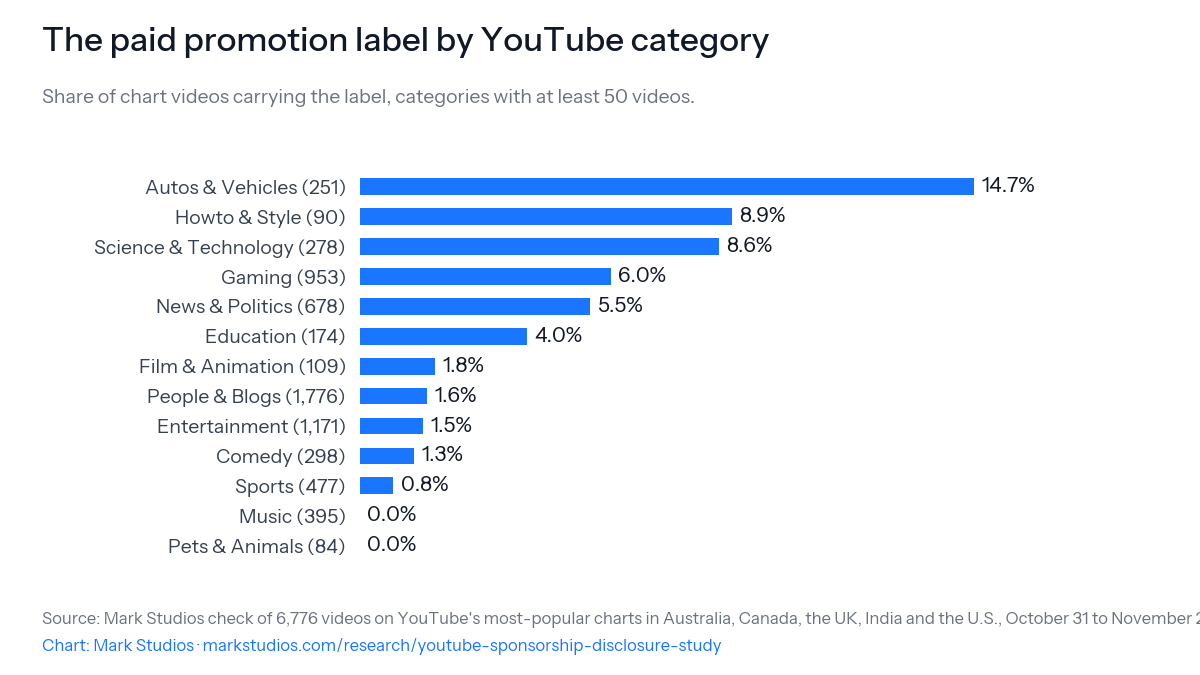
Autos & Vehicles videos carried the label most often, at 14.7%, among categories with at least 50 chart videos. See details
What is YouTube's paid promotion label?
When a creator ticks the paid promotion box in a video's details, YouTube shows a disclosure label at the start of the video. YouTube says creators "have to let YouTube know" this way when a video has branded content, sponsorships, endorsements or other commercial relationships, and that creators remain responsible for following the law (YouTube Help). In the U.S., the FTC's guide for influencers says a disclosure belongs in the video itself, not just in the description, and not to assume a platform's tool is enough on its own (FTC).
The label is public: the YouTube Data API returns it for any video. In our YouTube metadata study of the most-subscribed channels' uploads, 3% of regular videos and 2% of Shorts carried it; this study looks at the charts instead and checks the label against the description. So does the description, where many creators thank a sponsor or give a promo code. Comparing the two shows how often creators use YouTube's tool when the description names a deal.
How many popular videos carry the label?
Of the 6,776 videos on YouTube's most-popular charts in Australia, Canada, the UK, India and the U.S. (October 31 to November 2, 2026), 3.4% carried the paid promotion label (232 videos). The charts mix Shorts, music videos, trailers and sports clips with long creator videos, and sponsorships sit almost entirely in the long ones.
By country chart
Chart
Videos
Paid promotion label
Description names a sponsor
Of those, labelled
Australia
2,170
4.7%
2.9%
68.8%
Canada
2,361
4.7%
2.8%
75.8%
the UK
2,407
4.0%
2.2%
61.1%
India
2,150
0.7%
0.0%
–
the U.S.
2,897
4.5%
2.7%
74.4%
A video can sit on several countries' charts, so the rows overlap. India's chart named a sponsor in 1 description: our phrases are English, and most of its descriptions are not, so the India row undercounts. Shares of fewer than 10 videos are not shown.
Which videos carry it?
Length is the clearest divide. 13.0% of videos over 20 minutes carried the label and 7.1% named a sponsor in the description, against 4.6% of videos from 3 to 20 minutes and 0.4% of videos up to 3 minutes, most of them Shorts.
Longer videos carry the paid promotion label far more oftenShare of videos on YouTube's most-popular charts with the creator-set paid promotion label, by length.Use this chart on your site
Usually, not always. 1.7% of the chart videos named a sponsor in the description: "sponsored by", "thanks to … for sponsoring this video", "this episode is brought to you by", "#ad" or "paid partnership". Of those 114 videos, 81 carried the label and 33 (28.9%) did not.
We read each of the 56 unlabelled candidates by hand and set aside 23 that were not a sponsorship of that video: a channel's standing list of sponsors in every description, a plug for a nonprofit, an equipment credit. Another 2.1% of videos carried only a brand promo code, often a standing deal with a drinks or gear brand, and 27.7% of those carried the label.
28.9% of videos naming a sponsor had no labelShare carrying the paid promotion label, among videos whose description names a sponsor and those with only a promo code.Use this chart on your site
An unlabelled video may still disclose the deal on screen or out loud, which the FTC treats as the disclosure that counts, and we cannot see that from the data. What the gap shows is that the creator did not use YouTube's own tool for a sponsorship the description names.
Which brands sponsor popular videos?
No brand dominates. The sponsors named most often were SeatGeek (4 videos, 4 channels), BRUNT (4 videos, 4 channels), Helix Sleep (3 videos, 3 channels) and Upside (3 videos, 3 channels), each on 4 or fewer chart videos; 67 different brands were named in all.
Do labelled videos mention the sponsor in the description?
Not always. 48.3% of the 232 labelled videos named no sponsor and gave no promo code in the description. Their sponsorship is in the video only, a read by the host or a product on screen, which is what the label exists for.
Which categories carry the label most?
Autos & Vehicles videos carried the label most often, at 14.7%, among YouTube categories with at least 50 chart videos. Music, sports and film clips almost never did.
The paid promotion label by YouTube categoryShare of chart videos carrying the label, categories with at least 50 videos.Use this chart on your site
Tick the box and say it in the video. YouTube asks for the label; the FTC asks for a clear disclosure in the video. One does not replace the other.
Brands can check their own deals. The label is public. A brand can confirm that every video it paid for carries it before the campaign report goes out.
Promo codes are a grey area. A standing code with a gear or drinks brand may not be a paid promotion of the video it sits under, but a sponsored read is.
Videos. On October 31 to November 2, 2026 we read YouTube's most-popular chart for Australia, Canada, the UK, India and the U.S. through the YouTube Data API, overall and for each video category the chart serves, up to 200 videos per chart. Each video counts once (6,776 unique videos; live and upcoming streams left out).
The label. The API's paidProductPlacementDetails.hasPaidProductPlacement field, which is true when the creator has ticked the paid promotion box (YouTube Data API).
The description. A video names a sponsor when its description says "sponsored by", "this video/episode is sponsored", "thanks to … for sponsoring", "today's sponsor", "brought to you by", "paid partnership", "#ad" or "#sponsored", or lists a "Sponsor:". Channel memberships ("become a sponsor", "join this channel"), denials ("not sponsored"), disclosure-policy notes and Fortnite creator codes do not count. A brand promo code ("use code X") with no named sponsor is counted separately. Every named-sponsor video without the label was read by hand.
Limitations
We cannot see the video. A creator who did not tick the box may still disclose on screen or out loud.
Descriptions miss sponsorships. A sponsor read in the video with nothing in the description counts as unnamed here, so the named-sponsor share is a floor.
Charts, not all of YouTube. The most-popular charts lean to new, widely watched videos and to certain categories; smaller channels may behave differently.
English-language matching. Sponsorship phrases are matched in English; the India chart's non-English descriptions are undercounted.
Mark Studios. "YouTube Sponsorship Disclosure Study." Published November 2, 2026. https://www.markstudios.com/research/youtube-sponsorship-disclosure-study
APA
Mark Studios. (2026, November 2). YouTube sponsorship disclosure study. https://www.markstudios.com/research/youtube-sponsorship-disclosure-study
MLA
“YouTube Sponsorship Disclosure Study.” Mark Studios, 2 Nov. 2026, www.markstudios.com/research/youtube-sponsorship-disclosure-study.
Chicago
Mark Studios. “YouTube Sponsorship Disclosure Study.” Last modified November 2, 2026. https://www.markstudios.com/research/youtube-sponsorship-disclosure-study.
Our measurements and the CSV are free to reuse under CC BY 4.0 with a link to this page. The videos remain the property of the channels that published them.
November 2, 2026: Scoped the top-category takeaway to categories with at least 50 chart videos, as the category section already was.
Frequently asked questions
What is YouTube's paid promotion label?
It is a notice YouTube shows at the start of a video when the creator ticks the paid promotion box in the video's details. YouTube asks creators to tick it for branded content, sponsorships, endorsements and other commercial relationships, and says creators remain responsible for meeting legal requirements such as the FTC's rules in the U.S.
How many YouTube videos are sponsored?
Of the 6,776 videos on YouTube's most-popular charts we checked in Australia, Canada, the UK, India and the U.S., 3.4% carried the paid promotion label and 1.7% named a sponsor in the description. Among videos over 20 minutes the label rate was 13.0%; among videos up to 3 minutes it was 0.4%.
Do YouTubers always use the paid promotion label?
No. Of the videos whose description named a sponsor, 28.9% did not carry YouTube's label. That does not prove the video failed to disclose: a creator can say it on screen or out loud, which the FTC treats as the disclosure that matters. It does mean the creator did not use YouTube's own tool.
Is a disclosure in the YouTube description enough?
The FTC says no: its guide for influencers says a disclosure should be in the video, not just in the description, and that a platform's disclosure tool may not be enough on its own. It suggests using the platform's tool in addition to a clear disclosure of your own.
Can I use this data?
Yes. Our measurements and the per-video CSV are free to reuse under CC BY 4.0 with a link to this page. The videos belong to the channels that published them; we publish their public counts, titles, links and the short phrases our check matched, not the descriptions.