
Your Logo Is Judged at 98 Pixels
YouTube's channel branding documentation accepts a profile picture up to 15 MB. It then tells you exactly what happens to it: "Image that renders at 98 X 98 px." Whatever you uploaded, that is the size a viewer meets it at, next to every comment you leave and at the top of every search result your channel appears in.
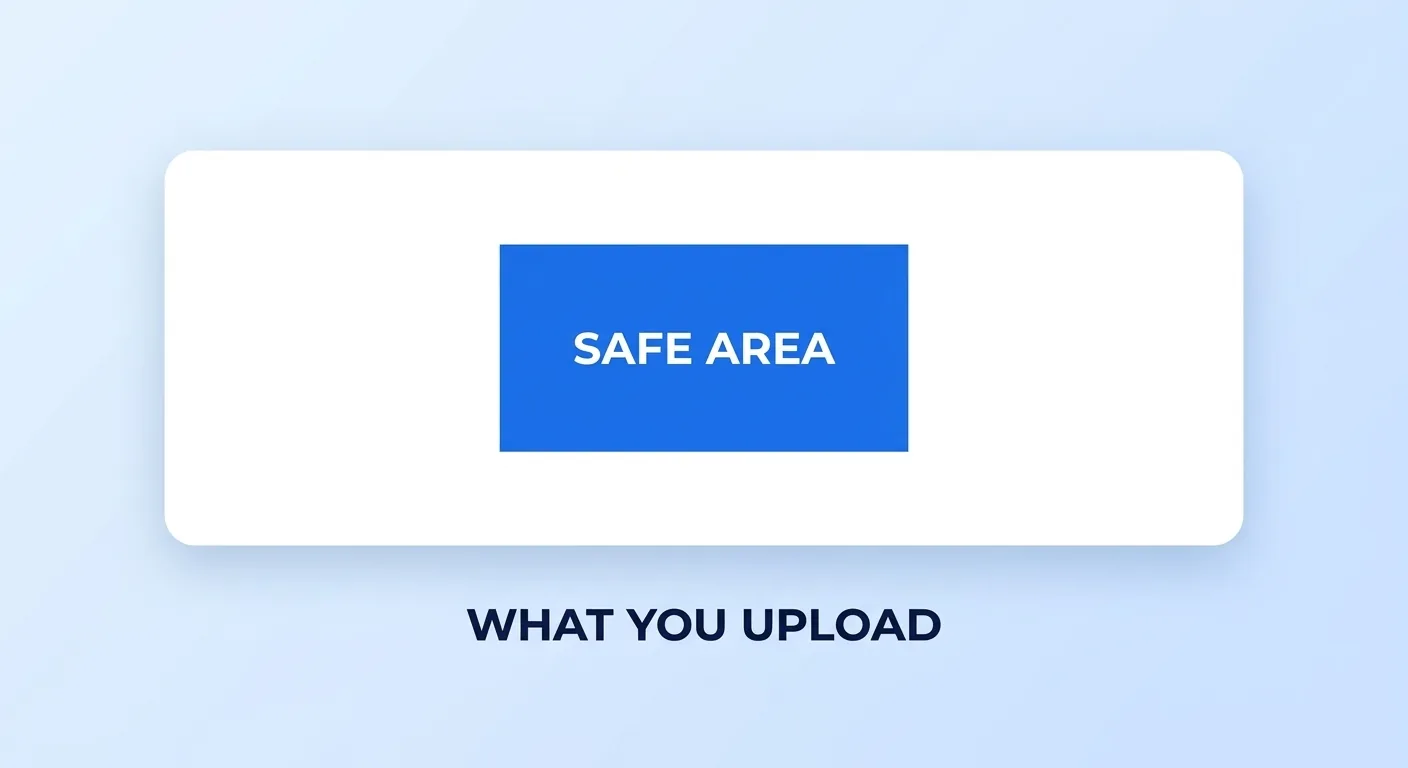
The banner is the same story with a harsher twist. Minimum upload is 2048 × 1152 at 16:9, recommended 2560 × 1440 for TV — but the safe area for text and logos is 1235 × 338 px. That is roughly 60% of the width and under a third of the height. Everything outside it gets cropped on some device, and YouTube adds a flat instruction most brand kits ignore: "Do not include any additional file embellishments (e.g. shadows, borders, and frames)."
A brand kit that was approved at full size in a design file and never checked at render size is the most common branding failure we see. Our guide to building the visual identity system covers the components; this post covers whether those components survive contact with YouTube's actual surfaces.
Design for the Render, Not the Canvas

The practical consequences are specific:
| Asset | Upload spec | What it means in practice |
|---|---|---|
| Profile picture | JPG, GIF, BMP or PNG, no animated GIFs, max 15 MB | Renders at 98 × 98. A wordmark is illegible here. Use a single glyph or monogram |
| Banner | Min 2048 × 1152, rec. 2560 × 1440, under 6 MB | Only 1235 × 338 is safe. Anything meaningful outside that band is decoration |
| Video watermark | Square, minimum 150 × 150 | The one persistent subscribe affordance inside the player |
The 98-pixel constraint is the one that changes design decisions. At that size you have room for one shape, one colour relationship, and no fine detail. A full wordmark becomes a grey smear; an icon with three tones becomes one tone. Channels whose avatar is recognisable at a glance in a comment thread almost always resolved to a single mark, and channels that kept the full logo almost always did not.
The banner safe area matters in a different way. Because the guaranteed zone is a narrow central band, anything you want read — a tagline, an upload schedule, a sponsor mark — belongs inside 1235 × 338 and nowhere else. Treat the rest of the 2048 × 1152 as atmosphere that some viewers will never see. The instruction against shadows, borders and frames is worth taking literally too: a border drawn into the image gets cropped asymmetrically and looks like a mistake rather than a frame.
The Asset That Actually Asks for the Subscribe
The video watermark is the only branding element that sits inside the player for the duration of a video and acts as a subscribe affordance. It is square, minimum 150 × 150, and can be set to appear at the end of the video, from a custom start time, or throughout.
There is a condition worth knowing before you build the workflow around it: watermarks are not available on videos set as made for kids, and if a video is later reclassified as made for kids, viewers stop seeing the watermark on it. That links your branding directly to a governance setting — the channel-level audience declaration applies to existing and future videos, and per-video settings override it. A channel that flips its audience setting has quietly switched off its own subscribe overlay across the back catalogue, which is exactly the kind of thing a quarterly channel management pass is for.
On timing: the end-of-video option is the conventional choice, but it competes for attention with end screens. Running the watermark from a custom start time — after the hook lands, before the midpoint — puts the ask in front of a viewer who is still watching rather than one who is already leaving.
The Brand Kit Render Test
Before you sign off a kit, run it at the sizes that matter rather than the size you drew it:
- Export the avatar at 98 × 98 and look at it. Not scaled in a design tool — exported. If you cannot identify it at a glance, it is a logo, not an avatar.
- Mask the banner to the central 1235 × 338. Everything readable has to be inside. If your tagline is not, move it.
- Strip the embellishments. Shadows, borders and frames baked into the banner file will be cropped unevenly.
- Check the avatar against your own thumbnails. They appear together in every search result and suggested card, and the thumbnail specification asks for an image "as large as possible" — recommended 3840 × 2160 — so you are pairing a 4K asset with a 98-pixel one in the same card. If the avatar uses the same colour as your thumbnail background, it disappears; the thumbnail pre-publish checklist treats this as a set-level check for the same reason.
- Confirm the watermark exists and the audience setting allows it. An empty watermark slot is the cheapest conversion fix on this list.
- View the channel page on a TV, or at TV dimensions. That is why YouTube recommends 2560 × 1440, and it is the surface nobody checks.
Across 10,000+ delivered projects the pattern is consistent: the kits that hold up are not the most beautiful ones, they are the ones whose designer knew the render sizes before starting. Recognition compounds — a viewer who can identify your channel from a 98-pixel circle is a viewer who can find you again — and it is also why the thumbnail and title guidance treats packaging as a system rather than a set of individual assets. Backlinko's ranking-factor research is a reasonable outside read on which surfaces these assets are competing in.
If you would rather hand the whole kit over — avatar, banner, watermark, thumbnail templates, and the motion pack that keeps them consistent in-video — that is what our design and branding service does. It matters most in categories where the avatar is competing in a dense feed, which is why we run it as a distinct track for gaming creators.
The Bottom Line
Your avatar renders at 98 × 98 and your banner only guarantees 1235 × 338 of what you upload. Design to those numbers, strip the shadows and frames YouTube tells you not to include, and fill the watermark slot — it is the only always-on subscribe affordance you get, and it silently switches off on anything set as made for kids.