Nothing in Your Pipeline Is Actually Slow
Add up the hours somebody spends genuinely working on a ten-minute video and you get a number in the low double digits. Then look at the calendar and it took three weeks. The gap is not effort, and it is not skill. It is the project sitting still between the moments anyone touches it — waiting for a brief to be finished, for an upload to complete, for someone to watch the cut, for notes to come back.
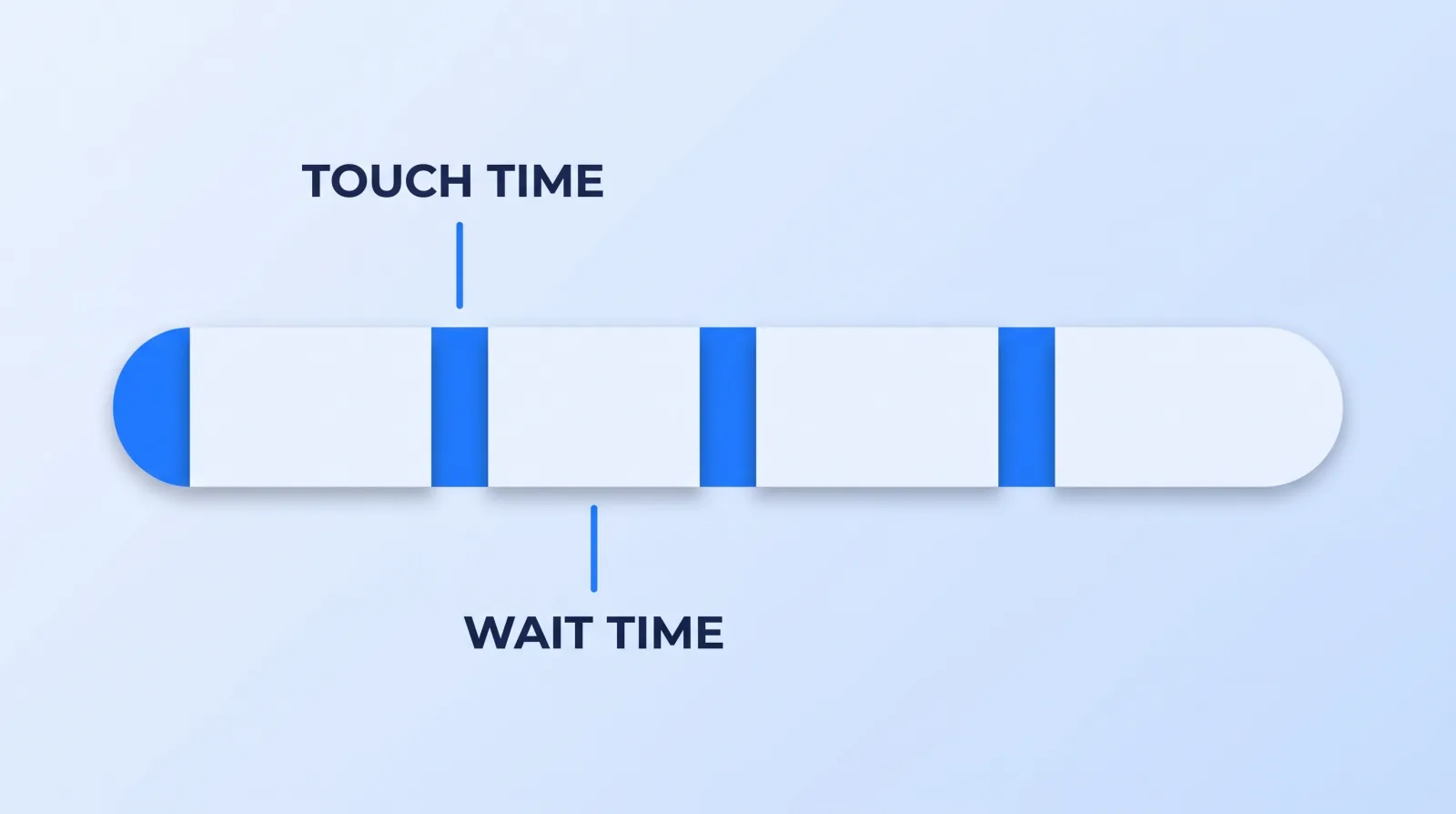
That is why hiring a faster editor so rarely moves the delivery date, and why how long an edit actually takes is a different question from how long a project takes. Streamlining a video project is not about making anyone work faster. It is about deleting the parts that have to happen in order.
The Only Three Things That Must Happen in Order
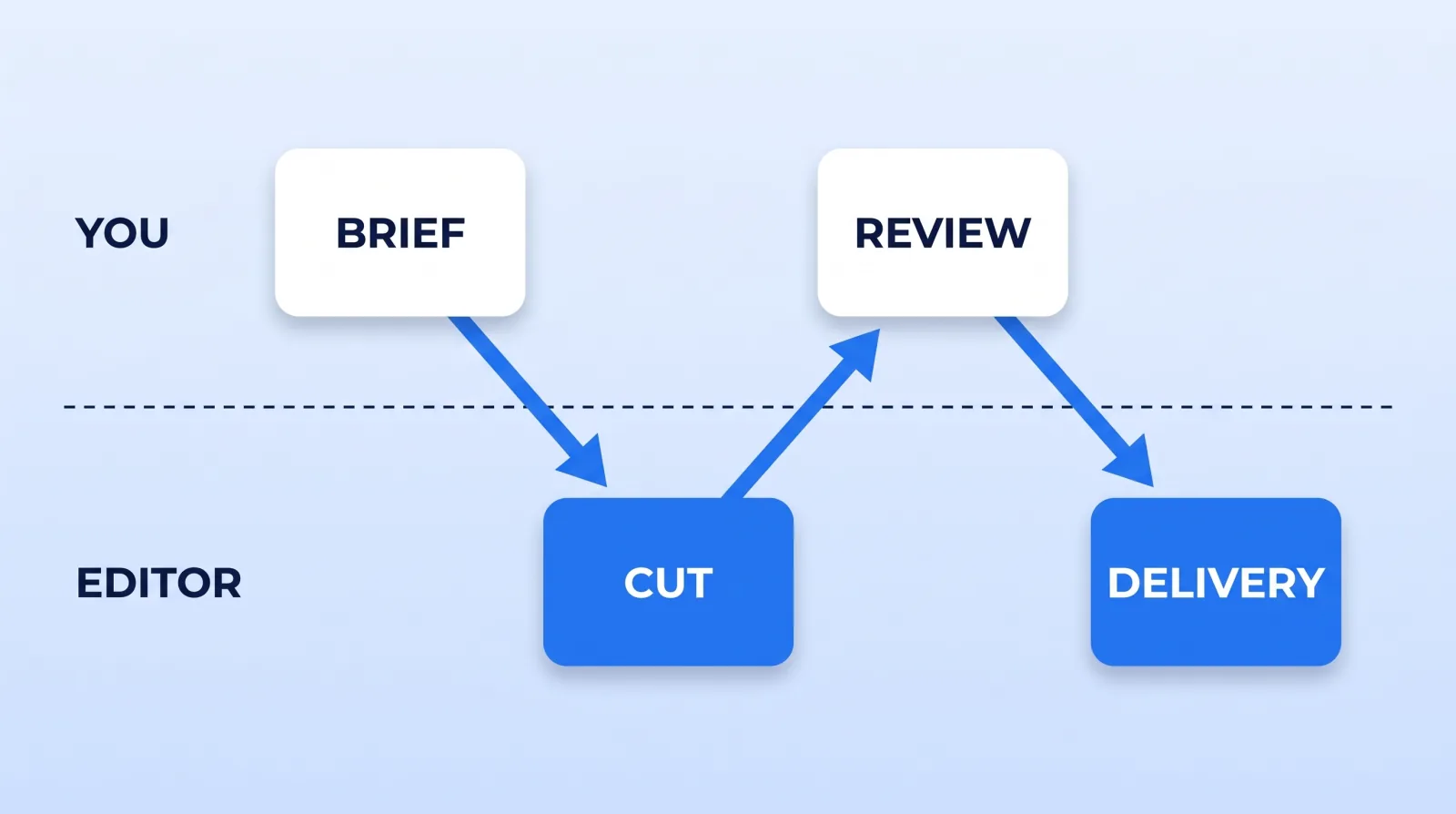
Here is the entire serial chain in a video project:
- Someone cuts the video.
- Someone watches the cut.
- Someone changes the cut.
That is it. Everything else in a typical delivery — thumbnail, title, captions, description, upload settings, the vertical cutdowns — has no technical dependency on a finished timeline. It queues behind the edit out of habit, and that habit is usually worth more calendar days than the edit itself.
Take the two most commonly delayed assets. A custom thumbnail is an image file with its own published spec: YouTube's thumbnail requirements ask for "a resolution of 3840 x 2160 pixels for videos," a minimum width of 640 pixels, JPG or PNG, 16:9, under 50 MB uploading from desktop. Nothing in that list mentions a locked cut. A thumbnail needs a concept and one usable frame or photograph, both of which exist on day one. Captions are the same story from the other direction — YouTube's automatic captioning documentation states plainly that it "can use speech recognition technology to automatically create captions for your videos," and warns that automatic captions "may not be ready at the time that you upload a video," which is precisely why a transcript produced from the audio earlier in the week beats waiting on the platform after publish.
The upload itself is also not a deadline. YouTube's scheduling documentation is explicit that to schedule a publication time "you have to first set the video as 'scheduled' or 'private' on the upload page," then "set the date, time, and time zone that you want your video to be published." The file can be sitting on the platform for three days before anyone sees it. And the metadata you retype every week does not need retyping at all: upload defaults let you preset "your videos' privacy setting, category, title, tags, comments, language, and more," with the one caveat that they "only affect videos uploaded through your browser on youtube.com/upload."
Definition of Ready: What Unblocks Each Stage
A stage does not start because someone is free. It starts because the thing it needs exists. Write that condition down once, and most of the queue disappears — because the gap gets found at the handoff instead of three days into the edit.
| Stage | Definition of ready | Who holds it |
|---|---|---|
| Brief | Runtime, platform, aspect ratio and two reference videos, written down | You |
| Footage handoff | One folder, consistent naming, separate audio if you recorded it, upload finished | You |
| Cut | Brief and footage both complete — not one of the two | Editor |
| Review | The cut watched end to end in one sitting, notes timecoded | You |
| Revise | Notes specific, consolidated into one list, internally consistent | Editor |
| Delivery | Approved cut plus the parallel assets built alongside it | Editor |
The column that matters is the third one. Most delay is not somebody refusing to work; it is nobody knowing whose desk the project is currently on. Naming the holder and dating each handoff turns an invisible queue into something you can point at. Our first-30-days onboarding plan treats this as week-one work for exactly that reason, and the admin hours nobody prices is what it costs when you skip it.
Two Rounds, Agreed Before Anyone Starts
Revisions are where schedules actually die, because every round costs twice: the fix, and then a fresh wait for the next review to come back. Three rounds with two days of waiting each is six calendar days for perhaps four hours of work.
Cap it at two rounds and say so in the brief. Round one takes structural notes — order, pacing, what comes out. Round two takes polish — a graphic, a level, a frame. The mechanics matter as much as the count: a note anchored to a timecode is a task, and a note in an email is a research project. Review tools exist specifically for this, and Frame.io's commenting documentation describes the behaviour well — you "pause the video at the exact timecode of your note," the comment is "posted as a comment card and comment bubble marking the timecode position," and for anything spanning more than a single frame you "use range-based comments." Notes that actually get fixed is the long version, and it is the highest-leverage habit on this page.
The Six-Item Start Gate
Run this before a project begins, not after it stalls:
- Is the brief complete? Runtime, platform, aspect ratio, references, music decision. The handoff framework is the template. The point here is that an incomplete brief does not delay the brief — it delays the cut.
- Is the footage finished uploading, and playable? Not "uploading now." A folder still syncing is a folder that is not ready, and a project structure that survives is what stops this becoming a conversation.
- What can start today that does not need the cut? Thumbnail concept, transcript, title options, description, upload defaults. Assign them now, to a named person.
- Who holds each stage? One person on each side, by name. Not a team, not an inbox.
- When is the review? Book it when the project starts, not when the cut arrives. An unbooked review is the longest queue in the system.
- How many rounds, and who signs off? Two, and one named person, written down.
Across 10,000+ delivered projects and 200M+ views, the accounts that ship on schedule are almost never the ones with the fastest editors. They are the ones that close this gate before day one — and between a project that clears it and one that does not, the difference is routinely a week of calendar on identical edit hours.
The reason we run this as a system rather than a preference is that it is the only part of our video editing service a client actually feels day to day. It matters most on episodic formats, where the same pipeline runs every week and a one-day leak compounds fifty times a year — which is why we operate it as a standing schedule for podcasters. If you are weighing whether that pipeline should live inside your own team instead, the in-house comparison is the honest version of that maths.
The Bottom Line
Your project is not slow because anyone is working slowly. It is slow because too much of it is arranged in a line. Only the cut, the review and the revise have to happen in order — thumbnail, captions, metadata and scheduling never did. Write down what has to be true before each stage starts, name who holds it, cap revisions at two rounds, and the same people doing the same work will deliver a week earlier.