

The Short Answer: How Financial Advisors Use YouTube
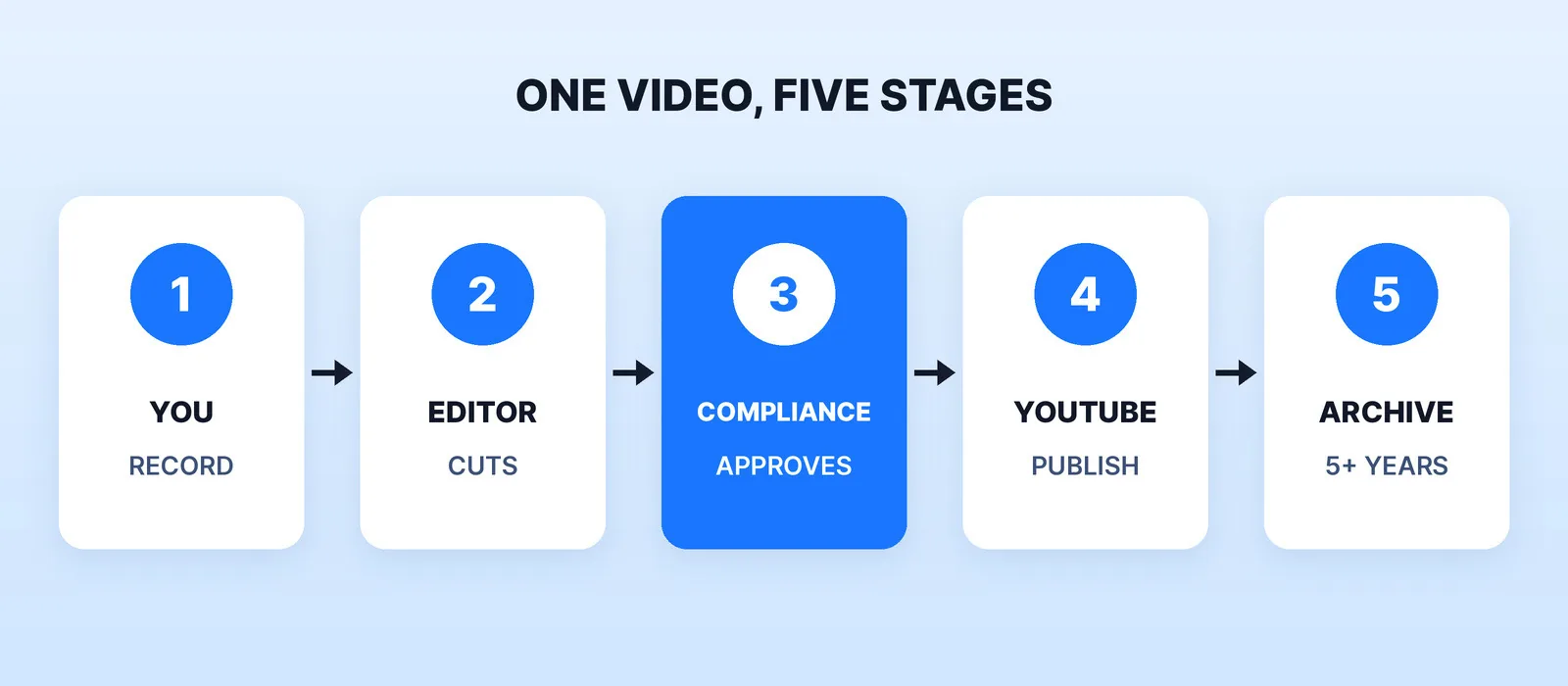
YouTube works for financial advisors when you treat each video as an advertisement, keep compliance in the review loop and hand the cutting to an editor. You record answers to the questions prospects already search. Your compliance team approves every word. Your editor turns the recording into a finished video, with captions, charts built from your numbers and Shorts cut from each upload.
The part most advisors miss is the comment section. When the SEC adopted its marketing rule, the adopting release said that if you delete or suppress negative comments, or push the positive ones up front, those comments are attributed to you. A happy client's comment you pin to the top can turn into a testimonial in your own advertisement. Set your comment policy before the first upload, not after the first nice comment.
This post covers SEC-registered investment advisers. If you're also a registered representative, FINRA's communications rules and your broker-dealer's review apply as well. State-registered advisers answer to their state securities regulator. None of this is legal or compliance advice. Your compliance team makes the call.
Step 1: Treat Every Video as an Advertisement
The rule defines an advertisement as any direct or indirect communication to more than one person that offers your advisory services to prospective clients, or new services to current ones. It leaves out extemporaneous, live, oral communications, so ask compliance how they treat a live stream and its replay. An end screen that invites viewers to book a call is exactly the kind of line that offers your services.
Once a video counts, these conditions apply:
| What's in the video | What the marketing rule requires |
|---|---|
| Any claim of fact | You can substantiate it if the SEC asks |
| Benefits of working with you | Fair and balanced treatment of the material risks and limitations |
| A client or third-party testimonial | A clear, prominent disclosure: client or not, whether they were paid, and any material conflicts |
| A rating or award | The date, the period it covers and who gave it |
| Performance | Net shown with gross, with equal prominence; 1-, 5- and 10-year periods for portfolio results |
The SEC staff keeps adding answers to its marketing rule FAQ. Two were posted in January 2026, on model fees and on testimonial disqualifications. Your compliance team should read each new one before it reaches your scripts.
Step 2: Set Your Comment Policy Before the First Upload
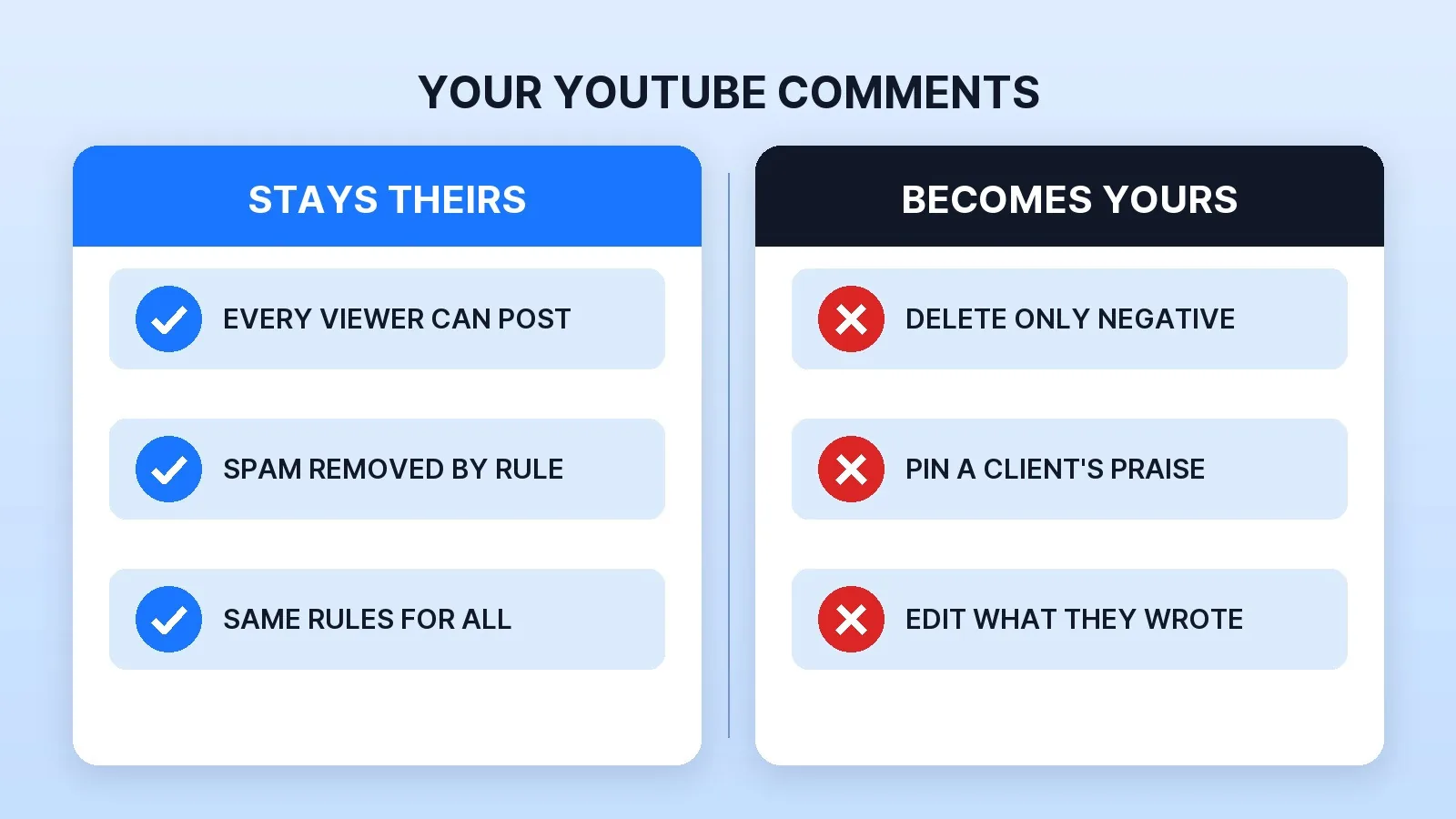
The adopting release draws the line clearly. Letting every viewer post public comments doesn't, on its own, make those comments yours, as long as you don't selectively delete or alter them. You can remove profanity, spam, threats, defamatory or unlawful posts, but only under objective criteria written into your policies and applied the same way to praise and criticism. The release is blunt: a policy of removing only negative comments doesn't count.
Here's how that maps onto YouTube's own tools:
- Hold settings. YouTube's comment settings let you hold none, potentially inappropriate (Basic or Strict) or all comments. Held comments stay private for up to 60 days unless you approve them. "Hold all" is fine, as long as you approve against your written criteria and never by tone.
- Blocked words. Add rule-based terms to the blocked words list, such as profanity or "guaranteed returns" spam, and keep a copy of the list with your policies.
- Pins and hearts. YouTube lets you pin a comment to the top of the watch page and heart one to show appreciation. Pinning a client's praise is prioritizing the display of a positive comment, which is the example the SEC gives. A heart is a public sign of approval, so clear it with compliance before you use it. The safe pin is your own comment with the disclosure or a correction.
For the day-to-day side of comment management, see our YouTube comment moderation system.
Step 3: Split the Work Between You, Compliance and Your Editor
| Task | Who | Why |
|---|---|---|
| Topic, script points and the advice itself | You | Your license and fiduciary duty |
| Recording | You | Your face and voice are the channel |
| Cutting restarts, tangents and pauses | Editor | The biggest time cost |
| Charts and on-screen figures | Editor, from your numbers only | Nothing an editor invents can be substantiated |
| Disclosures on screen | Editor, in your firm's exact wording | The same text every time |
| Captions | Editor; you check every figure | A misheard "15%" becomes "50%" in the record |
| A timecoded list of every on-screen word | Editor | Compliance reviews text without scrubbing video |
| Approval before publishing | Compliance | The call stays with your firm |
Captions need a human. YouTube itself warns that automatic captions can misrepresent what was said and encourages creators to add professional captions. On a finance channel, a wrong number in a caption is a misstatement with your name on it. Our post on burned-in vs closed captions covers which format suits which platform.
Give your editor channel permissions, never your password. If you haven't handed off a video before, start with how to brief a video editor. Our video editing for financial advisors page shows how review cuts and disclosures work in practice, and finance video editing for creators covers market-update channels.
Step 4: Keep Every Version for Five Years
The SEC's books and records rule requires a copy of each advertisement you disseminate. Keep it for at least five years from the end of the fiscal year in which you last disseminated it, with the first two years in an appropriate office. A YouTube video stays public until you take it down, so ask compliance how your firm dates "last disseminated" for evergreen uploads.
Keep a folder per video:
2026-11-18_roth-conversion-explainer/
  final_published.mp4         the exact file uploaded
  onscreen-text_approved.pdf  timecoded text list with compliance sign-off
  title-description-tags.txt  everything typed into YouTube Studio
  thumbnail_final.jpg
  sources/                    the numbers behind every chart
  shorts/                     each Short, with its own caption and approval
Ask your editor for the project files too, so a fix later doesn't mean starting over.
Pre-Publish Checklist
- Compliance has approved the final cut and the on-screen text list, not just the script.
- Every figure on screen matches a source in the folder.
- Disclosures appear in your firm's wording, long enough to read.
- Captions are checked by a person, numbers first.
- No testimonial, rating or performance appears without its required disclosures.
- The title, description and pinned comment were reviewed with the video.
- Comment settings match your written policy.
- The final file and approvals are in the archive folder.
In-House Editor or Outsourced?
A full-time editor makes sense once your firm publishes several videos a week. Below that, an outsourced editor usually costs less than a salary and scales with how often you record. Our in-house vs outsourced comparison lays out the trade-offs, YouTube video editing cost gives market ranges, and how to find a video editor covers building a shortlist. If you'd rather have a production company film at your office, see our list of video production companies for financial advisors.
Mark Studios has delivered 8,000+ orders and holds a 4.9★ rating across 4,500+ reviews. It's Top Rated on Fiverr, with 99% on-time delivery, and you work directly with Mark. Doctors face a similar review problem with different rules, covered in video editing for doctors.
The Bottom Line
On YouTube, an advisor's channel is an advertising program, so the workflow has to produce evidence: approved text, sourced figures, archived files and a comment policy you apply the same way to praise and criticism. Keep the advice and the approval in your hands, and hand the cutting, captions and paperwork to an editor who never adds a claim.


