Is film school worth it? We read the Department of Education's College Scorecard records for every film, video and photographic arts program to compare what graduates earn and borrow with other fields.
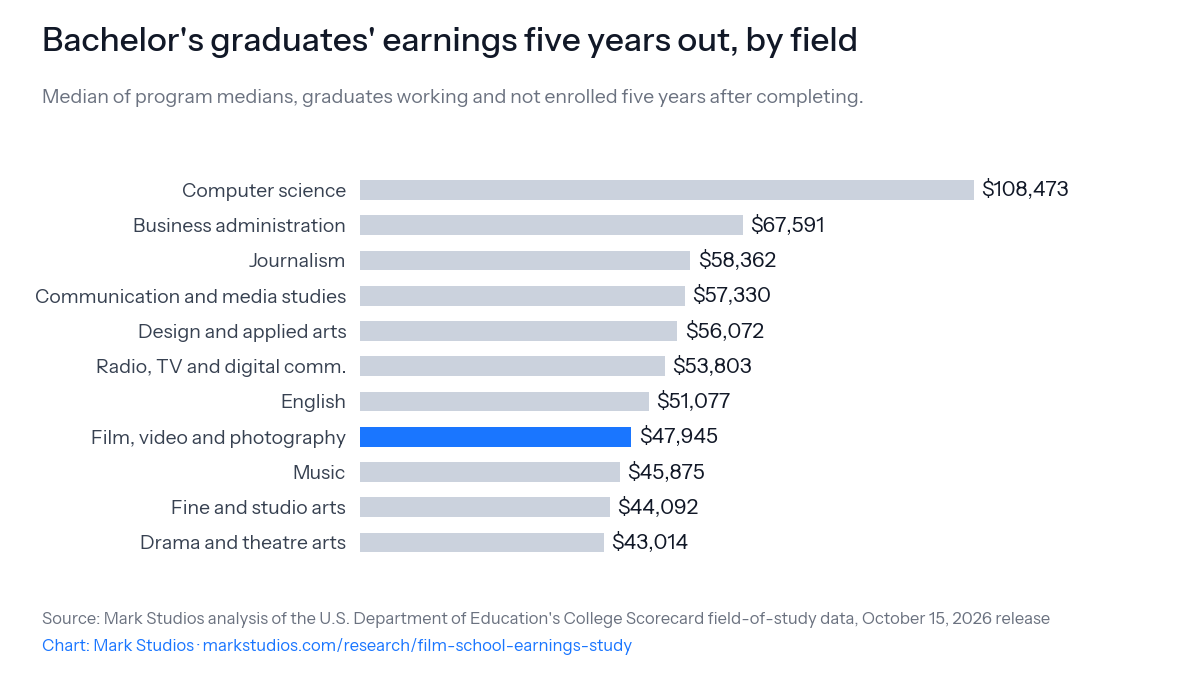
The median film and video bachelor's program has graduates earning $47,945 five years after completing, 24% below the $63,202 of all bachelor's programs; one year out it is $31,368. See details
Of the comparison fields, only drama and theatre arts, fine and studio arts and music graduates earn less; journalism graduates earn $58,362 and computer science graduates $108,473. See details
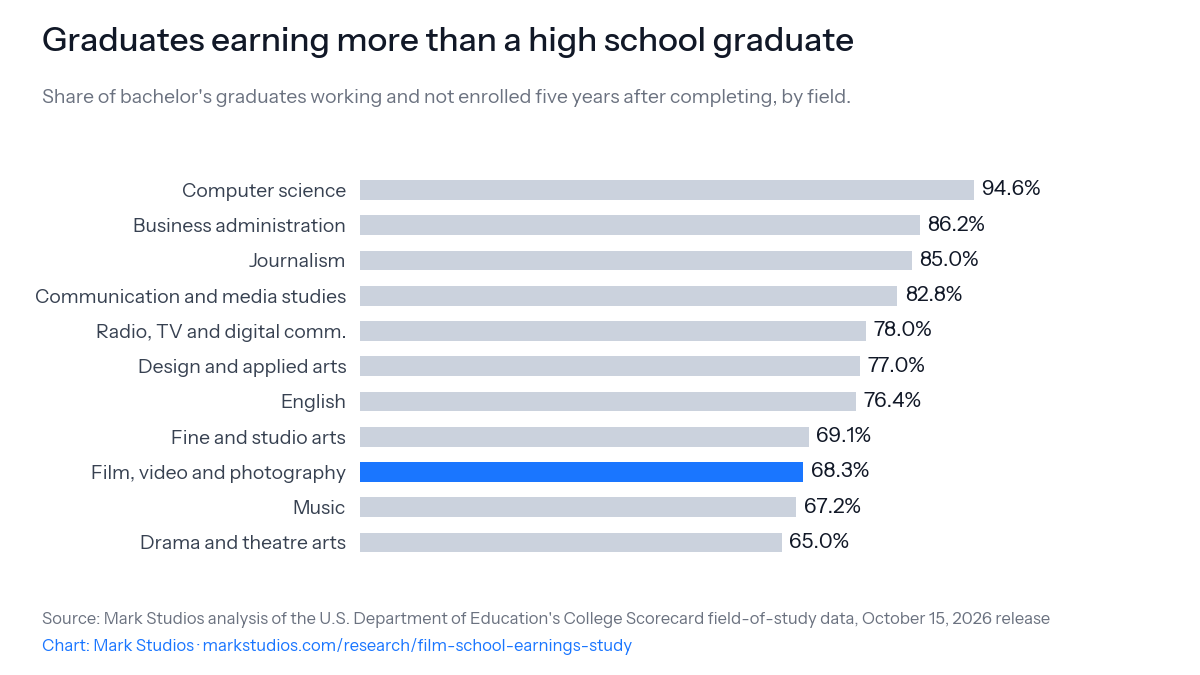
68.3% of film and video graduates working five years after completing earn more than a typical high school graduate, against 86.5% of all bachelor's graduates. See details
Undergraduate debt is ordinary: a median $21,500, against $21,250 for all bachelor's programs. See details
Film master's programs leave graduates with a median $81,617 in federal loans, 2.1 times the master's median; at 6 programs it tops $140,000. See details
The best-paid film bachelor's programs in the data are at Dartmouth College ($79,039), Lafayette College ($77,592) and University of California-Berkeley ($68,814). See details
How much do film school graduates earn?
We read the Department of Education's College Scorecard file of every college program by field of study (College Scorecard, release of October 15, 2026). In film, video and photographic arts, the median bachelor's program has graduates earning $47,945 five years after completing, across the 140 programs with published figures. The median across all 26,939 bachelor's programs with figures is $63,202, so film graduates earn 24% less. One year out the gap is similar: $31,368 against $45,713.
Bachelor's graduates' earnings five years out, by fieldMedian of program medians, graduates working and not enrolled five years after completing.Use this chart on your site
Of the 10 other fields we compared, only drama and theatre arts, fine and studio arts and music graduates earn less five years out. Journalism graduates earn $58,362, radio, television and digital communication graduates $53,803, and computer science graduates $108,473.
Every field we compared, bachelor's programs
Field (4-digit CIP)
Median earnings, 1 year
Median earnings, 5 years
Earn more than a high school graduate, 5 years
Median debt
Programs with 5-year earnings
Computer science
$73,615
$108,473
94.6%
$20,500
327
Business administration and management
$51,554
$67,591
86.2%
$22,250
1221
Journalism
$41,407
$58,362
85.0%
$20,000
186
Communication and media studies
$42,082
$57,330
82.8%
$20,437
656
Design and applied arts
$38,894
$56,072
77.0%
$23,964
284
Radio, television and digital communication
$37,655
$53,803
78.0%
$21,500
146
English language and literature
$36,768
$51,077
76.4%
$20,227
595
Film, video and photographic arts
$31,368
$47,945
68.3%
$21,500
140
Music
$34,293
$45,875
67.2%
$23,204
268
Fine and studio arts
$30,936
$44,092
69.1%
$21,500
428
Drama and theatre arts
$29,608
$43,014
65.0%
$22,375
250
All bachelor's programs
$45,713
$63,202
86.5%
$21,250
26,939
Do film graduates out-earn high school graduates?
Most do, but fewer than in other fields. The Scorecard counts how many graduates working five years after completing earn more than a typical high school graduate. In film, video and photographic arts that is 68.3% of 8,481 graduates, against 86.5% of all bachelor's graduates, close to drama (65.0%), music (67.2%) and fine arts (69.1%).
Graduates earning more than a high school graduateShare of bachelor's graduates working and not enrolled five years after completing, by field.Use this chart on your site
At the bachelor's level, no more than anyone else. The median film and video program leaves graduates with $21,500 in federal Stafford loans, against $21,250 across all bachelor's programs. Because earnings are lower, the debt weighs more: the median film program's debt is 0.67 times its graduates' first-year earnings, against 0.44 for all bachelor's programs. Private nonprofit programs have a median debt of $23,791 and public ones $20,171.
What about a film master's degree?
The debt changes. The median film, video and photographic arts master's program leaves graduates with $81,617 in federal loans, 2.1 times the $39,198 median for all master's programs, the highest of any field we compared. Its graduates' median first-year earnings, $39,104, are below the $65,758 of all master's programs. At the American Film Institute Conservatory, the median debt is $155,710.
The 10 film master's programs with the highest median debt
Institution
Control
Median debt
Median earnings, 1 year
Median earnings, 5 years
American Film Institute Conservatory
Private, nonprofit
$155,710
$44,382
$51,296
New York University
Private, nonprofit
$153,475
$38,545
$50,987
New York Film Academy
Private, for-profit
$146,450
–
$42,651
Loyola Marymount University
Private, nonprofit
$146,411
$41,500
$55,679
Chapman University
Private, nonprofit
$143,654
$39,104
$60,659
University of Southern California
Private, nonprofit
$141,854
$41,896
$55,880
Columbia University in the City of New York
Private, nonprofit
$125,000
$37,896
$51,689
University of California-Los Angeles
Public
$90,438
$37,971
$60,623
Columbia College Chicago
Private, nonprofit
$89,978
–
$63,618
Academy of Art University
Private, for-profit
$81,617
$42,432
$51,948
Master's debt and earnings by field
Field
Median debt
Median earnings, 1 year
Debt / first-year earnings
Film, video and photographic arts
$81,617
$39,104
2.03
Drama and theatre arts
$66,916
$42,359
1.55
Design and applied arts
$57,357
$53,468
0.85
Fine and studio arts
$44,678
$39,982
1.19
Radio, television and digital communication
$41,732
$60,622
0.58
Music
$39,700
$37,026
1.08
Journalism
$34,692
$58,724
0.6
Computer science
$34,500
$118,338
0.26
Business administration and management
$34,166
$77,658
0.41
Communication and media studies
$33,699
$56,486
0.56
English language and literature
$32,606
$51,422
0.59
Which film programs pay off best?
Among film and video bachelor's programs with published five-year earnings, the highest are at Dartmouth College ($79,039), Lafayette College ($77,592) and University of California-Berkeley ($68,814). The Scorecard withholds figures for programs with too few graduates, so many film programs, including some well-known ones, do not appear.
The 15 film bachelor's programs with the highest five-year earnings
Institution
Control
Median earnings, 5 years
Median earnings, 1 year
Median debt
Dartmouth College
Private, nonprofit
$79,039
–
–
Lafayette College
Private, nonprofit
$77,592
–
–
University of California-Berkeley
Public
$68,814
$35,898
$12,979
Chapman University
Private, nonprofit
$67,354
$40,622
$19,500
Mount Saint Mary's University
Private, nonprofit
$64,448
$41,871
$27,000
University of Michigan-Ann Arbor
Public
$64,159
$34,262
$19,500
Seattle University
Private, nonprofit
$63,850
–
$20,500
Fordham University
Private, nonprofit
$63,729
$37,428
$24,250
University of Southern California
Private, nonprofit
$63,722
$34,718
$17,000
American University
Private, nonprofit
$61,982
$38,663
$19,500
New York University
Private, nonprofit
$61,977
$36,652
$19,750
CUNY Hunter College
Public
$60,556
$40,578
$12,500
University of California-Irvine
Public
$59,908
$30,830
$12,853
University of California-Davis
Public
$59,314
$31,184
$12,800
Loyola Marymount University
Private, nonprofit
$59,134
$40,146
$20,000
What this means
A film degree is a lower-paying start. Graduates trail the typical bachelor's degree by about 24% five years out.
The debt matters more than the degree. Undergraduate borrowing is ordinary; the median film master's carries 2.1 times the usual master's debt.
Check the program, not the field. Earnings vary widely between schools.
Data. The College Scorecard's most recent field-of-study file (download, released October 15, 2026), read November 1, 2026: 223,587 programs, each one institution, one 4-digit field of study (CIP code) and one credential level. Film and video is CIP 50.06, film/video and photographic arts, which also includes photography programs.
Measures. Earnings are the Scorecard's median earnings of graduates who received federal aid and were working and not enrolled one and five years after completing; the high school comparison is the Scorecard's count of those graduates earning more than a typical high school graduate; debt is the median federal Stafford and Grad PLUS loan debt (definitions, technical documentation). Field figures are the median of program medians, among programs whose figures the Scorecard publishes; the high school share pools graduates across programs.
Limitations
Federal aid recipients only. Graduates who never received federal aid are not in the earnings or debt figures.
Small programs are withheld. The Scorecard suppresses figures for programs with few graduates, so the medians describe larger programs.
Photography is included. CIP 50.06 mixes film and video with photography programs.
Medians of programs, not of people. A large program counts the same as a small one in the field medians.
Earnings are early-career. Five years after completing is not a lifetime.
We plan to rerun the read after each College Scorecard data release. Corrections go to contact@markstudios.com.
November 1, 2026: First published.
Frequently asked questions
How much do film school graduates earn?
In the Department of Education's College Scorecard, the median film, video and photographic arts bachelor's program has graduates earning $31,368 one year after completing and $47,945 five years after, against $63,202 for all bachelor's programs. The figures cover graduates who received federal aid.
Is film school worth it?
It depends on the program and the debt. Five years out, 68.3% of film and video bachelor's graduates earn more than a typical high school graduate, against 86.5% of all bachelor's graduates, while their median debt, $21,500, is ordinary. Film master's programs carry much heavier debt.
How much debt do film master's students take on?
The median film master's program leaves graduates with $81,617 in federal Stafford and Grad PLUS loans, 2.1 times the $39,198 median for all master's programs. At the American Film Institute Conservatory the median is $155,710.
Which film schools have the highest-earning graduates?
Among film and video bachelor's programs with published five-year earnings, Dartmouth College ($79,039), Lafayette College ($77,592) and University of California-Berkeley ($68,814) rank highest. Many programs are too small for the Scorecard to publish.
Can I use this data?
Yes. The CSV of every film, video and photographic arts program in the Scorecard file, with earnings, debt and graduate counts where published, is free to reuse under CC BY 4.0 with a link to this page.