How do the world's most-visited websites handle the SEO basics on their homepage? We read the titles, meta descriptions, headings, social tags and structured data of 567 homepages from the Tranco top 1,000. Here is what they set, how long their titles and descriptions run, and what Google's own documentation says about each.
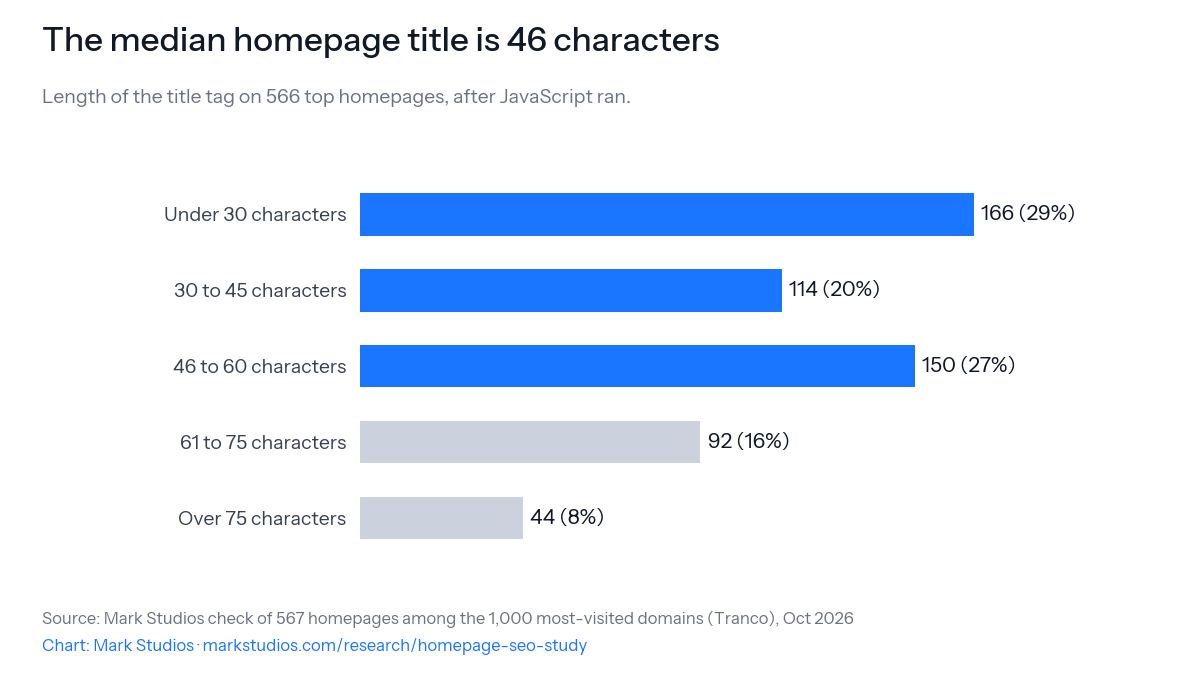
The median homepage title on the 1,000 most-visited domains is 46 characters; half run between 25 and 60, and 136 of 566 (24%) are longer than 60. See details
78% of titles include the site's name, and 73 (13%) are a single word, as on Google, YouTube, Facebook and Instagram. See details
64 homepages (11%) have no meta description. Those that do run a median 146 characters, and 25% are longer than 160. See details
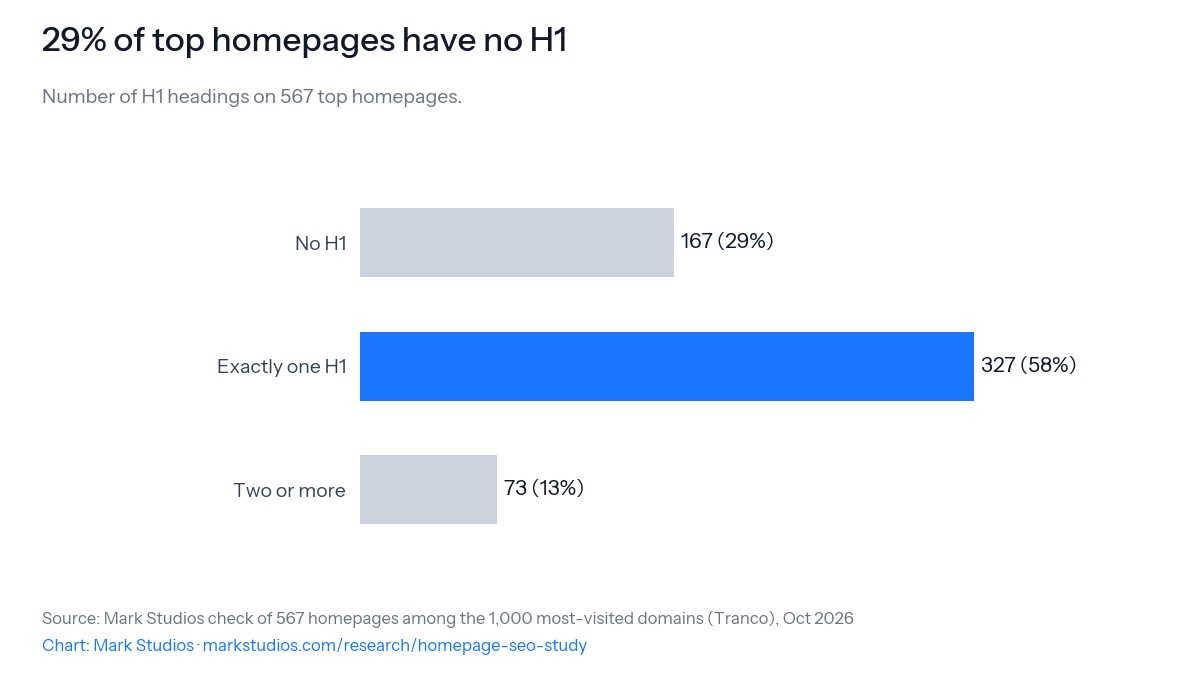
167 homepages (29%) have no H1 heading at all; 58% have exactly one and 13% have two or more. See details
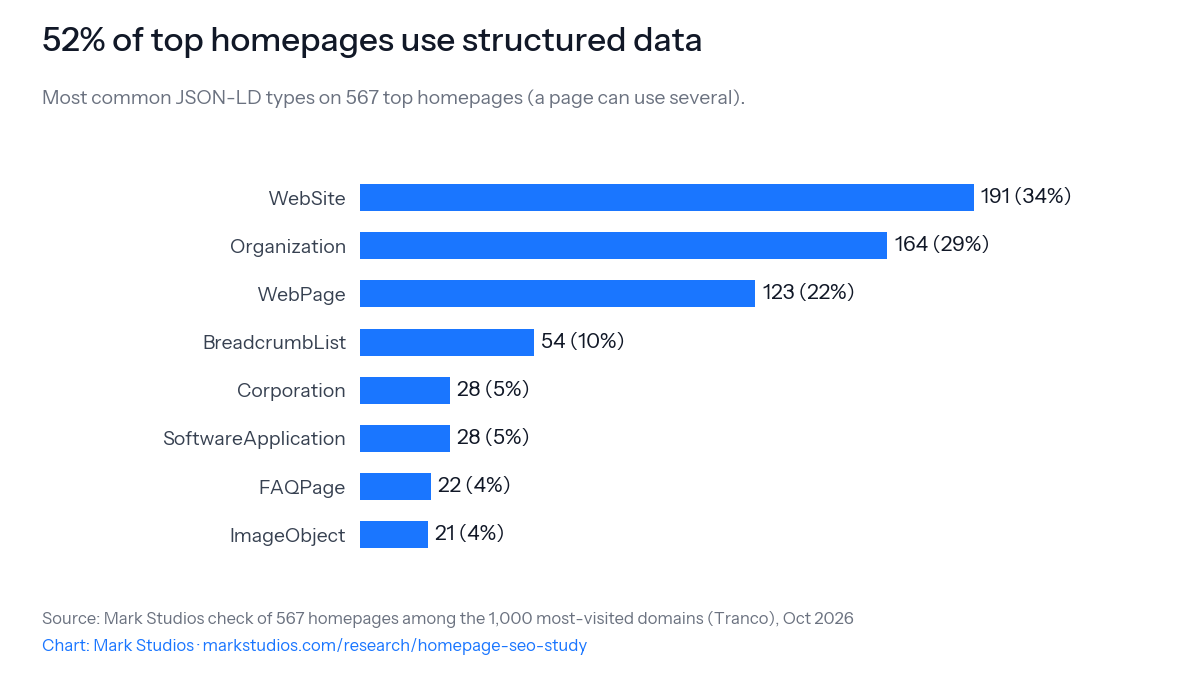
52% use structured data: 34% mark up WebSite, the markup Google uses for site names, and 37% an Organization. See details
Social previews are patchy: 69% set an Open Graph image and 55% a Twitter/X card. See details
Which SEO basics do top homepages have?
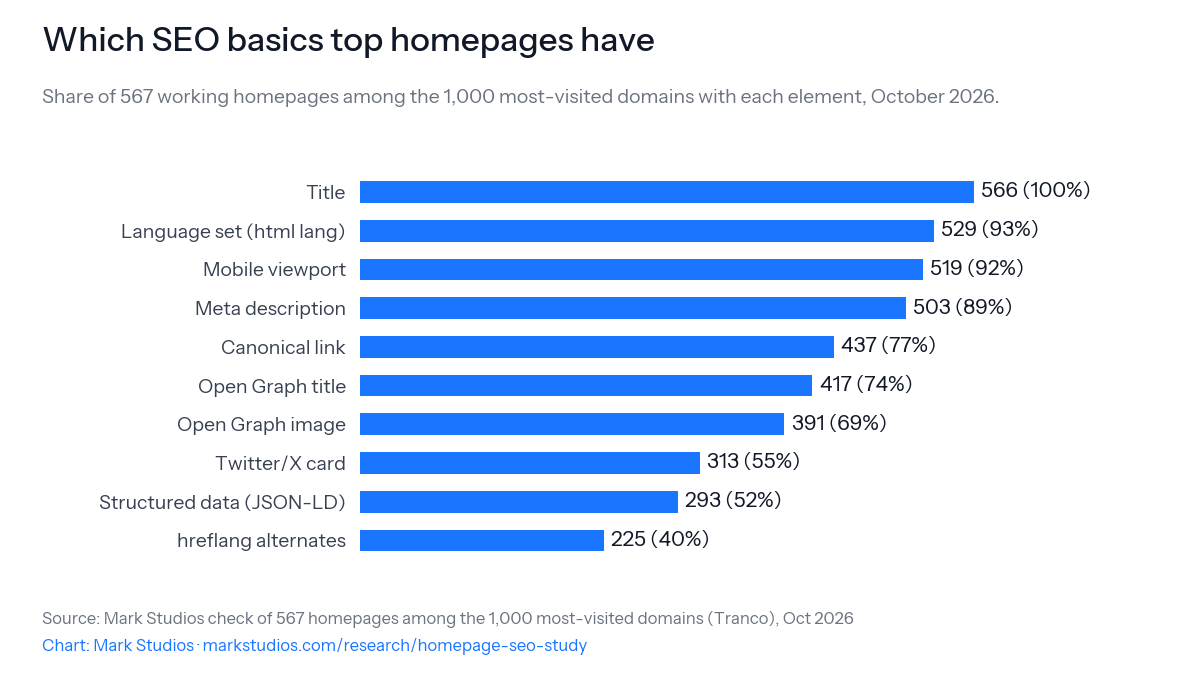
Most have the essentials, fewer have the extras. We opened the homepage of each of the 1,000 most-visited domains on the Tranco list and read its search and sharing tags, headings and structured data. Of the 567 working homepages, nearly all set a title, a language and a mobile viewport; 89% have a meta description, 77% a canonical link and 52% structured data.
Which SEO basics top homepages haveShare of 567 working homepages among the 1,000 most-visited domains with each element, October 2026.Use this chart on your site
The median is 46 characters, and half run between 25 and 60. 136 of 566 (24%) are longer than 60 characters, the figure often quoted as a limit, and 166 (29%) are shorter than 30. Google's own guidance sets no number: "there's no limit on how long a <title> element can be", and a long title is cut in results to fit the device width.
The median homepage title is 46 charactersLength of the title tag on 566 top homepages, after JavaScript ran.Use this chart on your site
78% of titles include the site's name. The most common separator between a page name and the brand is a vertical bar (195 titles), then a dash (160). 73 titles (13%) are a single word: Google, YouTube, Facebook and Instagram title their homepages with their name alone. On 25 of the 538 homepages whose server HTML we could read, JavaScript changed the title or supplied it.
Do top homepages have meta descriptions?
Most, not all. 64 homepages (11%) have none. The 503 that do run a median 146 characters; 127 (25%) are longer than 160 and 36 shorter than 70. Google again sets no limit: "there's no limit on how long a meta description can be", but the snippet is cut to fit the screen, and Google may write its own from the page text. On at most 18 of the 538 homepages whose server HTML we could read, the description appears only after JavaScript runs.
How many H1 headings do homepages use?
167 of 567 homepages (29%) have no H1 at all. 327 (58%) have exactly one, and 73 (13%) have two or more. The homepages with one H1 tend to look after the other basics too: 94% of them have a meta description, against 75% of those with none.
29% of top homepages have no H1Number of H1 headings on 567 top homepages.Use this chart on your site
About half. 293 homepages (52%) carry JSON-LD structured data; 69 use the older microdata format. The most common type is WebSite, on 191 homepages (34%): Google's site name documentation says WebSite structured data on the home page is the most important way to state which site name it should show above results. 207 (37%) mark up an Organization or one of its subtypes, which Google's Organization documentation says can help it understand the organization and choose its logo; 142 have both. On 9 of those 538 homepages, the structured data appears only after JavaScript runs.
52% of top homepages use structured dataMost common JSON-LD types on 567 top homepages (a page can use several).Use this chart on your site
Most do; nearly a third don't. 74% set an Open Graph title and 69% an Open Graph image, the tags social apps and messengers read to build a link preview. 313 (55%) set a Twitter/X card, 248 of them the large-image kind. 225 homepages (40%) list hreflang alternates for other languages or countries, a median of 15 each.
What this means for your homepage
Write a title for people, not a character count. Google sets no limit; the biggest sites' titles run a median 46 characters and 78% include the brand.
Give the homepage a meta description. 89% of top homepages have one; Google may still rewrite it, but without one it writes the snippet from the page text.
Use one H1 for the main heading. It's what 58% of top homepages do.
Add WebSite and Organization markup. They're the two types Google documents for the homepage, and only 25% of top sites have both.
Set an Open Graph image. Without one, a shared link may show no picture.
Sites. The 579 working homepages found among the 1,000 highest-ranked domains on the Tranco list ZJ8PG in our homepage video study, a list built for research (Le Pochat et al., NDSS 2019). On this visit 12 failed to load or answered with an error or a bot check, leaving 567.
Crawl. On October 29, 2026 we opened each homepage in headless Chromium driven by Playwright at a desktop size of 1366 x 900, waited four seconds and read the page's title, meta description, canonical, robots and viewport tags, html lang, hreflang links, Open Graph and Twitter card tags, H1 headings and every JSON-LD block, flattening @graph lists into their types. We also kept the HTML the server sent, to see what changed once JavaScript ran; for 29 homepages that HTML came back empty or as a bot-check page (HTTP 202), so those comparisons cover the other 538. Lengths are counted in characters after trimming spaces.
Checking the crawl. We re-fetched a random 20 homepages with a plain HTTP client instead of the browser: 17 answered, and the title and the presence of a meta description matched the crawl on all 17. One of the 567, digicert.com (rank 71), showed an Imperva bot-check page to the browser as well and is the only homepage counted without a title; leaving it out would change none of the percentages on this page. None of the sites reviewed or endorsed this study.
We plan to rerun the crawl every six months with the homepage video study. Corrections go to contact@markstudios.com.
Oct 29, 2026: First published: 567 homepages among the 1,000 most-visited domains.
Frequently asked questions
How long should a homepage title be?
Google sets no limit: its documentation says there's no limit on title length and that long titles are cut to fit the device width. Among the most-visited websites, the median homepage title is 46 characters, half fall between 25 and 60, and 24% run past 60, the length often quoted as a rule.
Do top websites use meta descriptions?
Most do: 503 of 567 top homepages (89%) had a meta description in October 2026, with a median length of 146 characters. Google says there is no limit on meta description length and that snippets are cut to fit the screen; 25% of these descriptions run past 160 characters.
Should a homepage have one H1?
Most top homepages do: 327 of 567 (58%) had exactly one H1 heading, 167 (29%) had none and 73 had two or more. Pages with one H1 also looked after other basics more often: 94% of them had a meta description, against 75% of the pages with no H1.
How many websites use structured data?
About half of the biggest: 293 of 567 top homepages (52%) carried JSON-LD structured data in October 2026. The most common types were WebSite, Organization, WebPage, BreadcrumbList. 34% marked up WebSite, which Google calls the most important way to state a preferred site name.
Do websites still need Open Graph tags?
Most top sites set them: 74% of 567 top homepages had an Open Graph title and 69% an Open Graph image, which social apps and messengers read to build link previews. 55% also set a Twitter/X card, 248 of them the large-image kind.
Can I use this data?
Yes. Our measurements and the per-site CSV are free to reuse under CC BY 4.0 with a link to this page. The homepages belong to their owners; we publish only what our crawler read from them on the day it visited.