Which outside tools do the world's most-visited websites load on their homepage? We recorded every domain 568 homepages from the Tranco top 1,000 contacted in their first 10 seconds. Here are the tag managers, analytics, ad pixels, session-replay, consent and chat tools they run, and how many outside domains a homepage talks to.
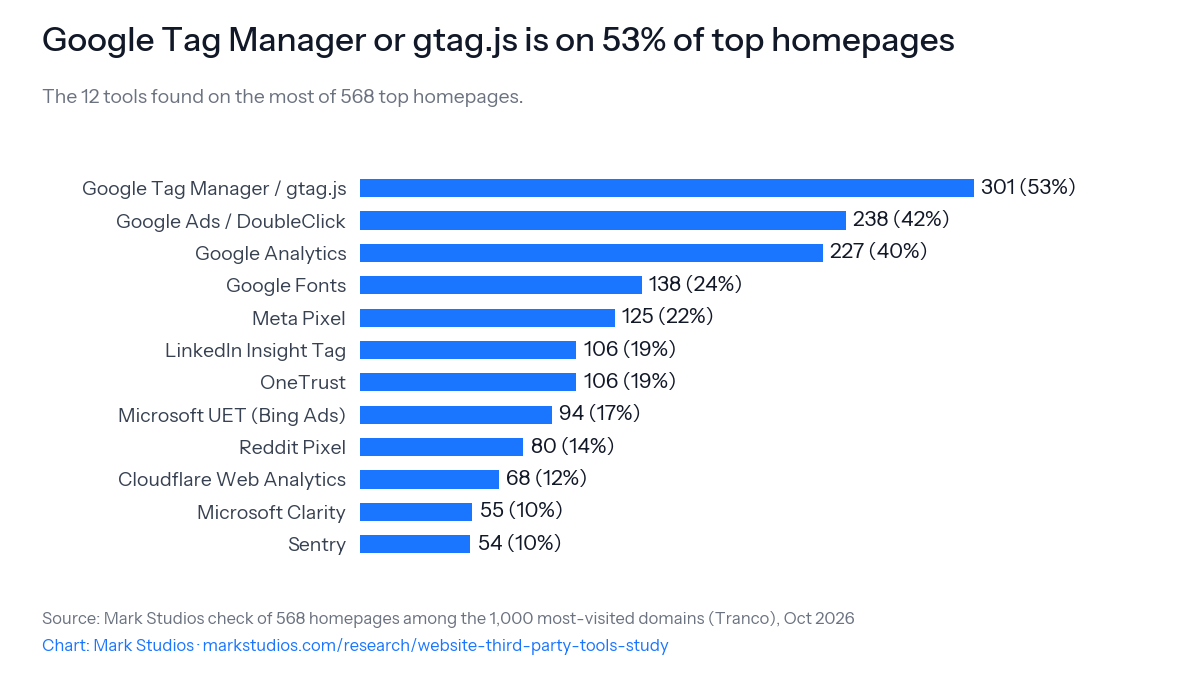
Of 568 working homepages among the 1,000 most-visited domains, 301 (53%) load Google Tag Manager or its gtag.js tag, the most common outside tool, and 40% send data to Google Analytics. See details
45% load at least one advertising tag: Google's ad tags on 42%, the Meta Pixel on 22%, LinkedIn's on 19% and Microsoft's on 17%, all on a visit that never clicked a cookie banner. See details
Microsoft Clarity, which is free, runs on 55 homepages (10%), about 3 times as many as Hotjar (17); 38 of them also load Microsoft's ad tag, which can switch Clarity on. See details
Only 39 homepages (7%) load a third-party chat widget; Qualified, a sales-chat tool, is the most common (16). 11 show a button to open an AI assistant. See details
A quarter (25%) load a cookie-consent platform, OneTrust on 106 of them. See details
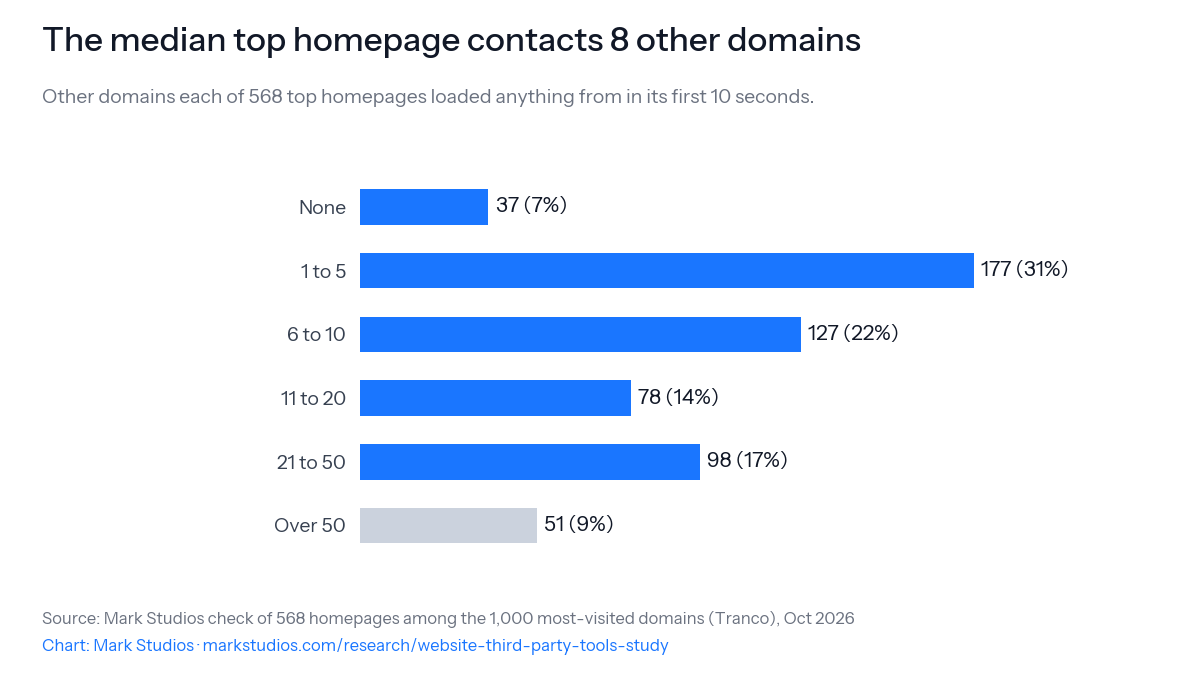
The median homepage contacts 8 other domains in its first 10 seconds; 51 contact more than 50, led by Weather.com, Yahoo and AOL, while Wikipedia, Apple, Google and GitHub contact almost none. See details
Which outside tools do top websites load?
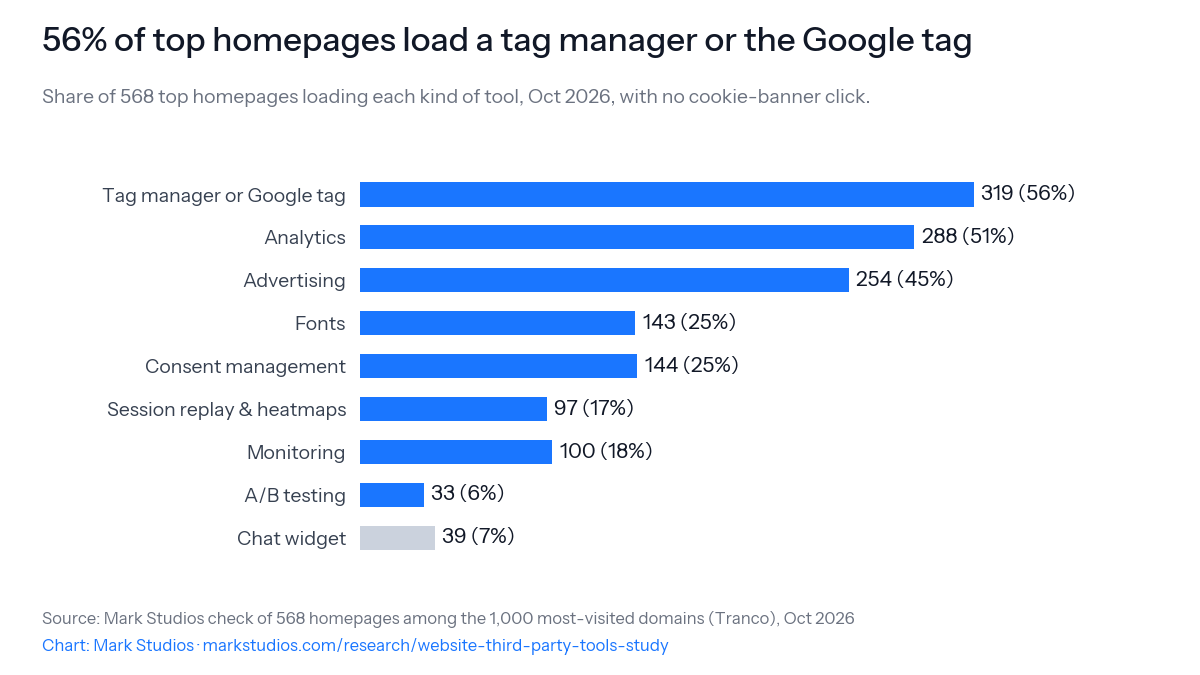
Google's, above all, plus a long tail. We opened the homepage of each of the 1,000 most-visited domains on the Tranco list in a desktop browser, never clicked a cookie banner or anything else, and recorded every domain the page loaded something from in its first 10 seconds. Of the 568 working homepages, 56% loaded a tag manager or the Google tag, 51% an analytics tool and 45% an advertising tag. Of the 413 that loaded any tool on our list, 357 (86%) loaded at least one of Google's.
56% of top homepages load a tag manager or the Google tagShare of 568 top homepages loading each kind of tool, Oct 2026, with no cookie-banner click.Use this chart on your site
At most 301 of 568 (53%), and its script is the single most common outside tool on top homepages. That is how many loaded a script from googletagmanager.com, which serves both Tag Manager containers and the gtag.js Google tag that installs Google Analytics or Google Ads without Tag Manager. Of the 164 homepages whose loader we could read in the server HTML, 145 used a Tag Manager container and 19 only gtag.js. Adobe's tag manager ran on 46 and Tealium's on 16. A tag manager loads other tools on the site's behalf, so many of the analytics and ad tags below arrive through it.
Google Tag Manager or gtag.js is on 53% of top homepagesThe 12 tools found on the most of 568 top homepages.Use this chart on your site
Google Analytics leads: 227 homepages (40%) sent it data directly. Cloudflare Web Analytics ran on 68, Yandex Metrica on 19, Adobe Analytics on 23 and Amplitude on 21. Sites that route analytics through their own domain don't show up as an outside request, so these are floors.
How many websites load ad pixels?
254 of 568 (45%) loaded at least one advertising tag. Google's ad tags led (238), then the Meta Pixel (125, 22%), LinkedIn's Insight Tag (106), Microsoft's UET for Bing ads (94), Reddit's pixel (80), X's pixel (53), Amazon's ad tags (52), Criteo (48) and TikTok's pixel (34). All of them loaded on a visit from the U.S. that never touched a cookie banner.
Which session-replay tools do websites use?
Microsoft's free tool leads by a distance. Microsoft Clarity ran on 55 homepages (10%) (free to use), about 3 times as many as Hotjar (17); Contentsquare ran on 15 and FullStory on 9. Together, session-replay and heatmap tools ran on 97 homepages (17%). Not every Clarity install is a separate choice: 38 of the 55 homepages also loaded Microsoft's UET tag for Bing ads, which can send data to Clarity once that option is on (Microsoft: UET and Clarity integration).
How many websites use a cookie-consent platform?
A quarter: 144 homepages (25%) loaded one. OneTrust dominates with 106; TrustArc ran on 15, Cookiebot on 10 and Usercentrics on 10. A site can also build its own banner, which this count misses.
How many websites have a chat widget?
Few. 39 of 568 homepages (7%) loaded a known third-party chat widget. The most common was Qualified (16), a sales-chat tool, here mostly on business-software sites, then Intercom (5), Salesforce (5), LivePerson (4) and HubSpot chat (2). 11 homepages had a button labelled to open an AI assistant or an "Ask AI" chat, among them NVIDIA, Adobe's developer site, Time, Statista and DuckDuckGo; we read every matching button by hand and left out product names such as Copilot.
Chat widget
Homepages
Qualified
16
Intercom
5
Salesforce
5
LivePerson
4
HubSpot chat
2
Help Scout
2
Ada
1
Zendesk
1
Userlike
1
Gladly
1
ASAPP
1
LiveChat
1
How many outside domains does a homepage contact?
A median of 8 in the first 10 seconds, with half between 3 and 22; the median homepage made about 134 requests in that time. News and ad-funded sites load the most: Weather.com (261), Yahoo (248) and AOL (237) lead, and 51 homepages contacted more than 50 domains. At the other end, 37 contacted none, among them Wikipedia, and Apple, Google and GitHub contacted one or two.
The median top homepage contacts 8 other domainsOther domains each of 568 top homepages loaded anything from in its first 10 seconds.Use this chart on your site
"Other domains" includes a company's own domains under another name, such as a content delivery network, so the count overstates true third parties a little. Google Fonts, served from Google's domains, loaded on 138 homepages (24%).
Every tool we looked for
Tool
Kind
Homepages
Share of 568
Google Tag Manager / gtag.js
Tag manager
301
53%
Google Ads / DoubleClick
Advertising
238
42%
Google Analytics
Analytics
227
40%
Google Fonts
Fonts
138
24%
Meta Pixel
Advertising
125
22%
LinkedIn Insight Tag
Advertising
106
19%
OneTrust
Consent management
106
19%
Microsoft UET (Bing Ads)
Advertising
94
17%
Reddit Pixel
Advertising
80
14%
Cloudflare Web Analytics
Analytics
68
12%
Microsoft Clarity
Session replay & heatmaps
55
10%
Sentry
Monitoring
54
10%
X (Twitter) Pixel
Advertising
53
9%
Amazon Ads
Advertising
52
9%
Criteo
Advertising
48
8%
Adobe Launch
Tag manager
46
8%
TikTok Pixel
Advertising
34
6%
Adobe Analytics
Analytics
23
4%
Amplitude
Analytics
21
4%
Akamai mPulse
Monitoring
20
4%
Yandex Metrica
Analytics
19
3%
New Relic
Monitoring
19
3%
Optimizely
A/B testing
18
3%
Hotjar
Session replay & heatmaps
17
3%
Datadog RUM
Monitoring
16
3%
Tealium
Tag manager
16
3%
Contentsquare
Session replay & heatmaps
15
3%
TrustArc
Consent management
15
3%
VWO
A/B testing
15
3%
Adobe Fonts
Fonts
13
2%
Cookiebot
Consent management
10
2%
Usercentrics
Consent management
10
2%
FullStory
Session replay & heatmaps
9
2%
Segment
Analytics
9
2%
Quantum Metric
Session replay & heatmaps
5
1%
Mixpanel
Analytics
4
1%
Heap
Analytics
4
1%
Baidu Tongji
Analytics
3
1%
Didomi
Consent management
3
1%
What this means for your website
A tag manager is the norm. 53% of the biggest sites load Google Tag Manager or its gtag.js tag, which keep the other tags in one place.
Every tag adds requests. The median top homepage already talks to 8 other domains; check what each tag costs before adding another.
Free session replay leads. Microsoft Clarity, which Microsoft offers free, is the most used tool of its kind on top sites.
Chat widgets are rare on homepages. Only 7% of the biggest sites load one on the front page.
Sites. The 579 working homepages found among the 1,000 highest-ranked domains on the Tranco list ZJ8PG in our homepage video study, a list built for research (Le Pochat et al., NDSS 2019). On this visit 11 failed to load or answered with an error or a bot check, leaving 568.
Crawl. On October 29, 2026 we opened each homepage in headless Chromium driven by Playwright at a desktop size of 1366 x 900, from the U.S., waited six seconds, scrolled three screens and waited two more, and recorded the host of every request the page made. We clicked nothing, so no cookie banner was accepted or refused. A tool counts when the page contacted one of its own hosts (for example googletagmanager.com, connect.facebook.net or clarity.ms); a maker's own homepages don't count for its tools, so Microsoft's sites don't count for Clarity, Google's for Google's tags or Amazon's for Amazon Ads. Google Analytics' advertising features send hits to stats.g.doubleclick.net, a host Google lists for Analytics rather than for Ads tags (Google: Tag Manager and CSP), so that host counts toward Google Analytics, not ad tags. We also read every button on the page for labels such as "Ask AI".
Checking the crawl. We fetched a random 25 homepages again with a plain HTTP client and looked for each tool's loader in the HTML: 22 answered, and of the 12 times a tool's loader appeared in the HTML, 9 had also been seen as a request. The other 3 were a consent tool served from the site's own domain (twice) and an ad pixel that had not fired within 10 seconds: the method misses tools rather than inventing them, so the shares are floors. We also screenshotted 25 homepages after the same wait: on 4 of the 7 where a chat widget was detected the chat button was visible, 0 of the 10 where nothing was detected showed one, and the other 8 had matched only on a button label, which we read by hand as described above. The other 3 had loaded a widget whose button wasn't showing yet, and on two of the four visible ones Qualified's widget opened as an "AI assistant". The screenshots also showed chats built in-house that no vendor list catches, such as Xbox's "Need help? Let's chat" bubble and Dell's AI shopping assistant, so chat is undercounted too. None of the sites or tool makers reviewed or endorsed this study.
The first 10 seconds, with no clicks. Tools that load later, after scrolling further or after consent, are missed.
Known hosts only. Tools served through a site's own domain (server-side tagging, first-party proxies) are invisible to this method, so every share here is a floor.
Homepages only, desktop, from the U.S. Sites load different tags by country and on other pages.
Domains, not companies. One company can appear several times.
We plan to rerun the crawl every six months with the homepage video study. Corrections go to contact@markstudios.com.
Oct 29, 2026: First published: 574 homepages among the 1,000 most-visited domains.
Oct 29, 2026, corrected the same evening: 6 bot-check pages that had been counted as homepages were removed (574 to 568); hits to stats.g.doubleclick.net now count as Google Analytics, not ad tags; a maker's own homepages no longer count for its tools; the googletagmanager.com count is labelled Google Tag Manager or gtag.js; the screenshot check is reported in full.
Frequently asked questions
What percentage of websites use Google Tag Manager?
Among the most-visited websites, at most 53%. In October 2026, 301 of 568 working homepages among the 1,000 most-visited domains on the Tranco list loaded a script from googletagmanager.com, more than any other outside tool. That host also serves the gtag.js Google tag: of 164 homepages whose loader we could read, 145 used a Tag Manager container and 19 only gtag.js.
How many websites use the Meta Pixel?
About one in five of the biggest. 125 of 568 top homepages (22%) loaded Meta's pixel script on a desktop visit from the U.S. that never clicked a cookie banner. Google's ad tags were more common (42%), and LinkedIn's Insight Tag ran on 19%.
Is Microsoft Clarity more popular than Hotjar?
On the biggest websites, yes. Microsoft Clarity, which is free, loaded on 55 of 568 top homepages (10%) in October 2026, against 17 for Hotjar, 15 for Contentsquare and 9 for FullStory. On 38 of the 55, Microsoft's UET ad tag also loaded, and that tag can turn Clarity on by itself.
How many websites have a chat widget?
Fewer than you might think: 39 of 568 top homepages (7%) loaded a known third-party chat widget, most often Qualified, Intercom, Salesforce or LivePerson. 11 homepages had a button that opens an AI assistant or an 'Ask AI' chat. Sites with their own chat built in are not all counted.
How many third-party domains does a website load?
On the most-visited websites, a median of 8 other domains in the first 10 seconds of a homepage visit, with half between 3 and 22. News and ad-funded sites load the most: 51 homepages contacted more than 50, while 37 contacted none at all.
Can I use this data?
Yes. Our measurements and the per-site CSV are free to reuse under CC BY 4.0 with a link to this page. The tools named belong to their makers; we record only which ones a homepage loaded on the day we visited.