Which fonts do the world's most-visited websites use? We read the body and heading fonts of 566 homepages from the Tranco top 1,000, and every web font they loaded. Here are the most common fonts, how many sites use their own, how rare serifs are, and how many font files a homepage downloads.
Of 566 working homepages among the 1,000 most-visited domains, Inter is the most common body font (51 homepages), then Roboto (37), Open Sans (28), Apple's system font (24) and Arial (23). See details
No font dominates: the homepages use 209 different first-choice body fonts, and the top five together cover only 29%. See details
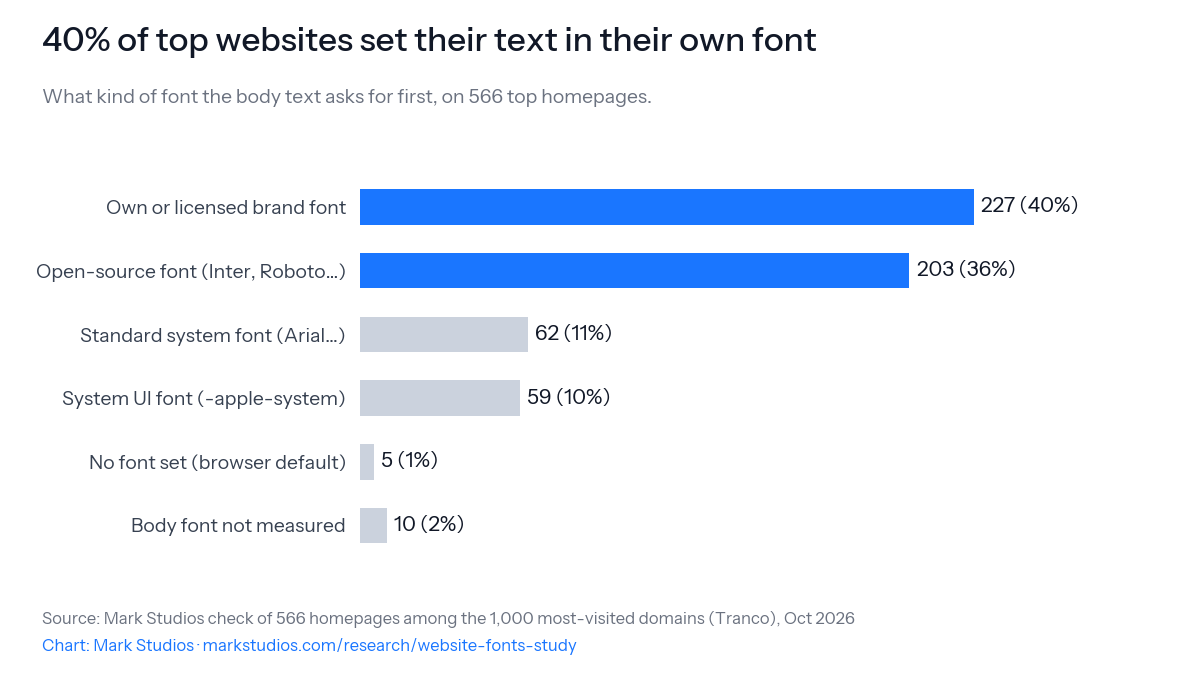
40% set their text in their own or a licensed brand font, as Amazon Web Services, Cloudflare, Binance, NVIDIA and Anthropic do; 36% use an open-source library font such as Inter or Roboto. See details
Serif body text is rare: 5 homepages (1%). 66% of homepages use the same font for their main heading as for body text. See details
The median homepage downloads 1 web font; 80 (14%) download none and rely on fonts already on the device. See details
5 homepages set no font at all and show text in the browser's default, Times. See details
What fonts do top websites use?
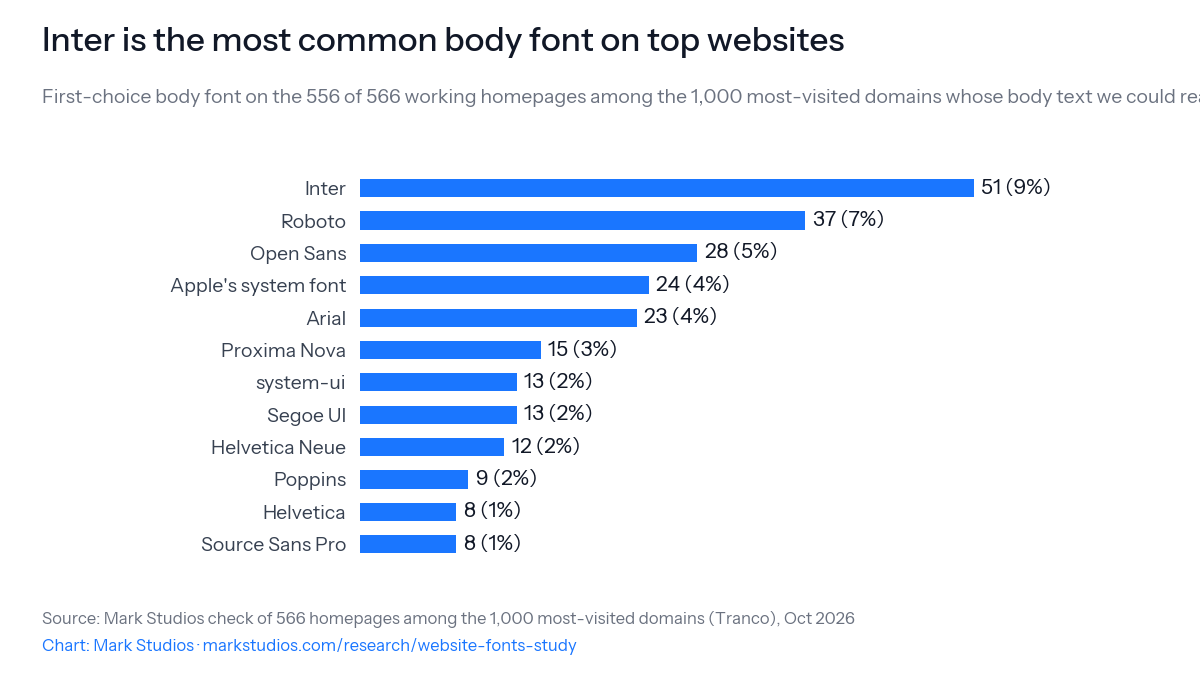
Inter, more than any other. We opened the homepage of each of the 1,000 most-visited domains on the Tranco list and read the font the body text asks for first. Inter led, on 51 of the 556 homepages whose body font we could read, followed by Roboto (37), Open Sans (28), Apple's system font (24) and Arial (23). Even so, no font dominates: those 556 homepages ask for 209 different body fonts, and the top five cover 29%.
Inter is the most common body font on top websitesFirst-choice body font on the 556 of 566 working homepages among the 1,000 most-visited domains whose body text we could read, October 2026.Use this chart on your site
More of them than any other kind, though not most. 227 homepages (40%) set body text in their own or a licensed brand font: Amazon Web Services (Amazon Ember), Cloudflare (STK Bureau Sans), Binance (BinanceNova), NVIDIA (NVIDIA-NALA) and Anthropic (Anthropic Sans) among them. 203 (36%) use a free, open-source library font such as Inter, Roboto or Open Sans; 62 (11%) use a standard font already on most computers, such as Arial or Helvetica; and 59 (10%) ask for the device's own interface font. 5 set no font at all, so text appears in the browser's default, Times. On 10 we couldn't read the body font: the longest paragraph was a cookie notice, an icon font or text with no font set on a page that otherwise uses web fonts.
40% of top websites set their text in their own fontWhat kind of font the body text asks for first, on 566 top homepages.Use this chart on your site
Usually not. Of the 484 homepages with a main heading we could measure, 321 (66%) use the same font for the heading as for body text. The rest pair two different fonts.
Do websites use serif fonts?
Hardly ever for body text: 5 of the 556 homepages we could read (1%) chose a serif for their body text, among them the BBC (BBC Reith Serif) and NPR. The homepage of a big website in 2026 is a sans-serif page.
How many web fonts does a homepage load?
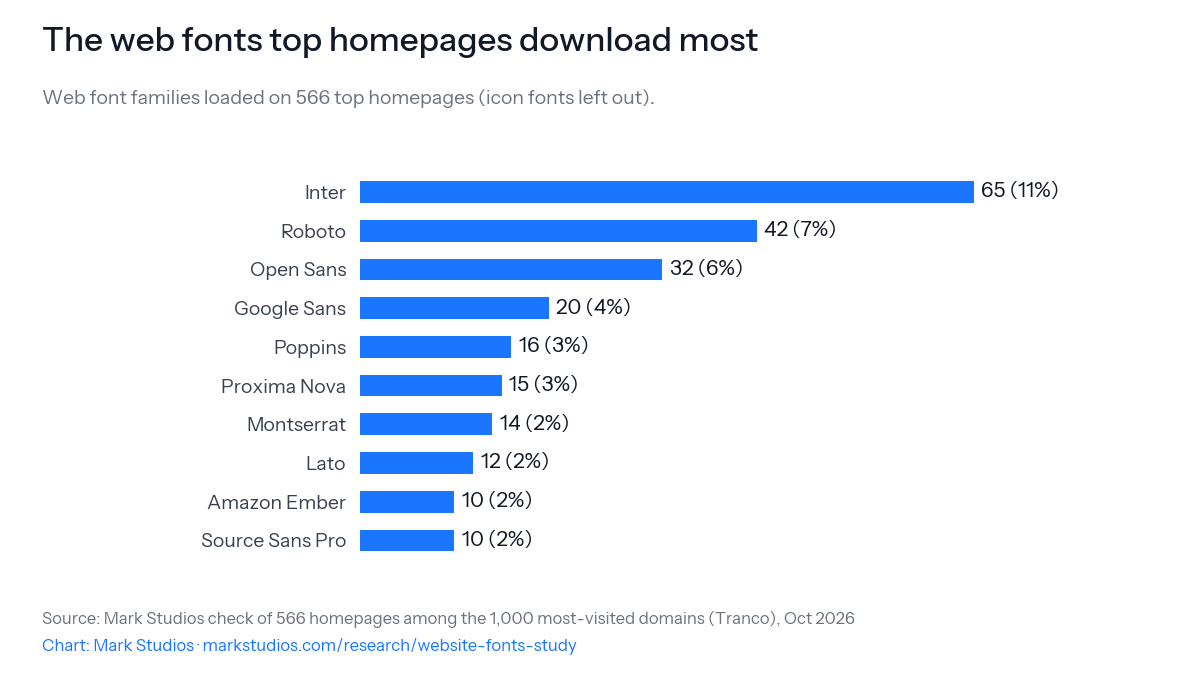
A median of 1 font family, not counting icon fonts. 80 homepages (14%) load none and use fonts already on the device. 76% of the homepages we could read render their body text in a font they download. The most-downloaded families are Inter, Roboto, Open Sans, Google Sans and Poppins.
The web fonts top homepages download mostWeb font families loaded on 566 top homepages (icon fonts left out).Use this chart on your site
Sites. The 579 working homepages found among the 1,000 highest-ranked domains on the Tranco list ZJ8PG in our homepage video study, a list built for research (Le Pochat et al., NDSS 2019). On this visit 13 failed to load, answered with a bot check or had no readable text, leaving 566.
Crawl. On October 29, 2026 we opened each homepage in headless Chromium driven by Playwright at a desktop size of 1366 x 900, waited for its fonts to finish loading, and read the computed font-family of the longest visible paragraph (the body text) and of the first visible H1, plus every font the page had loaded. A page's "first choice" is the first name in its font stack; names are normalised (case, quotes, suffixes such as "Variable"), copies of one family under other names ("proxima-nova", "ProximaNova", "__Inter_da1787") count once, faces that only supply emoji, flags or currency signs are skipped, and icon fonts are left out. On 10 homepages the longest paragraph was a cookie or consent notice, an icon font or text with no font set on a page that otherwise uses web fonts; their body font counts as not measured, and body-font shares use the other 556.
Checking the reading. For a random 25 homepages we asked Chrome itself which font painted the measured paragraph (DevTools CSS.getPlatformFontsForNode): on all 18 where Chrome reported a readable font name, it was the first choice we recorded. For the other 7 it returned no name or an unreadable one, as it can for downloaded fonts. None of the sites or type foundries reviewed or endorsed this study.
We plan to rerun the crawl every six months with the homepage video study. Corrections go to contact@markstudios.com.
Oct 29, 2026: First published: 573 homepages among the 1,000 most-visited domains.
Oct 29, 2026, corrected the same evening: 7 bot-check pages (IMDb, SlideShare and five Amazon sites) taken out, leaving 566; one family under several names now counts once (209 body fonts, not 256), and open-source fonts filed as brand fonts moved; 10 body readings that caught a cookie notice, an icon font or unstyled text are set aside, so 5, not 12, show the browser's default; serif body text is 5, not 19, because the default-Times readings had counted as serif.
Frequently asked questions
What is the most popular font on websites?
Among the most-visited websites, Inter. In October 2026 it was the first-choice body font on 51 of the 556 homepages we could read among the 1,000 most-visited domains, ahead of Roboto (37), Open Sans (28) and Apple's system font (24). No font dominates: the homepages used 209 different body fonts.
Do big websites use custom fonts?
More than any other kind of font, though not most: 227 of 566 top homepages (40%) set body text in their own or a licensed brand font, such as Amazon Ember on Amazon Web Services. Another 36% use a free library font like Inter or Roboto, and 21% use fonts already on the device.
Is Inter or Roboto more popular?
On the biggest websites, Inter: it was the first-choice body font on 51 top homepages against 37 for Roboto in October 2026. Counting every web font a homepage downloads, Inter loaded on 65 and Roboto on 42. Both are free, open-source fonts.
Do websites use serif fonts for body text?
Rarely: only 5 of the 556 top homepages we could read (1%) chose a serif for body text in October 2026, and 5 more show the browser's default serif because they set no font. The rest use a sans-serif: a brand's own font, a free library font such as Inter or a font already on the device.
How many web fonts should a website load?
The biggest sites keep it small: the median top homepage downloaded 1 font family, and 14% downloaded none, using fonts already on the device. Each extra font family is at least one more file a visitor downloads before the text settles.
Can I use this data?
Yes. Our measurements and the per-site CSV are free to reuse under CC BY 4.0 with a link to this page. The fonts named belong to their designers and owners; we record only which ones each homepage asked for and loaded.