Do the world's most-visited websites let AI crawlers in? We fetched the robots.txt of 579 homepages from the Tranco top 1,000 and checked 19 AI crawler tokens from OpenAI, Anthropic, Google, Apple, Perplexity, Meta and others, plus whether each site publishes an llms.txt. Here is who blocks what, and how training and search crawlers are treated differently.
Of 579 working homepages among the 1,000 most-visited domains, 110 (19%) block at least one AI crawler by name in robots.txt. See details
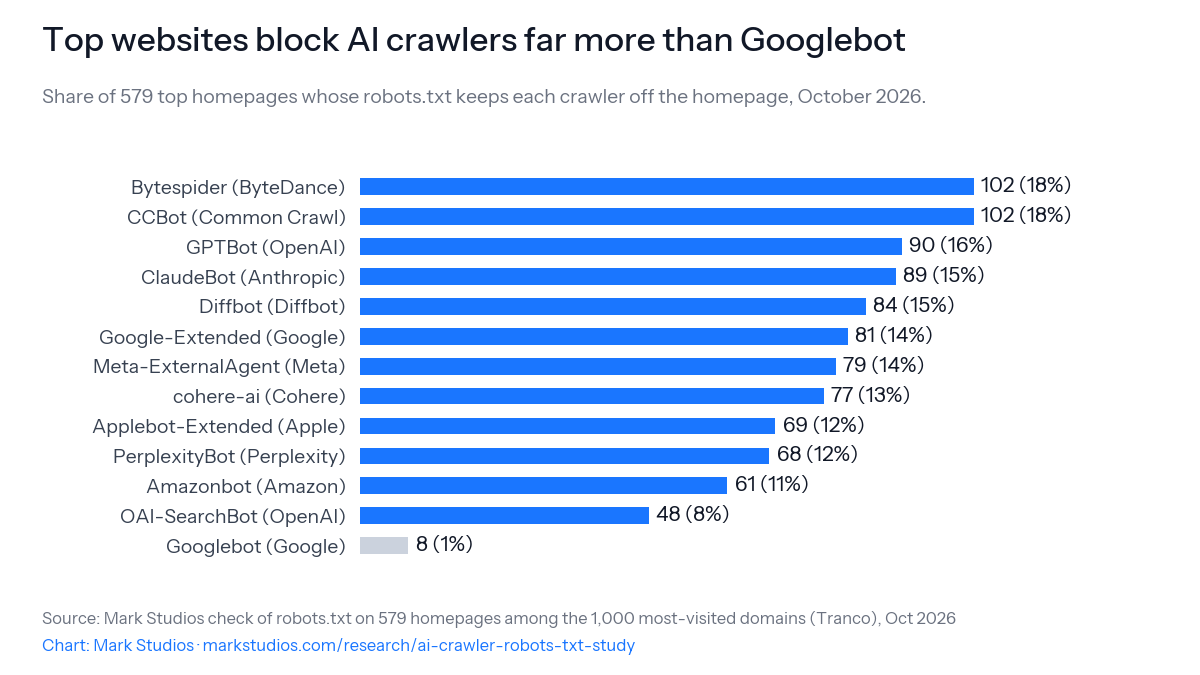
The most blocked are ByteDance's Bytespider (18%) and Common Crawl's CCBot (18%), then OpenAI's GPTBot (16%) and Anthropic's ClaudeBot (15%). Googlebot is blocked on 1.4%. See details
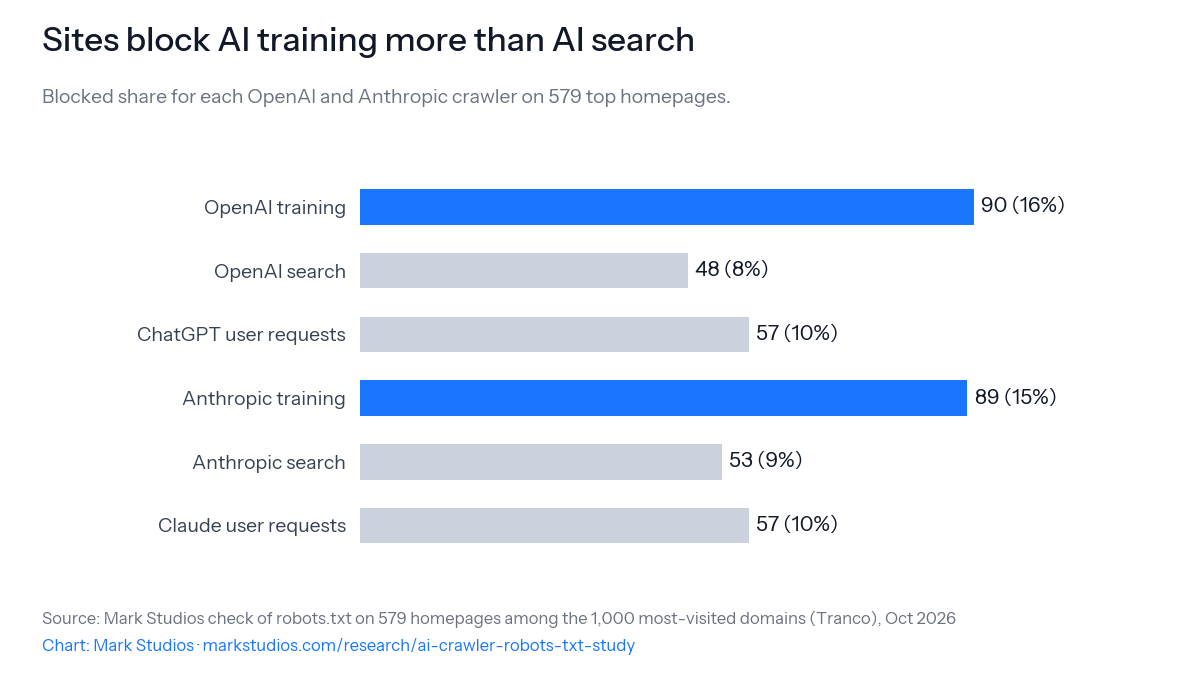
Sites block AI training more than AI search: GPTBot is kept off 16% of homepages but OpenAI's search crawler off 8%; ClaudeBot 15% against Claude-SearchBot 9%. See details
Google-Extended, the token that keeps a site's pages out of Gemini training and grounding, is blocked on 14%, about 10 times as often as Googlebot itself. See details
Sites pick and choose: The Guardian blocks Anthropic's crawlers but not GPTBot; CNN, Amazon, Medium and BBC block both; Wikipedia and Apple block neither, and the file Reddit served us blocks every crawler. See details
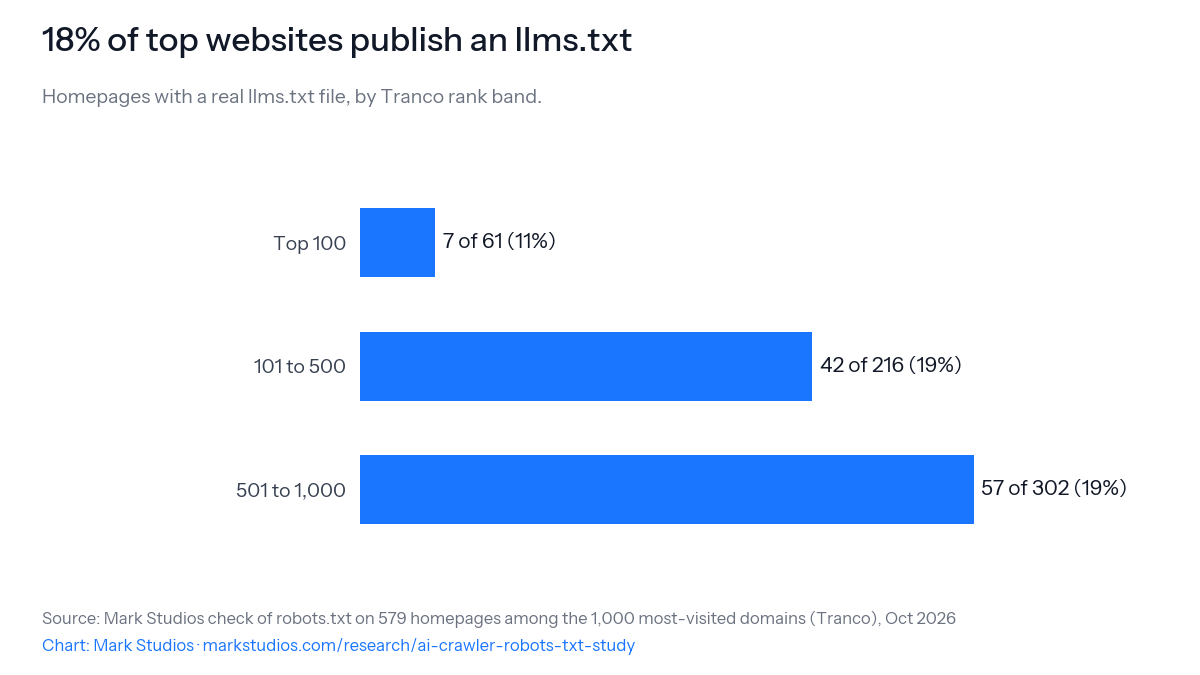
106 homepages (18%) publish an llms.txt, among them GitHub, Samsung, Roku and Business Insider; 3 of them block GPTBot at the same time. See details
How many top websites block AI crawlers?
About one in five. We fetched the robots.txt file of each of the 579 working homepages among the 1,000 most-visited domains on the Tranco list and checked, for 19 AI crawler tokens and two search crawlers, whether the file lets that crawler fetch the homepage. 110 sites (19%) block at least one AI crawler by name. Separately, 26 files block every crawler through the catch-all "*" group; 18 of those still let Googlebot in by name. The test is the homepage, and some files open little else: 14 more let GPTBot fetch the homepage but keep it off the rest of the site, bar a few listed pages (an "Allow: /$" above "Disallow: /"), SoundCloud, Statista, Naver and Vimeo among them. Counting those, GPTBot is kept off everything beyond the homepage on 104 sites (18%), ClaudeBot on 103 (18%) and Googlebot on 16 (2.8%).
Which AI crawlers do websites block?
The most blocked are bulk crawlers: Bytespider on 102 homepages (18%), CCBot on 102, GPTBot on 90 and ClaudeBot on 89, the last three documented as gathering data for datasets and AI training. Google-Extended, a token Google documents for keeping pages out of Gemini training and grounding without affecting Search (it isn't a crawler of its own), is blocked on 81 (14%). Googlebot itself is blocked on 8 (1.4%), all of them sites that block every crawler.
Top websites block AI crawlers far more than GooglebotShare of 579 top homepages whose robots.txt keeps each crawler off the homepage, October 2026.Use this chart on your site
Training, more than search. OpenAI and Anthropic each run separate crawlers for training, for search and for fetching a page a user asked about (OpenAI, Anthropic). GPTBot, OpenAI's training crawler, is blocked on 16% of homepages, but OAI-SearchBot on 8% and ChatGPT-User on 10%. Anthropic's split is the same: ClaudeBot 15%, Claude-SearchBot 9%, Claude-User 10%. 42 sites block GPTBot but let OAI-SearchBot in, and 36 block ClaudeBot but let Claude-SearchBot in: they keep their content out of training while staying open to AI search. OpenAI says sites that opt out of OAI-SearchBot "will not be shown in ChatGPT search answers".
Sites block AI training more than AI searchBlocked share for each OpenAI and Anthropic crawler on 579 top homepages.Use this chart on your site
They don't agree. The Guardian blocks Anthropic's crawlers but not GPTBot; CNN, Amazon, Medium and BBC block both GPTBot and ClaudeBot; Wikipedia and Apple block neither. The robots.txt Reddit served our crawler blocks every crawler with a single "Disallow: /" for all user agents. Every site's verdict for every crawler is in the CSV.
How many websites publish an llms.txt?
106 homepages (18%) serve a real llms.txt, the plain-text Markdown summary the llmstxt.org proposal suggests sites publish for language models. They include GitHub, Samsung, Roku, Business Insider, Intercom and Dynatrace; the median file is 13 KB. Another 88 sites answered /llms.txt with an HTML page or a file that wasn't one, and aren't counted. 3 sites publish an llms.txt while blocking GPTBot.
18% of top websites publish an llms.txtHomepages with a real llms.txt file, by Tranco rank band.Use this chart on your site
Decide training and search separately. 42 of the 90 top sites that block GPTBot still let OpenAI's search crawler in.
Name the crawler. Each of the main AI companies documents its own robots.txt token; a rule for "*" also blocks search engines.
Check what you already block. Blocking OAI-SearchBot keeps a site out of ChatGPT search answers, by OpenAI's own account, and Anthropic says blocking Claude-User may reduce a site's visibility in Claude's web search.
An llms.txt is cheap to add. 18% of top sites have one; it is a proposal, not a standard.
Sites. The 579 working homepages found among the 1,000 highest-ranked domains on the Tranco list ZJ8PG in our homepage video study, a list built for research (Le Pochat et al., NDSS 2019). 513 served a readable robots.txt. Of the other 66, 21 had none and 19 refused our crawler with a 403, which RFC 9309 treats as allowing every crawler; 19 sent an HTML page or a bot check, 3 redirected without reaching a file, and 4 gave a server error, a rate limit or no answer. For server and network errors RFC 9309 tells crawlers to assume a full block until the file can be read; we count all 66 sites as setting no rules, so the block counts are floors.
Files. On October 29, 2026 we fetched /robots.txt and /llms.txt from each site's homepage address with a crawler that named itself and linked to this research. A crawler counts as blocked when the file keeps it off the homepage ("/"), read the way RFC 9309 and Google describe: the group naming the crawler applies, otherwise the "*" group, and among matching rules the longest wins, with a tie going to Allow. Partial blocks that leave the homepage open aren't counted. An llms.txt counts when the address returns a file that isn't HTML and starts with a Markdown heading.
Checking the reading. Python's standard robots.txt parser agreed with our verdicts on 10,251 of 10,773 site-and-crawler pairs (95.2%). It applies the first matching rule instead of the longest and ignores the * and $ wildcards, so it differs on files such as google.com's and on sites that allow "/$" after "Disallow: /"; we follow the standard there. We also read a sample of the files and llms.txt bodies by hand. None of the sites or crawler operators reviewed or endorsed this study.
Robots.txt is a request. It shows what a site asks, not what crawlers do or whether they comply.
The homepage only. A site that blocks a crawler from some sections but not the homepage counts as not blocking it, including the 14 files that leave GPTBot only the homepage and a few listed pages.
Files can differ by crawler. We read each file as our crawler received it; a site can send a different file to a crawler it recognizes.
Some fetchers may not follow robots.txt. OpenAI says robots.txt rules "may not apply" to ChatGPT-User, and Perplexity says Perplexity-User "generally ignores robots.txt rules", because a person asked for the page (OpenAI, Perplexity).
Tokens we checked. 19 AI crawler tokens. Three aren't crawlers of their own: Google-Extended and Applebot-Extended only tell Google and Apple how they may use pages their other crawlers fetch (Google, Apple), and anthropic-ai is an older token missing from Anthropic's current list. ByteDance and Cohere don't document Bytespider or cohere-ai. Sites may block other crawlers, or block by IP address or firewall instead.
Domains, not companies. One company can appear several times, and some domains are services rather than publishers.
We plan to rerun the check every three months; AI crawler lists change fast. Corrections go to contact@markstudios.com.
Oct 29, 2026: First published: robots.txt and llms.txt on 579 homepages among the 1,000 most-visited domains.
Frequently asked questions
What percentage of websites block GPTBot?
Among the most-visited websites, 16%. In October 2026, 90 of 579 working homepages among the 1,000 most-visited domains kept OpenAI's GPTBot off the homepage in robots.txt, 76 of them by naming it. OpenAI's search crawler, OAI-SearchBot, was blocked on only 8%.
Which AI crawlers do websites block most?
ByteDance's Bytespider (18% of top homepages) and Common Crawl's CCBot (18%), then OpenAI's GPTBot (16%) and Anthropic's ClaudeBot (15%). Google-Extended, Google's opt-out token for Gemini training and grounding, was blocked on 14%; Googlebot, for search, on just 1.4%. In all, 110 of 579 homepages (19%) block at least one AI crawler by name.
Should I block AI crawlers in robots.txt?
It depends on whether you want to appear in AI answers. Many top sites that block do it selectively: 42 of the 90 that block OpenAI's training crawler, GPTBot, still let its search crawler in (only 8% block OAI-SearchBot). Blocking a search crawler can keep your pages out of that assistant's answers.
How many websites have an llms.txt file?
106 of 579 top homepages (18%) served a real llms.txt in October 2026: a plain-text Markdown file with a title, as the llmstxt.org proposal describes. Another 88 answered the address with an HTML page or something else, which we did not count.
Does robots.txt stop AI crawlers?
It asks them to stay away; it doesn't enforce anything. OpenAI, Anthropic and Google document the robots.txt tokens their crawlers obey, so a block works for crawlers that follow the standard. Fetches a person asks for can be exceptions: OpenAI says robots.txt rules may not apply to ChatGPT-User, and Perplexity says Perplexity-User generally ignores them. A crawler that ignores robots.txt can only be stopped at the server or network level.
Can I use this data?
Yes. Our measurements and the per-site CSV are free to reuse under CC BY 4.0 with a link to this page. The robots.txt and llms.txt files belong to their sites; we publish only how each one treats each crawler and whether a real llms.txt exists.