Do the world's most-visited websites put video on their homepage? We opened the homepage of each of the 1,000 top domains on the Tranco list and recorded every video on it. Here is how many use video, where it sits, whether it autoplays, who hosts it, and where the popular conversion claims come from.
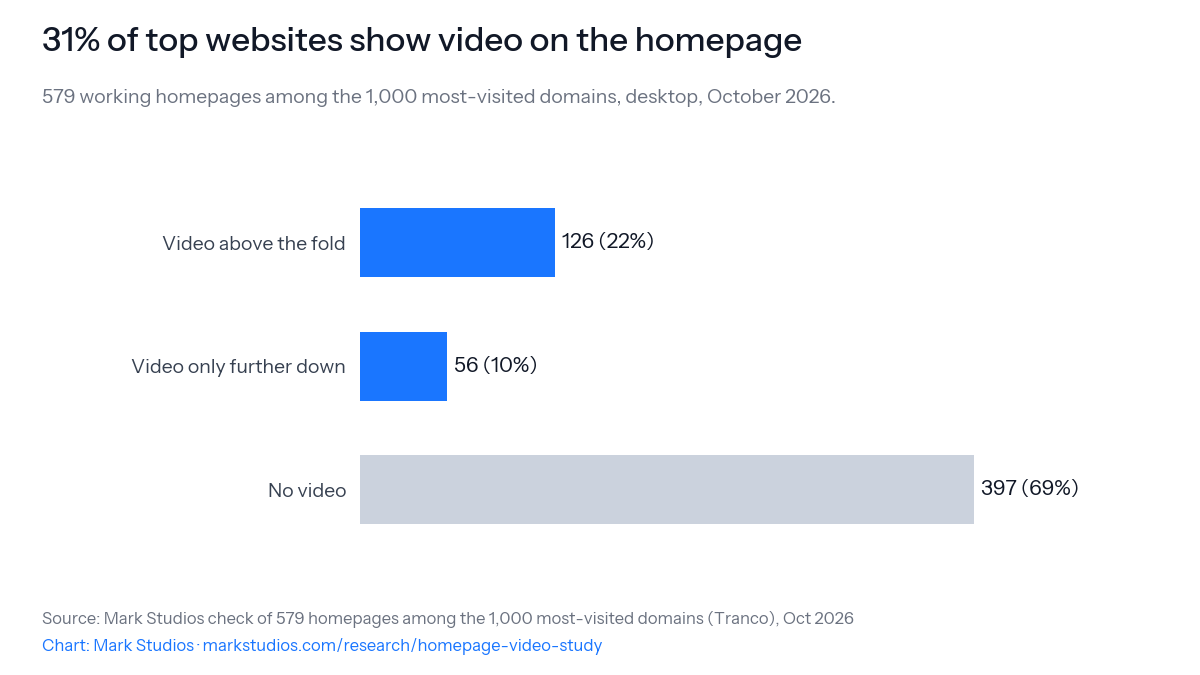
Of 579 working homepages among the 1,000 most-visited domains, 182 (31%) show video, and 126 (22% of all homepages) put it in the first screen. See details
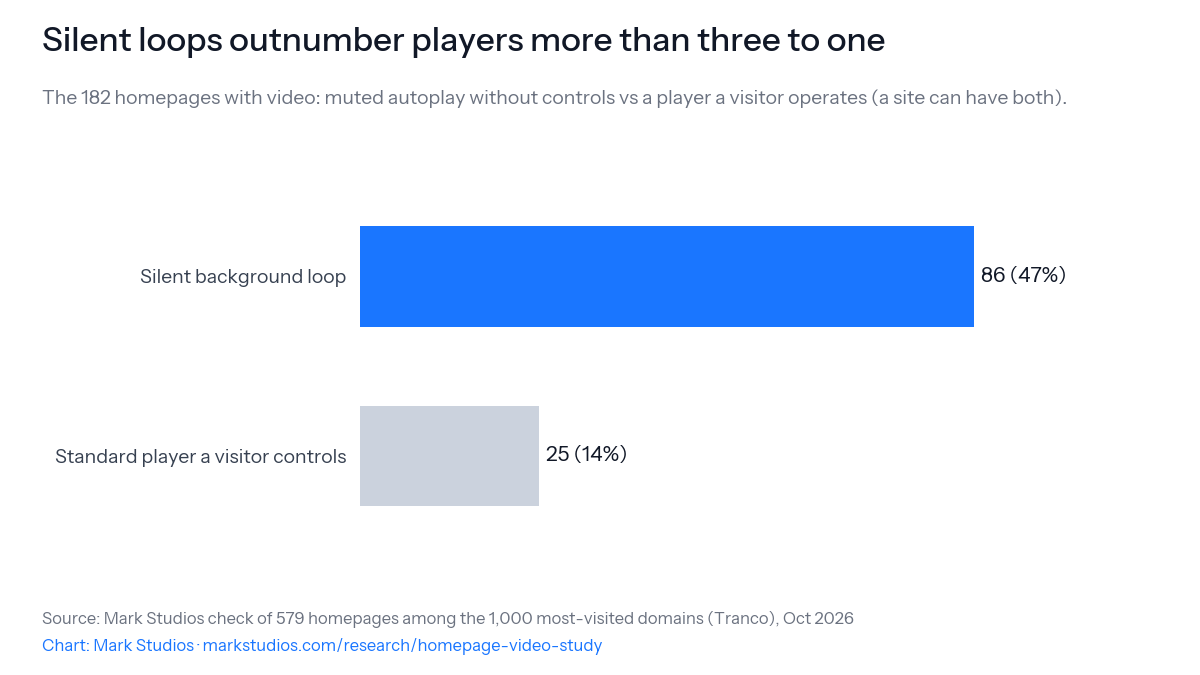
Homepage video mostly plays silently on its own: 107 of the 182 (59%) were already playing, muted, before any click, and 86 (47%) are set to autoplay muted with no player controls, while only 25 (14%) offer a player a visitor operates. See details
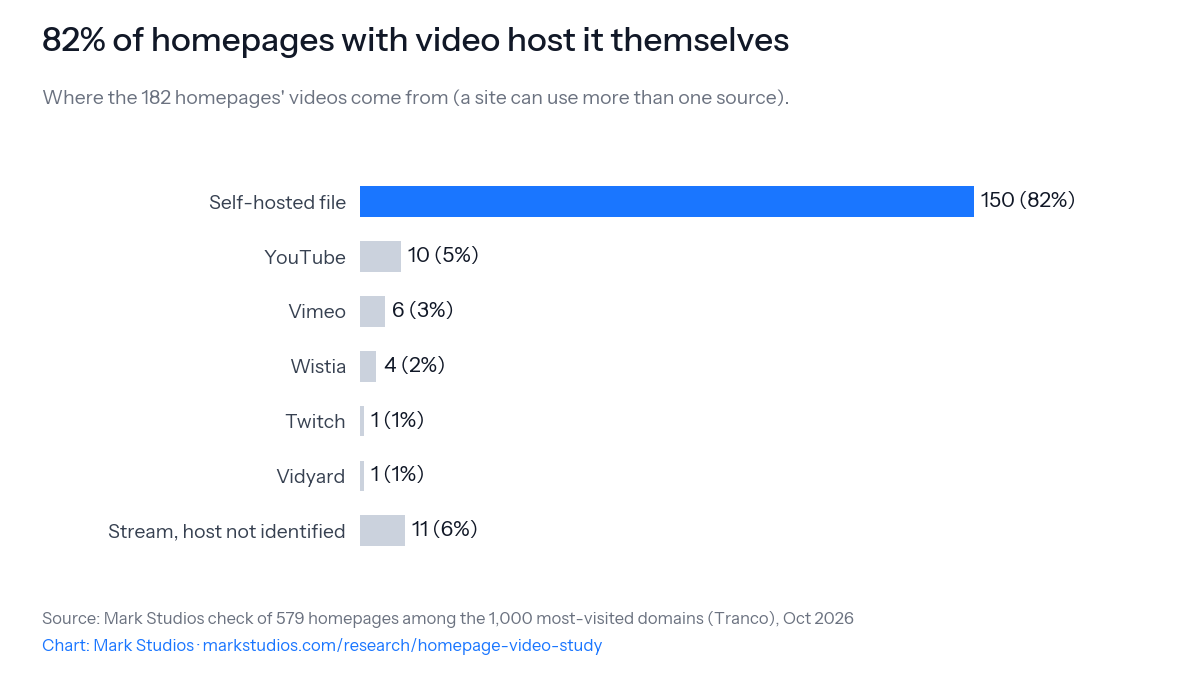
Big sites host it themselves: 150 of the 182 (82%) serve video files from their own servers or CDN. Only 10 embed a YouTube player, 6 Vimeo and 4 Wistia. See details
64 homepages run a hero video at least 1,000 pixels wide in the first screen, and 69 use three or more videos on the page. See details
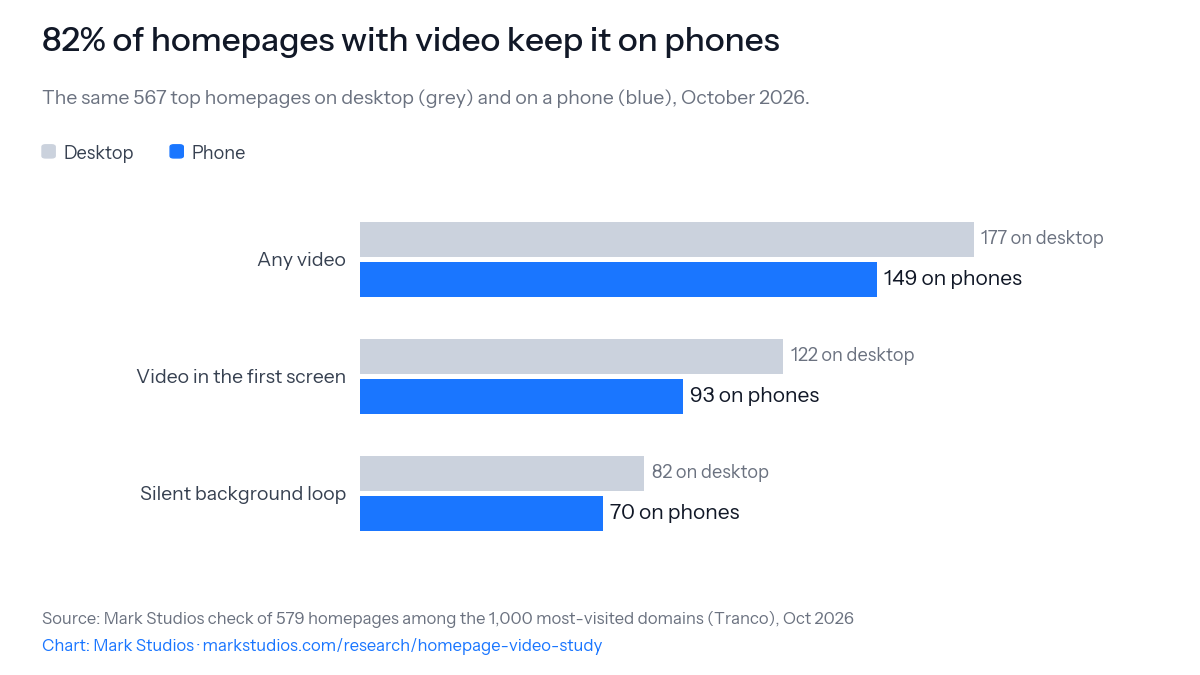
On phones, 145 of the 177 homepages that show video on desktop (82%) still show it, and 64 of the 82 sites with a silent background loop keep one on the phone. See details
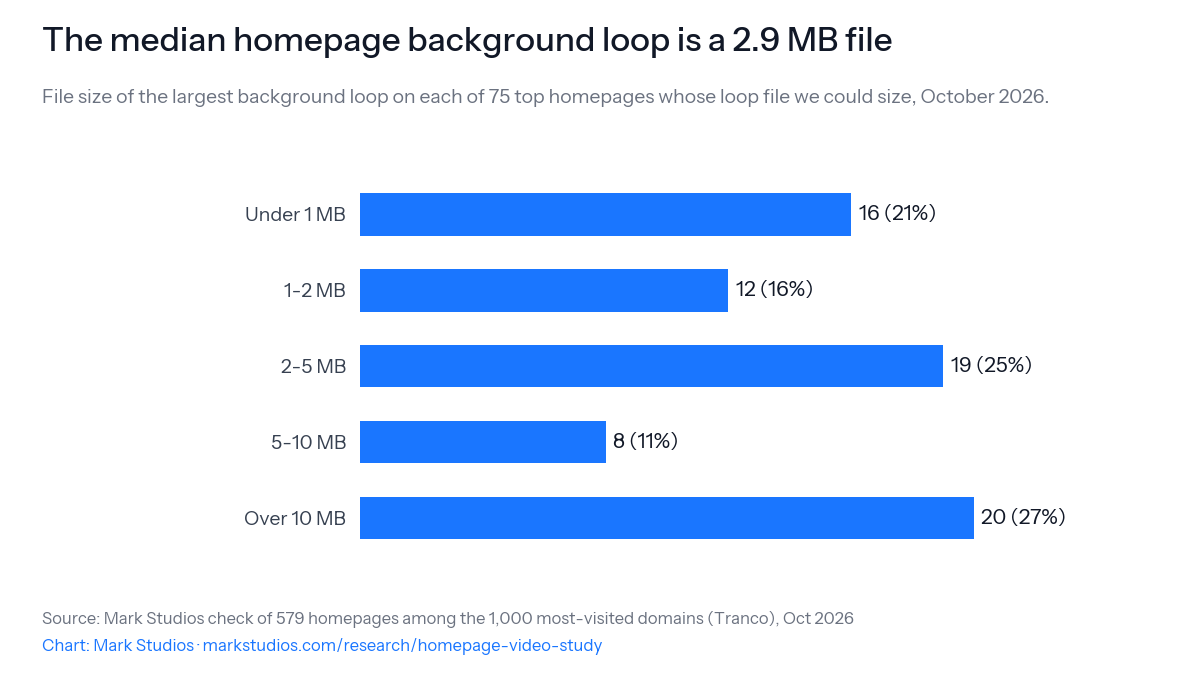
The median background loop is a 2.9 MB file running 12 seconds, about the weight of the median desktop homepage on its own (2,862 KB, HTTP Archive); 20 of 75 loops are over 10 MB. See details
Apple, Amazon, GitHub and Cloudflare show video on their homepages; Google, Microsoft, YouTube, Facebook, Netflix and Wikipedia don't. See details
Two popular claims about video on web pages trace to vendors: '86% more conversions' is one client's result, and '2.6x more time on page' is Wistia measuring its own website, which its rerun cut to about 1.4x. This study measures how many sites use video, not what it does for them. See details
How many top websites have video on their homepage?
About a third. We opened the homepage of each of the 1,000 most-visited domains on the Tranco list in a desktop browser; 579 answered with a working homepage, and 182 (31%) showed video somewhere on it. The other 397 showed none.
31% of top websites show video on the homepage579 working homepages among the 1,000 most-visited domains, desktop, October 2026.Use this chart on your site
Many domains on the list aren't websites people visit: 227 of them, mostly content delivery networks, ad servers and API hosts, have no website at the bare address the list gives. With sites that timed out or refused an automated browser, 421 of the 1,000 couldn't be counted (see the method).
Where on the homepage does the video sit?
Mostly in the first screen. Of the 182 homepages with video, 126 (69%) had a video starting within the first 900 pixels, what a desktop visitor sees before scrolling; 56 showed video only further down. 64 ran a hero video at least 1,000 pixels wide in that first screen, and 69 used three or more videos on the page, often product demos repeated down a feature list.
Does homepage video autoplay?
Usually, and silently. 107 of the 182 (59%) were already playing when we measured, before any click, and every one of them was muted. 86 of the 182 (47%) had a video set to autoplay, muted and without player controls: a background loop or an animated product demo rather than a video to sit and watch. Only 25 (14%) offered a standard player a visitor starts and controls: a native video player with controls, an embedded player from YouTube, Vimeo or Wistia, or a click-to-play placeholder that loads one.
Silent loops outnumber players more than three to oneThe 182 homepages with video: muted autoplay without controls vs a player a visitor operates (a site can have both).Use this chart on your site
The reason is the browser: Chrome always allows muted autoplay but lets a video start with sound only once a visitor has interacted with the site or has a history of playing video with sound there (Chrome autoplay policy), so a video meant to start by itself is made silent.
Who hosts homepage video: YouTube or the site itself?
The site itself. 150 of the 182 (82%) served a video file from their own domain or content delivery network. Only 10 embedded a YouTube player, 6 Vimeo and 4 Wistia; 22 used a known video platform of any kind, and 11 streamed video through a player whose host we couldn't identify.
82% of homepages with video host it themselvesWhere the 182 homepages' videos come from (a site can use more than one source).Use this chart on your site
A self-hosted file can loop silently without YouTube's branding, title bar or suggested videos, which suits a background loop. An embedded player suits a video meant to be watched with sound.
How big are homepage video files?
Bigger than the rest of the page. On a second visit we read the file behind each self-hosted video. Of the 75 background loops we could size, the median is a 2.9 MB file running 12 seconds: about the weight of the median desktop homepage on its own, which the HTTP Archive Web Almanac put at 2,862 KB in July 2025. 20 loops are over 10 MB, and 41 of 75 run under 15 seconds. The most common height is 1080 pixels (18 loops); 3 are 4K (3,840 by 2,160 pixels or more).
The median homepage background loop is a 2.9 MB fileFile size of the largest background loop on each of 75 top homepages whose loop file we could size, October 2026.Use this chart on your site
A loop that plays through downloads its whole file, so a 10 MB background video costs each new visitor 10 MB.
Do websites keep homepage video on phones?
Mostly. We opened the same homepages again in a phone browser. Of the 567 that loaded both times, 177 showed video on desktop, and 145 of them (82%) still showed video on the phone; 32 dropped it. Silent background loops held up as well: 64 of the 82 homepages with one on desktop had one on the phone too. Only 4 homepages showed video on the phone but not on desktop. In the first screen, 93 homepages put video in view on a phone, against 122 on desktop.
82% of homepages with video keep it on phonesThe same 567 top homepages on desktop (grey) and on a phone (blue), October 2026.
Apple, Amazon, GitHub and Cloudflare showed video on their homepages on the day we checked, all four in the first screen; Cloudflare's is a silent background loop. Google, Microsoft, YouTube, Facebook, Netflix and Wikipedia showed none. Homepages change often, so treat any single site as a snapshot; every domain's result is in the CSV.
Does video on a homepage increase conversions?
This study can't say: it counts how many sites use video, not what the video does for them. The two figures most often quoted for it come from vendors. "Video on a landing page lifts conversions 86%" is one video company's best client result, traced in our legal video statistics, and "people spend 2.6x more time on pages with video" is Wistia measuring its own website, which its own rerun cut to about 1.4x, traced in our ecommerce video statistics. A test on your own page is the only reliable answer.
What this means for your homepage
Video on a homepage is common, not universal. About a third of the biggest sites use it; many of the best known don't.
Decide what the video is for. A silent loop sets a mood or shows a product moving; a video with sound needs a play button and a reason to press it.
Keep background loops short and light. The median loop on a top site runs 12 seconds in a 2.9 MB file; a loop over 10 MB weighs more than three median desktop homepages.
Test before you trust a lift figure. The popular conversion numbers come from vendors' own customers.
Sites. The 1,000 highest-ranked domains on the Tranco list ZJ8PG, generated on October 28, 2026 by combining five top-site rankings over the preceding 30 days, a list built for research (Le Pochat et al., NDSS 2019).
Crawl. On October 29, 2026 we opened https://<domain> for each one in headless Chromium driven by Playwright, at a desktop size of 1366 x 900, waited five seconds, scrolled through the page to load lazy content and recorded every video element, every embedded player from YouTube, Vimeo, Wistia, Vidyard, Brightcove, JW Player, Loom, Dailymotion, Facebook, TikTok or Twitch, and every click-to-play player placeholder. A video counts when it is at least 150 x 80 pixels; "above the fold" means its top edge is within the first 900 pixels.
What we left out. 227 domains don't resolve at the bare address the list gives (a few, such as China's industry ministry at miit.gov.cn, have a site at a www. address, which the crawl didn't try), 48 didn't load within 25 seconds and 32 failed with another network or page error; 105 returned an error status, often to an automated browser, and 9 returned a challenge page or an empty page. That leaves 579 homepages. Self-hosted means a plain video file on a host that isn't a known video platform; a stream assembled by a player script (a blob: address) is counted as host not identified. The self-hosted count includes two video ads served from Google's ad servers (on AOL and USA Today) and one university video hosted on Kaltura.
File sizes. On a second visit the same day we recorded each video's file address, length and resolution, then asked the server for the file's size with an HTTP HEAD request, or a one-byte range request when HEAD gave none; no video was downloaded. Only real video files count (streams in segments and error pages are left out), and for each site we used its largest background loop. We could size a loop on 75 homepages.
Phone visit. The same day we opened the homepages again as a phone (Playwright's iPhone 13 profile: 390 x 844 pixels, a mobile browser identity and touch) with the same detection rules, "first screen" being the top 844 pixels. The profile runs in Chromium, not Safari's WebKit engine, so it shows what sites send to a phone rather than how Safari plays it. The 12 homepages that failed or met a bot check on the phone visit are left out of the comparison.
Checking the detection. We reopened a random sample of 30 homepages the crawl counted as having video and screenshotted the detected video twice, 2 seconds apart. Every one was a real video or player on the page: 19 were visibly moving, 4 showed a player waiting for a click, and 7 showed a still frame at that moment (a video that had finished, a paused loop or a slow animation; 2 of them partly covered by a cookie banner). None of the sites reviewed or endorsed this study.
Domains, not companies. One company can appear several times (for example Amazon's country sites).
Sites that block automated browsers are missing. 105 domains returned an error status, some of them large retailers and media sites.
A desktop and one emulated phone, from the U.S. Homepages rotate their heroes and differ by country and device.
"Video" includes animations and ads. Many homepage videos are animated product demos rather than filmed footage, and a video ad playing on the homepage counts too (AOL's did); we count all of them.
Video that loads only after a click without a recognisable placeholder isn't counted.
We plan to rerun the crawl every six months on the then-current Tranco top 1,000. Corrections go to contact@markstudios.com.
Oct 29, 2026 (update): Added a phone visit: how many homepages keep their video, first-screen video and background loops on a phone.
Oct 29, 2026 (update): Added video file size, length and resolution from a second visit the same day.
Oct 29, 2026: First published: 579 homepages among the 1,000 most-visited domains.
Frequently asked questions
What percentage of websites use video on their homepage?
Among the most-visited websites, about a third. Of 579 working homepages among the 1,000 most-visited domains on the Tranco list, 182 (31%) showed video in October 2026, and 126 (22% of all homepages) put it in the first screen a desktop visitor sees. Smaller websites may differ.
Do big brands use background video on their homepage?
Many do. 86 of the 182 top-site homepages with video (47%) had a video set to autoplay muted with no player controls, the usual way to run background video, and 64 ran a hero video at least 1,000 pixels wide. Only 25 offered a player a visitor starts and controls.
Should I self-host homepage video or embed YouTube?
The biggest sites mostly self-host: 150 of 182 served their homepage video from their own servers or CDN, and only 10 embedded a YouTube player. A self-hosted file can autoplay silently without YouTube's branding or suggested videos; YouTube is free to host and suits a video meant to be watched with sound.
Does video on a homepage increase conversions?
There is no independent measurement to settle it. The often-quoted '86% more conversions' is one vendor's best client result, and '2.6x more time on page' is Wistia measuring its own website, both traced in our research. Test it on your own page with an A/B test before relying on any industry figure.
Do Apple and Amazon use video on their homepage?
Yes, both showed video in the first screen of their homepages in our October 2026 check, as did GitHub; Cloudflare ran a silent background loop. Google, Microsoft, YouTube, Facebook, Netflix and Wikipedia showed no homepage video. A homepage can change daily, so this is one snapshot.
How big should a homepage background video be?
There is no standard, but the biggest sites show a range. The median background loop on a top-1,000 homepage in October 2026 was a 2.9 MB file running 12 seconds, most often 1080 pixels tall, and 20 of 75 loops were over 10 MB. That median loop weighs about as much as the median desktop homepage (2,862 KB, HTTP Archive), so its file size is worth checking before launch.
Should I use background video on mobile?
The biggest sites mostly do: of 82 top homepages with a silent background loop on desktop in October 2026, 64 still had one on a phone, and 82% of the homepages with any video kept it. On a phone, Chrome starts a video with sound by itself only once the visitor has interacted with the site or added it to the home screen, so a loop has to be silent, and a light file matters more on mobile data.
Can I use this data?
Yes. Our measurements and the per-domain CSV are free to reuse under CC BY 4.0 with a link to this page. The homepages and their videos belong to their owners; we publish only what our crawler recorded about them on the day it visited.