

The Short Answer: How Real Estate Agents Use YouTube
YouTube works for real estate agents when the channel answers the questions buyers and sellers ask before they pick an agent: what it's like to live in an area, what a home in a price band looks like, and how the process works. You film those answers in batches. An editor turns each recording into a finished video, captions it and cuts Shorts from it.
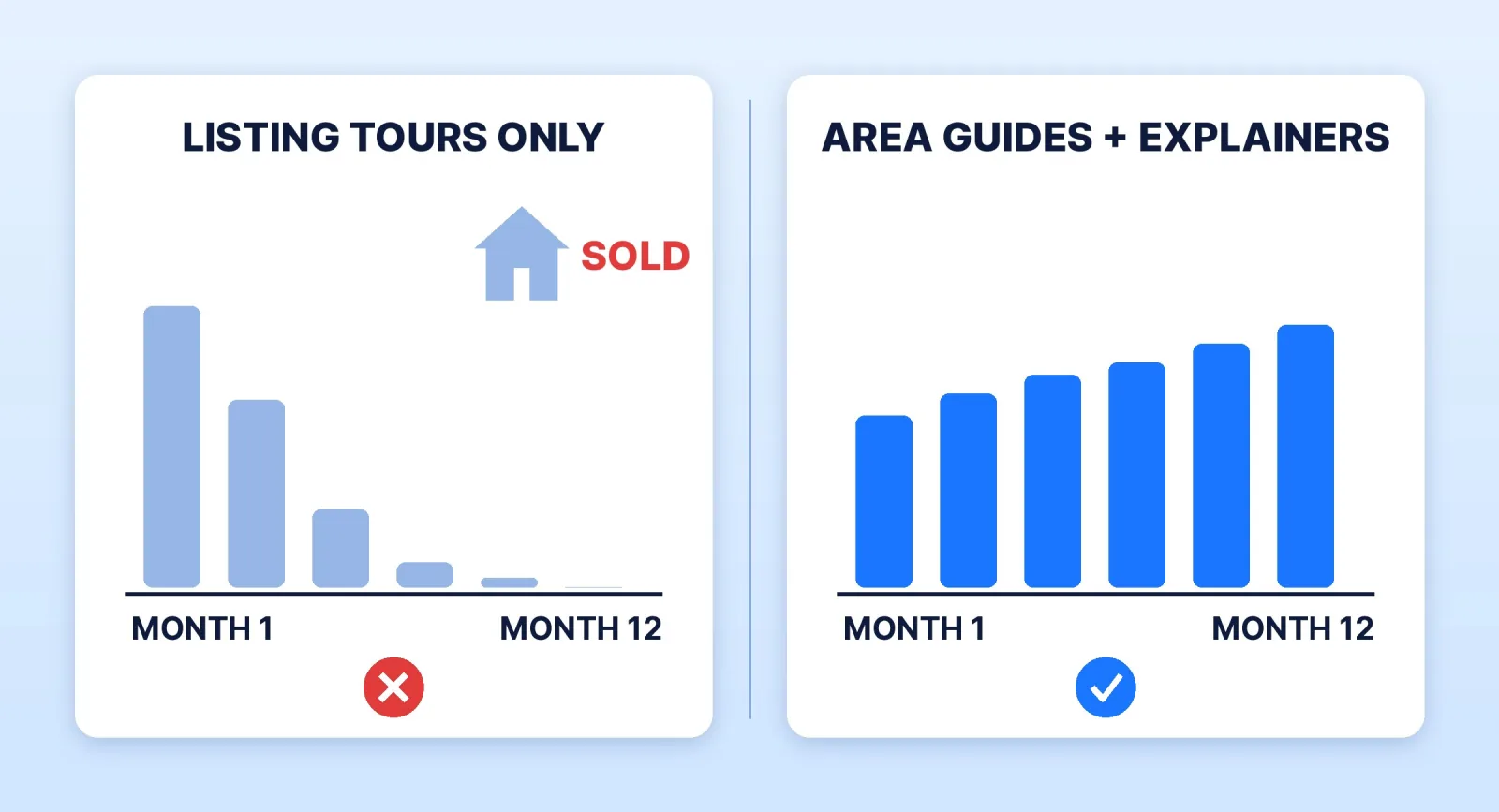
Buyers do look. In NAR's generational trends survey, 37% of buyers used an online video site as an information source in their 2024 home search, and in Google and NAR's 2013 Digital House Hunt study, 86% of home shoppers who watched video did so to learn about a specific community. Both figures are traced on our real estate video statistics page. That second number is the strategy: a channel built only from listing tours goes stale every time a house sells, while area guides keep working for years.
Agents still underuse the platform. NAR's 2023 Member Profile put YouTube at 23% for professional use, against 67% for Facebook.
Step 1: Pick the Video Types That Compound
| Video type | Who it reaches | Shelf life | What the editor adds |
|---|---|---|---|
| Area and neighborhood guides | Relocating buyers | Years | Maps, drive-time callouts, B-roll order, chapters |
| "What $X buys in [town]" tours | Buyers by budget | Months to a year | Price and spec cards from your listing sheet |
| Listing tours | Buyers for that home, sellers judging your marketing | Until it sells | Room order, music, a branded and an unbranded cut |
| Market updates | Local sellers and investors | Weeks | Charts built from your MLS numbers only |
| Buyer and seller process explainers | First-timers | Years | Graphics for each step, chapters |
| Shorts cut from all of the above | New viewers | Varies | Vertical reframes, burned-in captions |
Chapters make the long guides easy to scan. YouTube's chapter rules are simple: timestamps in the description, the first at 00:00, at least three in ascending order, each chapter at least 10 seconds. Ask your editor to deliver the timestamp list with every long video.
Step 2: Know the Advertising Rules Every Video Carries
A video that markets you or a home is real estate advertising, so the same rules as your flyers apply. Your broker's compliance policy has the final word, and none of this is legal advice.
- Fair housing. The HUD rule on discriminatory advertisements covers written and oral statements, and it names "words, phrases, photographs, illustrations, symbols or forms" that signal a home is or isn't available to a group because of race, color, religion, sex, handicap, familial status or national origin. In an area guide, describe the place: the park, the commute, the school locations. Don't describe who should live there. "Perfect for young families" points at familial status.
- State license-law rules. Florida's advertising rule, 61J2-10.025, requires the licensed name of the brokerage firm in all real estate advertising. Online, that name sits next to, or immediately above or below, your contact information. On YouTube, your contact details sit on the end screen, in the description and on the channel page, so the safe reading puts the brokerage name in all three. Other states have their own versions; ask your broker.
- Client testimonials. The FTC's endorsement guides say a testimonial presented as from an actual client should use actual clients in both the audio and the video, and that you shouldn't suppress or edit reviews in a way that misrepresents what clients think. Your editor can trim a client's pauses. They shouldn't splice a new sentence out of separate words.
- Virtual staging and sky swaps. YouTube requires a disclosure for realistic AI-generated or altered content that "alters footage of a real event or place". Color and lighting fixes don't need one. A virtually staged living room or a replaced sky in a tour of a real home is the case to ask about, and the safe default is to tick the AI use setting and say it in the video too.
Step 3: Split the Work With Your Editor
| Task | Who | Why |
|---|---|---|
| Topics, opinions on the market, local knowledge | You | It's the reason anyone watches you |
| On-camera segments and walk-throughs | You, or a videographer | Your face is the brand |
| Cutting restarts, pauses and dead walking | Editor | The biggest time cost |
| Prices, square footage, rates on screen | Editor, from your listing sheet only | An invented number is a false ad |
| Brokerage name, logo and contact cards | Editor, in your broker's exact wording | The same block every time |
| Captions | Editor; you check every number | A misheard "$1.5M" becomes "$15M" |
| Branded and unbranded cuts of each tour | Editor | Your MLS may want an unbranded tour link; check its rules |
| Thumbnails | Editor | Faces and the home, never stock photos |
Give your editor manager access to the channel, never your password. If you haven't handed off a video before, start with how to brief a video editor, and send footage the way our guide to sending large video files lays out. Our real estate video editing page shows the walk-through order, MLS cuts and sizes we work to.
Step 4: Batch One Filming Day a Month
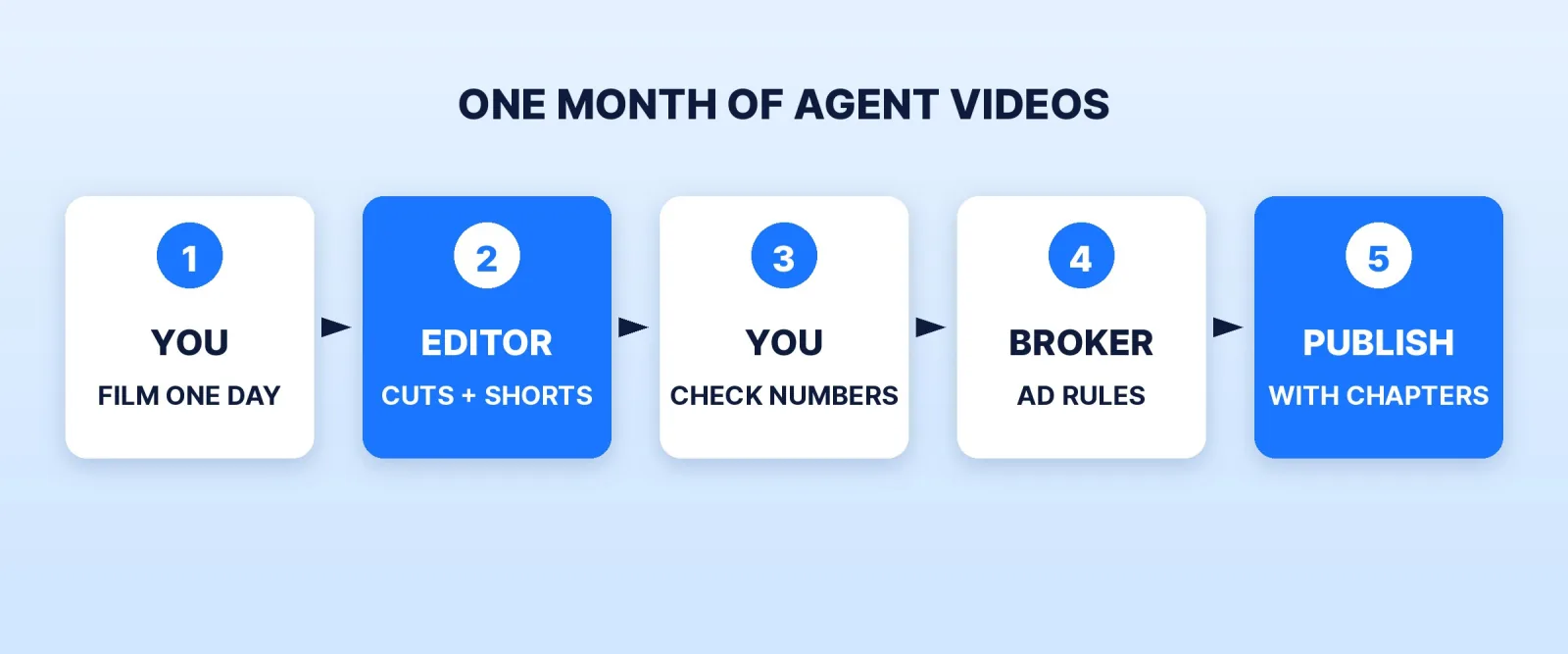
Most agents stall because filming competes with showings. One day a month fixes that:
Filming day (one per month)
  09:00  two area guides, same town, different streets
  11:00  one "what $X buys" tour
  13:00  lunch on camera = a Short about the restaurant
  14:00  one listing walk-through (if you have one)
  16:00  four process answers at your desk, one take each
Example output: 4 long videos + a dozen Shorts from one day
If you're in Palm Beach, Broward or Martin County and want the shoot handled too, we film on location and edit in-house; see our Palm Beach County real estate videography page. Market rates for each piece are in real estate video editing cost and real estate videography cost.
Pre-Publish Checklist
- Every price, rate and square footage on screen matches your listing sheet or MLS data.
- The brokerage name appears on the end screen, in the description and on the channel page.
- The script and on-screen text describe the home and area, never who should live there.
- Testimonials use real clients, in their own words.
- Staged or altered footage is disclosed with YouTube's AI use setting.
- Captions were checked by a person, numbers first.
- Long videos have chapters starting at 00:00.
- The listing tour has both a branded and an unbranded cut.
In-House Editor or Outsourced?
One agent posting weekly rarely needs a full-time editor. A team publishing daily might. Our in-house vs outsourced comparison lays out the trade-offs. Mark Studios has delivered 8,000+ orders and holds a 4.9★ rating across 4,500+ reviews. It's Top Rated on Fiverr, with 99% on-time delivery, and you work directly with Mark. Doctors and financial advisors face their own review rules, covered in video editing for doctors and YouTube for financial advisors.
The Bottom Line
An agent's YouTube channel earns its keep through area guides and process answers that outlive any single listing. Film them in batches, keep every number and every claim yours, and hand the cutting, captions, Shorts and brokerage branding to an editor who never adds a fact.


