Your Local Editor Pool Is Thinner Than You Assume
The Bureau of Labor Statistics counted 25,610 salaried film and video editor jobs in the United States in May 2025, and 6,010 of them — 23.5% of the entire country — sit in the Los Angeles metro area alone. New York holds another 3,430. Outside those two markets the local pool is genuinely thin — thin enough that BLS attaches a 27.7% relative standard error to its own New York count.
Outsourcing itself is already the norm — Wyzowl's video marketing survey found 42% of companies rely on external creators in some way. So the honest framing is not "should I hire overseas instead of locally." Unless you are in LA or New York, you were always hiring remotely. The only live question is how many time zones away, and whether you have built a process that survives the distance.
Across 10,000+ delivered editing projects — work sitting behind 200M+ views and more than $10M in client revenue — we have run edits at almost every time-zone offset there is. The pattern is consistent and slightly counter-intuitive: distance almost never breaks the picture. It breaks the conversation, and the conversation is what costs money.
What the Rate Gap Is Actually Made Of
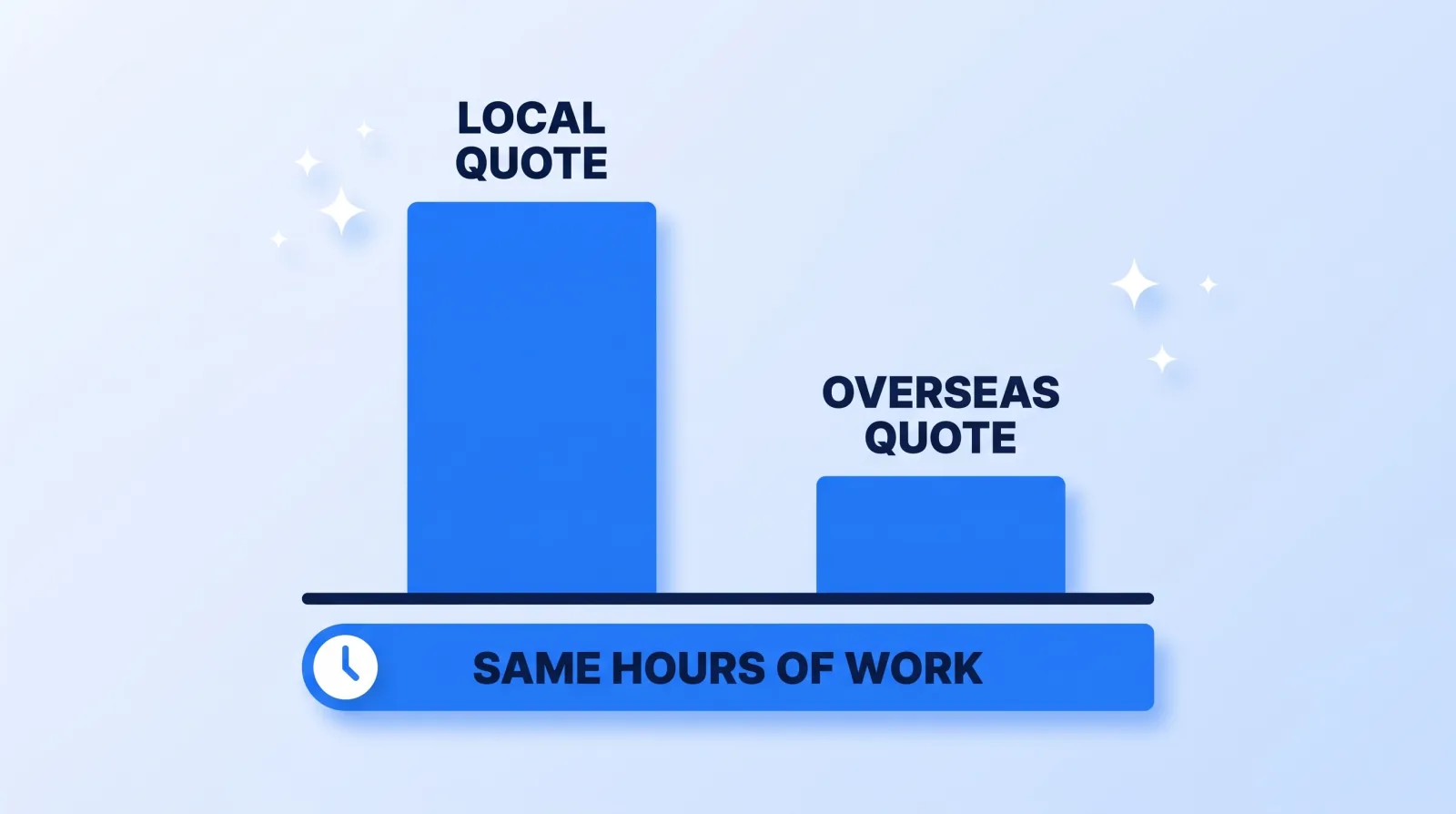
A $400 local quote and a $130 overseas quote for the same eight-minute cut usually buy the same hours. What differs is the rent, the tax burden and the currency underneath those hours. BLS puts the median wage for U.S. film and video editors at $75,420 a year, and its OEWS wage profile puts the San Francisco metro top of the table at $109,930 — an editor in Manila or Warsaw is solvent at a fraction of either number doing identical work.
That said, a low number is not automatically arbitrage. Three things get confused with each other:
| What the low rate might be | How to tell | What to do |
|---|---|---|
| Cost-of-living arbitrage | Portfolio matches your genre; the editor asks specific questions about your brief | Hire. This is the real opportunity |
| A trainee building a reel | Portfolio is all templates and stock; no questions asked | Pay for a trial, expect to direct heavily |
| An unsupervised AI pass | Turnaround is implausibly fast; captions and cuts have machine rhythm | Walk, unless you priced it as a rough assembly |
The diagnostic is not the price. It is whether the editor interrogates your brief before quoting. Someone who asks about your source-to-delivery ratio is pricing your actual job; someone who quotes in ninety seconds is pricing an average. That test works identically at $50 and at $500, and it is the one we lay out in what video editing actually costs.
The Time Zone Is the Product, Not the Obstacle
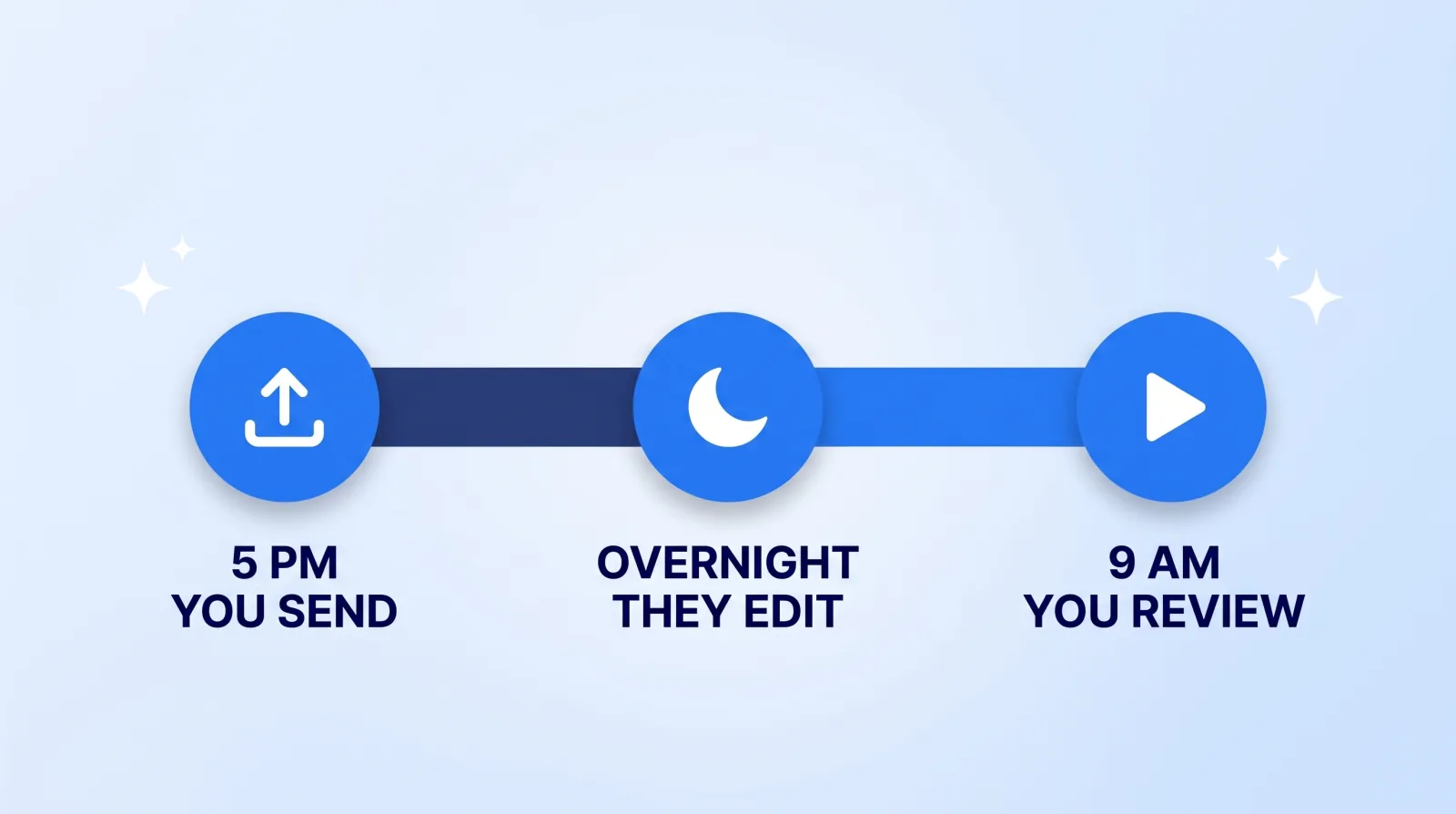
The most valuable thing a ten-hour offset gives you is not a discount. It is that your dead hours become working hours. Send footage and notes at 5pm and a first cut is in your inbox at 9am — against a same-city editor keeping your hours, that is a free day of turnaround on every revision round. And turnaround, as we covered in video editing turnaround times, is mostly queue position rather than editing speed.
The offset has exactly one failure mode, and it is expensive: an unanswered question costs a full day instead of ten minutes.
A cut stalls because the editor cannot tell which of two takes is approved. Same city, that is a Slack message and a two-minute gap. Twelve hours apart, the question lands while you sleep and your answer lands while they sleep — one ambiguity, 24 hours of calendar. Two of them turn a two-day edit into a four-day edit, at which point the cheaper quote has bought you nothing.
This is why the fix is not "communicate more." It is remove the need to communicate. Three habits do nearly all of the work:
- Answer the obvious questions in the brief itself. Which take, which music, which aspect ratios, how long, what to do if something is unusable. Our editor brief template exists for exactly this.
- Give a reference cut, not adjectives. One link to a previous video with "match this pacing and caption style" resolves more ambiguity than a page of description, in any language. Leave the notes as timecoded comments on the cut itself — a review platform like Frame.io pins every note to a frame, which removes a whole category of "which bit do you mean" round trips.
- Grant a standing decision rule. "If a take is unusable, pick the next best and flag it in the delivery note" converts a blocking question into a note you read the next morning.
The Four Things That Actually Break
Distance does not degrade craft. These four are the ones worth planning around:
- Idiom in captions and on-screen text. Transcription handles accents well now, but slang, product names and jokes get flattened. Keep a glossary of your recurring terms — brand names, guest names, SKUs — in the shared folder, and load it into whatever transcription tool the editor uses; Descript and caption tools like Submagic both accept a custom vocabulary list. Five minutes, and it eliminates the most common caption error.
- Payment rails and fees. Conversion spreads and transfer fees can eat 3–7% of a small invoice, and bank cutoffs mean a Friday payment lands Tuesday. Agree the currency, who absorbs the fees and the payment method in writing before the first invoice — how to pay a video editor covers the structures.
- Holiday calendars you do not share. Lunar New Year, Golden Week, Eid, Orthodox Christmas — each one can remove a week from your production schedule with no warning. Ask for the editor's non-working weeks at onboarding and put them in your publishing calendar, not in your memory.
- Enforcement reach on confidentiality. A signed agreement is still worth having, but pursuing a breach against a one-person business in another jurisdiction is rarely economic. That is an argument for controlling access rather than relying on remedies — the full version is in who sees your raw footage.
The Pre-Flight Checklist Before You Send Footage Abroad
Run this once, before the first paid project. Twenty minutes, and it prevents most of what goes wrong in month one.
- Confirm the overlap window. Name the two or three hours a day you are both awake. One real window beats an all-day promise nobody keeps.
- Set one review time, daily. A fixed hour means the editor knows when notes arrive and can plan around it. Scattered notes are how a relay turns into a stall.
- Send a reference cut with the brief. Not a mood board. An actual finished video of yours, or one you want to match.
- Write the standing decision rules. Three to five "if X, do Y" lines that let the editor proceed without you.
- Agree currency, fees and payment day in writing. Before work starts, not at the first invoice.
- Ask for the non-working calendar. Public holidays, planned travel, anything longer than a weekend.
- Pay for a trial edit on real footage. Not a spec test — a short, paid, genuine project. How to vet a video editing service covers what to look for; it is the highest-return twenty dollars in the process.
- Share to named accounts, with an expiry set at creation. Not an open link.
If you are evaluating platforms rather than individuals, our comparison of freelance marketplaces breaks down where the sourcing risk sits on each.
When Distance Is the Wrong Trade
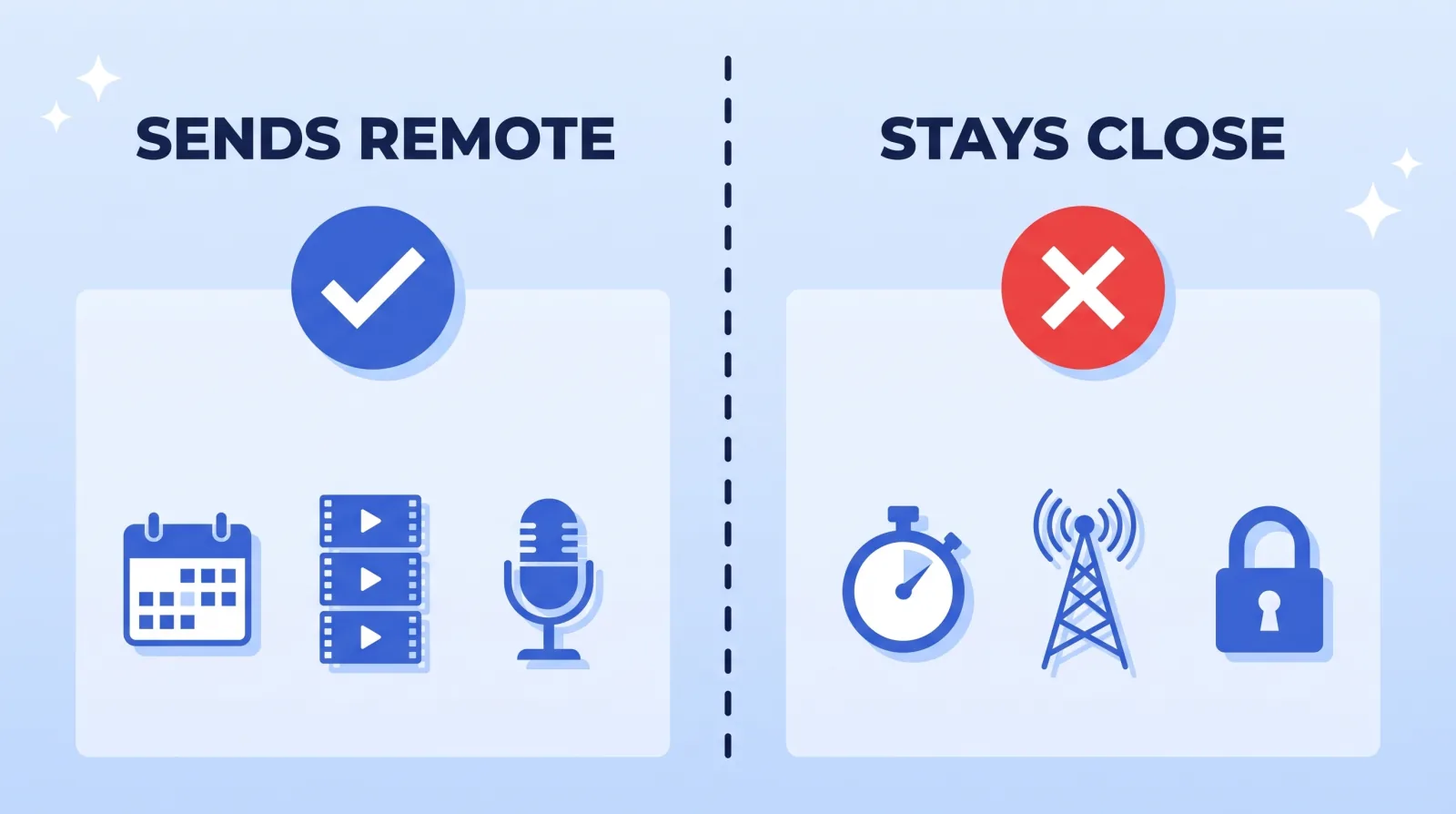
Three situations where the offset stops paying:
Same-day turnarounds with a hard clock. Event recaps, news-reactive cuts, anything shipping hours after it was shot. If your review hours barely overlap theirs, a same-day deadline has no room for even one round of notes.
Heavy creative direction on an unformed idea. When you are still discovering the format in the edit, you need synchronous back-and-forth. Build the format first — a repeatable show structure is what makes the work exportable — then hand it over.
Regulated or high-consequence footage. Clinical material, legal client footage, anything where a breach carries a statutory obligation — not because remote editors are less careful, but because your recourse thins as jurisdictional distance grows.
Everything else — scheduled uploads, podcast episodes, course libraries, short-form batches, founder-led content on a weekly cadence — travels well. Repeatable formats with predictable briefs are exactly the shape of work an overnight relay was built for.
The Bottom Line
Most of the rate gap between a local and an overseas editor is the cost of living where they sit, not the amount of work being done — and the ten-hour offset is an asset, because it converts your sleeping hours into editing hours. The distance only costs you when a question goes unanswered for a day. Front-load the brief, give a reference cut, write three standing decision rules, and fix one daily review time, and you get the rate and the overnight turnaround without paying for the ambiguity.