

The Short Answer: How to Hire a Documentary Editor
To hire a documentary editor, decide first what kind of documentary you're making, then shortlist three editors who have cut unscripted stories like it and watch a full piece by each. Pay your top two to cut the same interview selects into one short scene, check how each handles archival footage, music and rights, and put the cuts, review stages, files and copyright in writing.
Documentary or storytelling edits came up in 45 of the 698 first messages from buyers that we analysed, more than podcast edits. What a documentary edit costs by length and route is in our guide to documentary editing cost. This guide covers choosing the editor and setting up the work.
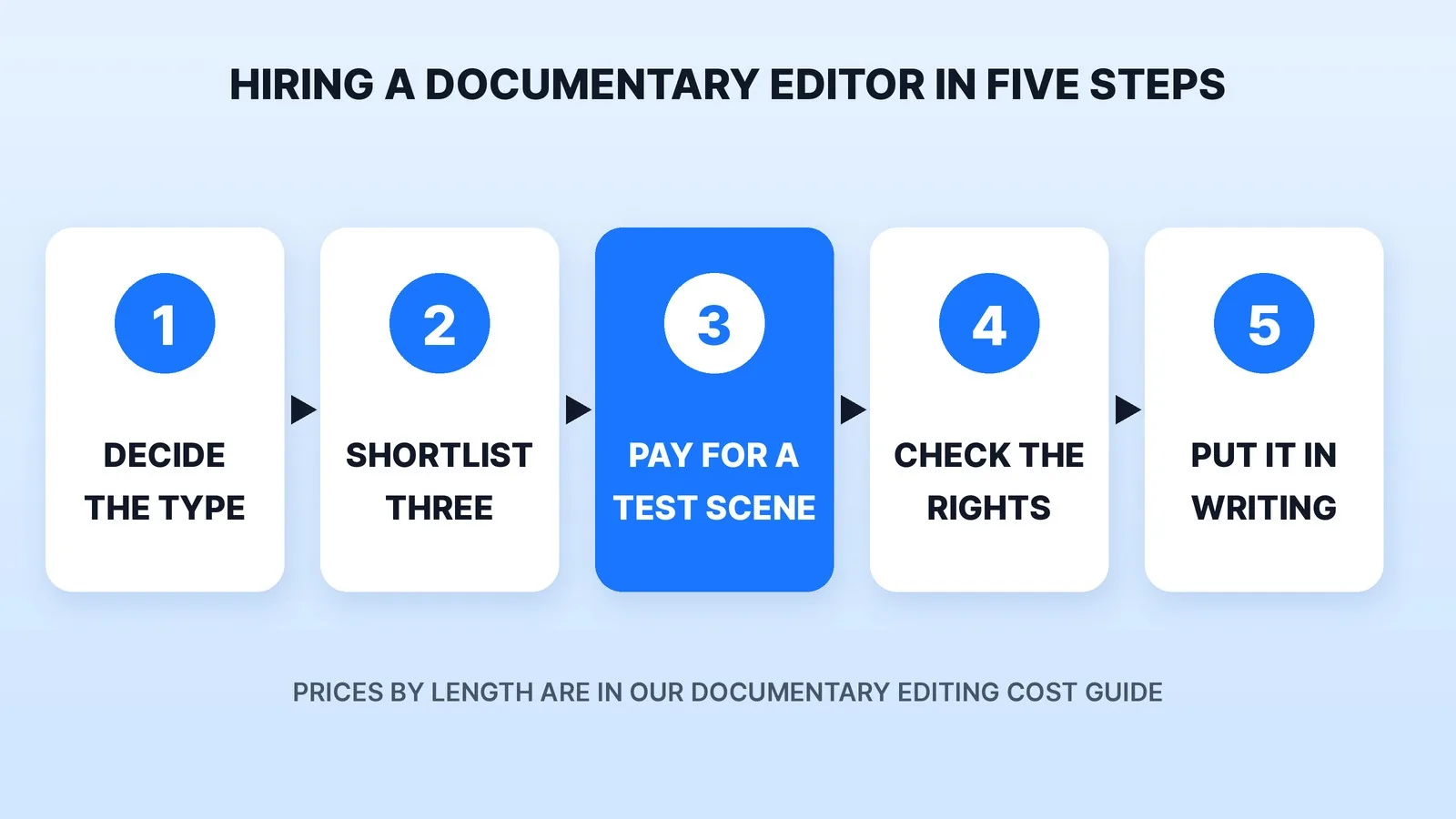
Step 1: Decide What Kind of Documentary It Is
"Documentary editor" covers three different jobs, and the right person for one is often wrong for the next:
| Type | Where it runs | What the editor must be good at |
|---|---|---|
| YouTube doc-style video | YouTube | Pacing for retention, voiceover, archival, graphics |
| Interview-led short documentary | Website, social, events | Finding a story in hours of interviews |
| Festival or broadcast documentary | Festivals, streamers, TV | Feature-length structure and rights paperwork |
A founder's origin story, a nonprofit impact film and a customer story are all the second kind. A narrative short film is a different job again; our guide to short film editing cost covers that one.
Write down four things before you contact anyone:
- The type and the running time.
- How much footage there is: hours of interviews, b-roll and archival.
- Whether there's a script or voiceover, or the story still has to be found in the interviews.
- Where it will be published and when it has to be ready.
Step 2: Shortlist Three Who Cut Unscripted Stories
Look on freelance marketplaces, check the editing credits of documentaries you admire, and ask filmmakers or creators in your niche who cuts their work. Our freelance marketplaces comparison lays out the trade-offs between a marketplace seller and a managed service, and our guide on how to find a video editor covers where to search.
Watch one full piece by each candidate, not a trailer or a reel. A two-minute reel shows that an editor can pick good shots. A finished twenty-minute film shows whether they can hold a story together, which is the actual job.
Then ask each one: "What did you start with, and how did you find the structure?" Listen for transcripts, a paper edit or a string-out of the best moments. An editor who can't describe the process on a project they've already finished will struggle to explain it on yours.
Step 3: Pay Your Top Two for the Same Test Scene
Send both finalists the same interview selects, an hour or so of footage with transcripts, and a short brief: who the film is for, the point this scene has to make, and one reference you like. Ask each for a scene of two to three minutes, and pay both.
Then compare:
- Did they find the strongest moment in the interviews, or just the first usable one?
- Does the scene build: a setup, a turn, a payoff?
- Are the cutaways honest? B-roll that covers a jump cut is normal. B-roll that implies something the speaker didn't say isn't.
- How did they take your notes on the first round?
Our guide on how to brief a video editor has the full brief structure, and our guide on how to send large video files to an editor covers getting the footage to them.
Step 4: Check How They Handle Rights
Documentaries collect rights questions: news clips, archival photos, other people's music, and now AI-generated recreations. Ask each finalist how they track them. The answer you want is a rights log: every third-party clip with its source, timecode and either a license or a written fair-use reason.
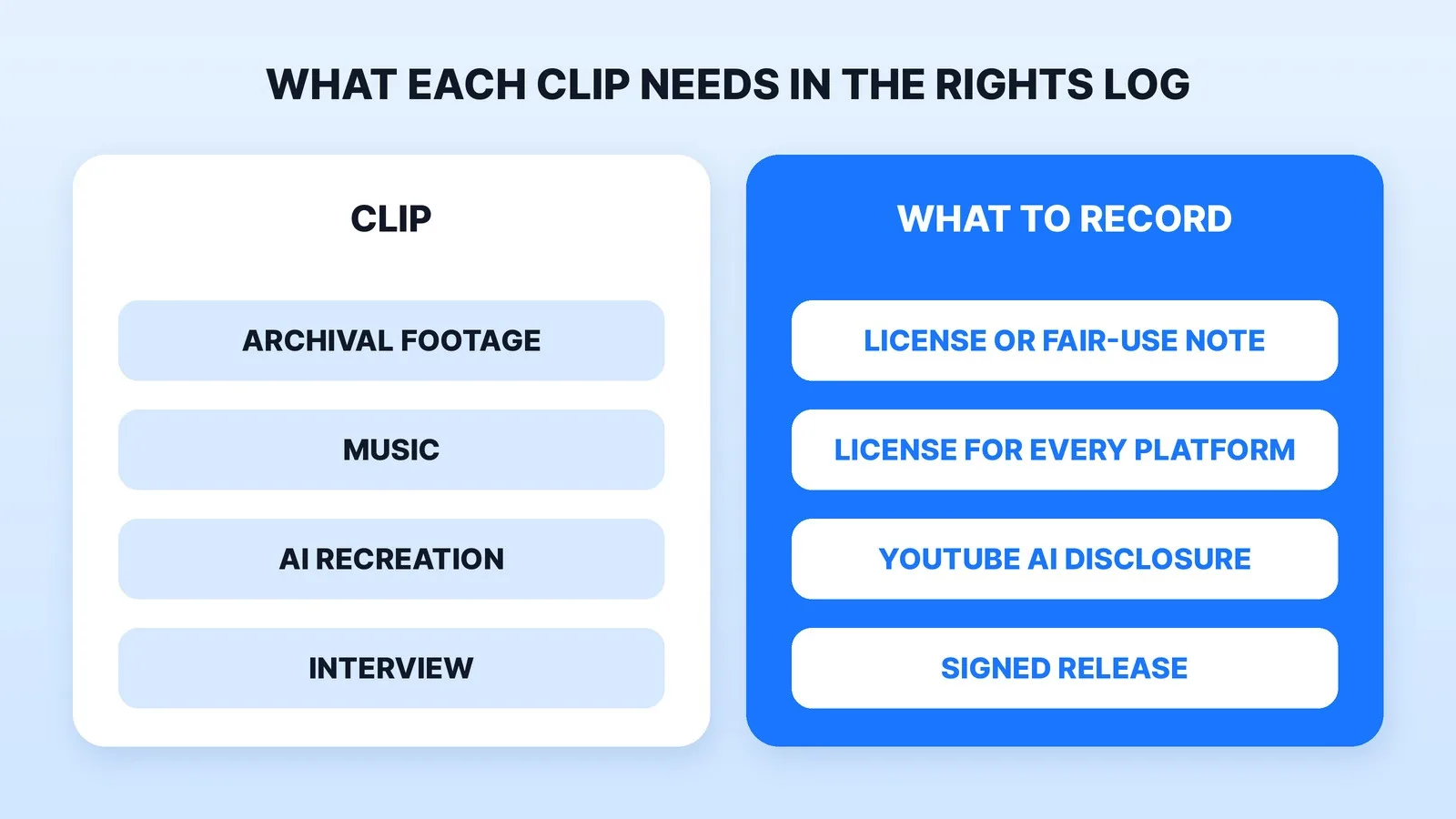
- Archival footage and fair use. The U.S. Copyright Office's Fair Use Index says courts weigh four factors and judge fair use claims "on a case-by-case basis", with "no formula" for how much of a work you can use without permission. The Documentary Filmmakers' Statement of Best Practices in Fair Use, published in 2005 by documentary groups including the International Documentary Association, is organized around four situations documentarians regularly face where fair use can apply, such as critiquing a work or using material in a historical sequence. Our guide to copyright strikes, Content ID and fair use covers the YouTube side.
- Content ID. YouTube says every upload is "automatically scanned by Content ID" against files submitted by copyright owners, and a Content ID match can block, monetize or track the video. A clip you can defend as fair use can still be claimed, so ask the editor to flag every third-party clip before upload.
- Music. Every track needs a license that covers every platform the film will run on. Our YouTube music licensing guide explains the options.
- AI recreations. YouTube requires creators to disclose realistic AI content that "Makes a real person appear to say or do something they didn't do", "Alters footage of a real event or place" or "Generates a realistic scene that didn't actually occur", using the "AI use" setting in YouTube Studio. Ask the editor to list every AI-generated or AI-altered shot.
- Releases. Know who holds the signed release for every person interviewed.
Step 5: Put It in Writing
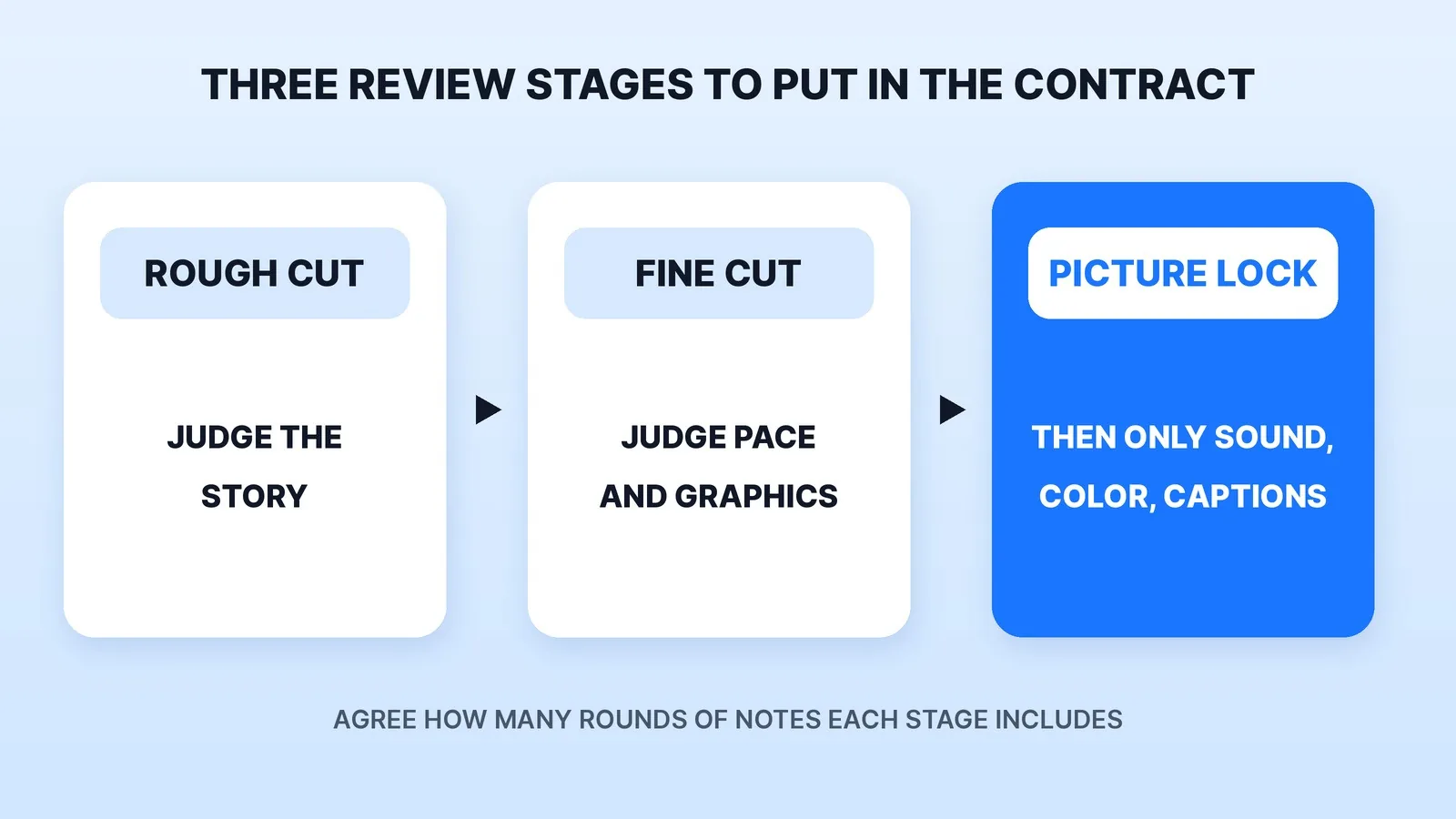
Before the edit starts, agree on:
- Review stages: rough cut, fine cut and picture lock, and how many rounds of notes each stage includes. Our guide to how many revision rounds sets out the usual terms.
- Deliverables: the master file, captions, any trailer or short cutdowns, the rights log and the music list.
- Project files and media, if you'll ever want to change editors or recut later. Our guide on who owns your project files explains why this belongs in the contract.
- Ownership. Under the U.S. Copyright Office's work-made-for-hire rules, commissioned work counts as made for hire only in nine listed categories, one of which is "a part of a motion picture or other audiovisual work", and only "if the parties expressly agree in a written instrument signed by them". A documentary edit fits that category, so a signed agreement settles who owns the cut.
- Confidentiality and credit: who can see the interview footage, and how the editor is credited. Our guide on NDAs and access to raw footage covers the first.
Where Mark Studios Fits
Mark Studios edits documentary-style videos through our video editing service: interviews cut into a story, with b-roll, archival footage you supply, motion graphics and music. A founder's origin story is one kind of short documentary, and our video editing for founders page shows that work. If the interviews still need filming in Palm Beach County, we film them on site across Palm Beach, Broward and Martin counties through our on-site videography. Each project gets a fixed quote up front from the footage, the running time and the deliverables. Mark Studios has completed 8,000+ orders with 4,500+ reviews, 99% on time, with work behind 100M+ views, and is Top Rated on Fiverr with a 4.9★ rating.
The Bottom Line
Decide what kind of documentary you're making, shortlist three editors who have cut stories like it, and pay your top two to cut the same scene. Hire the one who found the story and can show you a rights log, then get the review stages, deliverables, project files and copyright in writing before the edit starts.


