Most Couples Skip the Videographer. Plenty Still End Up With Footage.
The Knot reports that only 37% of couples book a wedding videographer, while 88% of couples who married in 2025 hired a photographer. Price is the obvious reason. Published averages run from $1,799 at WeddingWire to $3,993 in Zola's cost index, and the highest of those figures is 2.2 times the lowest. Skipping the videographer rarely means there is no video, though. Zola's 2026 First Look Report found that 21% of couples planning 2026 weddings intend to create their own social-first content on the day.
So a lot of couples are sitting on footage without a film: a friend's mirrorless camera, a phone on a tripod at the back of the ceremony, forty guest clips in a group chat. Wedding videographers in peak season have the opposite problem, with more footage than hours to cut it. Both need the same thing: someone to edit wedding footage that already exists.
Mark Studios does not film weddings. We edit them, for couples and for the studios that shoot them, inside a body of work of more than 10,000 editing projects behind 200M+ views and over $10M in client revenue. The hiring and price figures above are each checked against their source on our wedding video statistics page.
What a Videographer's Price Actually Pays For
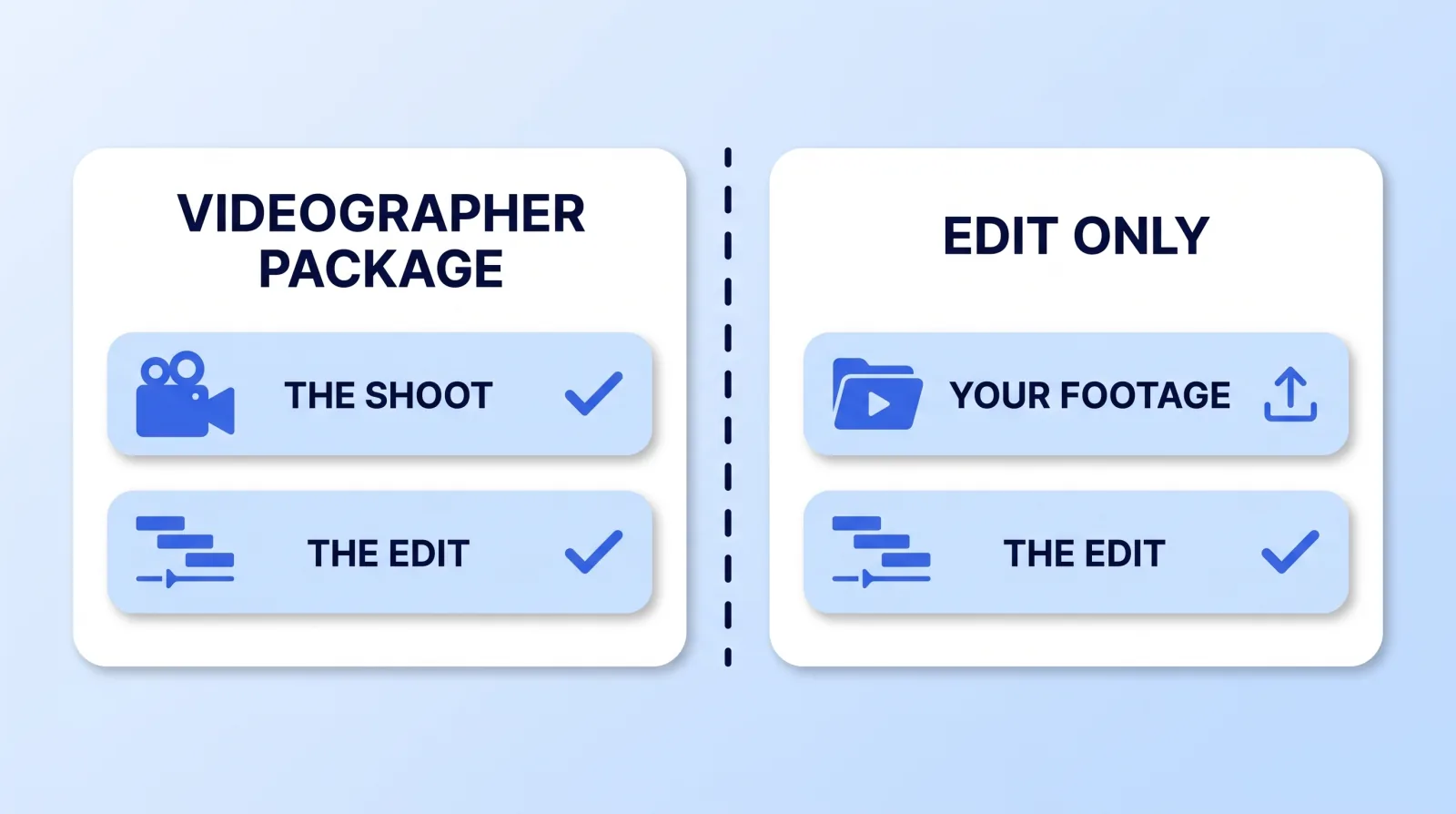
A videographer quote bundles two jobs into one number. Zola's pricing guide names coverage hours as the most significant factor in the price, followed by team size and deliverables. Most of what couples compare between videographers is the shoot.
| Zola package tier | Coverage | Crew | Edited films | Raw footage |
|---|---|---|---|---|
| Basic | 4–6 hours | One videographer | Highlight film only | Typically not included |
| Standard | 6–8 hours | One or two | Highlight plus a longer documentary edit | A common extra cost |
| Premium | 8–12 hours | Several | Multiple versions, including social cuts and the full ceremony | Included |
That has three consequences when you hire an editor instead:
- Edit-only work is priced on post-production, not coverage. No hours on site, no second shooter, no travel. The price moves with how much footage there is, how many sources need syncing and how many films you want, the same variables behind any video editing quote.
- The edit cannot add what nobody captured. Part of a videographer's fee buys dedicated audio on the officiant and the couple; Zola ties professional audio capture to clear vows and speeches. A phone in row twelve records applause and air conditioning. Some of that is recoverable, and what editors can actually salvage in post covers where the limit sits.
- Raw footage from a videographer may be an add-on. If you hired one and received only a highlight film, ask for the raw files before they are archived. What you are entitled to afterwards is the subject of who owns your project files.
What Your Footage Can Become
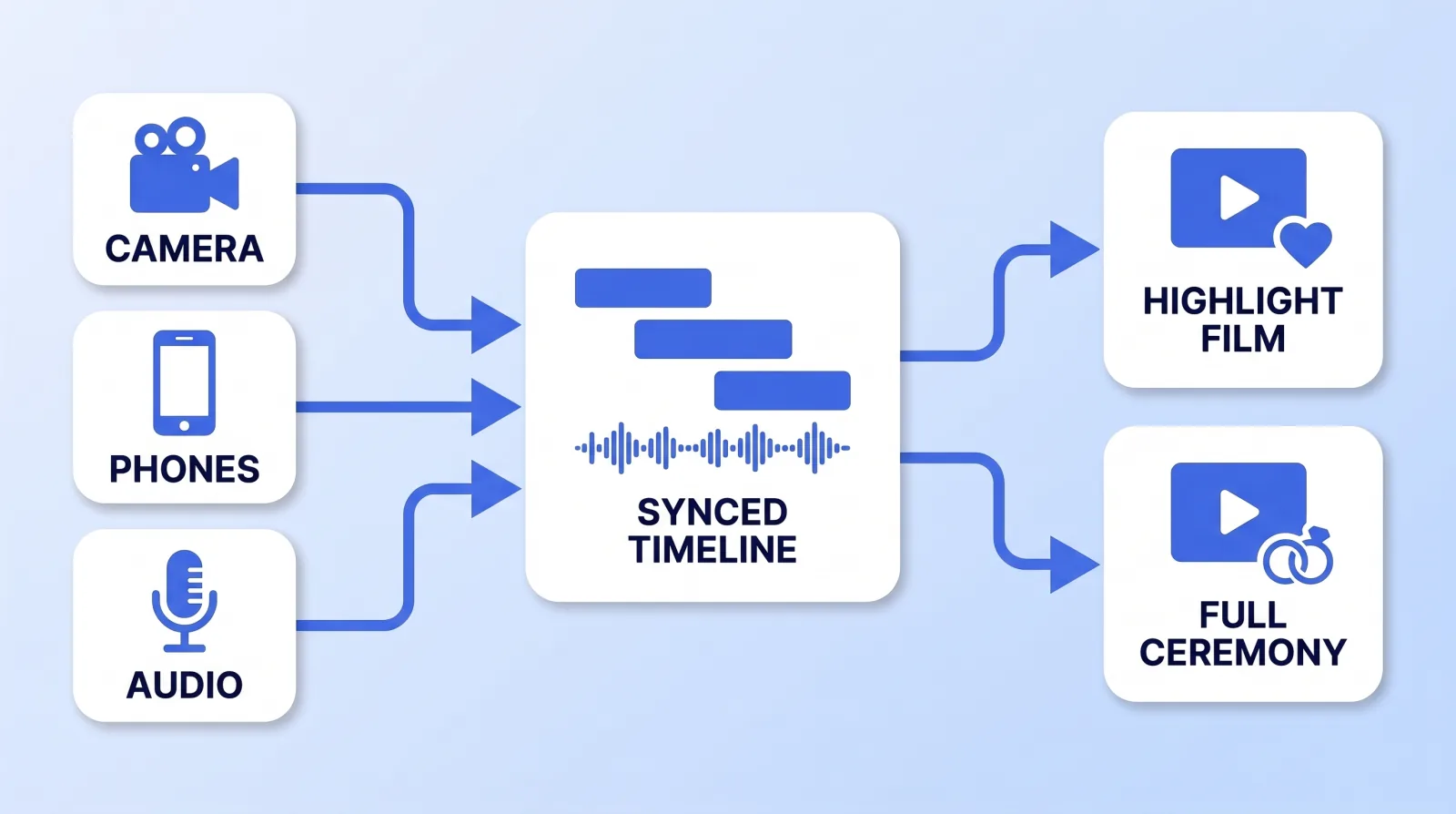
Wedding edits come in a small set of standard shapes. Which ones your footage supports depends less on camera quality than on whether a few key moments were covered and whether anyone recorded usable audio.
| Film | Typical length | What it needs from the footage |
|---|---|---|
| Teaser or social reel | 30–90 seconds, often vertical | Good-looking moments and one song. Phone footage works well |
| Highlight film | 3–8 minutes | Coverage across the day, plus clean audio of a line or two from the vows or a toast |
| Full ceremony film | The ceremony in real time | Unbroken coverage of the whole ceremony and audible vows |
| Speeches film | Each toast in full | A steady angle on every speaker and one clean audio source |
The full ceremony film is the one couples most often want and the one amateur footage most often cannot support. A phone that stopped recording during the ring exchange leaves a gap no edit fills, unless a second source covers the same minutes. That is why every angle matters more than the best angle.
Unplugged ceremonies make this harder. In The Knot's 2025 study, 62% of Gen Z couples had an unplugged ceremony, which is lovely in the room and leaves fewer guest angles of the moment that matters most.
The Guest-Footage Problem: Wrong Dates, Compressed Copies, Weak Audio
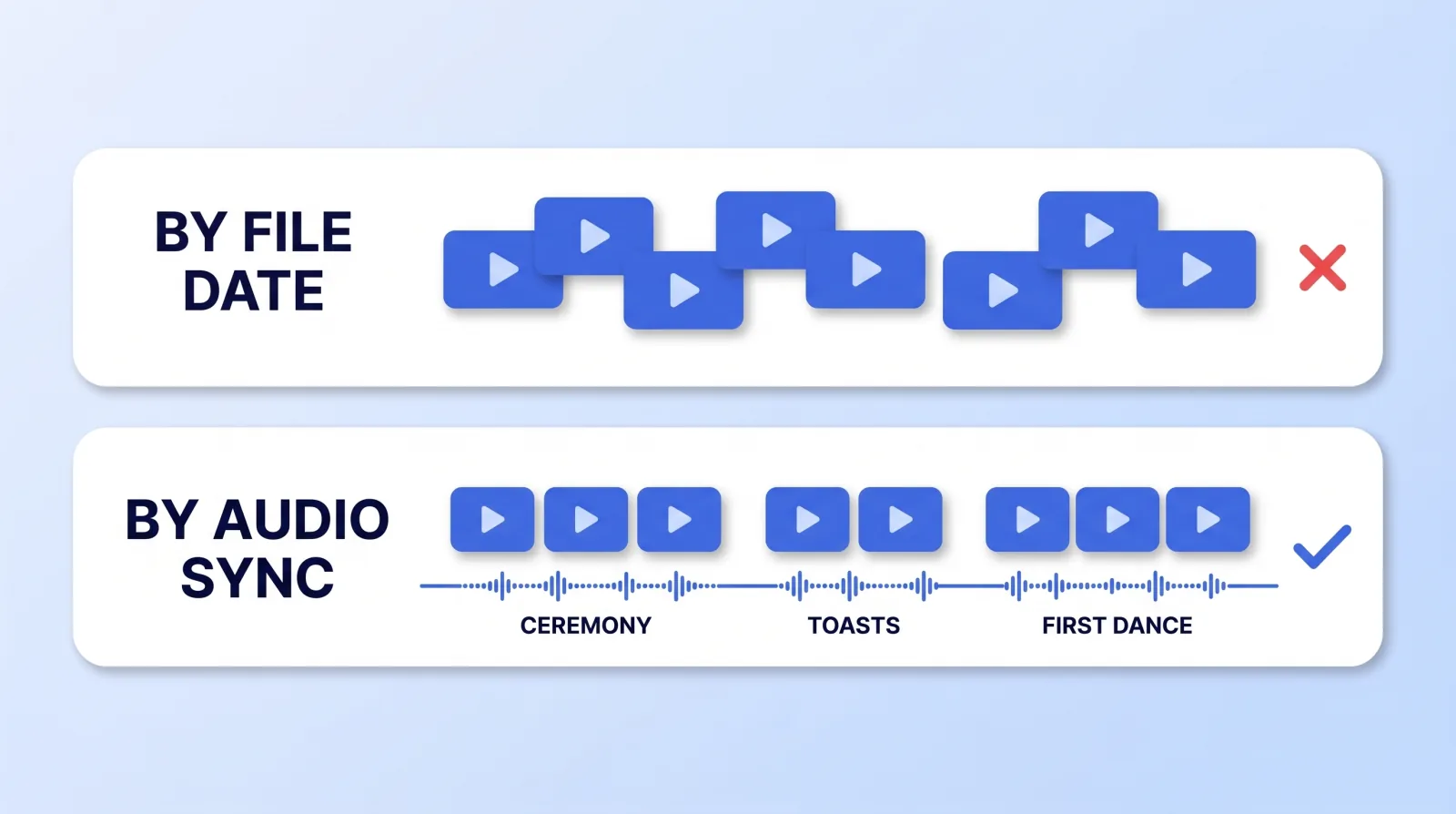
When footage comes from guests rather than one operator, the same three problems turn up in almost every folder we receive.
- The dates lie. Every phone keeps its own clock, and a clip saved from a messaging app often carries the date it arrived rather than the date it was filmed. Sorted by date, the first dance lands before the vows. The fix is to rebuild the day by matching overlapping audio, with the ceremony recording as the spine.
- The copies are compressed. Messaging apps shrink video to save data, and shared albums have not always kept originals: Apple's support page lists full-resolution sharing in iCloud Shared Albums as new in iOS 27. Ask guests for original files in one shared cloud folder, not the version that reached the group chat.
- The audio is the weakest link. Phone microphones capture the room, not the speaker. A DJ's board feed or a small recorder on the officiant is worth more than a fourth camera angle.
The Wedding Footage Handoff Checklist
Run this before you send anything to an editor. It decides what the finished films can include, and it is most of what separates a smooth first cut from three rounds of "that's not the right order".
- Collect originals into one folder. Camera cards copied whole, phone clips as original files, nothing renamed. Keep a second copy on another drive until the films are delivered.
- Include every separate audio file. Officiant or lapel recorders, the DJ or venue feed, a phone left recording on the lectern.
- Write the run of the day. Ceremony start time, processional order, who gave toasts and in what order, the first dance song. It is how an editor places clips with wrong timestamps.
- Spell every name that could appear on screen. The couple, the venue, the date, the wedding party if titles are wanted.
- Choose the films and formats now. Highlight, ceremony, speeches, vertical reels. A vertical cut planned from the start costs less than one retrofitted later.
- Decide on music by where each version will live. Your first-dance song belongs to a label, and a public upload can be matched by YouTube's Content ID. A private family copy and a public reel may need different tracks; our music licensing guide covers the options.
- Send one or two reference films, plus the moments that must be in and any that must not.
Choosing Who Edits It
Couples usually find editors in three places: the videographer who shot it, a freelancer on a marketplace, or an editing studio. For wedding work specifically, four questions sort them quickly.
- Can I see a multi-source edit? Syncing one camera, six phones and a recorder is a different skill from cutting a clean two-camera shoot. A showreel will not tell you which one you are looking at.
- What do you do when the ceremony audio is poor? A good answer names the source they would use and what they would cut around. "We'll fix it" is not an answer.
- How many revision rounds are included? Then write your notes the way revision notes that actually get fixed describes: one consolidated list with timestamps.
- Who keeps the project and the footage afterwards, and for how long?
Marketplace hiring can work for a single wedding, but the vetting falls on you. The trade-offs are on our freelance marketplace comparison, and how to vet a video editing service has the paid trial and the red flags. Videographers outsourcing post-production in peak season need one more answer: will the editor deliver to your house style, under your name, at a turnaround you can promise couples? That is what our wedding video editing service is built around.
The Bottom Line
A videographer's price mostly pays for being there: coverage hours, crew and audio on the day. If the footage already exists, you are buying only the edit, and what it can become is set by what was captured, above all the ceremony audio. Gather every original file and audio source, write down the run of the day, choose the films before the edit starts, and hire someone who has already cut messy multi-source weddings.